Falconer Distance Conjecture: How OpenAI’s Proof Reaches the Sharp d/2 Threshold
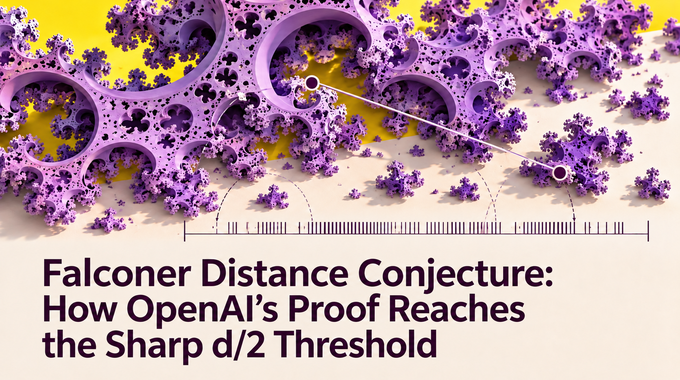
Falconer Distance Conjecture artwork linking violet fractal points to pairwise distance marks.

A fractal can contain infinitely many points and still occupy no area. Can its pairwise distances nevertheless occupy a positive length on a ruler? The Falconer Distance Conjecture predicts exactly when that must happen. OpenAI’s September 23, 2026 manuscript presents a proof in every integer dimension d≥2d\ge2: a compact set whose Hausdorff dimension exceeds d2\frac … Read more

Anderson Localization OpenAI Proof: How Extended States Survive Weak Disorder in 3D

Anderson localization OpenAI proof illustrated by a mint wave spanning a disordered three-dimensional lattice.

Randomness can trap a quantum particle. The harder question is whether weak randomness must trap it. The Anderson localization OpenAI proof addresses that second question: its September 23, 2026 manuscript establishes a nonempty energy interval with purely absolutely continuous spectrum for the nearest-neighbor Anderson model with independent uniform disorder, in every fixed dimension d≥3d\geq3. The … Read more

Generalized Star Height Problem: How OpenAI’s Two-Split Proof Sets a Three-Level Ceiling

Generalized Star Height Problem illustrated by a ribbon sculpture beneath a three-level ceiling.

A regular language can require arbitrarily deep repetition in an ordinary regular expression. Add complement, and OpenAI’s September 25, 2026 manuscript gives every regular language a three-level ceiling. Its answer to the Generalized Star Height Problem is a uniform upper bound over the original alphabet, not a proof that three levels are necessary. Whether one … Read more

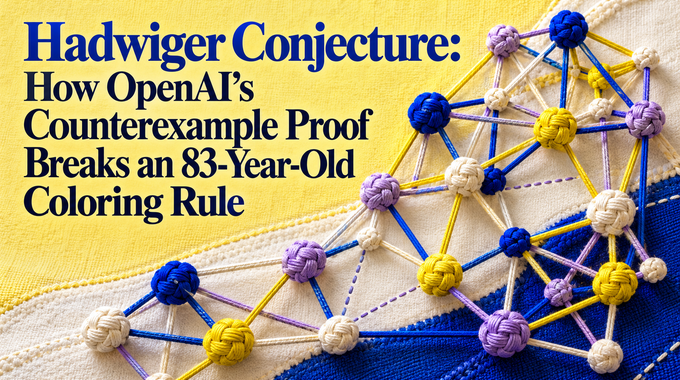
Hadwiger Conjecture: How OpenAI’s Counterexample Proof Breaks an 83-Year-Old Coloring Rule

Hadwiger Conjecture artwork with colorful embroidered graph knots and missing connections.

A graph can demand many colors while refusing to collapse into an equally large complete graph. OpenAI’s September 23, 2026 manuscript constructs precisely that separation, presenting a disproof of the Hadwiger Conjecture, proposed in 1943. Its counterexamples have no independent set larger than two vertices, yet their largest clique minors fall well below the resulting … Read more

Rigidity of the Turing Degrees: How OpenAI’s Proof Eliminates Every Hidden Symmetry

Rigidity of the Turing Degrees shown as a unique jade structure resisting a displaced duplicate.

An infinite hierarchy can have no movable parts. OpenAI’s September 24, 2026 paper, Rigidity of the Turing degrees, proves that every symmetry preserving relative computability fixes every degree. The ordering itself leaves no room to exchange computational powers while keeping every relationship intact. That is the answer to the rigidity of the Turing degrees problem. … Read more

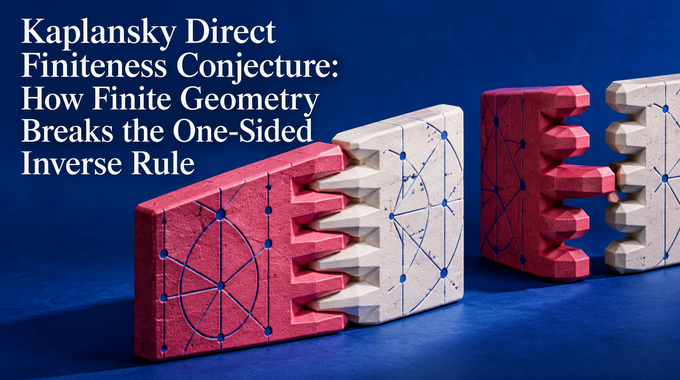
Kaplansky Direct Finiteness Conjecture: How Finite Geometry Breaks the One-Sided Inverse Rule

Kaplansky Direct Finiteness Conjecture illustrated by ceramic combs that fit in one order but clash in reverse.

An inverse is supposed to undo an operation. OpenAI’s September 23, 2026 preprint constructs two finite algebraic expressions that undo each other in one order and fail in the other. The Kaplansky Direct Finiteness Conjecture predicted that this could never happen in a group algebra. The paper presents a characteristic-two counterexample, with a finitely presented … Read more

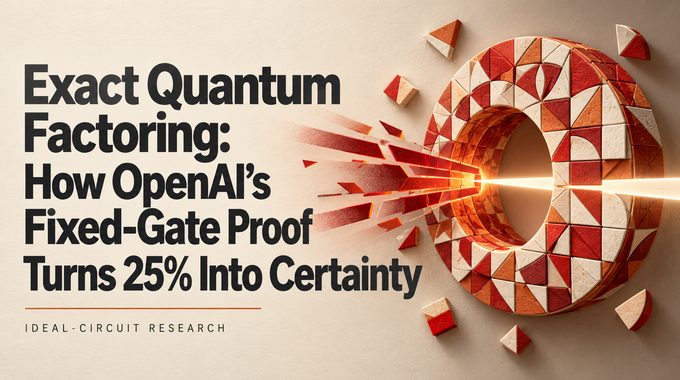
Exact Quantum Factoring: How OpenAI’s Fixed-Gate Proof Turns 25% Into Certainty

Sculptural mosaic illustrating exact quantum factoring and engineered certainty.

A factoring algorithm that almost always works is not the same as one that cannot fail. That distinction drives exact quantum factoring, the subject of OpenAI’s September 25, 2026 preprint. Its claimed advance is a polynomial-time-uniform family of quantum circuits that returns the complete prime factorization of every integer at least two with probability exactly … Read more