Birch and Swinnerton Dyer Conjecture: How OpenAI’s Proposed Proof Closes the Prime-Factor Gap
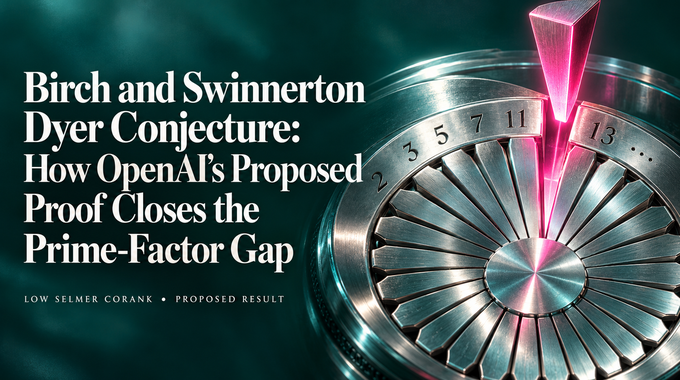
Birch and Swinnerton Dyer Conjecture artwork shows a final prime-factor wedge closing a silver seal.

A proof can identify an elliptic curve’s rank and still miss the exact arithmetic hiding in its first nonzero L-value. That missing precision is the subject of OpenAI’s October 7 manuscript on the Birch and Swinnerton Dyer Conjecture. It presents the full leading-term formula for elliptic curves over the rationals whose full Selmer group has … Read more
Claude Quantum Circuits: How a New Divsteps Proof Unlocked 17× Fewer Gates

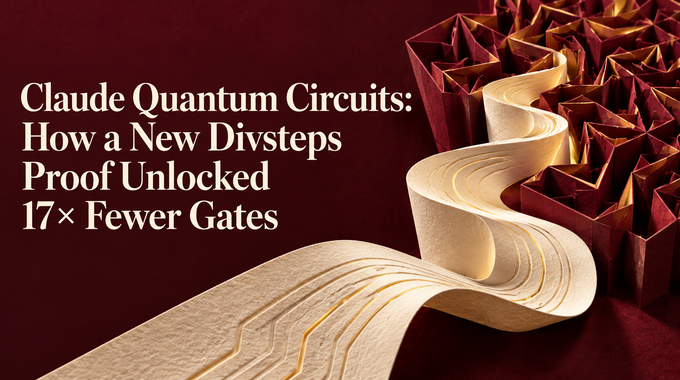
Claude quantum circuits visualized as a folded ribbon preserving paths through a burgundy maze.

A quantum circuit can spend much of its budget remembering how to undo its own work. The new Claude quantum circuits research attacks that overhead. Announced by Anthropic on October 16, 2026, the project used Claude Mythos 5 to redesign eight computational primitives. Seven designs reduced both Toffoli gates and qubits. The eighth introduced reversible … Read more

Partition Principle vs Axiom of Choice: How OpenAI’s Proof Settles a Century-Old Problem

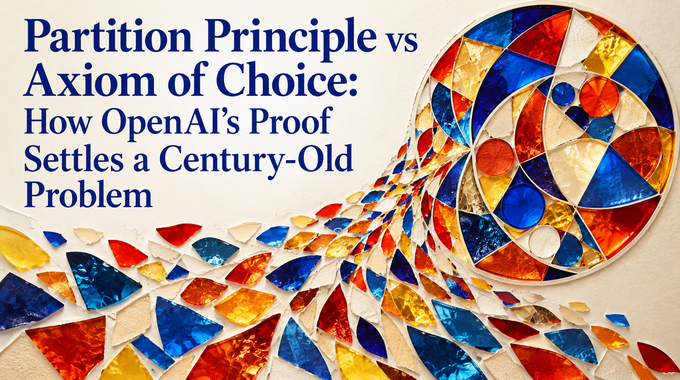
Partition Principle vs Axiom of Choice illustrated by a stained-glass mosaic separating into distinct pieces.

An injection can compare two infinities without choosing a single correct representative. That gap is the heart of the Partition Principle vs Axiom of Choice problem. OpenAI’ss September 24, 2026 paper presents a negative answer: assuming Zermelo–Fraenkel set theory is consistent, the Partition Principle can hold while the Axiom of Choice fails. The construction also … Read more

Permanent vs Determinant Problem: How OpenAI’s Proof Broke the Quadratic Barrier

Permanent vs determinant problem: a coral cubic sculpture breaks a plum square lattice.

Remove the alternating signs from a determinant, and a familiar matrix formula becomes a central challenge in algebraic complexity. OpenAI’s September 24, 2026 paper advances the permanent vs determinant problem by proving a cubic lower bound on the size of determinant representations, even when coefficientwise limits are allowed. The previous unrestricted complex border bound was … Read more

Short Egyptian Fractions: How OpenAI’s Proof Solved Erdős’s 76-Year-Old Conjecture and Established the Optimal Double-Logarithmic Bound

Short Egyptian Fractions artwork: many fragments become a few distinct pieces.

How many fractions does a fraction really need? For 76 years, a conjecture of Paul Erdős asked whether every rational number below one could be assembled from remarkably few distinct reciprocals. OpenAI’s September 25, 2026 manuscript, Short Egyptian Fractions, presents a proof that the worst-case minimum length grows like the logarithm of the logarithm of … Read more

Gaussian Moat Conjecture: How OpenAI’s Proof Solves the 64-Year Walk-to-Infinity Mystery

Gaussian moat conjecture illustrated by finite islands linked with copper bridges beneath the full article title.

Imagine stepping from prime to prime across the complex plane, always keeping the next jump below the same fixed limit. OpenAI’s September 26, 2026 manuscript answers that challenge negatively: the Gaussian moat conjecture admits no infinite walk through distinct Gaussian primes with bounded steps. Its stronger conclusion caps every connected component, wherever the walk starts. … Read more

BKT Transition: How OpenAI Proved the 2D XY Model’s Exponential Divergence

BKT transition artwork shows paired spin vortices and expanding correlations, with the full article title.

A phase transition can be known to exist while its most distinctive prediction remains unproved. That was the gap facing the BKT transition in the original square-lattice XY model: exactly how fast does the distance over which spins remain correlated grow near criticality? OpenAI’s October 5, 2026 preprint proves that the logarithm of this correlation … Read more