

An injection can compare two infinities without choosing a single correct representative. That gap is the heart of the Partition Principle vs Axiom of Choice problem. OpenAI’ September 24, 2026 paper presents a negative answer: assuming Zermelo–Fraenkel set theory is consistent, the Partition Principle can hold while the Axiom of Choice fails. The construction also retains choice for every ordinal-indexed family.
The result is a relative-consistency theorem, compatible with ordinary mathematics using Choice. Its achievement is to put reverse injections and a family lacking a choice function inside the same universe. The difficulty is making local quotient bijections coexist there.
Table of Contents
1. What Is the Partition Principle vs Axiom of Choice Problem?
A surjection reaches every element of its target. An injection sends distinct inputs to distinct outputs. The Partition Principle, abbreviated PP, says that the existence of the first guarantees the existence of the second in reverse:
A partition divides a set into disjoint, nonempty parts. Mapping each element to its part is surjective, so PP equivalently says that the set of parts injects into the original set.
| Item | Verified Statement |
|---|---|
| Source | OpenAI, September 24, 2026, 44-page manuscript |
| Main Result | Relative consistency of |
| ACWO | Choice for families indexed by any ordinal |
| Large Cardinals | No inaccessible cardinal required by the paper |
| Technical Core | Exact quotient fibers and coherent equivariant bijections |
The Axiom of Choice, AC, supplies a selection from every family of nonempty sets. Applied to the fibers of a surjection, it chooses one input per output. Those choices form a reverse injection, so AC implies PP. The question is whether cardinal comparison recovers that power.
2. Why Does a Reverse Injection Not Guarantee a Choice Function?
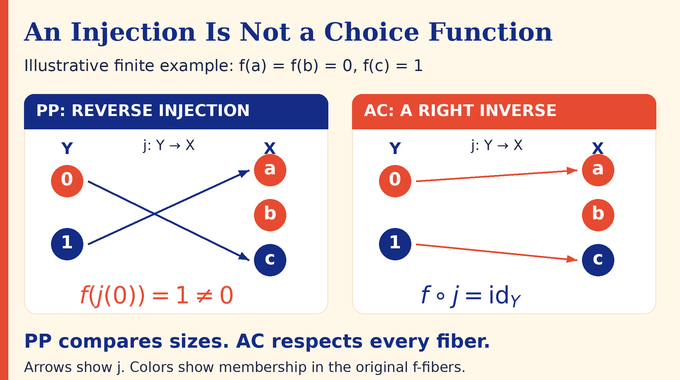
For a surjection , PP asks for an injection . Choice supplies something stronger: a right inverse satisfying . That equation forces each selected input to belong to the correct fiber.
Consider and , with and . The assignment , is injective. Yet both outputs return to the wrong target under . The example illustrates the logical distinction, although finite families themselves need no AC.
Over ZF, the assertion that every surjection has a right inverse is equivalent to AC. Apply it to the projection from the disjoint union of a family onto its index set. A section selects one member of each original set. PP imposes no such compatibility. The proof exploits exactly that freedom.
3. The Century-Old Barrier: Why Earlier Approaches Could Not Settle the Problem
The original paper’ historical discussion traces PP to Beppo Levi in 1902. It also records September 2026 corrections withdrawing model-construction claims from three earlier approaches. The obstacle was establishing the right global principle, not merely describing an attractive local model.
Blass’ small violations of choice principle, , says every nonempty set is a surjective image of for some ordinal . Its injective counterpart, , instead embeds every set into such a product. Reversing those arrows silently assumes part of what needs proving.
Ryan-Smith’ reductions distinguish reverse injections between arbitrary subsets of from reverse injections for surjective images of . Under the appropriate injective presentation, the former combines with ordinal choice to yield full PP. The latter need not suffice, even with those additional assumptions.
The new Partition Principle proof establishes a stronger local classification: every non-well-orderable image of is bijective with . It then proves the all-set reduction explicitly. As with the precise lower-bound scope in the permanent versus determinant problem, the strength of the intermediate statement matters.
4. OpenAI’s Proof: The Exact Theorem and Its Consistency Statement
Theorem 1.1 states the final consistency implication. Here Con means that the indicated first-order theory has no finite proof of a contradiction:
ZF means Zermelo–Fraenkel set theory without Choice, including Foundation and the full Separation and Replacement schemata. ACWO permits choice when the indexing set is well-orderable, equivalently when it is an ordinal. Full AC also covers families whose index sets cannot be well-ordered. PP already implies ACWO by a classical argument, but the construction proves ordinal choice first because it needs it later.
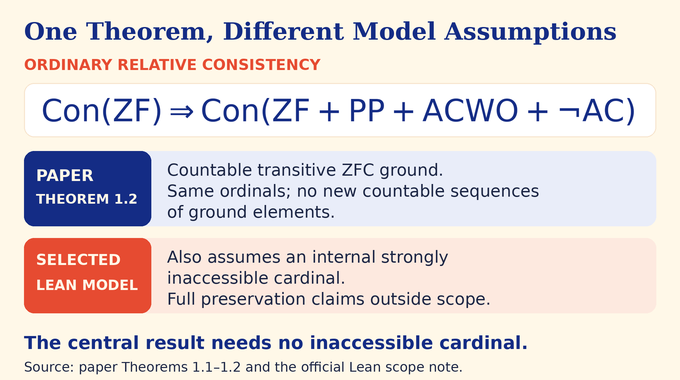
Theorem 1.2 is separate. Starting from any countable transitive model of ZFC, the paper constructs a transitive symmetric model between and a forcing extension. It has the same ordinals and adds no countable sequences of ground-model elements.
Ordinary consistency does not assert the existence of such a transitive ground. Models may be externally ill-founded. Unlike an explicit algebraic counterexample, this separation changes the ambient set-theoretic universe in which the principles are evaluated.
5. Constructing the Diagram Monoid: The Algebra Behind the Proof
The construction begins in a universe satisfying ZFC with a specially designed monoid , an associative multiplication with identity. Left cancellation means . Consequently an injective diagram has injective translated subdiagrams . Here indexes the generic labels.
Conditional joins encode overlap. Whenever two principal right cones intersect, their intersection is another principal cone. This makes intersections of diagram ranges expressible as common subdiagrams, where names can share support.
Finite amalgamation merges finitely many copies with prescribed consistent overlaps, without collapsing points within a copy. Probe extensions insert many new positions whose old divisors realize a specified availability pattern. The first operation makes conditions compatible. The second manufactures enough independent witnesses for exact counting.
Real-valued heights and positive costs prevent availability ideals from requiring uncountably long descriptions. Approaching the supremum of the heights gives a countable cofinal sequence. If a divisor were missed throughout, its positive cost would force a height jump contradicting that supremum.
A countable-base rearrangement of the monoid later controls surviving symmetries. These properties serve different proof obligations. Many copies alone would not establish quotient compatibility.
6. Symmetric Forcing: Constructing a Model Where Choice Can Fail
The forcing is a product. One factor adds distinct Cohen subsets of the ground-model , indexed by . Its conditions are partial binary assignments with countable domain. The other factor consists of ground-model diagrams, with a larger diagram stronger when it contains the weaker diagram as a translated subdiagram.
Permutations of the indices act on both factors simultaneously. A name has a support if permutations fixing that support pointwise leave the name unchanged. Hereditarily symmetric names satisfy this requirement recursively for their member names. Their interpretations form the model of full ZF.
The generic label set belongs to , and each individual label does too. A proposed ordinal enumeration of all labels would have a support. Move a label outside that support to a fresh coordinate, leaving the enumeration name fixed. Compatible conditions would then force the same entry to equal two distinct labels, a contradiction.
Thus is not well-orderable internally. This concerns functions belonging to . The surrounding universe, with Choice available, can well-order .
7. How the Proof Codes Arbitrary Sets and Preserves Ordinal-Indexed Choice
Orbits of supported names produce invariant partial functions from . For a given set , a ground-model ordinal enumerates enough of these partial functions to cover every member of . Filling unused arguments with one fixed element yields a surjection when is nonempty.
Crucially, the argument applies to names of arbitrary rank. It does not merely cover subsets of or objects below some predetermined level of the cumulative hierarchy.
To prove ACWO, the probes first provide one well-orderable portion of meeting every member of a given ordinal-indexed family of nonempty subsets of . Independent copies and Cohen genericity establish this meeting property for every index. Taking the first available label in that portion selects a member of each subset.
For an arbitrary ordinal-indexed family, apply the product presentation once to its union. For each member, take the least ordinal slice meeting it. The resulting nonempty subsets of fall under the preceding argument. This proves ordinal choice without assuming full Choice inside .
8. Exact Availability Fibers: The Key to Controlling Quotient Cardinalities
Fix an equivalence relation on whose quotient is not well-orderable. At a diagram , form a symbolic quotient of supported class names: identify names when forces them equal. These objects precede evaluation in a generic extension. A record-counting argument bounds their number by the ground cardinal , also the size of .
Each symbolic class has an availability ideal: the translated subdiagrams where it still has a supported name. Each label index has the analogous ideal recording where it remains present. Support descent proves closure under joins. When names agree on overlapping supports, their common value has a name supported by the common subdiagram.
For every exact ideal, Lemma 4.3 proves that the label fiber and class fiber both have cardinality in the ordinary Cohen extension. Matching total counts would not suffice.
For the lower bound, non-well-orderability supplies a class unavailable at the common root. Probes create independent copies with the prescribed pattern. Cohen genericity activates copies. Two copies cannot coincide, since descent would then name their common class at the forbidden root. Availability at any prohibited subdiagram would give the same contradiction. Local counting supplies the upper bound.
Contracting within an ideal canonically identifies whole exact fibers. These identifications compose consistently and organize the fibers into components. Each component has a countable cofinal chain. The monoid’ rearrangement theorem then shows that its stabilizer, modulo permutations fixing a sufficiently late diagram, has only countably many residual symmetries.
9. Equivariant Bijections: Why Non-Well-Orderable Quotients Match the Label Set
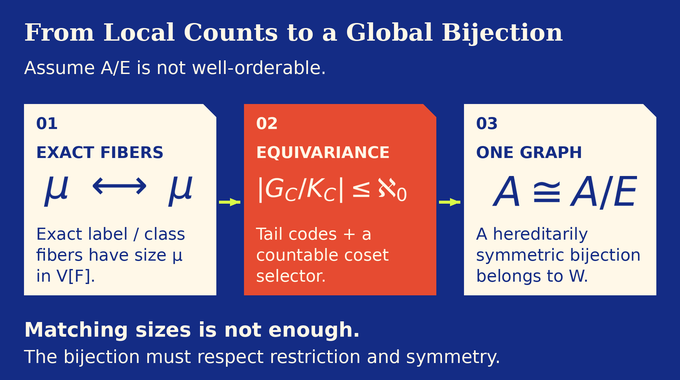
Equal cardinalities do not automatically produce a bijection belonging to . Independent choices can disagree under restriction or fail symmetry. The construction must solve both problems:
Here ≅ denotes a bijection. Along a component’ cofinal chain, sequences of supported names code its class-fiber elements, ignoring finite initial segments. Countable closure of the Cohen factor puts those sequences in the ground model. A fixed ground well-ordering of codes gives each element its least representing code and supplies a preliminary bijection.
Any permutation fixing a sufficiently late diagram fixes the tail entries literally. The preliminary bijection therefore transforms correctly under this subgroup. The remaining quotient group is countable, but its action must still be handled.
For every nonidentity residual coset, choose detector points moved by a representative along the chain. Compare bounded initial segments of the corresponding Cohen rows, modulo eventual equality. Distinct rows differ somewhere. Regularity of the ground bounds the countably many distinguishing coordinates, and then bounds them simultaneously for all coset pairs.
At the least bound distinguishing every coset, choose the least pattern in a fixed ground well-ordering. This selector transforms covariantly when the generic filter moves. It selects a transported preliminary bijection with the required equivariance. Transport across component orbits is well-defined because component stabilizers already satisfy that identity.
Pulling these assignments back to exact fibers makes them agree under every contraction. Their union defines one hereditarily symmetric graph. Common stronger diagrams verify single-valuedness and injectivity. Density reaches every label and every quotient class, proving surjectivity. These transports compare different generics, not automorphisms of one fixed evaluated universe.
10. From Quotient Classification to the Full Partition Principle
Lemma 7.1 now works entirely inside ZF. Given a surjection with nonempty target, choose a presentation . Let be the source slices. Define and . Each target belongs to its earliest slice, so the -slices partition , the S-slices are disjoint, and maps each S-slice onto its -slice.
If a target slice is well-orderable, ACWO chooses from its nonempty preimage fibers, producing a reverse injection. If it is not well-orderable, neither is its source slice: an image of a well-orderable set would be well-orderable.
Both non-well-orderable slices are images of . A nonempty subset of an image of remains such an image by redirecting unwanted values to one fixed member. The quotient classification therefore makes both slices bijective with , supplying an injection between them.
There is a final choice issue. Instead of silently selecting all those injections, define for each ordinal index the set of candidate injections into its source slice. Each candidate set is nonempty, including the empty-target case. ACWO selects one from every candidate set. Their union is a function on and remains injective because source slices are disjoint.
The source slices need not cover . The injection need not follow the original fibers. Every witness belongs to the same model, without rank restrictions.
11. Why the Axiom of Choice Still Fails: The Final Consistency Argument
Internally, has no choice function. If it had one, repeatedly choosing from the unused members of would enumerate . Hartogs’ theorem supplies an ordinal too large to inject into , forcing that recursion to exhaust earlier and hence well-order it. This contradicts the symmetry argument.
For ordinary relative consistency, the constructible universe L transfers consistency of ZF to ZFC plus = L. Completeness gives a countable ground model, potentially externally ill-founded. The construction is interpreted there through forcing relations and equivalence classes of internal names, rather than external recursion along its membership relation. The resulting symmetric quotient satisfies the target theory, establishing Theorem 1.1.
For a given countable transitive ground, ordinary evaluation of names instead gives Theorem 1.2 and its preservation conclusion. These are distinct deductions. PP also implies dual Cantor–Schröder–Bernstein, meaning mutual surjections yield a bijection, and consequently the Weak Partition Principle. The same model separates both weaker principles from AC.
| Artifact | Scope |
|---|---|
| Relative-Consistency Formalization | Central syntactic consistency implication |
| Selected Transitive Construction | Additional ground assumptions, including an internal strongly inaccessible cardinal |
| Paper’ Full Preservation Claims | Outside that selected model-construction formalization |
The published Lean scope note reports the central consistency implication as formalized. The implementation files include the all-set reduction and main consistency theorem. Comparator files specify target statements and must not be mistaken for implementation proofs. The separate model-construction artifact has stronger assumptions, as the table records. This article checks their documented scope and source statements, not an independent Lean build.
That distinction also guides our coverage of Fermat’ Last Theorem in Lean and Poincaré formalization scope. The Partition Principle vs Axiom of Choice result separates cardinal comparison from coherent selection. Follow Binary Verse AI’ mathematical-proof coverage for explanations that track the theorem, its assumptions, and what the available artifacts actually verify.
What is the Partition Principle in set theory?
The Partition Principle states that whenever a set maps surjectively onto a set , an injection from into exists. Equivalently, the collection of parts of any partition can be injected into the original set.
Does the Partition Principle imply the Axiom of Choice?
No, assuming ZF is consistent. The paper establishes that ZF together with the Partition Principle and the failure of the Axiom of Choice is also consistent. Thus PP does not imply full AC over ZF under that consistency assumption.
What principle is equivalent to the Axiom of Choice?
Over ZF, the statement that every surjection has a right inverse is equivalent to AC. This is stronger than PP, which requires a reverse injection without requiring that it select an element from each original fiber.
Why doesn’t the injection supplied by the Partition Principle select representatives?
For a surjection , an injection need not satisfy . Its values may belong to different fibers. Consequently, it need not choose one representative from each original fiber.
How can the Partition Principle hold while Choice fails?
The paper constructs a symmetric model containing a non-well-orderable set while ensuring every surjection in that model has a reverse injection there. The internal family of nonempty subsets of has no choice function, so full AC fails in the same model.
Does OpenAI’s proof require inaccessible cardinals?
The paper’ relative-consistency theorem does not require inaccessible cardinals. The selected Lean transitive-model construction uses additional ground-model assumptions, including an internal strongly inaccessible cardinal. These are different statements and must not be conflated.
Has OpenAI’s Partition Principle proof been formally verified in Lean?
The published scope note reports that the Lean formalization proves the central relative-consistency implication. The selected transitive-model construction uses stronger assumptions, and the paper’ full preservation assertions lie outside that construction. This article reviews the scope note and implementation statements without independently rebuilding the Lean project.