Existential Theory of the Reals: How OpenAI Proved a Counting Hierarchy Bound Without Building Giant Matrices
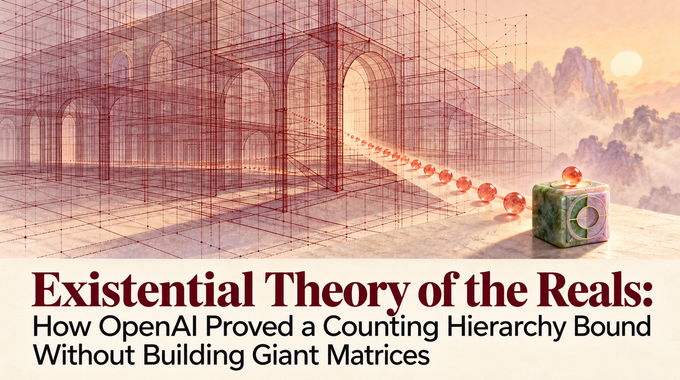
Existential Theory of the Reals artwork links vast implicit matrix architecture to a compact exact decision.

A matrix with 5n5^n rows is a peculiar starting point for avoiding enormous computations. OpenAI’s October 4, 2026 preprint does exactly that: it uses the matrix mathematically, then computes the information it needs without constructing it. The resulting Existential Theory of the Reals proof places exact polynomial feasibility in a fixed level of the counting … Read more
Claude Scorpion Toxin: How 318,484 Designs Became 17 Protein Binders

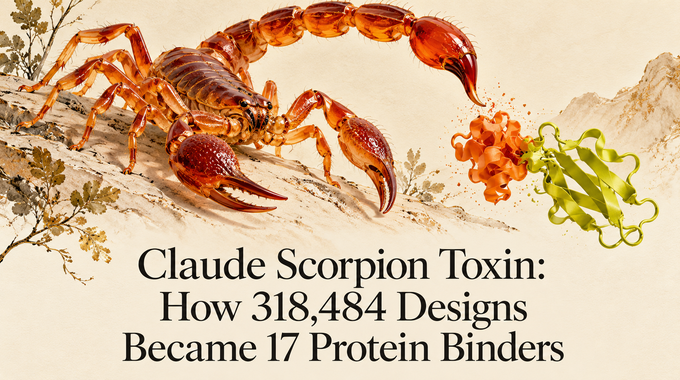
Claude Scorpion Toxin artwork showing an amber scorpion and a designed protein binding a toxin.

Out of 318,484 computer-generated protein designs, 211 reached laboratory testing and 17 met the researchers’ binding criteria. None has been shown to neutralize a scorpion toxin. That is the essential finding behind the Claude Scorpion Toxin study, released by Anthropic on October 20, 2026. An internal research model working within Claude Science coordinated specialist software … Read more

Bose Einstein Condensation Proof: OpenAI’s Route to Coherence at Positive Temperature

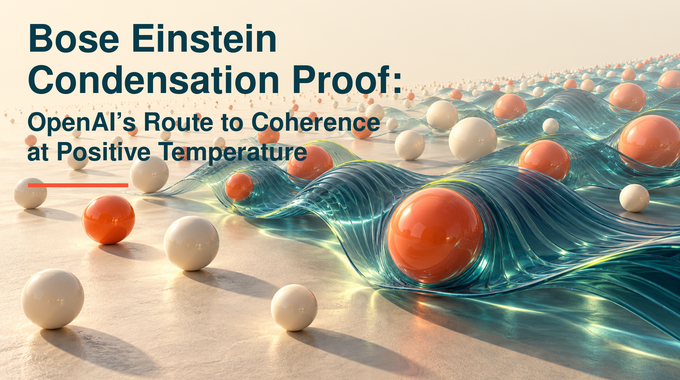
Bose Einstein condensation proof illustrated by separate spheres and a shared wave across a growing gas.

An interacting quantum gas can look well behaved in every small region while still withholding the one thing a condensation proof needs: coherence across the whole sample. The difficulty grows with the box. A bound that works for a thousand particles may disappear when their number becomes unlimited. The Bose Einstein condensation proof in OpenAI’s … Read more

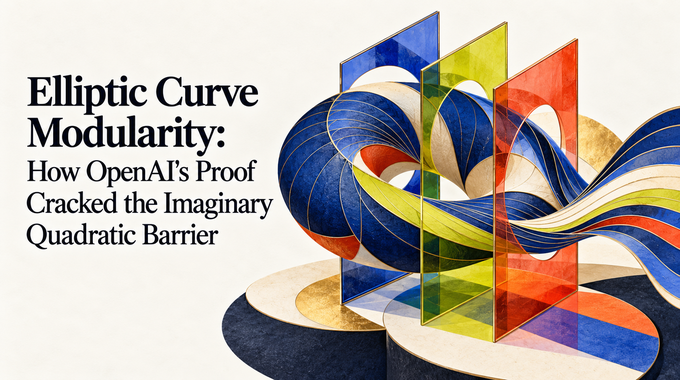
Elliptic Curve Modularity: How OpenAI’s Proof Cracked the Imaginary Quadratic Barrier

Elliptic curve modularity visualized as a sculpted torus passing through three coloured geometric facets.

Counting an elliptic curve’s points modulo primes produces an arithmetic fingerprint. Modularity says that an entirely different object, an automorphic representation, reproduces that fingerprint and its deeper local structure. OpenAI’s October 4, 2026 manuscript claims elliptic curve modularity for every elliptic curve over every imaginary quadratic field, removing restrictions that earlier results still required. The … Read more

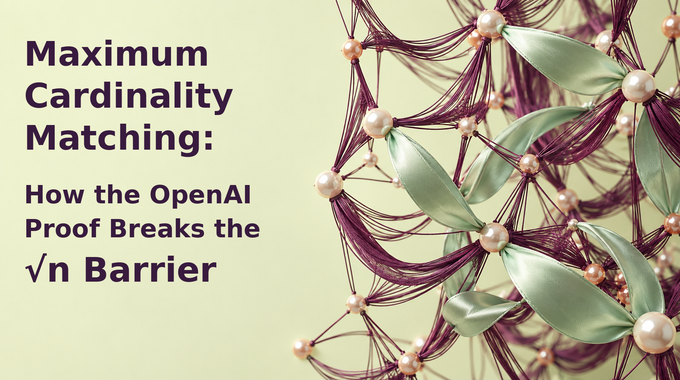
Maximum Cardinality Matching: How the OpenAI Proof Breaks the √n Barrier

Maximum cardinality matching illustrated with woven graph strands, paired pearls, and the full article title.

A greedy pairing can stop after one edge even when two fit. Finding the best pairing is easy to describe, yet odd cycles have made fast, exact solutions surprisingly difficult. OpenAI’s September 24, 2026 manuscript presents a maximum cardinality matching algorithm running in almost-linear time in the graph’s explicit input size, including the cost of … Read more

Quantum Query Complexity: The OpenAI Proof That Breaks the Cubic Conjecture

Quantum query complexity illustrated by a hidden certificate unlocked inside a fractured glass archive.

An algorithm can lose badly even when it may toss coins, adapt its questions, and perform unlimited computation between them. OpenAI’s October 5, 2026 preprint constructs precisely that situation: total Boolean functions where classical randomized algorithms need almost the fourth power of the quantum query count. The result concerns quantum query complexity, the number of … Read more

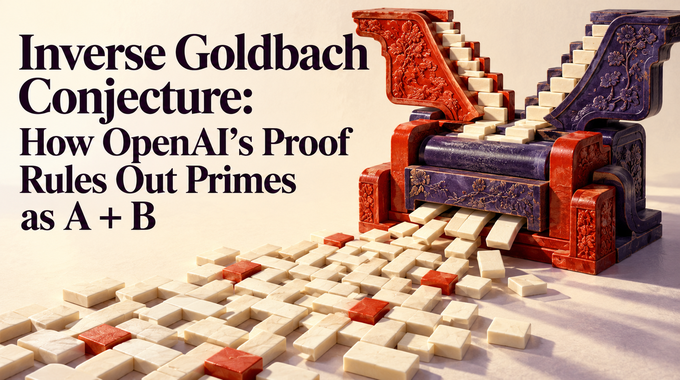
Inverse Goldbach Conjecture: How OpenAI’s Proof Rules Out Primes as A + B

Inverse Goldbach Conjecture visualized as a two-input press producing unavoidable unwanted outputs.

Two sets of integers, one addition sign, and every sufficiently large prime: that is the deceptively simple target of the Inverse Goldbach Conjecture. OpenAI’s September 24, 2026 manuscript, The Additive Indecomposability of the Primes, presents a proof that this construction is impossible when each set contains at least two nonnegative integers. Even allowing finitely many … Read more