Shortest Common Superstring: How OpenAI Finally Proved the Factor-2 Guarantee
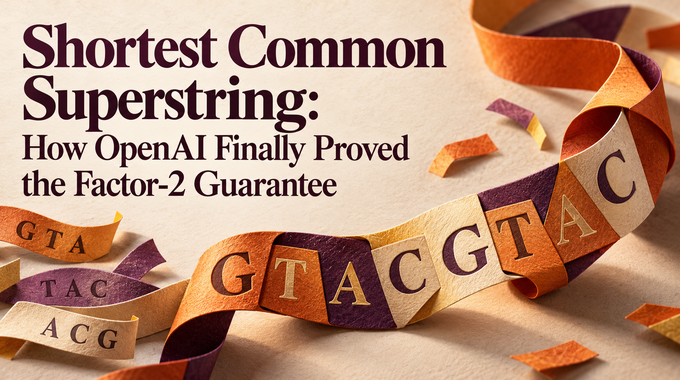
Shortest common superstring artwork showing letter ribbons merging through shared overlaps.

The fragments CAT, ATG, and TGC fit into CATGC. Five letters do the work of nine. Scale that puzzle to arbitrary strings, and finding the shortest possible assembly becomes computationally hard. OpenAI’s September 24, 2026 preprint proves a deterministic polynomial-time shortest common superstring approximation: its output contains every input and is at most twice as … Read more
Time Space Tradeoff in Turing Machines: How OpenAI’s Proof Reduces Simulation Memory

Time space tradeoff in Turing machines shown as a looping paper tape passing through one small reusable workspace.

A machine may spend a trillion steps changing its tape, yet a simulator need not remember every changed cell to recover its answer. OpenAI’s September 25, 2026 preprint advances the time space tradeoff in Turing machines: a fixed deterministic machine with one writable tape can be simulated using two-fifths-power space, up to polylogarithmic factors, when … Read more

Quadratic Sensitivity Conjecture: How OpenAI’s Proof Broke the Square Barrier

Quadratic sensitivity conjecture artwork: grouped tiles breaking a copper square barrier.

A square looked like a plausible ceiling. OpenAI’s September 25, 2026 paper constructs Boolean functions that break it: for every positive constant CC, some total function satisfies bs(f)>Cs(f)2\mathrm{bs}(f)>C\,s(f)^2. That disproves the quadratic sensitivity conjecture, while leaving Hao Huang’s 2019 polynomial Sensitivity Conjecture theorem intact. The construction combines separated Hamming balls, labelled tournaments, and recursive target-and-gate … Read more

Counting Perfect Matchings: How the OpenAI Proof Escapes the Exponential Sampling Trap

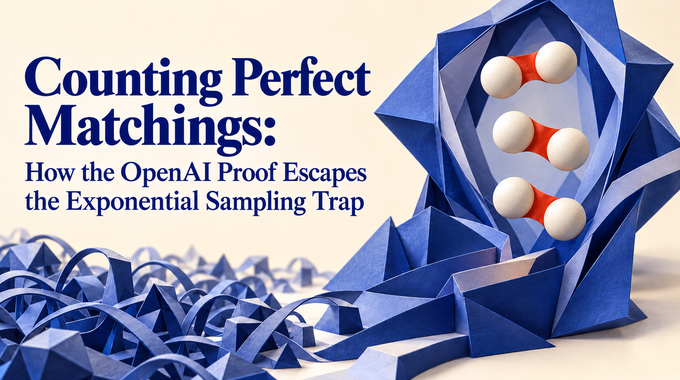
Counting perfect matchings shown as three paired sculptures escaping an ultramarine sampling trap.

A graph can reveal one perfect pairing quickly while concealing how many others exist. Counting perfect matchings asks for that hidden population, and arbitrary graphs have resisted a general randomized approximation guarantee for decades. OpenAI’s September 23, 2026 paper supplies a fully polynomial randomized approximation scheme, or FPRAS: an estimate with selectable relative accuracy and … Read more

Strong Cosmic Censorship: Inside OpenAI’s Proof of Generic Inextendibility Near Kerr

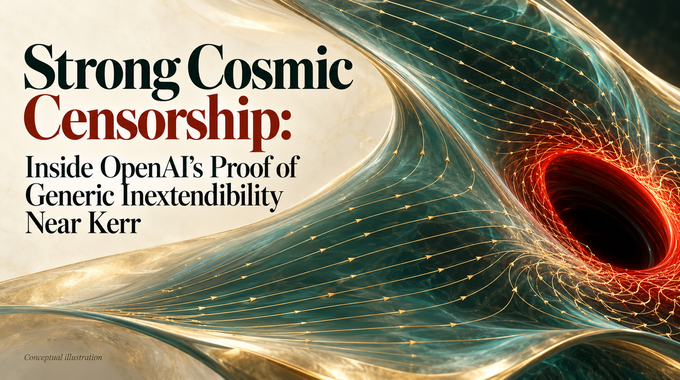
Strong cosmic censorship art showing continuous Kerr-like geometry with disrupted vector transport.

A black hole can have a boundary across which distances remain continuous while the mathematical machinery for transporting vectors becomes too singular. That gap is the target of OpenAI’s strong cosmic censorship proof near Kerr. Its September 23, 2026 manuscript presents a precise result: near each fixed rotating, subextremal Kerr bridge, data allowing a future … Read more

Barker Sequence Conjecture: How the OpenAI Proof Rules Out Lengths Beyond 13

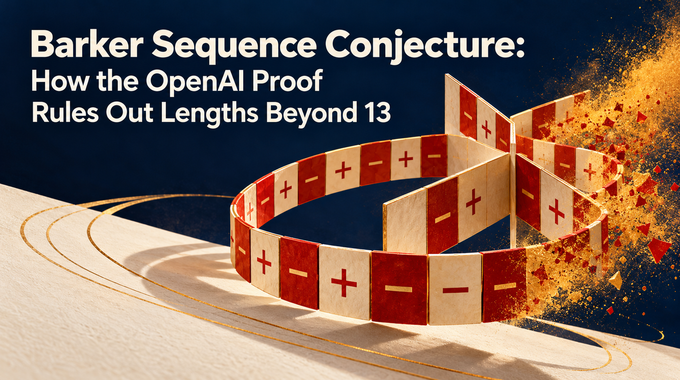
Barker sequence conjecture artwork showing cyclic sign tiles dissolving beyond a mathematical boundary.

Thirteen signs can meet a strict cancellation rule. According to OpenAI’s September 23, 2026 manuscript, fourteen signs, fourteen trillion signs, and every other length above thirteen cannot. Its proof of the Barker sequence conjecture closes the outstanding even-length case through a theorem about cyclically shifted matrices. The answer is precise: Barker sequences longer than one … Read more

Quantum Circuit Lower Bounds: How OpenAI Proved Parity Is Beyond QAC⁰

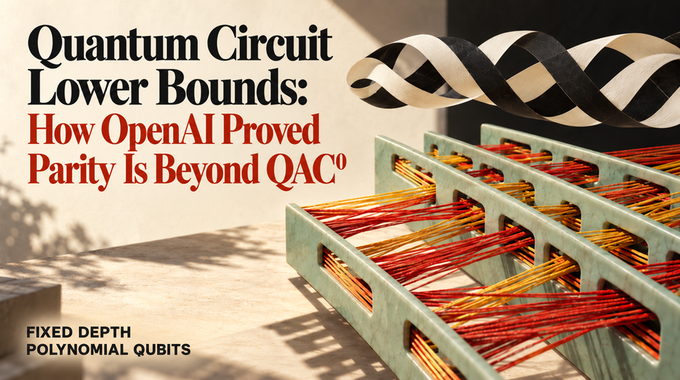
Quantum circuit lower bounds shown as a shallow ceramic loom beneath a global parity braid.

Adding four bits modulo two is easy. Proving that a powerful family of shallow quantum circuits cannot reliably do the same job took a much subtler argument. OpenAI’s September 24, 2026 paper establishes quantum circuit lower bounds excluding parity from QAC⁰, even with polynomially many workspace qubits, arbitrary discarded outputs, and any fixed positive worst-case … Read more