Artin’s Primitive Root Conjecture: How OpenAI’s Proof Breaks the 99-Year Infinitude Barrier
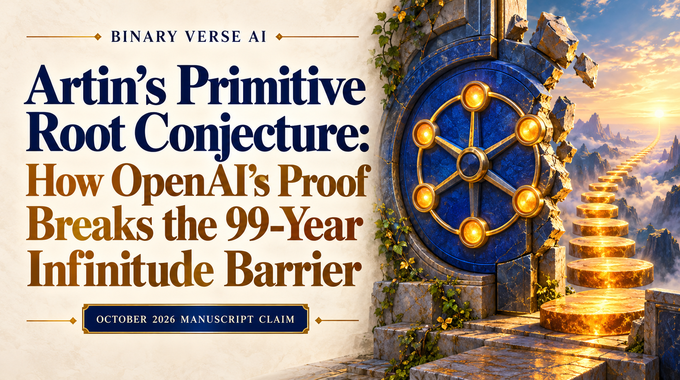
Artin’s primitive root conjecture shown as an opened wheel leading to an endless prime horizon.

Choose the integer 2. Can its powers generate every nonzero residue modulo infinitely many primes? Artin’s primitive root conjecture predicts yes. OpenAI’s October 4, 2026 manuscript Primitive roots for every admissible integer base claims an unconditional proof, covering every integer except −1 and perfect squares. Its quantitative guarantee is a lower bound of order x/(logx)2x/(\log … Read more
Subset Sum Problem: Inside OpenAI’s Proof Beyond the 52-Year Barrier

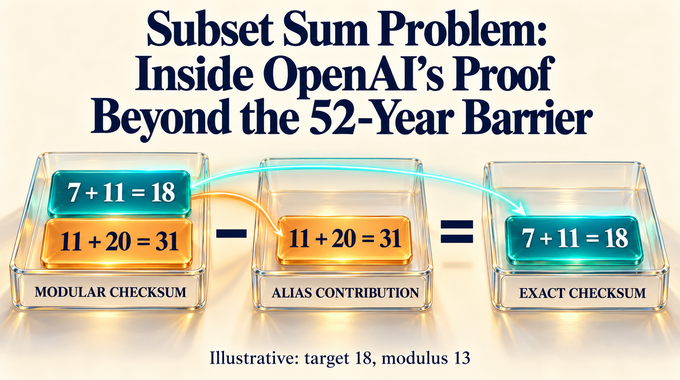
Subset sum problem artwork shows a lime path crossing a coral barrier beneath the article title.

For 52 years, the Subset sum problem had a stubborn exponential benchmark: split the inputs in half and search at the 2n/22^{n/2} scale. OpenAI’s October 4, 2026 preprint presents a randomized classical algorithm running in O(20.49n)O(2^{0.49n}) for polynomial-bit inputs in a specified word-RAM model. It promises at least 2/32/3 correctness probability for every fixed input, … Read more

Borsuk Conjecture: OpenAI’s 9D Proof Shatters the 63-Dimension Record

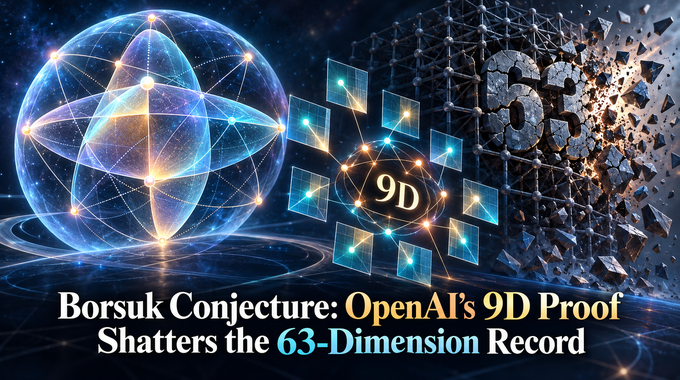
Feature image for the Borsuk conjecture article showing OpenAI's 9D proof breaking the 63-dimension record.

Ten pieces should have been enough. OpenAI’s September 23, 2026 preprint gives a compact set in nine-dimensional Euclidean space that refuses to fit that rule: every cover by ten subsets leaves at least one subset with the original diameter. The Borsuk conjecture counterexample lowers the previously reported counterexample dimension from 63 to nine. The original … Read more

Two-Point Chowla Conjecture: OpenAI’s Proof Breaks a 61-Year Averaging Deadlock

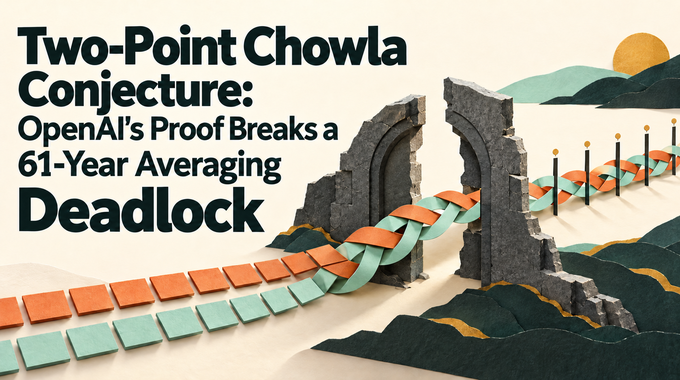
Two-point Chowla conjecture artwork showing paired parity streams crossing a broken 61-year averaging barrier.

Prime factors can be counted, but their parity has resisted a deceptively simple prediction for decades. The two-point Chowla conjecture asks whether the even-or-odd factor counts of two integers a fixed distance apart become uncorrelated. OpenAI’s September 24, 2026 manuscript claims a proof for ordinary averages at every cutoff, with a power-of-logarithm saving. It also … Read more

Discrete Fourier Transform Complexity: How OpenAI Cracked the n log n Barrier

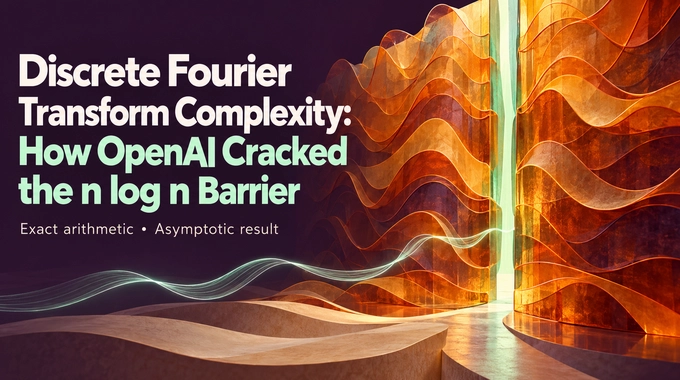
Discrete Fourier transform complexity shown as a mint wave passing through a narrow amber barrier.

The Fast Fourier Transform has spent decades turning quadratic calculations into manageable work. OpenAI now presents a proof that discrete Fourier transform complexity can fall below the familiar O(nlog⁡n)O(n\log n) scale, at every input length. The improvement is asymptotic, deterministic, and exact, but it belongs to a computational model with unrestricted complex coefficients and supplied … Read more

Edit Distance Approximation: OpenAI’s Almost-Linear Proof Meets the DNA Reality Check

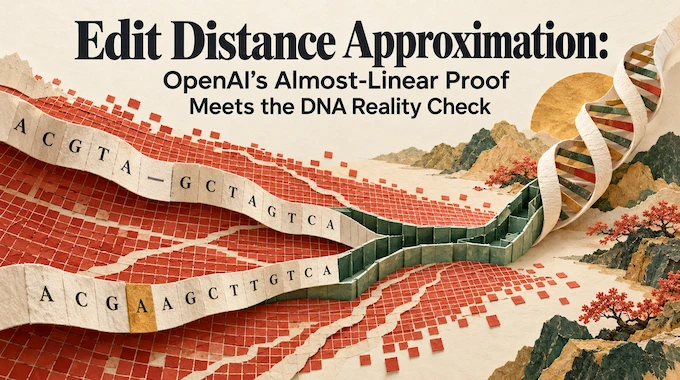
Edit distance approximation concept: glowing DNA strands crossing a grid with a narrow light path

Comparing two strings sounds like a small job. Then the strings become long, insertions shift everything sideways, and a simple comparison becomes a search through millions of possible alignments. OpenAI’s September 24, 2026 manuscript tackles that cost with an edit distance approximation that combines almost-linear expected runtime with accuracy arbitrarily close to exact, provided the … Read more