Short Egyptian Fractions: How OpenAI’s Proof Solved Erdős’s 76-Year-Old Conjecture and Established the Optimal Double-Logarithmic Bound
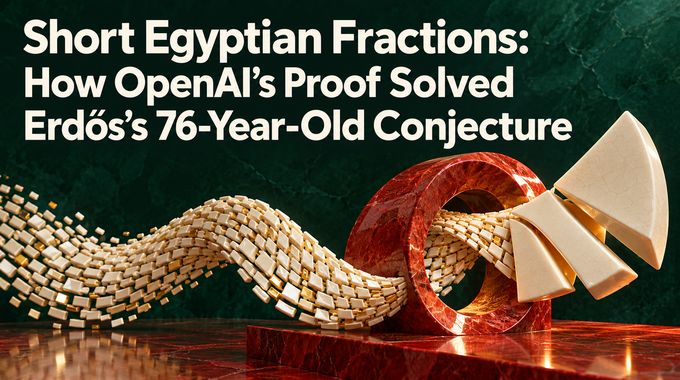
Short Egyptian Fractions artwork: many fragments become a few distinct pieces.

How many fractions does a fraction really need? For 76 years, a conjecture of Paul Erdős asked whether every rational number below one could be assembled from remarkably few distinct reciprocals. OpenAI’s September 25, 2026 manuscript, Short Egyptian Fractions, presents a proof that the worst-case minimum length grows like the logarithm of the logarithm of … Read more
Gaussian Moat Conjecture: How OpenAI’s Proof Solves the 64-Year Walk-to-Infinity Mystery

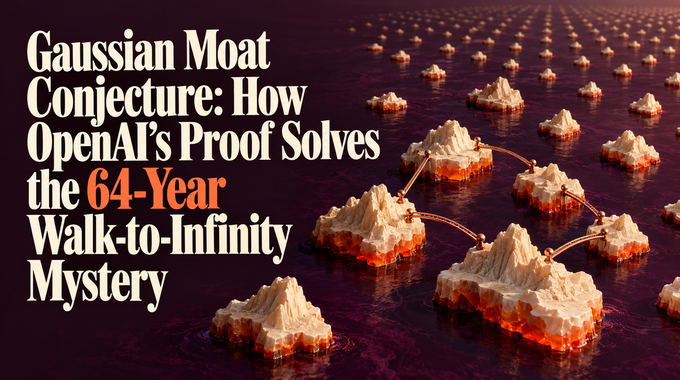
Gaussian moat conjecture illustrated by finite islands linked with copper bridges beneath the full article title.

Imagine stepping from prime to prime across the complex plane, always keeping the next jump below the same fixed limit. OpenAI’s September 26, 2026 manuscript answers that challenge negatively: the Gaussian moat conjecture admits no infinite walk through distinct Gaussian primes with bounded steps. Its stronger conclusion caps every connected component, wherever the walk starts. … Read more

BKT Transition: How OpenAI Proved the 2D XY Model’s Exponential Divergence

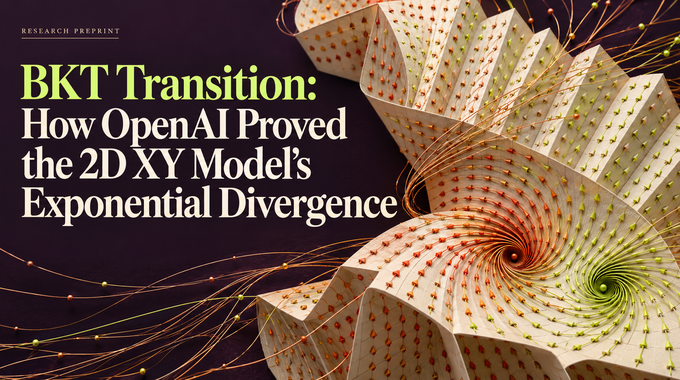
BKT transition artwork shows paired spin vortices and expanding correlations, with the full article title.

A phase transition can be known to exist while its most distinctive prediction remains unproved. That was the gap facing the BKT transition in the original square-lattice XY model: exactly how fast does the distance over which spins remain correlated grow near criticality? OpenAI’s October 5, 2026 preprint proves that the logarithm of this correlation … Read more

Mezard Parisi Formula: How OpenAI’s Proof Settled the 22-Year Panchenko–Talagrand Conjecture

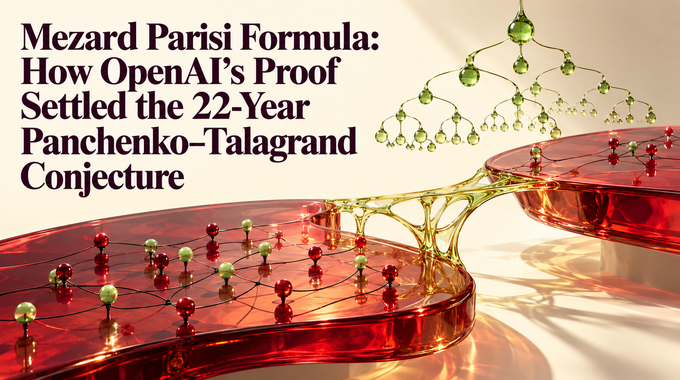
Mezard Parisi formula: glass surfaces joined by a branching bridge symbolize the missing lower bound.

A formula can give the right answer for twenty-two years without anyone knowing how to prove it. The Mezard Parisi formula faced precisely that problem: a hierarchy of cavity-field distributions supplied rigorous upper bounds for sparse spin systems, but the matching lower bound remained missing. OpenAI’s September 23, 2026 paper proves that equality for the … Read more

Quantum Heisenberg Ferromagnet: How OpenAI’s Proof Settled a Decades-Old 3D Ordering Problem

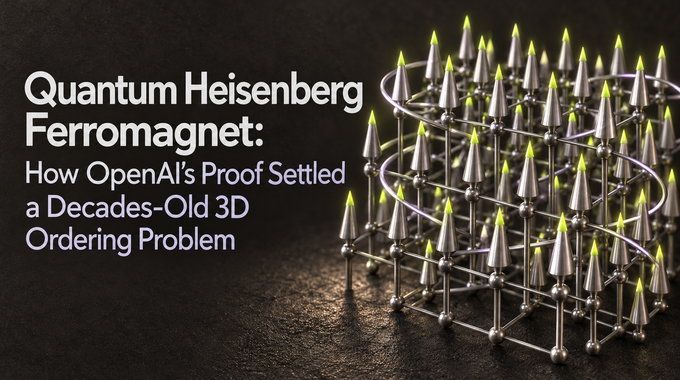
Quantum Heisenberg ferromagnet artwork showing collective spin order and the full article title.

A magnet should not need a mathematical permission slip to stay magnetized. Yet proving positive-temperature order in the quantum Heisenberg ferromagnet required much more than showing that neighboring spins prefer alignment. OpenAI’s September 24, 2026 paper supplies that proof for the nearest-neighbor isotropic model on the integer lattice in every dimension d≥3d\geq3, for every positive … Read more

Zauner MUB Conjecture: How OpenAI’s Proof Ruled Out a Fourth Basis After 35 Years

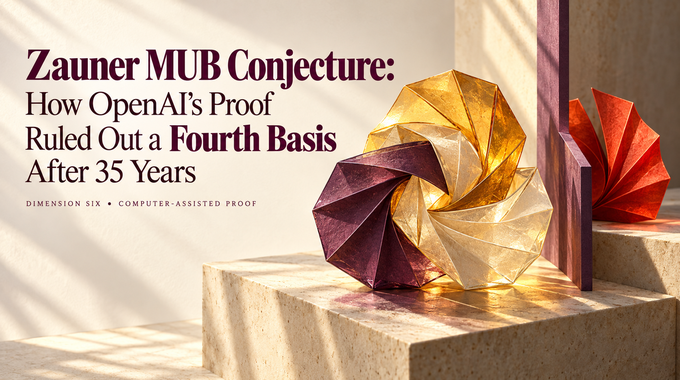
Zauner MUB conjecture artwork showing three interlocking forms and a fourth excluded by a geometric boundary.

Three measurement bases fit. A fourth has resisted every attempt to build it for decades. OpenAI’s new paper tackles that missing basis by covering the possible complex matrices, then eliminating every configuration that could support it. The Zauner MUB conjecture says that dimension six admits exactly three pairwise mutually unbiased orthonormal bases. The supplied manuscript … Read more

Irrational Triangular Billiards: How OpenAI’s Proof Tackles a Decades-Old Ergodicity Mystery

Irrational Triangular Billiards: OpenAI’s Ergodicity Proof illustrated through jade paths and mirrored triangles.

A particle can ricochet inside a triangle forever, obeying one elementary reflection rule, while hiding a difficult question: does its motion explore position and direction in the correct statistical proportions? OpenAI’s September 25, 2026 manuscript presents a proof that irrational triangular billiards are ergodic whenever at least one interior angle is an irrational multiple of … Read more