
Three measurement bases fit. A fourth has resisted every attempt to build it for decades. OpenAI’s new paper tackles that missing basis by covering the possible complex matrices, then eliminating every configuration that could support it.
The Zauner MUB conjecture says that dimension six admits exactly three pairwise mutually unbiased orthonormal bases. The supplied manuscript states a computer-assisted proof of that result under explicit arithmetic and compiler conditions. Its decisive evidence is a reported complete execution on October 4, 2026. The accompanying Lean work proves a weaker bound, so this is not a fully Lean-verified resolution.
Table of Contents
1. What Is Zauner’s MUB Conjecture, and Why Did Dimension Six Remain Unsolved?
Write for the maximum number of pairwise mutually unbiased bases in a complex space of dimension . The proposed answer is:
The paper traces the conjecture to Gerhard Zauner’s 1991 diploma thesis, giving the 35-year framing. This is the dimension-six MUB problem. It should not be confused with the distinct Zauner conjecture about symmetric informationally complete measurements.
1.1. Zauner MUB Conjecture: Key Facts
| Question | Verified Scope |
|---|---|
| What Does The Paper State? | Theorem 1.1 excludes four arbitrary complex bases under its stated execution and arithmetic conditions. |
| Why Exactly Three? | Lemma 1.2 constructs three; the computer-assisted argument supplies the matching upper bound. |
| Which Run Supports It? | The manuscript documents October 4, 2026, not an authenticated September 7 run. |
| What Does Lean Establish? | A weaker upper bound of five and supporting Fourier results, not the unrestricted four-basis exclusion. |
A fourth basis is decisive because any larger family contains four. Excluding four therefore excludes five, six and seven simultaneously. This matching of construction and obstruction is what establishes the maximum number of mutually unbiased bases.
2. The Mathematics of Mutually Unbiased Bases: Why Six Dimensions Are Different
An orthonormal basis contains unit vectors that are mutually perpendicular. Two such bases are unbiased when every cross-basis overlap has the same squared magnitude. In six dimensions:
Here is the Hermitian inner product, with complex conjugation on the first vector. Prepare the state and measure in the other basis: each of its six outcomes has probability . Within the original basis, the matching outcome is certain.
The general upper bound is . For prime-power dimensions, such as four, eight and nine, complete families attain it. The prime-power construction literature establishes that distinction. Six is the smallest positive dimension above one that is not a prime power, and those constructions do not supply seven bases there.
For readers exploring quantum computing and artificial intelligence, the immediate relevance is measurement geometry. This theorem constrains exact complementary measurements. It supplies no demonstrated improvement in quantum hardware, training speed or experimental noise tolerance.
The upper bound has a useful dimension-counting explanation. Each basis contributes independent traceless diagonal observables. Unbiased bases make those subspaces orthogonal in the space of traceless matrices, whose dimension is . There is room for at most such subspaces. That counting permits seven in dimension six. It cannot explain why the sharper answer would be three.
3. Constructing Three Mutually Unbiased Bases in Complex Dimension Six
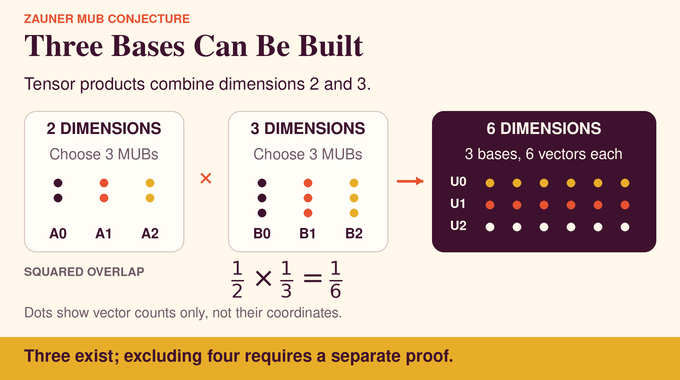
Lemma 1.2 first proves attainability independently of the computer search. Identify with . In dimension two, take the coordinate basis, the normalized columns and , and the normalized columns and . Here .
Call their unitary basis matrices . For dimension three, put , define for , and set . Use , and .
Their cross-basis squared overlaps are and , respectively. Set for . For , tensor products multiply those overlaps:
Thus the columns of the three matrices form the required bases. A two-level system and a three-level system give a concrete six-dimensional example. This proves existence, while leaving the impossibility of four entirely open.
The three-dimensional check uses . It makes the Fourier columns orthogonal and gives constant overlap magnitudes between and . Pair the first two-dimensional basis with the first three-dimensional basis, and similarly for the other two pairs. This produces three bases of six vectors each, not six different bases. The number of vectors and the number of bases answer different questions.
4. Why Earlier Mathematical Approaches Could Not Exclude a Fourth Basis
Grassl ruled out four bases containing the standard–Fourier pair. Jaming, Matolcsi, Móra, Szöllősi and Weiner extended the rigorous obstruction to the two-parameter Fourier family. Their interval discretization and compatibility tests are direct methodological predecessors.
That family restriction matters. An arbitrary second basis might lie elsewhere among complex Hadamard matrices. Classifying individual matrices also leaves the separate question of their compatibility with additional bases.
Numerical optimization provided strong evidence, but unsuccessful searches cannot exclude a narrow missed region or an isolated exact solution. The new mutually unbiased bases proof must account for every second basis, including matrices outside familiar parameter families.
The Fourier matrix here supplies a measurement basis. Readers of our discrete Fourier transform complexity analysis should distinguish that role from the cost of evaluating a transform. The present obstruction concerns which exact bases can coexist.
5. The Critical Reduction: From Four Hypothetical Bases to Complex Hadamard Matrices
Apply one unitary transformation to every proposed basis so that the first becomes the coordinate basis. Unbiasedness forces every entry of the second basis matrix to have magnitude . Write that matrix as , where:
The star denotes conjugate transpose, and is the identity matrix. These equations define the unscaled complex Hadamard matrices of order six used in the paper.
Rephasing rows and columns, permuting them, and complex conjugation preserve extendibility. Transposition does too, through a reversible change of basis followed by conjugation. The proof establishes that last equivalence for exact matrices, without pretending an approximate center defines a unitary transformation.
Rephasing makes the first row and column all ones, a normalization called dephasing. These reductions remove duplicate descriptions. They do not restrict the hypothetical family to a preferred Fourier construction.
6. How OpenAI’s Proof Covers Every Candidate Using Nine Phase Variables
Write a unit-modulus entry as , with measured in cycles. After dephasing, the first two rows and columns contain nine free seed phases: five in the second row and four additional entries in the second column.
Symmetries arrange circular gaps and phase orderings so every exact matrix has an admissible representative. Orthogonality supplies vanishing sums of six unit complex numbers, which eliminate impossible bins.
The seed grid uses 112 closed intervals per phase cycle. Closed boundaries overlap, preserving candidates exactly on an endpoint. The shared second-row, second-column entry has one displacement appearing in both sum constraints. Treating it independently would weaken the compatibility test.
A retained center can cover another bin only after a bound covers its entire feasible portion. The resulting 249,878 seed centers cover the seed coordinates of every exact candidate, up to equivalence. Centers themselves need not solve the equations. This is certified coverage, not a claim that 249,878 sampled matrices exhaust a continuous space.
Think of a closed bin as an interval containing an unknown exact angle. Testing only its midpoint could miss a solution near its edge. Here the rejection bound allows the angle to move anywhere in that interval. A bin disappears only when even that permitted motion cannot repair the violated condition. Overlap costs extra work but protects completeness.
7. Stage A: Completing Every Hadamard Matrix Through Unitary Covers and Certified Phase Balls
Split rows and columns into groups of two and four. The seed controls the upper-left, upper-right and lower-left blocks. The unknown lower-right block is four by four.
At an accepted seed center, the upper-right block and the adjoint of the lower-left block have two-dimensional kernels. Fixed orthonormal frames compress the missing block to a two-by-two matrix. Hadamard identities bound its distance from times its unitary polar factor.
Polar decomposition separates a matrix into unitary and positive parts. Covering , the group of two-by-two unitary matrices, therefore covers the remaining completion freedom. Taylor remainder bounds carry uncertainty in both the seed and unitary parameters.
The polar factor has four real parameters, covered by closed cells. This is the compression that makes the completion search manageable: the sixteen missing complex entries are constrained together by orthogonality, rather than varied independently. Kernel frames stay fixed at the seed center, with certified allowances for the exact matrix’s displacement. Recomputing ideal frames without controlling their variation would leave a gap.
Each cell must be excluded by a necessary inequality, subdivided, or assigned to a certified phase ball. A “Root” certificate stores a center, approximate tangent directions and bounds controlling exact solutions nearby. Despite its name, it does not assert that a root exists. Successful assignments form a coarse atlas covering all exact completions. Failed checks remain unresolved.
8. Stage B: Tangent-Space Refinement Without Losing an Exact Solution
Stage B shrinks the covering balls. Nearby exact solutions tend to move along approximately tangent directions, but assuming an exact smooth manifold could silently omit singular cases.
Instead, let be an exact solution’s horizontal phase displacement from a stored center. “Horizontal” removes row and column phase freedom. The stored matrix contains numerical tangent directions. Its certificate bounds the remaining displacement:
The nonnegative constants , and are certified error bounds, not fitted guarantees. Separate bounds control imperfect orthogonality and residual error at the center.
An exhaustive grid covers tangent coordinates while retaining the normal allowance. Relations between old and new centers then certify smaller covering radii. No exact manifold parametrization is required. A heuristic solve can suggest a useful center, but its checked residual determines whether the proposal is usable.
9. Stage C: How Compatibility Graphs Make a Fourth Basis Impossible
Fix a final Hadamard phase ball. Every additional vector unbiased to the coordinate basis has six equal-magnitude entries, leaving five phases after fixing its global phase. Closed bins cover those phases, and necessary tests retain all vectors potentially unbiased to the varying second basis.
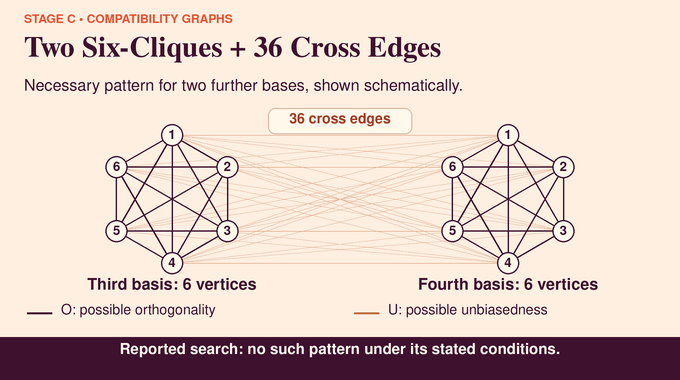
Small vector balls become graph vertices. An O edge means orthogonality remains possible. A U edge means unbiasedness remains possible. Keeping an edge asserts possibility, never existence.
Two further bases would require two disjoint six-cliques in O, with every one of the 36 cross pairs connected in U. A clique is a set whose every pair has an edge. This converts the geometric obstruction into a finite compatibility problem, a different use of graphs from graph coloring in the Hadwiger–Nelson problem.
The strongest edge test couples vector constraints through one shared tangent displacement of the second basis. Both vectors must work with the same matrix. Allowing each its own convenient matrix would admit spurious possibilities. Exhaustively excluding the required pattern rules out two additional bases throughout the ball.
10. The Computer-Assisted Certificate: Why the Exhaustive Search Counts as a Proof
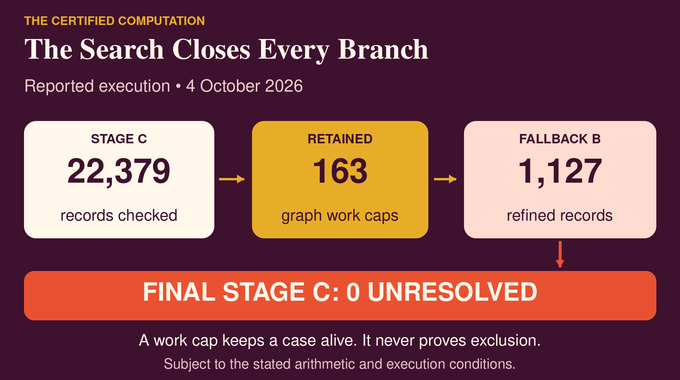
Section 7.5 documents a fresh October 4 run. Its reported checkpoints are:
10.1. Recorded Execution: From Seed Cover to Zero Final Failures
| Stage | Recorded Output | Unresolved |
|---|---|---|
| Seed Cover | 249,878 centers from 151,744,086 tested pairs | Not an exclusion stage |
| Stage A, Four Shards | 3,083 coarse records | 0 |
| Stage B, Mid Then Fine | 600 mid records; 22,379 fine records | 0 |
| Initial Stage C | 22,379 records checked in 88 batches | 163, all graph work caps |
| Stage B Fallback | 1,127 refined records from those 163 | 0 |
| Final Stage C, Four Shards | All 1,127 fallback records checked | 0 |
The initial 163 cases were unresolved work, not counterexamples. Every case entered fallback refinement and final exclusion. A time or search cap cannot count as success. This completeness obligation resembles the finite-certificate scrutiny in our Snaky proof analysis.
The arithmetic contract requires binary64 round-to-nearest operations, correctly rounded square roots, no unsafe reassociation or operation contraction, and preserved subnormals. Appendix A proves conservative comparison margins under those assumptions. Hardware probes offer limited evidence, not a proof of compiler semantics. The seed executable also requires a specific check of how two squaring expressions were compiled.
Logs and hashes establish the identity and coverage of executed inputs. The geometric lemmas justify why those tests exclude exact solutions. Neither layer replaces the other.
For developers, the central design lesson is to make uncertainty an explicit output state. An overflow, failed clustering attempt or exhausted graph budget must survive into later work. A program that merely prints “no solution found” has a weaker contract. This pipeline requires every surviving region to reach a justified terminal exclusion before the global conclusion is accepted.
11. What OpenAI’s Proof Establishes and What Its Verification Limits Mean
The research manuscript’s Theorem 1.1 combines the three-basis construction with its conditional computational exclusion. The Lean scope documentation explicitly limits formal coverage to a weaker five-basis bound and supporting Fourier work. The unrestricted four-basis exclusion remains outside that coverage. Our guide to Lean formalization explains why the encoded theorem matters more than a project label.
One evidence gap remains. As of October 15, inspection of the public paper directory found the PDF and manuscript sources, but not the cited verification directory. Direct requests for its computation README and reproduction guide returned 404s. The supplied paper describes preserved archives, but this review could not retrieve or replay them. Its run counts are reported evidence, not independently reproduced results.
OpenAI’s October mathematics release places this work among model-produced results. That announcement supplies context, without independently validating this computation. The distinction also guides our coverage of AI mathematical proofs and research verification and review.
Corollary 1.3 transfers the same conditional maximum of three to pairwise Killing-orthogonal Cartan subalgebras of closed under the same standard adjoint. These are the traceless diagonal matrix algebras associated with bases. Dropping the adjoint condition would overstate the result.
The Zauner MUB conjecture now has a reported unrestricted computer-assisted resolution with explicit verification obligations. For researchers, the next useful step is independent access to and replay of the execution artifacts. Follow Binary Verse AI for paper-level explanations that track the theorem, its assumptions and the evidence supporting it.
What does Zauner’s MUB conjecture state in dimension six?
It states that the maximum number of pairwise mutually unbiased orthonormal bases in is three. The supplied OpenAI manuscript states under its specified execution, arithmetic and compiler conditions. The central computational exclusion has not been independently replayed in this review.
Why is dimension six special for mutually unbiased bases?
Six is the smallest dimension above one that is not a prime power. The general upper bound permits seven mutually unbiased bases, but the standard prime-power constructions do not produce a complete seven-basis set in dimension six.
How can three mutually unbiased bases exist if a fourth is impossible?
Lemma 1.2 explicitly constructs three bases using tensor products of mutually unbiased bases in dimensions two and three. Their squared overlaps multiply to . The separate computer-assisted upper-bound argument excludes extending any allowable pair to a family of four, under its stated conditions.
Why could earlier proofs not settle Zauner’s dimension-six conjecture?
Earlier rigorous exclusions covered particular Hadamard matrices or restricted families, including the two-parameter Fourier family. Numerical searches supplied evidence but could not exclude every exact matrix. The new manuscript addresses arbitrary second bases through a certified covering argument.
How does OpenAI’s proof exclude a fourth mutually unbiased basis?
It covers possible second bases with certified phase balls, refines the cover, and covers candidate additional vectors. Four bases would require two disjoint orthogonality six-cliques with all 36 cross-unbiasedness edges. The reported complete computation excludes that pattern, including every initially unresolved case after fallback refinement.
Has OpenAI’s dimension-six proof been formally verified in Lean?
Not in full. The accompanying scope documentation describes a weaker upper bound of five and supporting Fourier results. It explicitly says that the paper’s upper bound of three and its computer-assisted exclusion of four arbitrary bases are not established by the selected formalization.
What makes OpenAI’s computer-assisted result rigorous rather than a numerical approximation?
The argument combines complete coverage, necessary exclusion inequalities, conservative error bounds and a recorded run with zero final unresolved cases. Its validity depends on the stated arithmetic and compiler assumptions. The supplied manuscript describes execution archives, but the cited public verification paths were unavailable during this review, so independent replay remains unconfirmed.