
Introduction
You swap out your model for the newest frontier release, and your agent still falls apart on the same tasks. It still loses the plot after twenty tool calls. It still retries the same failed action four times before giving up. If that sounds familiar, the problem probably isn’t the model. It’s the agent harness wrapped around it.
An agent harness is the software layer that sits between a language model and the real world. It decides what the model sees, when it acts, how errors get handled, and when the loop should stop. Two teams can run the exact same model and get wildly different results, because the harness, not the weights, is doing most of the work that determines whether an agent actually finishes the job.
This piece breaks down what an agent harness is, how to engineer one for production reliability, and what a MIT CSAIL paper revealed about harnesses being the real driver of how well AI agents generalize to new problems.
Table of Contents
1. What Is an Agent Harness? (Beyond The Basic Loop)
At its simplest, an agent harness is the runtime that turns a language model into something that can actually do things. A model on its own only predicts the next token. It cannot call an API, read a file, or know whether its last action succeeded. The harness is what closes that gap. It runs the loop that calls the model, executes whatever tool the model asks for, feeds the result back in, and decides what happens next.
Most people picture an agent harness as just “the loop.” In practice, a working harness rests on three pillars, and weak implementations of any one of them is usually why an agent fails in production even when the underlying model is excellent.
Agent Harness Core Pillars: What Each One Does and What Breaks Without It
| Pillar | What It Actually Does | What Breaks Without It |
|---|---|---|
| Tool Execution | Validates and runs the actions the model proposes, against real permissions and real systems | The model “succeeds” on paper while nothing actually happened |
| Context Management | Decides what stays in the prompt, what gets summarized, and what gets offloaded entirely | Long sessions degrade into “context rot,” and reasoning quality drops even though the context window isn’t technically full |
| Loop Control | Governs when to retry, when to stop, and how to tell a transient failure from a logical one | Agents get stuck in retry loops, burn tokens, or quit too early on recoverable errors |
Microsoft’s Agent Framework documentation puts it plainly: coding assistants and autonomous agents are all built on some form of harness, and it’s the engine wrapped around the model, not the model itself, that determines whether the agent can plan, remember, and keep working toward a goal. Their own harness implementation bundles function invocation, context compaction, a todo provider for tracking multi-step plans, and approval-gated tool execution into one package specifically because teams kept rebuilding the same scaffolding by hand.
2. Why “Model vs. Model” Benchmarks Are Lying To You
Here’s the part that should worry anyone comparing agent leaderboards at face value. A benchmark score like SWE-bench isn’t really a model score. It’s a model-plus-harness score, and the harness half of that equation moves the needle more than most people assume.
A recent analysis of harness-only variance on SWE-bench Pro found that holding Claude Opus 4.5 fixed and only swapping the scaffold around it moved the score from 45.9 percent under a standardized evaluation harness to 55.4 percent under a different, more capable one. Same weights, same training, nearly a 10-point swing from scaffolding alone. Other independent monitoring has reported double-digit percentage point gaps for the same model across different scaffolds on SWE-bench Verified.
This matters practically, not just academically. If you’re evaluating models for a production agent, a leaderboard number tells you almost nothing about how that model will perform inside your harness. You have to test the actual pairing. A mid-tier model wrapped in a thoughtful, well-engineered agent harness will frequently outperform a frontier model dropped into a sloppy one.
3. AI Agent Architecture: The Anatomy Of A Production Harness
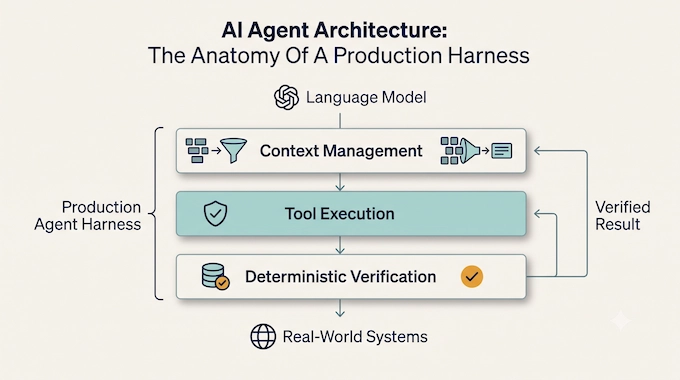
Once you accept that the harness carries real weight, the next question is what a production-grade one is actually made of. Good AI agent architecture comes down to two things: how you manage what the model sees, and how you verify what it did.
3.1 Context Management And Offloading
The default, naive approach to building an agent is to append every tool output, every observation, and every intermediate thought to a single growing prompt. It works for a few turns. Then it doesn’t.
This is what researchers call context rot: as the transcript grows, the prompt drifts further from anything resembling the model’s training distribution, and reasoning quality degrades even though there’s technically still room in the context window. The fix that’s gaining traction across serious harness designs is context offloading. Instead of stuffing a huge tool output directly into the conversation, the harness stores it in an external variable, often inside a code REPL, and only passes a summary or a reference back to the model. The model can still query that data when it needs to, but it isn’t forced to read all of it on every single turn.
Microsoft’s Agent Framework implements a version of this through what it calls compaction: once you configure a maximum context window and output size, the harness automatically compacts long tool-calling histories so they don’t overflow, and it persists chat history after every model call so a crashed session can recover mid-run instead of starting over.
3.2 Tool Execution And Deterministic Verification
The second architectural pillar is separating what the model proposes from what actually gets executed. An agent harness should never simply trust the model’s claim that a task succeeded. It should verify against the system of record, the actual database, the actual file, the actual API response, rather than the model’s self-report.
This is also where permissioning lives. A well-built harness gates risky actions, like shell commands, behind approval logic. Worth noting: even in mature implementations, a deny-list of dangerous commands is treated as a UX pre-filter, not a real security boundary. If your harness is exposing shell access or file writes to an agent, the verification layer needs to assume the model can be wrong, confidently, and often.
Here’s how the major approaches to agent harness architecture compare in practice:
Agent Harness Approaches Compared: Scaffolds, Frameworks, and Lean Alternatives
| Approach | Context Strategy | Best Fit | Main Tradeoff |
|---|---|---|---|
| Claude Code / Codex-style scaffolds | Appends tool output and history to a growing prompt | Fast prototyping, short interactive sessions | Context rot on long-running tasks |
| LangChain / heavy orchestration frameworks | Config-driven chains, memory modules, many integrations | Teams standardizing across many tools and providers | Framework overhead, large boilerplate system prompts |
| Microsoft Agent Framework (HarnessAgent) | Token-budget compaction, todo and mode providers, approval gating | Production apps that want batteries-included reliability | Ties your architecture to its provider model |
| Recursive Language Model (RLM) harness | Context offloading to sub-calls via REPL variables | Long-horizon, cross-domain generalization | 1.5 to 3x more training and runtime overhead |
| Lean / custom harnesses (e.g. Pi) | Minimal system prompt, hand-rolled loop | Local development, engineers who want full control | You own all the reliability engineering yourself |
4. Agent Harness Engineering: Solving The Reliability Problem
Getting an agent to work in a demo is easy. Getting it to work reliably, unattended, across thousands of runs, is a different discipline entirely. This is where agent harness engineering earns its keep.
4.1 Idempotency And State Management
A classic bug class in agentic systems is the TOCTOU problem, time-of-check to time-of-use. The model checks a condition, decides an action is safe, and then by the time the action actually executes, the underlying state has changed. Maybe another process already modified the file. Maybe the record the agent was about to update no longer exists.
The fix is architectural, not clever prompting. Checks need to happen at commit time, right before the action executes, not back when the model first proposed it. This usually means designing tools to be idempotent wherever possible, so that if an action does get retried, running it twice doesn’t produce a different or broken outcome.
4.2 Fixing The “Retry Loop Of Death”
Anyone who’s run an agent unattended has seen this: something fails, the harness retries, it fails again, it retries again, and ten minutes later you’ve burned a meaningful chunk of your token budget on an action that was never going to succeed. Naive “retry N times” logic treats every failure the same way, and that’s the core mistake.
A better-engineered harness distinguishes between failure types before deciding what to do next. A network timeout is transient and worth a retry, maybe with backoff. A malformed API call or a logical error in the agent’s own generated code is not going to fix itself by trying again unchanged. It needs a different action, not a repeat of the same one. Building even a simple classifier into your loop control, one that routes transient errors to retry logic and logical errors to re-planning, eliminates a huge share of the wasted cycles that plague production agents.
5. The MIT Breakthrough: Harnesses As Compositional Generalizers
In July 2026, MIT CSAIL researchers Alex Zhang and Omar Khattab published a paper that reframes the harness conversation entirely. Their argument: the biggest unsolved problem in scaling AI isn’t raw model capability, it’s compositional generalization, the ability to solve unfamiliar problems by combining familiar building blocks. And they show that this capacity largely lives in the harness, not the underlying neural network.
Their reasoning starts from an uncomfortable observation. Modern post-training throws more environments and longer training horizons at models to cover more ground, but this is expensive precisely because Transformers are unreliable at generalizing what they learn across tasks that look different on the surface but share the same underlying structure. Every new domain ends up needing its own dedicated training investment.
The researchers’ proposed fix is to design harnesses that keep every individual call to the model “locally in-distribution,” meaning each observation the model actually sees looks like something it was trained on, even when the overall task is completely novel. A good harness, in their framing, reduces an unfamiliar, complex problem down to a sequence of familiar, simple ones for the model to handle one at a time.
6. Recursive Language Models Vs Traditional Scaffolding
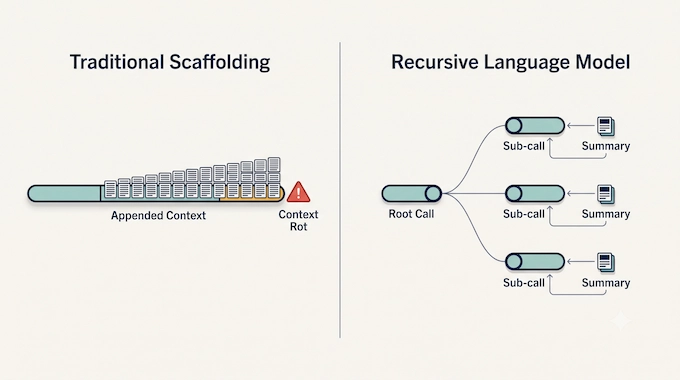
To test this, the MIT team built what they call a Recursive Language Model, or RLM: a harness where the model offloads large chunks of context into external variables and defers execution to programmatic sub-calls rather than reading everything itself. The results were striking. Training an RLM’s root model on only short tasks let it generalize to held-out tasks 8 to 32 times longer, with roughly ten times the evaluation lift compared to training a base Transformer directly on the same data. Training on one domain also transferred to entirely different domains far more effectively than it did for a standard model.
The mechanism behind this is what the researchers call an induced equivalence class. Because the RLM harness offloads task-specific details to sub-calls and only lets the root model see the decomposition strategy, two superficially different tasks, say a graph-traversal problem and a document-search problem, can end up producing nearly identical token trajectories in the model’s main context. If the harness has already seen how to solve one, it can treat the other as functionally the same problem.
It’s not free. The researchers note that RLM training runs 1.5 to 3 times longer than training a base Transformer on comparable tasks, due to the overhead of multiple steps and waiting on sub-calls. But that cost scales far better than the alternative: training a standard agent on genuinely long-horizon tasks quickly becomes impractical due to context bloat, even on serious hardware.
7. Agent Harness Vs LangChain: Choosing The Right Software
For a lot of teams, the practical decision isn’t “should I build a harness,” it’s “should I use a heavy orchestration framework or build something leaner myself.” LangChain and similar frameworks offer a lot out of the box: chains, memory abstractions, a large ecosystem of integrations. That’s genuinely useful if you’re standardizing agent behavior across a big team or a wide range of tools.
The tradeoff shows up in production. Senior engineers building reliability-critical systems have increasingly pushed back on framework bloat, heavy abstraction layers, system prompts that balloon to thousands of tokens before the actual task even begins, and debugging that requires stepping through several layers of framework code to find where an agent actually went wrong. None of that is a knock on LangChain specifically. It’s a reminder that more abstraction means more distance between you and the actual behavior of your agent harness, and that distance has a cost when something breaks at 2am.
8. Lean Harnesses: Why Developers Are Switching To Pi Agent Harness And Custom Scripts
There’s a visible trend, especially in developer communities, toward stripping agent harnesses back down. Tools like the Pi coding agent have gained a following for exactly this reason: a lean agent harness that doesn’t re-send a bloated 14,000-token system prompt on every single turn, doesn’t carry unnecessary orchestration layers, and gives the developer direct visibility into what’s actually happening in the loop.
For local development in particular, this pays off in wall-clock time and in cost. Every unnecessary token in a system prompt gets billed and processed on every turn of every session. A harness that keeps its footprint small runs faster and cheaper, and it’s a lot easier to reason about when something goes wrong, since there are fewer layers between the developer and the actual model call.
This doesn’t mean lean is always right. A five-person team shipping a customer-facing product with compliance requirements probably wants the guardrails a framework like LangChain or Microsoft’s Agent Framework provides. But for engineers building and debugging agents themselves, the pull toward smaller, more legible harnesses is a real signal about where the field’s practical instincts are heading, even as the research points toward more sophisticated context management underneath.
9. Conclusion: The True Secret To Building AI Agents
If there’s one idea worth taking away from all of this, it’s that building AI agents is mostly a software engineering problem wearing an AI costume. The model matters, but chasing the newest frontier release while ignoring your agent harness is optimizing the wrong variable. The MIT research makes the case at the deepest level: the capacity for generalization itself increasingly lives in how you structure context, decompose tasks, and manage state, not just in the number of parameters underneath.
The practical version of that lesson is simpler. Before your next model upgrade, look at your context management, your verification logic, and your retry behavior. That’s usually where the real reliability gains are sitting, and it’s the difference between an agent that demos well and one that survives contact with production.
If you’re building or evaluating agent systems and want more breakdowns like this, that’s exactly the kind of thing we cover regularly at Binary Verse AI. Explore more of our AI architecture and tooling coverage to stay ahead of how these systems are actually built, not just how they’re marketed.
What is an agent harness in AI?
Answer: An AI agent harness is the software infrastructure surrounding a Large Language Model (LLM) that turns a passive text generator into an autonomous worker. The harness manages the agent’s memory, provides sandboxed environments to execute tools, and runs the ReAct (Reason-Act-Observe) loop to keep the model on track.
Why is it called an agent harness?
Answer: It is called a “harness” because it straps the LLM into a controlled framework. Just like a physical harness restricts and directs movement, a software agent harness restricts the model from endless hallucinations, giving it a structured environment (APIs, memory limits, and safety guardrails) to execute real-world tasks safely.
What is the difference between an agent harness and an AI runtime?
Answer: An AI runtime is the low-level engine that executes the model’s weights and computes the tokens (like vLLM or llama.cpp). The agent harness is the higher-level orchestration layer sitting above the runtime. It takes the tokens generated by the runtime, parses them into tool commands, executes those commands, and feeds the results back to the model.
Is Claude Code or LangChain an agent harness?
Answer: Yes, Claude Code is a proprietary agent harness built by Anthropic specifically for software engineering. LangChain is an open-source framework that allows developers to build their own agent harnesses, though many developers today prefer leaner, custom-built harnesses to avoid framework bloat and context window rot.
How do agent harnesses improve compositional generalization?
Answer: According to recent MIT CSAIL research, well-designed harnesses act as “compositional generalizers.” By using context offloading and programmatic sub-agents, a harness can break down a complex, unseen task into a series of smaller, familiar steps. This ensures that every prompt the LLM sees is “locally in-distribution,” drastically improving the model’s reliability without requiring fine-tuning.