
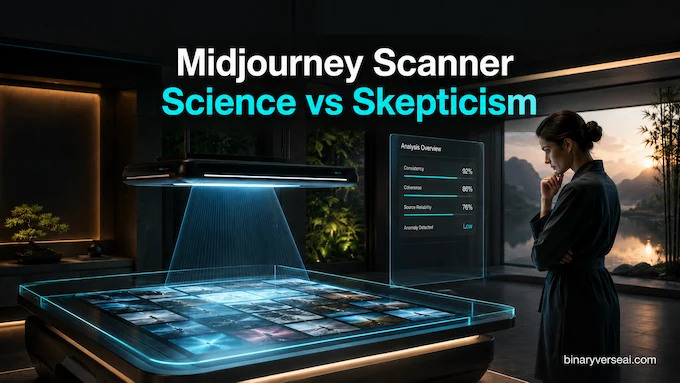
An AI image company just walked into healthcare wearing a spa robe and carrying a medical scanner. Naturally, the internet reacted with the emotional range of a group chat during a fire drill: awe, suspicion, memes, and a lot of “please do not Theranos this.”
The Midjourney Scanner is real enough to deserve serious attention, but not proven enough to deserve blind trust. Midjourney Medical describes it as a 60-second, full-body ultrasound system that lowers a person through water while a ring of sensors sends sound waves through the body. The company calls the technology “Ultrasonic CT” and frames it as a future alternative to medical imaging, minus the magnets, radiation, and hospital atmosphere.
That is the dream. The clinical question is sharper: can a wellness-first whole body ultrasound system produce medically useful images without drowning patients in false alarms, regulatory ambiguity, and pretty segmentation maps that outrun the evidence?
Table of Contents
1. What The Midjourney Scanner Actually Claims
Midjourney’s announcement is not shy. The company wants medical imaging to feel less like an appointment with a machine and more like a weekly spa visit. Its first San Francisco location is planned for the end of 2027, according to the Midjourney Medical page, with a long-term ambition of 50,000 scanners and a billion monthly scans.
Midjourney Scanner
| Question | Midjourney’s Claim | Careful Reading |
|---|---|---|
| What is it? | A full-body ultrasound system called Ultrasonic CT | A new consumer-facing imaging concept built around ultrasound tomography |
| How does it scan? | A person descends through water while a sensor ring sends and receives ultrasound waves | Water coupling is scientifically sensible because ultrasound hates air gaps |
| How fast is it? | As little as 60 seconds | The product target is not the same as peer-reviewed clinical validation |
| What does it output? | 3D body maps and AI segmentation | Useful if accurate, risky if users treat wellness maps as diagnoses |
| Is it diagnostic? | Midjourney says it will start with body composition maps | Diagnostic claims usually need FDA clearance or approval |
| What is the hardware? | A ring of ultrasound-on-chip modules | Butterfly says the current prototype uses 40 Butterfly modules |
| What is the evidence base? | Related ultrasound tomography research exists | The strongest public paper is Caltech research, not a finished Midjourney clinical trial |
Midjourney Scanner vs MRI, CT, and Ultrasound
| Modality | Best At | Main Tradeoff | Radiation | Clinical Maturity | Consumer Screening Fit |
|---|---|---|---|---|---|
| Midjourney Scanner | Fast, repeated soft-tissue and body-composition mapping if validated | Prototype-stage claims, unclear clinical accuracy | No ionizing radiation | Early | Unproven |
| Whole Body Ultrasound / UST | Soft tissue, tissue stiffness, longitudinal monitoring | Bone, air, and deep-tissue artifacts | No ionizing radiation | Research to emerging | Promising but limited |
| MRI | High soft-tissue contrast, brain, joints, oncology workups | Slow, expensive, magnets, access limits | No ionizing radiation | Established | Debated for healthy people |
| CT | Fast, high-resolution anatomy, trauma, lungs, bone | Ionizing radiation | Yes | Established | Poor fit for casual screening |
| Handheld Ultrasound | Bedside imaging, fetal scans, soft tissue, blood flow | Operator dependent, narrow field of view | No ionizing radiation | Established | Good for targeted exams |
The key distinction is simple. The Midjourney Scanner is not magic. It is an aggressive productization of ultrasound tomography, sensor hardware, reconstruction algorithms, and AI in medical imaging. The magic is in whether those pieces can survive contact with clinical reality.
2. Midjourney MRI Is The Wrong Comparison
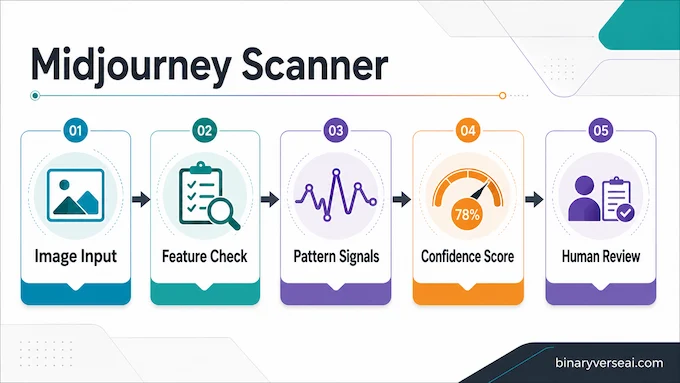
People searching for “Midjourney MRI” are asking the right question with the wrong noun. MRI and ultrasonic CT do not see the body in the same way.
MRI uses strong magnetic fields and radiofrequency pulses to measure signals related to hydrogen nuclei in tissue. It is excellent for soft tissue contrast, neurological imaging, tumors, joints, and many areas where anatomy and chemistry matter. It is also expensive, loud, slow, and unpleasant for some patients.
Ultrasonic CT, by contrast, uses sound. Waves move through tissue, change shape as they pass through structures with different stiffness and density, then return as measurable signals. From those signals, software reconstructs images and quantitative maps such as speed of sound and attenuation.
That difference matters. A Midjourney medical scanner might become useful for body composition, soft-tissue tracking, and repeated monitoring. It should not be described as an MRI replacement until data show where it equals MRI, where it loses, and where it produces clinically misleading images. Marketing likes simple substitutions. Medicine prefers boring validation, which is why medicine occasionally survives.
3. The Science Behind Ultrasonic CT Is Real

The strongest reason not to dismiss the Midjourney Scanner as pure vaporware is that the underlying science exists. In April 2026, Caltech researchers published “Whole cross-sectional human ultrasound tomography” in Nature Biomedical Engineering, indexed on PubMed. The team built a 512-element circular ultrasound receiver array with a rotating transmitter and demonstrated imaging of human abdomens and thighs.
Caltech’s public summary says the system scanned five healthy volunteers’ abdomens for 10 seconds at a time. It generated images similar in appearance to MRI for some regions, while also measuring transmission signals, speed of sound, and attenuation. The paper describes two promising applications: adipose tissue assessment without radiation or compression, and video-rate biopsy needle localization.
That is serious work. It also has boundaries. The study is not a population-scale screening trial. It is not proof that monthly whole body ultrasound scans reduce mortality. It does not prove that a spa-based scanner can safely triage healthy consumers. It shows that whole cross-sectional ultrasound tomography can image meaningful human anatomy and may fill gaps that conventional handheld ultrasound leaves open.
That is enough to be excited. It is not enough to retire the radiology department.
4. The Physics Barrier Is Not A Minor Footnote
Ultrasound is wonderful because it is safe, cheap, and dynamic. It is also stubborn. Sound waves do not pass through every part of the body with equal grace.
Bone is a major problem. Dense structures create shadowing and transmission barriers. That limits brain and spinal imaging, unless future systems solve hard acoustic reconstruction problems that conventional ultrasound still struggles with.
Air is the other villain. Ultrasound couples well through water and gel, which is why standard ultrasound exams use gel on the skin. Air pockets in the bowel and lungs create large acoustic impedance mismatches. In plain English, the sound waves hit air and the party gets weird. This makes abdominal and chest interpretation much harder.
The Caltech paper explicitly discusses bone and air as historical barriers to human-scale ultrasound tomography. The researchers try to reduce those issues with full 360-degree viewing angles, but “reduced” is not “eliminated.” Any claim that a Midjourney medical scanner can casually image the entire body needs to answer these physics questions with data, not vibes.
5. Why An AI Company Is Building Medical Hardware
At first glance, Midjourney moving from image generation to a medical spa sounds like a category error. But the connection is less strange when you look at the computational problem.
Ultrasound tomography is an inverse problem. The scanner does not simply “take a picture.” It records enormous streams of wave behavior, then software reconstructs anatomy from how those waves changed while passing through the body. Midjourney says the device produces terabytes of data per second. Butterfly Network says the prototype involves about half a million sensors and over two petaflops of processing power, according to its June 2026 statement.
This is where AI in medical imaging becomes relevant. The scanner needs reconstruction, segmentation, artifact handling, longitudinal comparison, and probably quality control at scale. Midjourney’s core competence is not radiology. It is turning messy signals into convincing images. That can be useful, but it is also exactly why skepticism is healthy. A beautiful reconstruction is not automatically a truthful one.
Medical imaging does not reward visual confidence alone. It rewards calibrated accuracy, known failure modes, reproducibility, and clinical outcomes.
6. The Butterfly Network Hardware Backbone
The hardware partner gives the project more credibility than a glossy concept video would have on its own. Butterfly Network says the current prototype includes 40 Butterfly Ultrasound-on-Chip imaging modules per system, licensed under a co-development agreement. It also says future versions are expected to use more modules.
This matters because semiconductor ultrasound can scale differently from traditional piezoelectric crystal systems. Butterfly’s existing products already use ultrasound-on-chip technology in portable probes. Midjourney is trying to arrange many such sensing elements into a ring that images the body from multiple angles as the patient moves through water.
Still, a working component is not the same as a clinically validated system. The device must handle body variation, motion, hygiene, throughput, signal quality, reconstruction time, and interpretation. Medical hardware is where beautiful prototypes go to meet procurement committees, infection-control teams, reimbursement policy, and the FDA. It is a humbling ecosystem.
7. The Spa Strategy And The FDA Question
Midjourney says it will begin by offering body composition maps, while submitting test results to the FDA for increased capabilities. That phrasing is important.
The FDA’s General Wellness guidance explains that certain low-risk products aimed at maintaining or encouraging a healthy lifestyle may fall outside device regulation or receive enforcement discretion, provided they are unrelated to diagnosis, cure, mitigation, prevention, or treatment of disease.
That is the narrow bridge Midjourney appears to be walking. Body composition mapping sounds wellness-adjacent. Diagnosing tumors, liver disease, aneurysms, or soft-tissue tears is a different world.
The “Midjourney Spa” idea is clever because it makes repeated scanning feel normal. It is also controversial for exactly that reason. If the product is framed as a pleasant bath with bonus anatomy maps, consumers may treat uncertain findings as medical truths. If it becomes diagnostic, it needs the clinical validation and regulatory clearance that medicine demands.
This is not a loophole to admire blindly. It is a product strategy to watch carefully.
8. Incidentalomas Are The Real Clinical Trap
The biggest danger is not that the scanner sees nothing. The bigger danger may be that it sees too much, too often, without enough clinical context.
An incidentaloma is an unexpected finding discovered during imaging done for another reason. The American College of Radiology notes that increased cross-sectional imaging has led to more incidental findings, many of which are unlikely to pose health risks, but can still cause over-testing and over-treatment. The ACR has also said there is not enough evidence to recommend total-body MRI screening for healthy people without symptoms, risk factors, or family history.
A monthly whole body ultrasound habit could amplify this problem. Scan enough healthy people often enough and you will find shadows, cysts, asymmetries, nodules, fluid pockets, odd textures, and things that look ominous until a specialist spends two weeks proving they are boring.
Boring is wonderful in medicine. Boring is also expensive to prove.
This is where Midjourney must be extremely careful. A consumer scanner should not turn every body into a mystery novel. If the output is wellness data, it needs clear boundaries. If the output becomes clinical, it needs clinical-grade reporting, referral pathways, and evidence-based follow-up rules.
9. Whole Body Ultrasound Cost And Access
The strongest case for the Midjourney Scanner is access. MRI capacity is limited. CT uses radiation. Traditional ultrasound is operator dependent. A fast, automated, radiation-free whole body ultrasound platform could become useful if it produces reliable, interpretable, repeatable data.
The cost story is not settled. Midjourney talks about cheap, frequent scanning. Butterfly frames the technology as low cost and accessible. Caltech’s paper suggests its research system used relatively low material and equipment cost compared with many imaging modalities. But a spa with ten scanners, massive compute, water systems, staff, cleaning protocols, insurance, data storage, clinical oversight, and regulatory work is not exactly a lemonade stand.
Affordability will depend on more than sensors. It will depend on throughput, reimbursement, liability, scan interpretation, cloud compute, maintenance, and whether the system is sold as wellness, medical screening, or both.
The hopeful version is a cheap longitudinal body map that helps track fat distribution, muscle change, and clinically relevant soft-tissue trends. The darker version is a high-margin anxiety engine with warm lighting.
10. Water Tanks, Hygiene, And Real-World Operations
The water tank is not just theatrical. It solves a physics problem by removing air gaps between body and sensor field. But it creates operational questions that hospitals and spas cannot hand-wave away.
How is the water filtered between users? What happens with skin infections, open wounds, fungal conditions, incontinence, medical devices, mobility limitations, or immunocompromised customers? How does the system maintain acoustic quality while meeting hygiene standards? How do users with obesity, disability, claustrophobia, or trauma histories experience the scan?
Caltech’s team has already imagined future versions beyond an immersion tank, including a horizontal bed with a thin water pouch and conductive gel. That direction may be more clinically practical than a spa pool. Midjourney’s consumer version may be more approachable, but every approachable medical-ish product inherits the boring details of real bodies.
Bodies are not demo users. They leak, scar, move, panic, heal, age, and surprise you.
11. Is The Midjourney Scanner A Gimmick Or The Future?
The honest answer is both possible.
The Midjourney Scanner could become a serious step toward routine, radiation-free, longitudinal imaging. The underlying ultrasonic CT science is credible. The hardware partnership with Butterfly gives the project a real engineering base. The ambition to make body data cheaper and more frequent is not foolish. Preventive healthcare does need better tools.
But the current public story is still ahead of the evidence. The scanner is not yet a validated replacement for MRI. It is not a proven cancer-screening platform. It has physics limits around bone, air, and deep tissue. It faces FDA constraints if it moves beyond wellness mapping. It risks overdiagnosis if consumers treat every visual anomaly as a warning siren.
That is the clinical verdict: promising machine, immature evidence, high-stakes rollout.
For now, the right posture is neither hype nor mockery. Watch the trials. Ask for peer-reviewed data. Ask what the device misses, not only what it sees. Ask how often false positives happen. Ask who reads the scans. Ask how findings are escalated. Ask whether the system improves outcomes, not just whether the images look impressive.
If Midjourney can answer those questions, this could become one of the strangest and most important pivots in AI hardware. If it cannot, the Midjourney Scanner will be remembered as a beautiful idea that confused body awareness with medicine.
Binary Verse AI will keep tracking the intersection of AI, medical imaging, and real-world evidence, because the future should be exciting, but it should also survive peer review.
What is the Midjourney Scanner and how does it work?
The Midjourney Scanner is a proposed full-body ultrasound imaging system that Midjourney calls Ultrasonic CT. A person descends into water through a ring of underwater sensors, which send sound waves through the body from many angles. Software then reconstructs the acoustic data into 3D body maps and AI-assisted segmentations of internal anatomy.
Is the Midjourney Scanner an MRI replacement?
No. The Midjourney Scanner is not a proven MRI replacement. MRI uses magnetic fields and radiofrequency signals to image soft tissue, water content, and chemical differences. Ultrasonic CT uses sound waves, which makes it promising for soft tissue and body-composition mapping, but limited around bone, lungs, bowel gas, and other air-filled structures.
Why is Midjourney launching a spa instead of putting scanners in hospitals?
Midjourney’s spa strategy appears to position the scanner first as a wellness and body-composition service rather than a diagnostic medical device. That lets the company test operations, collect real-world scan data, and improve the system while pursuing FDA clearance for broader medical capabilities later. It is a product strategy, but also a regulatory tightrope.
Are there hygiene risks with a water-immersion ultrasound scanner?
Yes, water immersion creates real hygiene and operations questions. A scanner used by many people would need strict water filtration, disinfection, skin-safety rules, wound policies, privacy controls, and emergency procedures. Future clinical versions may use sealed water membranes, sterile circulation systems, or hydrogel-based coupling to reduce contamination risk.
Will routine whole-body ultrasound scans cause incidentalomas?
Routine whole-body scanning can increase incidentalomas, which are unexpected findings discovered during imaging for another reason. Some may be important, but many are harmless cysts, nodules, asymmetries, or artifacts. Without careful reporting rules and clinical follow-up protocols, frequent scans could create anxiety, extra testing, unnecessary biopsies, and overdiagnosis.