
OpenAI claims a positive answer to the unitary synthesis problem: a quantum computer can approximate any quantum unitary efficiently when supplied with a suitably chosen classical Boolean oracle. The qualification belongs in the opening sentence. The paper does not show how to construct that oracle efficiently.
That still makes this a striking claim. The problem asks whether the difficulty of performing an arbitrary quantum operation can be reduced to accessing classical information. Researchers had evidence against simple solutions, and Scott Aaronson, who posed the question with Greg Kuperberg, describes the positive answer as contrary to what most expected.
The October 5, 2026 manuscript, Polynomial-Time Unitary Synthesis from a Boolean Oracle, offers more than a surprising yes. Its argument tackles two stubborn obstacles: preserving quantum coherence while removing unwanted information, and keeping a recursive construction from becoming exponentially expensive. Understanding those steps reveals both the result’s significance and its boundaries.
Table of Contents
1. What Is the Unitary Synthesis Problem?
A unitary operation is a reversible transformation of a quantum state. Its matrix satisfies
[ U^\dagger U=I, ]
where (U^\dagger) is the conjugate transpose and (I) is the identity matrix. This condition preserves the state’s total probability and the inner products between states.
The Hadamard gate provides a small example. It turns a qubit in state (|0\rangle) into an equal superposition of (|0\rangle) and (|1\rangle). Applying it again returns the original state.
Unitary synthesis means building a circuit that performs a specified transformation. Checking a matrix’s unitary condition is a different task, much like checking that a recipe is valid differs from cooking dinner.
Unitary Synthesis Problem: Key Facts and Limits
| Key Fact | What It Means |
|---|---|
| Target | Any unitary operation on n qubits, acting on arbitrary inputs. |
| Claimed Answer | Positive for the constant-error oracle formulation. |
| Quantum Resources | Polynomial gates, qubits, oracle calls, and query length. |
| Information Source | One Boolean oracle chosen for the target unitary. |
| Accuracy | Full diamond-norm channel error at most 1/2. |
| Main Limitation | Efficient oracle construction is not supplied. |
2. The Aaronson–Kuperberg Question and Classical Oracle Access
The Aaronson–Kuperberg unitary synthesis question appeared in their 2007 work. It asks whether a fixed efficient quantum procedure can implement every target unitary when the classical oracle changes to match that target.
An oracle is an idealized interface to a function. Here, the function accepts a binary string and returns one bit. The quantum computer queries it coherently:
[ O_f|x,b\rangle=|x,b\oplus f(x)\rangle. ]
The symbol (\oplus) means XOR. This operation also works on superpositions of addresses, preserving their quantum relationships. It isn’t an ordinary server returning a measured answer.
Unitary Synthesis Problem: Resource Bounds and Oracle Limits
| Resource or Property | Counted or Guaranteed? | Why Readers Should Care |
|---|---|---|
| Elementary Gates | Polynomially bounded | Bounds computation between queries. |
| Working Qubits | Polynomially bounded | Avoids hiding exponential space. |
| Oracle Calls and Address Length | Polynomially bounded | Controls access frequency and interface width. |
| Oracle Truth-Table Complexity | Unrestricted | The supplied information can remain expensive. |
| Efficient Oracle Generation | Not established | Limits practical deployment claims. |
The unitary synthesis problem therefore separates the cost of using classical information from the cost of producing it. A developer can think of a fixed interpreter reading different programs, provided the analogy retains the unusual power of coherent oracle access.
3. Why Quantum State Synthesis Is Not Enough
Quantum state synthesis prepares one chosen state from a fixed starting state. Unitary synthesis must work on every possible input, including an unknown superposition entangled with another system.
Why not prepare the output corresponding to each input label? Suppose a circuit produces
[ |i\rangle|0\rangle\longmapsto |i\rangle U|i\rangle. ]
For a superposition, the result retains the input labels alongside the intended output. Those labels can remain entangled with it. Discarding them can destroy the interference required for the transformation.
The register cannot simply be deleted. The information must be removed coherently, through a valid reversible process that preserves the desired output.
Gate teleportation offers another tempting route. Prepare a resource state representing the operation, then teleport the input through it. For an arbitrary unitary, however, the required corrections can become difficult operations themselves. Accepting only the outcome with no correction has exponentially small probability.
This is the first major lesson: having all the right output states available does not automatically give an efficient machine that transforms arbitrary inputs into them.
4. The Previous Barrier: Exponential Costs and Lower Bounds
An operation on (n) qubits acts in a space of dimension (2^n). A general unitary matrix therefore contains exponentially many entries. Universal quantum gates can approximate such operations, but universality alone offers no polynomial-size implementation of every unitary.
Before this manuscript, Gregory Rosenthal’s oracle-based upper bound required roughly (2^{n/2}) time, apart from polynomial factors. It improved the landscape while retaining exponential growth.
Alex Lombardi, Fermi Ma, and John Wright proved unitary synthesis lower bounds for algorithms making one oracle query. Their result also excludes polynomially many parallel queries of polynomial length. These are restrictions on access patterns, not a prohibition on every possible sequence of queries.
Other constructions achieved impressive query or depth bounds by allowing exponential ancillary resources. Counting only calls or layers could therefore make an expensive circuit look deceptively modest.
The unitary synthesis problem requires the resources to behave well together. A circuit with few queries and an enormous workspace has not cleared the same barrier as one with polynomial total resources.
5. What OpenAI’s Unitary Synthesis Paper Actually Claims
The theorem gives a deterministic classical generator that receives the qubit count and produces a quantum oracle circuit in polynomial time. That circuit’s structure is independent of the target unitary.
For every target (U), an appropriate Boolean function can then be selected so the circuit approximates the channel (\mathcal U(\rho)=U\rho U^\dagger). The allowed elementary gates are Hadamard, (T), (T^\dagger), and CNOT, alongside oracle calls.
The order of those statements matters. The circuit is generated first from (n) alone. The target-specific choices live in the oracle. The theorem does not assume a custom circuit generator that efficiently reads every entry of a huge matrix.
The error guarantee is
[ |\Phi-\mathcal U|_\diamond\leq\frac12. ]
Diamond norm compares the implemented and ideal channels under their most demanding inputs, including inputs entangled with a reference system. The paper uses the full norm, without an extra factor of one-half.
This is not a claim that the operation succeeds half the time. It is a bound on channel discrepancy. Constant error also should not be silently rewritten as exact synthesis or an unrestricted accuracy guarantee.
6. The Boolean Oracle and the Missing Construction Cost
The OpenAI unitary synthesis argument encodes target-dependent choices into one Boolean function. Those choices include finite descriptions of gates used by a programmable circuit structure.
A query address identifies information such as the programmable slot, its control values, and a position in a stored gate word. The circuit retrieves the relevant bits coherently, applies the selected operation, and clears the lookup workspace.
Short addresses do not imply a short truth table. A function accepting (m) bits can have (2^m) possible inputs. Polynomial address length therefore leaves room for an enormous classical description and a function with high circuit complexity.
That explains why the unitary synthesis Boolean oracle assumption is consequential. The paper establishes that an admissible encoding exists. It does not provide an efficient classical compiler that takes an arbitrary unitary and builds the required oracle.
The result addresses an abstract reduction question. Turning it into a useful implementation would require tractable target families, a way to supply their oracle, and realistic resource estimates.
The oracle assumption does not make the answer automatic. Even with unrestricted classical information available, the quantum circuit must access it through a narrow Boolean interface while preserving an unknown input. Earlier lower bounds show that a sufficiently rich description alone does not remove the restrictions imposed by how the circuit queries it.
7. The New Argument: Contracting Blocks and Feedback
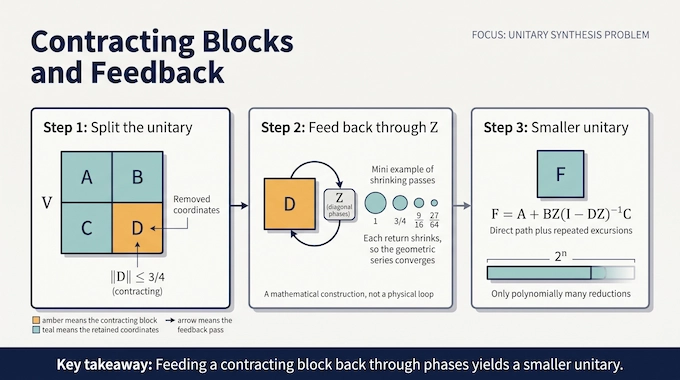
The proof begins by changing bases using permutations, diagonal signs, and Walsh–Hadamard transforms. It arranges the current unitary into blocks:
[ V=\begin{pmatrix}A&B\C&D\end{pmatrix}, \qquad |D|\leq\frac34. ]
The block (D) corresponds to coordinates that will be removed from the smaller synthesis task. Its contracting norm is essential. Repeated passages through it shrink, allowing a geometric series to converge.
Choose a diagonal unitary (Z) on those internal coordinates. Feeding their output back through (Z) produces an effective transformation on the remaining coordinates:
[ F=A+BZ(I-DZ)^{-1}C. ]
The first term describes direct passage through the retained coordinates. The second collects excursions through the internal part, including repeated returns. Conservation of norm establishes that (F) is unitary on the smaller space.
This feedback is a mathematical construction, not an instruction to wire a quantum circuit into a physical loop. The proof still needs encodings that translate the identity into executable operations.
Each reduction removes at least an inverse-polynomial fraction of the dimension. Even starting at (2^n), only polynomially many reductions are needed.
8. How Fourier Encodings Remove the Input Labels
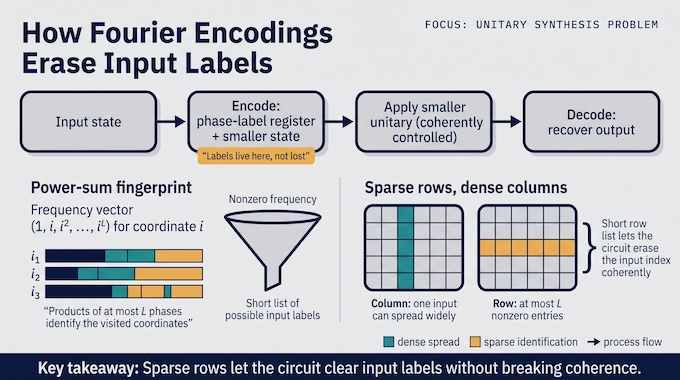
Reducing the dimension raises an obvious concern: where does the information in the removed coordinates go?
It is carried by a larger encoding space containing a phase-label register and a smaller quantum state. The input is encoded, the smaller unitary is applied under coherent control, and a matching decoding recovers the desired output.
The construction uses truncated geometric expansions for forward and backward encodings. Averaging phases removes unwanted cross terms, while unitarity makes the remaining terms cancel in a controlled way. The resulting maps almost preserve lengths and inner products.
The clever bookkeeping assigns each internal coordinate (i) a frequency vector based on
[ (1,i,i^2,\ldots,i^L). ]
For products involving at most (L) phases, these power sums identify the multiset of visited coordinates. A nonzero Fourier frequency therefore restricts the possible input labels to a short list.
The encoding matrices have at most (L) nonzero entries per row, even though their columns can be dense. This sparsity lets the circuit erase the retained input index coherently. Amplitude amplification then promotes a scaled implementation into the required approximate encoding.
The argument turns a dense transformation into structured encodings rather than assuming the original unitary is sparse.
Rows and columns matter differently here. A column describes where one input can spread, potentially across many outputs. A row identifies which inputs can contribute to one encoded output. Restricting that second list supplies exactly the information needed to clear the input register.
9. Why One Recursive Call Keeps the Resources Polynomial
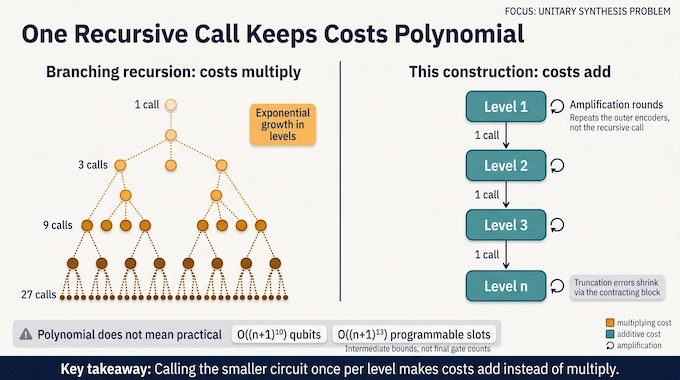
Recursion is easy to propose and expensive to control. If every reduction invokes its smaller synthesis routine several times, the resulting circuit can grow exponentially with the number of levels.
Here, each level uses the smaller circuit exactly once. The outer encoding circuits perform their own amplification rounds, but those repetitions do not repeat the recursive call.
This distinction is central to polynomial-time unitary synthesis. The costs of successive levels add instead of multiplying through a branching recursion. The contracting block also makes truncation errors shrink rapidly enough to control their accumulation.
The manuscript then replaces programmable gates with finite words over the fixed elementary gate set. Their descriptions are stored in the Boolean oracle. This compilation preserves relative phases between coherent control branches, where ignoring a seemingly harmless scalar phase would change the operation.
Polynomial does not mean practical. One intermediate construction uses (O((n+1)^{10})) qubits and (O((n+1)^{13})) programmable slots. Those are intermediate bounds, not final elementary-gate counts, but they show why a theoretical efficiency result should not be mistaken for a ready-to-run compiler.
10. Why Random-Oracle Unitary Synthesis Can Still Be Impossible
An almost simultaneous paper, Random-Oracle Unitary Synthesis Is Impossible, by Andrew Huang, Akshar Ramkumar, and John Wright, sounds like a contradiction waiting to happen.
Its model imposes a different requirement. The oracle is uniformly random, and the algorithm must produce an approximation to a Haar-random unitary under an appropriate coupling. The paper proves a superpolynomial query lower bound for that task.
OpenAI’s argument allows a function deliberately chosen for each target. It may contain elaborate structure selected to support the encoding. It need not resemble a uniformly random function.
Random-oracle unitary synthesis and target-dependent oracle synthesis therefore ask different questions. Existence of carefully selected working oracles says nothing about whether a random oracle supplies one with sufficient probability.
The earlier one-query lower bounds remain compatible for another reason: the new construction uses multiple oracle queries interleaved with quantum computation. A single batch of parallel access cannot reproduce that entire sequence.
The apparent contradiction disappears once the access model and resource restrictions are stated. Those details carry the mathematics.
11. Verification, Cryptography, and Unresolved Questions
As of October 9, 2026, OpenAI’s published catalogue lists this as result family 283 without an accompanying Lean formalization link. Formal certificates provided for other results cannot be transferred to this theorem by association.
Expert interest also differs from completed verification. In her October 8 essay, Classical at Heart, cryptographer Dakshita Khurana describes working through the manuscript. She recognizes ideas she explored herself, including recursive implementation and sparse-row almost-isometries, while discussing consequences conditionally.
A full assessment must check the contracting-block estimate, Fourier support argument, coherent encoders, recursion costs, and phase-sensitive compilation. It must also confirm that the assembled channel guarantee follows from those components.
If the argument holds, it would sharpen the relationship between quantum cryptographic hardness and classical computational hardness. Khurana’s interpretation places the relevant hardness inside a classical problem. That does not imply quantum and classical cryptography need identical assumptions or equal amounts of hardness.
Aaronson also mentions possible implications for decoding Hawking radiation, explicitly retaining the missing efficient oracle construction. The paper does not deliver a black-hole decoder or an attack on deployed encryption.
The immediate open tasks are understanding and verifying the argument, finding usable oracle constructions for interesting targets, and improving resource bounds.
12. What Readers Should Take Away
The unitary synthesis problem connects two kinds of difficulty: describing quantum operations through classical information and performing those operations coherently. OpenAI’s claimed answer rests on an encoding that removes unwanted labels and a recursion that avoids repeated smaller synthesis calls.
For builders, the useful next question is whether a particular target admits an efficiently computable oracle with manageable costs. For researchers, the construction offers specific mechanisms to inspect, simplify, and test against existing barriers.
Follow Binary Verse AI at binaryverseai.com for research-paper explainers that trace the original problem, examine the new argument, and keep verification separate from excitement.
1. What is the unitary synthesis problem in simple terms?
The unitary synthesis problem asks whether a quantum computer can efficiently perform any specified reversible quantum operation when given access to a suitably chosen classical Boolean function. The operation must work on arbitrary unknown input states, including superpositions. The challenge is to use that classical information coherently without requiring exponentially many quantum resources.
2. Has OpenAI solved the unitary synthesis problem?
OpenAI’s manuscript claims a positive solution to the constant-error Aaronson–Kuperberg problem. It describes a quantum circuit generated from the qubit count alone that approximates any target unitary when supplied with an appropriate Boolean oracle. As of October 9, 2026, the published catalogue does not list an accompanying Lean certificate for this result, and a completed independent verification has not been established in the sources reviewed.
3. Why does solving quantum state synthesis not automatically solve unitary synthesis?
State synthesis prepares one chosen state from a fixed starting state. Unitary synthesis must apply the same transformation correctly to every possible input. Preparing the unitary’s columns individually can leave records of the input labels entangled with the output. Erasing those records while preserving interference is a central obstacle that the new construction aims to overcome.
4. Does OpenAI’s result contradict earlier unitary synthesis impossibility results?
The results concern different restrictions. Earlier one-query lower bounds do not rule out multiple queries interleaved with quantum computation. The separate random-oracle impossibility theorem requires a uniformly random Boolean oracle. OpenAI’s construction instead permits an oracle specifically chosen for each target unitary, with no requirement that its truth table be random or efficiently constructible.
5. Does this make quantum computing easy or break quantum cryptography?
The manuscript does not establish either practical consequence. It claims an efficient way to use a suitable oracle, while leaving the cost of constructing and implementing that oracle unrestricted. If the argument holds, it would clarify how quantum computational hardness relates to classical Boolean-function hardness. It does not demonstrate an efficient attack on deployed encryption or a practical method for decoding Hawking radiation.