
Introduction
If you gave today’s best language model the instructions to build a skyscraper, bolt by bolt, would you let it run the whole job unattended? Most teams are comfortable using models to draft emails or debug code. Very few are ready to hand them a million-step workflow and walk away. That gap between flashy demos and trustworthy AI problem solving is exactly what the MAKER framework tries to close.
MAKER, from Cognizant AI Lab, takes a small, inexpensive model and turns it into a long-horizon reasoning engine that executes more than one million steps with zero errors. The test bed is the classic Towers of Hanoi puzzle with twenty disks, which requires 1,048,575 legal moves in a row. The point is not to show that a language model can play with disks. The point is to show that careful system design can deliver industrial grade AI problem solving where raw model scaling cannot.
In this article we will unpack how MAKER works, why it matters for AI problem solving, and what it suggests about the future of multi-agent systems and AI agent frameworks. The high level message is simple. You do not always need a smarter model. You often need a smarter system that decomposes work, applies ruthless AI error correction at each step, and coordinates many fallible agents into something that behaves like a reliable organization.
Table of Contents
1. The Achilles’ Heel Of Modern AI: Why Long-Horizon Reasoning Fails
Ask a language model one question and it often shines. Ask it a dozen dependent questions and cracks appear. Ask it to execute thousands of dependent actions and it usually fails in slow motion.
The math behind that failure is straightforward. Suppose a model gets any given step right with probability 0.99. On a standard benchmark with independent items that looks excellent. On a process that demands a million correct steps in a row it is hopeless. The chance that all steps are correct is 0.99 raised to the millionth power, which is effectively zero. That is the core LLM reliability problem in large workflows and it is a direct blocker for serious AI problem solving.
The Towers of Hanoi benchmark makes this concrete. The puzzle is deterministic and the rules are simple. Yet as you add disks, the optimal plan grows exponentially. Strong models can reason about a few disks. Beyond that, long-horizon reasoning falls apart. The model loses track of the plan, repeats a move, or violates a basic rule. The failure is not about intelligence in a human sense. It is about a small error rate that explodes over time.
If we want AI problem solving that is safe enough for infrastructure, we cannot just hope that next year’s model will magically make compounding errors go away. We need an architecture that is built to fight them.
2. The MAKER Paradigm: A New Architecture For AI Problem Solving
MAKER starts from a blunt observation. The issue is not only the model. It is the way we structure the work around it.
Instead of asking one agent to handle everything, MAKER treats AI problem solving as an organizational design problem. The paper introduces a “massively decomposed agentic process,” where a large task is smashed into tiny subtasks, each handled by a focused micro-agent, and stitched together with layered AI error correction.
The framework has three main ingredients.
- Maximal agentic decomposition. Break the task into the smallest meaningful steps. For Towers of Hanoi that means each agent is responsible for deciding exactly one legal move and the resulting board state.
- First-to-ahead-by-k voting. For each micro-step, sample multiple candidate answers from the underlying model and keep drawing until one answer is ahead of all others by a margin of k votes.
- Red-flagging. Automatically discard responses that look unreliable, such as very long rambles or malformed data. Treat those as signs that the model is confused and resample.
These ideas do not change the underlying model weights. They change the way the model is used for AI problem solving, especially in the regime where LLM reliability is most fragile.
3. How It Works: Extreme Decomposition And Multi-Agent Voting
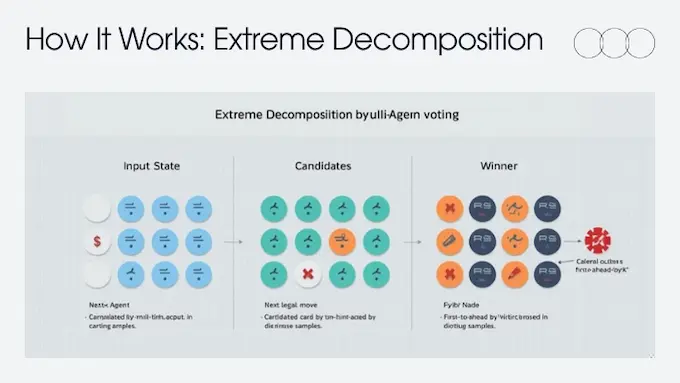
In a conventional agent setup you might prompt a model with “solve the puzzle” and let it stream out an entire plan. MAKER reverses that pattern. The global plan stays fixed and simple. The system focuses its intelligence on choosing one correct next move at a time.
For Towers of Hanoi, each micro-agent sees the current configuration of disks, a short description of the strategy, and the last move. Its only job is to propose the next legal move and the new state. That is all. No multi paragraph explanation. No meta reasoning. Just a precise micro-action.
Here is where multi-agent systems enter the picture. For every micro-step, several agents draw candidate outputs from the same base model. The system applies the “first-to-ahead-by-k” rule. Sampling continues until one candidate has at least k more votes than any other. That candidate becomes the chosen action.
The authors show that if the base model has a decent per-step success rate, this voting scheme can push the probability of picking the correct action extremely close to one, while the extra sampling cost grows only logarithmically with the number of steps. In plain language, you pay a modest overhead to make each step very safe, and that overhead hardly grows as your AI problem solving stretches to hundreds of thousands or millions of steps.
Red-flagging adds another layer of defence. Very long or badly formatted outputs often mean that the model has wandered into a confused state. MAKER treats those as red flags, throws them away, and samples again. That simple rule cuts down both ordinary mistakes and rare, correlated failures that could otherwise slip through voting.
4. The Million-Step Benchmark: Why Towers Of Hanoi Is A Great Stress Test

Towers of Hanoi looks like a toy puzzle, yet for long-horizon reasoning it is a nearly perfect stress test.
The domain is simple and deterministic. A correct strategy is known. Every move can be checked cheaply. There is no ambiguity about whether a given step is right or wrong. At the same time, the required number of steps grows exponentially with the number of disks, so researchers can dial difficulty from short sequences up to million-step monsters just by adding more disks.
In the MAKER experiments, the team tackles a 20 disk instance. That instance requires 2^20 minus 1 moves, which is 1,048,575 actions in a strict order. Using a relatively small model plus decomposition, voting and red-flagging, MAKER solves the entire sequence with zero mistakes.
The takeaway is simple and powerful. Under the right architecture, you can turn a modest base model into a system that delivers extremely reliable AI problem solving over very long horizons. The same model used as a single agent fails after a few hundred steps. Wrapped in a careful micro-agent architecture, it does not miss once.
5. An Orchestra, Not A Violinist: Reading The Performance Graph
One of the most striking figures in the paper plots approximate model capability on one axis and consecutive error free steps on the other. Capability is estimated by API price per token. Consecutive error free steps come from observed per-step error rates. Base models form a cloud of points that range from cheap and error prone to pricey and somewhat more reliable. The MAKER system sits far to the right with over a million clean steps.
A Reddit commenter captured the intuition nicely. Comparing MAKER to a single LLM on that graph is like comparing a full orchestra with a conductor to a solo violinist. The violinist might be brilliant. The orchestra and conductor can play a much more complex piece without falling apart because the system is designed to coordinate imperfect players.
MAKER is that orchestra. It is a coordinated system built on many micro-agents. It does not magically make the underlying model smarter. It uses multi-agent systems, voting and red-flagging to stretch the reliable horizon of AI problem solving by orders of magnitude.
To make the trade off concrete, here is a simplified snapshot of two scaling strategies.
AI Problem Solving Approaches Comparison
| Approach | What You Scale | Strengths | Pain Points |
|---|---|---|---|
| Bigger Single Models | Parameters and training data | Strong one shot answers, good on standard benchmarks | Costly, brittle on long workflows, failures hard to debug |
| MAKER AI Style Smarter Systems | Decomposition, agents, voting rules | High LLM reliability over long runs, flexible architecture | Requires engineering effort, careful task decomposition |
MAKER AI represents the second row. You scale the structure around the model instead of the model itself. For anyone building serious AI problem solving pipelines, that is an appealing trade.
6. Beyond Puzzles: Can MAKER Generalize To Real-World Problems?
The obvious question after a million-step puzzle solve is whether any of this helps outside the lab.
The authors are open about the limits. Towers of Hanoi is a clean environment for studying long-horizon reasoning and AI error correction. Real systems are messy. APIs fail. Data shifts. Humans intervene. Often there is no single ground truth answer for the system to vote on.
Even so, the architectural lessons are highly portable. Many real processes already look like graphs of micro-steps with local checks. Think about a complex ETL pipeline, a document review flow, or a robotic assembly line. In each case you can often define small local units that are either correct or not and you can run cheap checks at each boundary.
MAKER suggests a pattern for AI problem solving in these domains.
- Decompose aggressively into micro-steps wherever you can.
- Treat each step as a small competition between agents.
- Place AI error correction exactly where it matters, at the edges between steps.
- Use domain validators when ground truth is fuzzy, so voting happens only among sane candidates.
The hardest open problems involve decomposition and verification. How do you automatically break down an open ended data science project into minimal steps without a human architect? How do you decide what “correct” looks like when experts themselves disagree? MAKER does not answer those questions. It does something more basic and more valuable. It gives us a working reference design for reliable long-horizon reasoning when a good decomposition is available.
7. The “Smarter Systems, Not Bigger Models” Advantage

One of the nicest surprises in the experiments is that MAKER performs best when it uses relatively small, non reasoning models as its base. You do not need a giant, tool using super model to get reliable AI problem solving at long horizons. You need a model with decent per-step accuracy and a framework that squeezes reliability out of that accuracy.
The theory in the paper explains why. When you decompose into single-step subtasks and add voting with a margin of k, the probability of finishing the whole run without error stays high while the extra sampling cost grows only with the logarithm of the number of steps. In contrast, if you ask each agent to handle many steps, the chance that its whole sequence matches exactly across samples drops rapidly and the cost of AI error correction explodes.
Two big implications follow.
First, architecture beats wishful thinking. Instead of waiting for raw model improvements to magically unlock extremely reliable AI problem solving, we can build AI agent frameworks that deliberately sculpt error rates with structure.
Second, economics change. If a small model equipped with the right error correction system can solve million-step tasks, teams can get much more predictable budgets for long workflows. It even becomes reasonable to imagine multi-agent systems that mix models, using tiny models for routine steps and heavy models for rare, difficult branches.
In other words, MAKER AI reframes scaling. Bigger is no longer the only move. Smarter systems become a first class option.
8. Getting Started With MAKER AI: Key Concepts For Developers
You probably do not want to reimplement the Towers of Hanoi setup in production. You do want to borrow its design patterns.
If you already build distributed systems, MAKER will feel familiar. It looks like a microservices architecture for AI problem solving. A few practical principles stand out.
- Think in micro-roles. Design agents that do the smallest meaningful unit of work. The more local the context, the easier it is to reason about LLM reliability.
- Introduce voting early. For any step where an error would be expensive, have multiple agents propose answers and pick via a simple rule such as first-to-ahead-by-k.
- Make red flags strict and cheap. Define heuristics that mark outputs as unsafe, such as very long explanations or malformed data. Discard and resample. When in doubt, treat a sample as tainted.
- Instrument everything. Log which prompts, steps and agents produce errors. Over time you can adjust where to spend more samples and where a single shot is enough.
- Separate insight from execution. Use creative agents to design plans and strategies. Use MAKER style micro-agents to execute those plans with tight AI error correction.
From a tooling perspective, none of this demands exotic infrastructure. You need a scheduler for micro-tasks, a store for state, and a clean way to express the dependency graph. That is exactly what many emerging AI agent frameworks aim to provide. MAKER gives you a target pattern for how those frameworks can be wired when you care about reliability more than showy one shot performance.
9. Conclusion: A New Direction For Reliable AI Problem Solving
The real headline in the MAKER work is not “LLM solves Towers of Hanoi.” It is that a modest model, wrapped in a smart architecture, can deliver a million-step sequence with zero errors. That should reset how we think about AI problem solving at scale.
If we want AI systems that can plug into hospitals, power grids or financial rails, the path is unlikely to be a single super agent that never blinks. A more realistic and safer picture looks a lot like MAKER AI. Many narrow agents. Extreme decomposition. Aggressive AI error correction. Structural checks on every link in the chain.
For practitioners, the next step is clear. Take one critical workflow in your stack and ask a concrete question. How would this look if it were rebuilt as a MAKER style multi-agent system, with tiny agents, local checks and voting on every important decision? Then start small. Wrap one brittle script in a micro-agent harness. Add redundancy. Measure how far you can stretch LLM reliability before things break.
Long-horizon reasoning will not come from optimism alone. It will come from engineering discipline. The MAKER paper shows that if you treat AI problem solving as a systems design problem instead of a pure model choice, you can get much closer to the level of reliability that real infrastructure demands.
What is the biggest problem with LLMs?
The biggest problem with LLMs is reliability over long sequences of steps. They can answer single questions well, but small mistakes accumulate across many actions and derail AI problem solving in complex workflows. This compounding failure is often called cascading errors and it is exactly what frameworks like MAKER are designed to control. By attacking error rates at each micro-step, these systems turn impressive but brittle models into dependable tools.
How can AI be used in problem-solving?
AI can be used in problem-solving by breaking big goals into structured steps and letting models handle the reasoning inside each step. In simple cases that might mean using one model to suggest ideas, code snippets or decisions. For more serious AI problem solving, multi-agent systems coordinate many small agents, each responsible for one micro-task, while an AI agent framework manages state, validation and error correction. This architecture lets teams scale from toy examples to workflows with thousands or millions of dependent actions.
What is the MAKER model (framework)?
The MAKER framework is a system for AI problem solving that turns a single language model into a coordinated team of micro-agents. It uses extreme task decomposition, so each agent only decides one small next action, then combines those decisions using a first-to-ahead-by-k voting rule and strict AI error correction. Instead of hoping one powerful model can run a whole process flawlessly, MAKER treats long workflows as a massively decomposed agentic process that can be monitored and controlled step by step. The result is an AI agent framework built for reliability, not just raw intelligence.
What is long-horizon reasoning in AI?
Long-horizon reasoning in AI is the ability to carry out a long chain of dependent steps without drifting off course. It shows up whenever AI problem solving moves from a single answer to a multi-stage process, such as planning, tool use or multi-day projects. The challenge is that even a tiny per-step error rate becomes disastrous when you need thousands of correct decisions in a row. Architectures like MAKER tackle long-horizon reasoning by breaking the chain into micro-steps, adding redundancy and applying AI error correction at every link.
Are LLM benchmarks reliable?
reliability problems that matter for AI problem solving. Many popular tests use short tasks where a model only needs a few correct steps, so cascading errors never have a chance to appear. When you stress models with long-horizon reasoning tasks, their performance usually drops sharply and the gap between lab scores and production reliability becomes obvious. That is why million-step evaluations, like the MAKER Towers of Hanoi experiments, are important complements to traditional benchmarks.