
“Can one new generator and one relation erase an entire group?” The Kervaire conjecture says no. Start with any nontrivial group, adjoin a generator, and impose one relation. The resulting group still has an element other than the identity. OpenAI’s September 24, 2026 manuscript proves something stronger in the difficult case. When the new generator occurs with total exponent or , the original group embeds in the quotient, so every original element survives with its identity and multiplication intact.
The proof starts with a group element that supposedly vanishes and turns that equality into a planar surface. A trace built from unitary spectral angles then shows that the surface cannot have exactly one nontrivial boundary word.
Table of Contents
1. What Is the Kervaire Conjecture in Group Theory?
Let be the coefficient group and the new generator. The free product keeps all the laws of and imposes no relation between and the infinite cyclic group generated by . Pick a word in . Imposing kills every conjugate of and , and every finite product of those conjugates. They form the normal closure . The quotient is the group obtained by imposing the relation.
| Question | Answer in the September Manuscript |
|---|---|
| Starting group | Any group, including infinite groups and groups with torsion. |
| Construction | Adjoin one generator and impose one relation. |
| Nontriviality | Every relator leaves a nontrivial quotient if the starting group is nontrivial. |
| Embedding | The original group embeds when the exponent sum is plus or minus one. |
A presentation specifies generators and the relations they satisfy. For a small example, take to be the cyclic group of order three, generated by , and impose . The new relation gives . Substituting this into the presentation leaves the original relation , so is again cyclic of order three.
2. Why Is the Exponent Sum ±1 the Difficult Case?
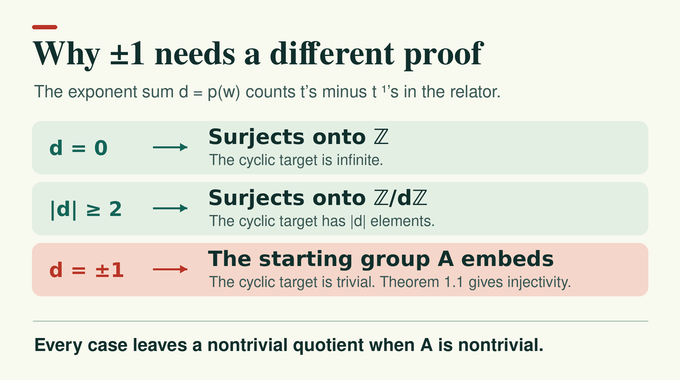
The homomorphism sends every coefficient to zero and sends to one. Thus counts occurrences of minus occurrences of after powers are split into individual letters. The composite map to kills and therefore descends to a surjection from . For the target is . For it is a finite cyclic group with at least two elements.
When , the cyclic target is trivial. These are the unimodular equations over groups. OpenAI proves survival in this case by embedding the coefficient group itself. For comparison, imposing in the order-three example kills the entire coefficient group, while the free generator still gives an infinite cyclic quotient.
3. What Exactly Does OpenAI’s Kervaire Theorem Prove?
Theorem 1.1 of the Kervaire theorem for groups asserts that for every group and every word with , the following canonical homomorphism is injective.
Corollary 1.2 says that if , then for every . It combines the embedding at exponent sum with the cyclic quotient at all other sums. Coefficient injectivity also solves the equation in an overgroup. Take as that overgroup and the image of as the solution. The theorem permits the solution to lie outside .
4. How Far Did Earlier Approaches Reach?
The problem grew out of Kervaire’s characterization of high-dimensional knot groups, where normal generation by one element is one of the defining conditions. The group-theoretic question asks whether a free product with a new infinite cyclic factor can have that property. Gerstenhaber and Rothaus established solvability of nonsingular equations over finite groups in finite overgroups.
For a residually finite coefficient group, each nonidentity element stays nonidentity in some finite quotient, so the finite result prevents that element from vanishing in the one-relator quotient. Hyperlinear methods extended nonsingular solvability to groups that embed in metric ultraproducts of unitary groups. Klyachko proved unimodular injectivity for torsion-free groups, and Lvzhou Chen gave a proof in that setting using estimates on the complexity of surfaces.
The September manuscript also discusses Akio Kawauchi’s published proposed resolution via knot exteriors and ribbon sphere-link groups. OpenAI gives an independent argument using a faithful trace from the regular representation of every group. Its applicability covers coefficient groups with torsion, regardless of their finite quotients or approximation properties. The proof also accommodates infinite presentations, since any proposed vanishing coefficient can be witnessed by a finite product of conjugates.
5. How the Proof Turns a Vanishing Group Element Into a Planar Diagram
Suppose maps to the identity in . Membership in means there are finitely many conjugating words and signs with
Picture a disk with one hole per factor. Its outer circle reads , each hole reads or in the orientation of its missing disk, and the paths from the outer basepoint to the holes read the conjugating words. Mark each -letter as a slot. Disjoint bands pair slots with opposite traversal signs. To index the slots uniformly, cyclically conjugate the relator so it starts with a -letter, then split powers into single letters. This gives , with and coefficients that may be the identity. A negative disk reverses the reading, inverting each letter and each corner label. The pieces between slots carry the original coefficients, and following the edge of a disk-and-band component reads a word entirely in . Section 10 explains how to obtain the bands from the given equality.
6. How Spectral Phase Bounds a Product
Use the Hilbert space with basis vectors indexed by group elements. Left translation acts by and commutes with right translations. On the algebra of operators commuting with all right translations, the trace takes the diagonal entry at . It is faithful because a positive operator with zero trace has a square root that kills and, by translation, every other basis vector. This group von Neumann algebra works for arbitrary . The trace on -by- operator matrices sums the traces of the diagonal entries, giving .
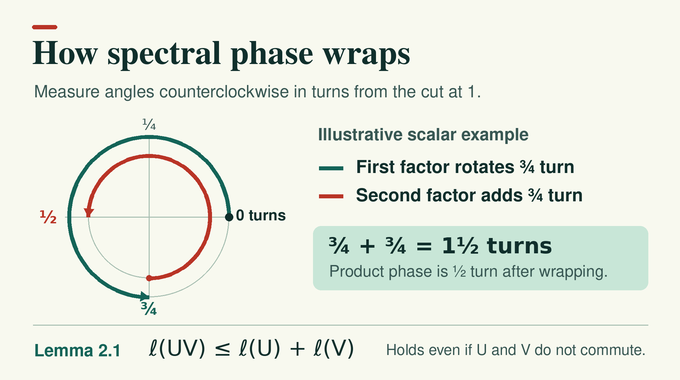
For a unitary , take the fractional phase , measured in turns. Set using spectral calculus. The cut is at , where . Because the phase operator is positive and the trace faithful, vanishes exactly when . Lemma 2.1 supplies the estimate used to compare two ways of following a surface.
Write and follow the unitary path from to . For smooth on the circle, differentiating the trace along this path gives , with the derivative taken in turns. The formula follows for powers of from the product rule and cyclicity of the trace, and extends by Fourier expansion. If , positivity bounds the derivative by .
The fractional phase itself jumps at the cut. Averaging small positive shifts smooths it while keeping the derivative at most one, since a forward move increases fractional phase by at most the length of the move. The smoothed function converges to zero at the cut as well as to the correct value elsewhere. In the scalar example , the two phases add to turns, while the product’s phase is turn. In the operator argument the unitary path and trace give the inequality even when the two operators fail to commute. Integrating the smooth estimate and taking the limit under the finite trace gives the inequality.
7. Where Topology Enters the Fixed-Space Lemma
Write for the number of disks of each sign. If there are slots on a relator, their signs sum to . Lemma 3.1 says that for any , a single matrix can mix the disk copies so that
fixes a complex subspace of dimension at least . Here is the group of -by- unitary matrices.
The argument keeps a unitary together with a complex -plane that it fixes pointwise. These pairs form a compact incidence manifold. Over each , the action on its orthogonal complement is an arbitrary unitary. For the incidence space has real dimension . Adding the variable gives a domain of dimension , matching the target for the map taking to .
A homotopy first moves to the identity. Rotating the two coordinate planes in each positive and negative pair cancels the corresponding blocks of and . Their constant blocks are then moved to minus the identity. One unpaired block with sign remains. At that endpoint the map hits the identity only when , is the unpaired plane and is the resulting endpoint matrix.
Variations of , the plane and the complementary unitary give independent tangent directions covering the target, so this preimage is regular. The unpaired plane is singled out because minus the identity fixes no vector on its complement other than zero. The regular fiber therefore has odd cardinality. Homotopy preserves that mod-two degree, so the original map also hits the identity, where fixes .
8. Why a Planar Surface Cannot Have Exactly One Nontrivial Boundary
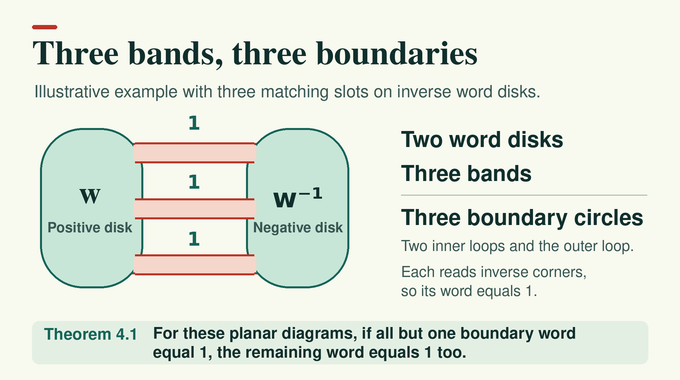
Label a corner by when it follows slot on the same disk. Let advance along a disk to its next slot, and let exchange the two slots of a band. Each boundary step crosses the band first, then passes the corner before reaching . The cycles of are therefore the boundary circles. Multiply the corner labels along a cycle to obtain its boundary word . Moving the starting point conjugates the word and preserves whether it is the identity.
Each positive disk contributes the relator’s exponent sum, and each negative disk contributes its opposite. Every band cancels a pair of traversal signs, so the counts of positive and negative disks match. The connected surface has disks and bands. Since it has genus zero, its Euler characteristic gives the boundary count .
For example, join one positive three-slot disk to its negative copy by matching slot indices. The opposite cyclic orders give a planar attachment with three boundary circles. In each circle, a negative corner contributes and its positive partner contributes , so the two labels multiply to the identity. Theorem 4.1 says that if all but one boundary word are trivial, that last word must be trivial too. The count is what lets the phase comparison isolate its contribution.
9. The Trace Comparison That Forces the Boundary Word to Vanish
The unitary advances around the disks with weights . The unitary involution crosses the bands with opposite scalar phases at the two ends. Their product therefore travels around the boundary cycles. To bound its phase, insert a scalar involution that exchanges positive and negative disk arrays via and . The corner conventions give . Thus is a self-adjoint unitary with trace zero: it interchanges disk kinds. Its negative spectral projection has trace , giving . The fixed-space estimate acts on the finite slot coordinates, while the coefficient weights continue to act on the Hilbert space of the original group.
The fixed-space lemma chooses so that fixes at least directions on the positive-traversal slots. Conjugation by exchanges traversal signs and sends to its inverse, giving at least fixed directions on the other half. Away from eigenvalue , inverse eigenvalues contribute one turn per pair. Hence , and subadditivity gives
For the second calculation, a boundary cycle of length contributes plus the trace of the fractional phase of its circuit weight . Here is its total scalar phase. Rephasing the slot coordinates makes the cycle operator unitarily conjugate to its rotation by a th root of unity. Summing fractional phases over these rotations produces the constant and leaves the phase of one complete circuit.
The band phases realize any boundary phases of total zero by routing a flow along a spanning tree of the connected graph of boundary circles. Put phase for on each trivial circle and the compensating nonnegative phase on the exceptional circle . The trivial circuits approach the cut from below and contribute one each. The exceptional circuit retains its nonnegative phase in the limit. With just one boundary circle its phase shift is zero throughout. The length terms sum to , because the cycles partition all slots. The trivial circuits contribute another in the limit. Substituting the Euler identity makes the phase limit
The upper bound holds throughout the limiting process, so the extra term must be zero. Faithfulness then implies . Applying that translation to shows .
10. Completing the Proof From Planar Surfaces to Group Injectivity
Realize the punctured disk as a map into a presentation space for with one circle wedged on for . Project onto the circle. The outer circle projects to the wedge point, and the coefficient intervals do too. A piecewise-affine approximation that agrees with the boundary lets the authors choose a level away from vertex values and the wedge point. Each -letter meets that level once. The level arcs pair opposite traversal signs. Thin bands around the arcs stay where the original map takes values in the added circle, so their projection into the coefficient space is constant. The intervening corner labels retain the original coefficients.
Now restore the missing disks and consider the components of the disks and bands. Choose an innermost component, whose interior complementary disks contain no other component. The coefficient map already fills those inner circles, so their words are trivial. The planar boundary theorem makes the exterior word trivial too. Fill that exterior loop in the coefficient space and remove the component. The replacement agrees with the old map on the exterior boundary. The other components retain their labels, and repeating the step eventually fills the original outer loop in the coefficient space. Thus already in .
11. What the OpenAI Proof Establishes and What Lean Verifies
The September manuscript proves nontriviality for arbitrary relators and coefficient injectivity for unimodular relators. The broader Kervaire–Laudenbach question asks for injectivity at every nonzero exponent sum. A separate October companion preprint proves nonsingular solvability in overgroups, including that broader one-variable case.
The selected Lean comparator for the September result checks the canonical map’s injectivity for arbitrary coefficient groups at exponent sum . The Lean implementation also proves the all-relator nontriviality corollary by splitting off the cyclic-quotient case. OpenAI’s October 6 release announcement describes the broader collection, while the manuscript and Lean files give the statements specific to Kervaire.
The Kervaire conjecture proof shows how planar topology can keep a newly imposed relation from erasing an original element: if a nonidentity coefficient were erased, the trace would require more phase than the surface allows. Follow Binary Verse AI for more proof walkthroughs in group theory and formal mathematics, including the work on Thompson’s group F and Lean formalization of Fermat’s Last Theorem.
What is the Kervaire conjecture in group theory?
The Kervaire conjecture states that adjoining one new generator and imposing one relation on a nontrivial group cannot make the resulting group trivial. Equivalently, no free product of a nontrivial group with an infinite cyclic group can be normally generated by a single element.
Has the Kervaire conjecture been solved?
Yes. OpenAI’s September 2026 proof establishes the conjecture for arbitrary nontrivial groups. Its main theorem proves that the original group embeds into the one-relator quotient whenever the new generator has exponent sum plus or minus one.
Why is exponent sum ±1 important in the Kervaire proof?
For every other exponent sum, the quotient maps onto a nontrivial cyclic group. At exponent sum plus or minus one that cyclic target is trivial, so the proof instead establishes coefficient-group injectivity using spectral phase, unitary matrices and planar topology.
Does the Kervaire theorem apply to non-sofic groups and groups with torsion?
Yes. The theorem imposes no restrictions on torsion, cardinality or presentation. Its proof uses the left regular representation and a faithful trace available for every group, without requiring soficity or hyperlinearity.
Does imposing one relation always preserve the original group?
Preservation can fail when the exponent sum is zero. For example, with an order-three coefficient group, imposing that its generator equals the identity erases the coefficients and leaves the new generator free. The September theorem guarantees an embedding for unimodular relations, and the October companion extends that guarantee to all nonzero exponent sums.
Is the Kervaire conjecture the same as the Kervaire–Laudenbach conjecture?
The Kervaire conjecture asks whether the resulting group remains nontrivial. Kervaire–Laudenbach asks for the original group to embed whenever the exponent sum is nonzero. The September paper proves injectivity in the unimodular case and resolves the original conjecture. The October companion covers the broader nonsingular case.
What part of OpenAI’s Kervaire proof is formally verified in Lean?
The selected Lean comparator checks coefficient-group injectivity for arbitrary groups when the relator has exponent sum plus or minus one in the new generator. The accompanying implementation also proves the nontriviality corollary for every relator, using the separate cyclic-quotient argument for the other exponent sums.