
ChatGPT Hubpage for complete articles
Introduction
You wait three weeks for an appointment. You get ten minutes of “so, what brings you in,” and you leave remembering the one important question you forgot to ask.
That frustration is the opening for ChatGPT Health. Not an AI doctor. Not a diagnosis machine. More like a patient-side cockpit that can pull your scattered context, labs, notes, and wearable trends into one place, then help you think clearly before you talk to an actual clinician.
OpenAI announced ChatGPT Health on January 7, 2026 as a dedicated space inside ChatGPT for health and wellness conversations, with extra privacy controls and the option to connect medical records and wellness apps. Access begins via a waitlist and expands over time.
The thesis is simple: ChatGPT Health is great for preparation, translation, and pattern-spotting. It’s a bad idea as a replacement for care. The difference isn’t subtle. It’s the difference between “help me ask smarter questions” and “tell me what’s wrong with me.”
Table of Contents
1. The Doctor Will See You Now, And So Will AI
Healthcare today can feel like debugging a distributed system with missing logs. Your labs live in one portal. Your imaging report is a PDF from 2019. Your watch knows you slept four hours, but your clinician never sees it. You’re expected to reconstruct your history from memory, under time pressure.
ChatGPT Health is trying to be the glue. It’s a dedicated space where you can chat about health and, if you choose, ground the conversation in your own data by connecting records and apps. It also comes with a key design choice: the Health space is compartmentalized, and Health chats are not used to train foundation models.
Here’s the quick map of what it’s for.
ChatGPT Health: What AI Helps With vs What Humans Do
A quick, practical split between prep work and clinical responsibility.
| What You Want Done | What AI Can Actually Do | What You Still Need A Human For |
|---|---|---|
| Make lab results readable | Explain ranges, trends, and plain-English meaning | Decide what’s clinically important for your case |
| Turn a messy story into a timeline | Summarize visits, meds, symptoms, and dates | Validate details, examine you, and order the right tests |
| Prep for appointments | Draft a one-page brief and a question list | Make decisions, prescribe, treat, and take responsibility |
| Spot patterns over time | Correlate sleep, stress, activity, diet, and symptoms | Diagnose, especially when pattern ≠ cause |
| Compare options | Organize tradeoffs in plans or interventions | Apply judgment and your personal risk profile |
If that feels unglamorous, perfect. The win here is clarity, not magic.
2. Is ChatGPT Health Safe? The Black Mirror Fears Vs. Reality
The question people mean when they ask about AI in medicine is usually this: Is ChatGPT safe for confidential information?
In ChatGPT Health, that question becomes less abstract because the product is explicitly built for sensitive context, not general chatter.
Online, the fear mutates into “I typed a symptom and my insurer will deny coverage.” It’s an understandable anxiety, and it blends two separate risks:
- Access risk, someone gets into your account.
- Use risk, your data gets reused in ways you didn’t intend.
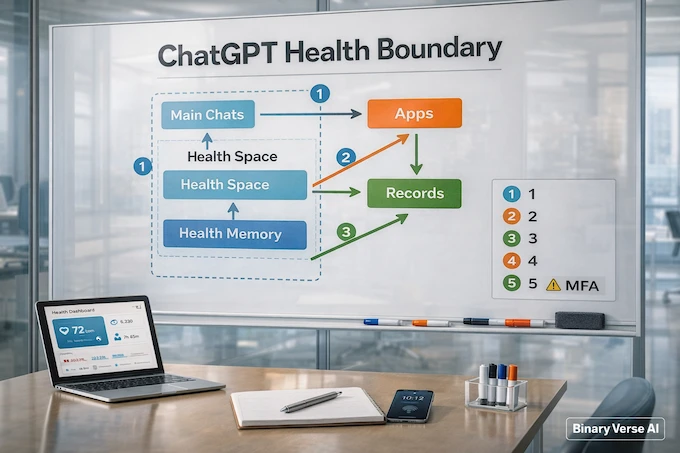
ChatGPT Health mainly targets the second risk with architecture. Health lives in a separate space inside ChatGPT. Health chats, files, and Health memories stay inside that space. Health information does not flow back into your normal chats. And Health content is not used to train foundation models.
That’s not a forcefield. It’s a boundary. Your job is still to protect your account, and to decide what you’re comfortable connecting.
2.1 The “Sandbox” Idea, Without The Marketing
Think of ChatGPT Health as a locked room inside the same house. You can enter it easily, but what’s said in the room doesn’t automatically become background noise everywhere else.
OpenAI also describes layered protections for health, including purpose-built encryption and isolation. Translation: treat Health data as higher sensitivity, and compartmentalize it.
2.2 The b.well Bridge, And Why It Matters
When you connect U.S. medical records, the connection runs through b.well, which helps fetch information from provider portals.
That creates a chain: your portal, the intermediary, your ChatGPT account, your device. The weak point is usually the boring one, like a reused password or skipped MFA. If you do one thing, enable MFA.
3. The Billion-Dollar Question: OpenAI HIPAA Compliance
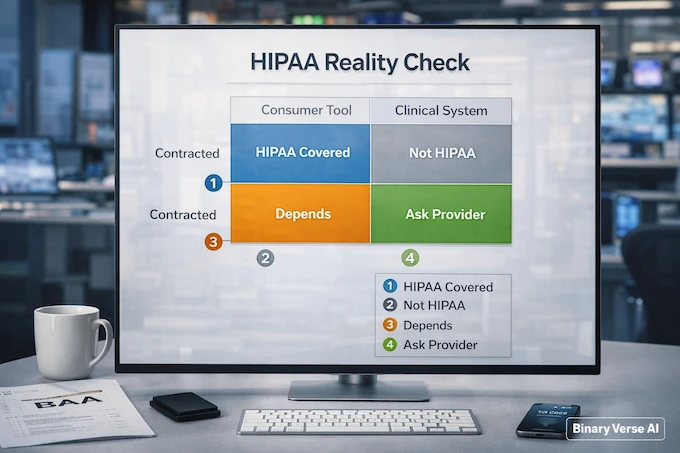
The phrase OpenAI HIPAA compliance is popular because it sounds like a clean yes-or-no label. HIPAA, in practice, is a legal framework tied to specific roles and contracts, not a universal property of “software that touches health.”
OpenAI positions Health as a consumer product designed to support, not replace, care. That matters because consumer tools often sit outside the HIPAA contract structure that governs hospitals and EHR vendors, even if the underlying security patterns look similar.
So here’s the practical version you can use:
You are the custodian of what you upload and connect.
That’s also why ChatGPT Health should start with the smallest possible dataset that still helps you.
If your privacy stance is “my medical data stays only in my provider portal,” then ChatGPT Health is not for you right now. If your stance is “I’m willing to share some data for better prep and understanding,” then proceed like you would with banking apps: deliberate, minimal, reversible.
4. Accuracy Benchmarks: Can A Model Read Your Labs Without Making Stuff Up?
Benchmarks are useful. They are also a trap. ChatGPT Health benefits from strong models, but you benefit more from strong habits.
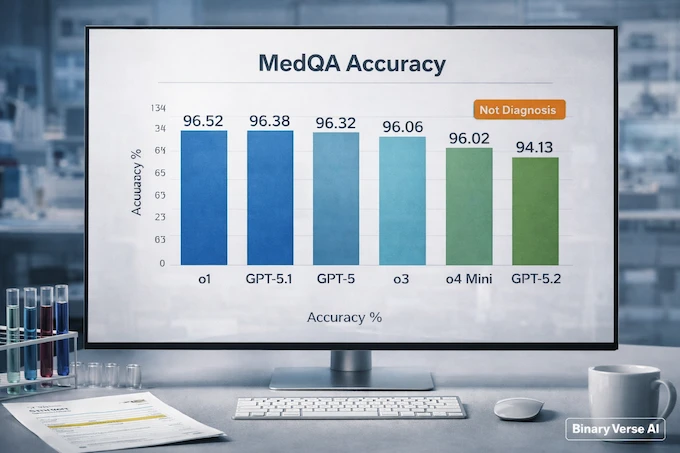
A MedQA snapshot updated December 24, 2025 shows top models clustered in the mid-90s for accuracy on medical Q&A. GPT-5.1 is listed at 96.38%.
Here’s a compact view.
ChatGPT Health: MedQA Accuracy Snapshot
Benchmark accuracy is useful context, not a clinical guarantee.
| Model | MedQA Accuracy | What That Suggests In Practice |
|---|---|---|
| o1 | 96.52% | Strong benchmark performance on medical Q&A tasks |
| GPT-5.1 | 96.38% | High reliability on structured questions, still fallible |
| GPT-5 | 96.32% | Similar tier, performance depends on setup |
| o3 | 96.06% | Competitive with top cluster |
| o4 Mini | 96.02% | Fast, accurate for many everyday tasks |
| Gemini 3 Flash (12/25) | 95.81% | Strong, efficient option |
| GPT-5.2 | 94.13% | Good performance, still meaningfully imperfect |
A 96% score is not a clinical license. In health, the last few percent is where harm hides. If a model misses one in twenty-five, and the miss happens to be the one critical detail in your case, you don’t get a refund on the anxiety.
This is why I don’t like the default fantasy of ChatGPT diagnosis. Diagnosis is not a quiz. It’s messy context, uncertainty, physical exam, and tests you don’t know you need. Benchmarks reflect some of the reasoning, not the whole job.
4.1 Treat It Like A Fast Resident, Not The Attending
Use ChatGPT Health to translate, summarize, and generate hypotheses. Then verify with records and clinicians.
Good uses:
- Explain terms and lab flags.
- Summarize your own history into a one-page brief.
- Generate a differential list to discuss, not to self-treat.
Bad uses:
- Deciding treatment.
- Ignoring red-flag symptoms because the model sounded calming.
- Believing a confident paragraph over actual evidence.
4.2 The 4% Problem Is Not Evenly Spread
Averages hide spikes. Models tend to do well on common, well-described scenarios, and fail harder when the story is sparse, contradictory, or emotionally loaded. The most dangerous failure mode is not “everything is wrong.” It’s “mostly right, plus one invented detail.”
Grounding conversations in your own records can reduce that, but it never eliminates it.
5. Step-By-Step: How To Connect Medical Records To ChatGPT
If you decide to connect records in ChatGPT Health, treat it like linking a payment method. Calm, minimal, and reversible.
At launch, medical records integration is U.S.-only and involves signing into provider portals. Sync can take minutes to hours depending on history size.
5.1 What You Need
- Provider portal login for each system you want to link.
- MFA on your ChatGPT account, and ideally on your email too.
- Patience for the initial sync.
5.2 The Flow
- Open the Health space, not a regular chat.
- Go to Tools (+) or Settings, then Apps, and choose Medical Records.
- Find your provider through the b.well flow and sign in.
- Authorize access and complete any 2FA prompts.
- After sync, ask a grounded question, like “Summarize my last two labs and what changed.”
Deleting a chat is not the same as disconnecting a source. Chats are conversations. Sources are pipes. If you want the pipe closed, disconnect it.
6. How To Connect Wearables And Wellness Apps
Records are the “official” story. Wearables are the “lived” story. Your portal can tell you your A1C. Your watch can tell you you’re sleeping badly for six weeks.
With ChatGPT Health, you can connect Apple Health on iOS, plus wellness apps like MyFitnessPal. This is where ChatGPT healthcare applications become genuinely practical, not sci-fi. You’re not hunting a diagnosis. You’re extracting signal from noise.
Prompts that stay useful:
- “Using my Apple Health sleep and resting heart rate trend over 8 weeks, summarize what changed around the time my anxiety increased.”
- “From my MyFitnessPal logs, estimate my average protein intake by week and suggest simple ways to improve it.”
7. Three Ways To Use ChatGPT Health Before Your Next Appointment
If you do nothing else, do these three.
7.1 The Translator
Prompt:
“Explain these lab results like I’m 12. Then list the top five follow-up questions for my appointment.”
7.2 The Timeline Builder
Prompt:
“Review my last three years of records and produce a one-page timeline of symptoms, diagnoses, meds, and key tests for my knee pain. Include dates.”
7.3 The Question Prepper
This is the safe answer to “How to use ChatGPT for medical diagnosis.” You don’t ask the model to diagnose. You ask it to widen your thinking and sharpen your questions.
Prompt:
“Based on these symptoms and my history, list possible categories of causes. Then give me five specific questions to ask my specialist, plus red flags that should trigger urgent care.”
People will keep searching for ChatGPT diagnosis because it’s the shortest phrase for “help me make sense of this.” Fine. Just don’t stop at the shortest phrase.
8. What Not To Do: Where AI Fails, And Where It Can Hurt You
8.1 The Emergency Rule
If you have symptoms that could be an emergency, like chest pain, stroke signs, or severe allergic reaction, seek urgent care. Don’t outsource time-critical judgment to a chat box.
8.2 The Anxiety Amplifier
If you tend to spiral, avoid prompts like “What’s the worst thing this could be?” You’ll get a fluent answer that might be wrong, and your nervous system won’t care about the “might.”
Use grounding prompts instead:
- “What are common benign explanations, and what signs would distinguish them from serious ones?”
- “What’s a reasonable monitoring plan to discuss with my clinician?”
8.3 The Confidentiality Trap
If your question is deeply sensitive and you’re not comfortable with it being stored anywhere outside your head, don’t type it. That’s the most honest answer to Is ChatGPT safe for confidential information.
9. Expert Verdict: Should You Join The Waitlist?
Say yes to ChatGPT Health if you have complex records, chronic conditions, or just want to stop narrating your medical history from memory every time you switch doctors. That’s the core value proposition of ChatGPT Health in one sentence.
Say no, for now, if you’re extremely privacy-sensitive, you have minimal history, or you know you’ll treat it as a replacement for care.
Used well, ChatGPT Health makes you a better participant in your own care. You show up with a clean summary, better questions, and less cognitive noise. That’s a real upgrade.
If you want in, join the waitlist, turn on MFA, and start small. Connect one source. Ask for one summary. If the result makes you clearer and calmer, keep going. If it makes you anxious, back off, and bring the questions to your clinician instead.
And if this guide saved you ten minutes, send it to one friend, and then go drink water like it’s a feature, not a moral obligation.
Is ChatGPT Health HIPAA compliant?
No. ChatGPT Health is a consumer feature, and OpenAI does not position it as HIPAA-compliant in the way hospitals and covered entities are. The practical nuance is that Health is built with extra isolation and encryption layers, and medical-record connectivity runs through b.well, but you should still treat it as a personal tool, not a HIPAA-covered clinical system.
Does OpenAI sell my health data to insurance companies?
OpenAI says ChatGPT Health conversations, files, and memories are not used to train foundation models, and Health is designed as a separate space with added privacy controls. That does not mean “sell to insurers,” and there is no claim from OpenAI that it monetizes Health data that way. The smarter concern is account access and what you choose to connect, so enable MFA and keep your connected sources minimal.
How accurate is ChatGPT 5.1 for medical diagnosis?
If you mean exam-style medical QA, GPT-5.1 is listed at 96.38% accuracy on MedQA in the benchmark snapshot referenced in your article. But ChatGPT diagnosis in real life is harder than MedQA, because real cases have missing context, comorbidities, and the need for exams and tests. Use ChatGPT Health to summarize, translate, and prep questions, not to self-treat.
Can I delete my medical records from ChatGPT Health?
Yes, but it’s a two-step mental model: deleting a Health chat deletes the conversation, not the connected source. To remove medical records access, disconnect Medical Records in Settings > Apps. OpenAI’s help documentation also notes that disconnecting Medical Records deletes your records from their partner b.well, while content already mentioned inside chats may require deleting those chats or Health memories too.
Is ChatGPT safe for confidential information like blood results?
Is ChatGPT safe for confidential information depends on your risk tolerance and setup. ChatGPT Health is built as a separate space, and OpenAI states Health chats are not used to train foundation models. Still, you should avoid sharing anything you wouldn’t want exposed in a worst-case account compromise. Turn on MFA, limit integrations, and ask the tool to explain results and trends rather than storing highly sensitive identifiers.