
Introduction
Call it the WOW moment in AI this week: in what already feels like the most amazing week of 2025, Google unleashed a string of power moves, from Nano Banana Pro and WeatherNext 2 to Guided Learning in Gemini and massive scientific compute upgrades, while OpenAI, xAI, Anthropic, Microsoft and others answered with frontier coding models, science-accelerating GPT-5 experiments, Grok 4.1 upgrades, and new agent ecosystems for real businesses.
This edition breaks down how those Google power moves collide with everything else that shipped, why this week is a genuine inflection point for AI in the real world, and what it all means if you build, invest, or ship products on top of these models.
7 Big Moves In AI News November 22 2025
- Gemini 3 steps up as Google’s new “intelligence layer,” wiring one frontier model across Search, Workspace, Android and Cloud so users and developers get richer answers with less prompting.
- Nano Banana Pro turns Google’s playful image model into a studio grade design engine, delivering grounded, text perfect visuals that can power real campaigns, infographics and UI mockups instead of just meme fodder.
- WeatherNext 2 turns cutting edge AI weather modeling into a practical global risk tool, delivering fast probabilistic forecasts that plug straight into Earth Engine, BigQuery, Vertex AI and everyday Google apps.
- GPT-5.1-Codex-Max becomes OpenAI’s long running coding workhorse, using compaction and deeper reasoning to keep multi hour software projects on track while staying inside a safer, sandboxed agent environment.
- Google Antigravity reimagines the IDE as agentic mission control, letting developers manage swarms of Gemini powered agents that plan, code, run tools and explain their own work instead of just autocompleting lines.
- Anthropic exposes the first large scale AI orchestrated cyber espionage campaign, showing how a jailbroken Claude Code can automate 80–90 percent of an intrusion and forcing security teams to treat agents as both threat and shield.
- Grok 4.1 redraws the frontier for AI chat, combining state of the art benchmark scores with sharp emotional intelligence so conversations feel more like talking to a witty, grounded friend and less like querying a search box.
4 Deep Dives To Read Next
Want more than quick headlines? Start with these four BinaryVerse AI deep dives that connect directly to stories in AI News November 15 2025.
Table of Contents
1. Gemini 3 Redefines AI Reasoning As Google Launches Agentic Era
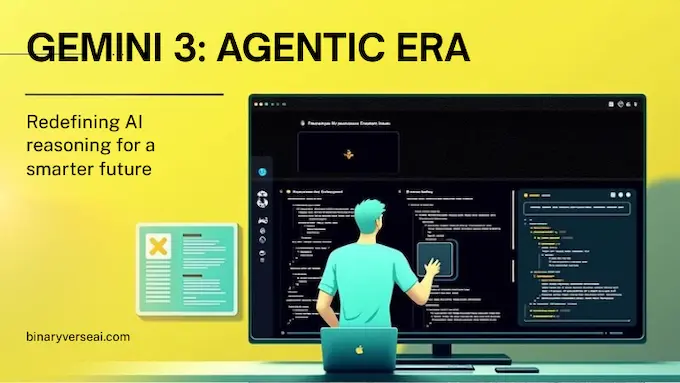
Gemini 3 is Google’s clearest answer yet to the question behind AI News November 22 2025: what happens when you wire one frontier model into everything. Instead of living as a single chat surface, Gemini 3 sits across Search, Workspace, Android and Cloud as a kind of nervous system for Google’s products.
AI Overviews reach billions, the Gemini app serves hundreds of millions, and a tidal wave of developers already treat it as default infrastructure. The pitch is simple. You should get what you want with less prompting, whether that is rewriting a doc, unpacking a lecture, or exploring AI updates this week without touching a search operator.
Under the benchmarks, the model hits PhD-level scores on math and science, dominates LMArena, and shines on multimodal tests. Deep Think mode layers extra reasoning on top, using code execution where it helps. On the surface, new interfaces in AI Mode for Search turn dense topics into visual simulations, guided explanations and interactive breakdowns.
On the agentic side, Gemini 3 powers full workflows, not just snippets, which is why it shows up in so many top AI news stories this cycle. If you want a single motif for AI News November 22 2025, it is this: models are quietly becoming operating systems for knowledge work.
2. Google Antigravity Turns IDE Into Agentic Mission Control For Developers
Google Antigravity looks at the modern IDE and asks a rude question: why are humans still babysitting every command. Instead of another autocomplete sidebar, it turns the development environment into mission control for long-running agents. You describe an outcome, and Antigravity’s Gemini 3 powered agents plan, code, run tools and document their own work while you supervise at task level. The editor view handles real time coding, while a manager view lets you orchestrate multiple agents in parallel workspaces. It is a concrete example of Agentic AI News moving from slideware into something a developer can actually install.
What keeps this from feeling like blind delegation is its obsession with trust and feedback. Antigravity groups low-level tool calls into human readable “artifacts” such as plans, walkthroughs, screenshots and recordings. You can comment on any of them, and the running agent adapts without a full reset.
Sessions feed a shared knowledge base so agents reuse hard won patterns instead of rediscovering every trick. Support for multiple models, including Claude and GPT, hints at a future where your IDE is basically a multi model control plane. For developers tracking AI and tech developments past 24 hours, Antigravity is one of the clearest signals that agentic workflows are about to be very normal.
3. Google’s Nano Banana Pro Turns AI Images Into Studio-Grade, Text-Perfect Design Engine

Nano Banana Pro is what happens when an image model stops being a meme and grows into a proper design tool. Built on Gemini 3 Pro Image, it is tuned not just to render pretty pictures, but to produce visual assets you can drop straight into campaigns, pitch decks or explainer videos. You can ground images in live data through Search, so recipe cards, climate infographics or sports breakdowns stay anchored to real numbers. For anyone following AI world updates in design and marketing, this is one of the more practical AI advancements of the week.
The real magic is text. Nano Banana Pro can draw long, clean headlines and labels inside the image in multiple languages, with far fewer cursed letters than earlier generations. It can keep layout and style intact while swapping languages, remix up to fourteen input images, and preserve character likeness across an entire storyboard.
Fine grained controls let you adjust camera angle, depth of field, lighting and grading so it feels closer to a visual IDE than a random prompt slot machine. SynthID watermarks and visible badges on many tiers make the provenance clear without killing the aesthetic. If you care about new AI model releases that actually ship into products, this one deserves a spot on your radar.
Nano Banana Pro Review: Mastering Google’s New Studio-Quality Image Model
4. Weathernext 2 Brings Faster, Smarter Global Forecasts To Everyday Decisions Worldwide
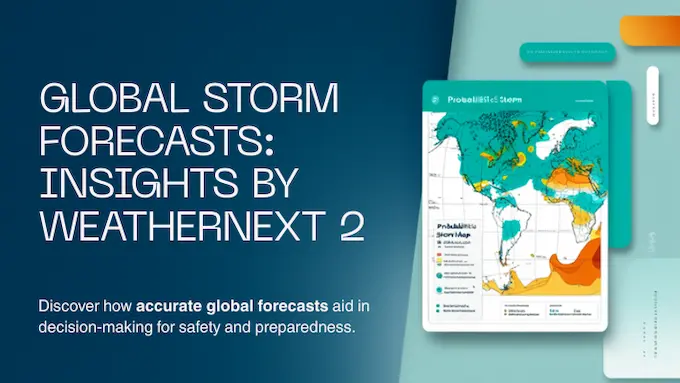
If you want a story that captures the “AI for the real world” thread inside AI News November 22 2025, WeatherNext 2 is it. Built by Google DeepMind and Google Research, the system replaces slow, monolithic weather simulations with a fast AI model that can spin up hundreds of plausible futures in under a minute.
Instead of a single deterministic forecast, you get probabilistic views of storms, heat waves and wind events that matter for ports, grids and farms. Crucially, those forecasts are not stuck in a paper. They now flow into Earth Engine, BigQuery, Vertex AI and consumer products like Pixel Weather and the Maps Platform Weather API.
Underneath, a new Functional Generative Network architecture injects noise directly into the model so its ensembles stay physically consistent instead of drifting into fantasy. The system is trained on marginals such as temperature or humidity at individual points, yet it still recovers large scale patterns like storm tracks and heat domes.
Performance beats the previous generation on almost every metric and lead time. For planners, it means faster and sharper inputs to logistics, agriculture and disaster readiness. For everyday users catching AI news this week November 2025, it is a reminder that some of the most important artificial intelligence breakthroughs will never show up in a chat window. They will quietly refine the weather app on your phone.
5. Guided Learning In Gemini Turns Quick Answers Into Deep Understanding
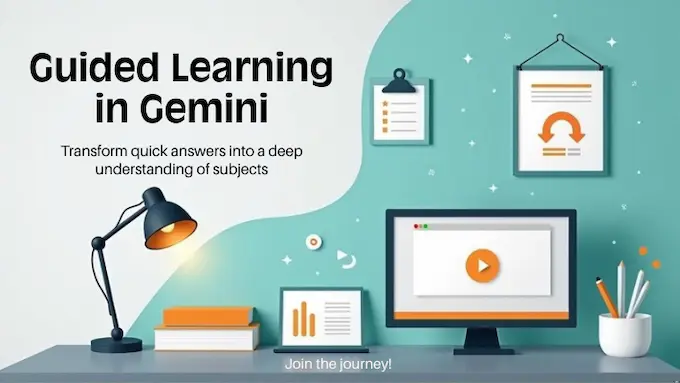
Guided Learning in Gemini is Google’s attempt to move past the “answer vending machine” model of education. Instead of dropping a clean solution and calling it a day, Gemini now engages like a tutor that refuses to let you stay passive.
Built on the LearnLM family of education tuned models, it asks probing questions, breaks problems into digestible steps and nudges you to explain ideas back in your own words. That is a big shift for AI News because it frames the model less as an oracle and more as a thinking partner.
The experience is strongly multimodal. Explanations can blend diagrams, short videos, interactive quizzes and traditional text, all adjusted to your pace and prior knowledge. Teachers can hand students a dedicated link that plugs directly into Google Classroom, letting this workflow slot into real curricula instead of living on a separate island.
Behind the scenes, cognitive scientists and educators helped shape the pedagogy so it supports reflection instead of cheating. For students who currently treat AI as a last minute homework parachute, Guided Learning is a subtle but important reset. It shows that AI updates this week are not only about bigger context windows. They are also about respecting how humans actually learn.
6. GPT-5.1-Codex-Max Becomes Long-Running Agentic Coding Workhorse For Developers
GPT-5.1-Codex-Max is OpenAI’s answer to a problem every engineer has felt: copilots are great on short snippets, then lose the plot once a project spans thousands of files. This model is tuned for long running, messy coding sessions where tests fail, requirements shift and you need an agent that can stay focused for hours.
Its signature trick is “compaction,” the ability to summarize its own history while preserving key decisions, so the effective working context stretches into the millions of tokens. In AI News November 22 2025, that makes it one of the most impactful OpenAI news today for anyone building serious software on top of agents.
On SWE-bench Verified and similar benchmarks, GPT-5.1-Codex-Max matches or beats earlier models while using fewer thinking tokens at the same medium reasoning setting. An extra high reasoning mode exists for gnarlier bugs and architectural changes, though medium remains the default. All of this runs inside a sandboxed Codex environment that defaults to no network, restricted file writes and transparent logs so you can audit what happened.
OpenAI stresses that it should complement, not replace, human review, especially as it becomes their most capable cybersecurity model. As AI and tech developments past 24 hours keep shifting toward agents that do real work, Codex-Max feels less like a toy and more like the new baseline for professional coding workflows.
7. GPT-5 Starts Coauthoring Science And Accelerating Discovery
OpenAI’s early science experiments with GPT-5 ask a provocative question: can a general model actually move the frontier in math, biology or physics, not just comment from the sidelines. In collaboration with researchers from top universities and labs, GPT-5 has helped draft proofs, suggest experiments and connect obscure literature in ways that sped up ongoing projects.
In one case it inferred a plausible immune system mechanism from a single unpublished chart. In another it helped close a stubborn number theory problem by surfacing a missing structural insight for human mathematicians. That is a different flavor of AI News than product launches, but arguably just as important.
The pattern that emerges is not “AI replaces scientist.” It is more like “AI extends the surface area of what a small team can explore.” GPT-5 can propose proof sketches or experimental variations in minutes, while humans still decide what survives contact with rigor, physical reality and ethics boards. Researchers describe the model as an adversarial collaborator that spots gaps, offers alternatives and occasionally suggests a wild idea that becomes the seed of a paper.
It can also hallucinate, so expert oversight stays mandatory. Still, as new AI papers arXiv increasingly list models in the acknowledgments or even author lists, this kind of work hints at a future where “top AI news stories” include fewer product names and more theorems, datasets and instruments.
8. Small Business AI Jam Puts Powerful OpenAI Tools In Main Street Hands
Small Business AI Jam is OpenAI’s way of reminding everyone that AI is not just for FAANG scale infrastructure diagrams. Under the OpenAI Academy banner, the company is flying mentors into cities like Detroit, Miami and Houston to spend a full day building real workflows with local owners.
The idea is refreshingly concrete. Instead of promising “digital transformation,” they sit down with restaurant operators, repair shops, law offices and creative agencies to ship at least one working tool by sundown. That might be a scheduling assistant, an inventory forecaster, a marketing content machine or a smarter support inbox.
What makes this interesting in the context of AI world updates is the ecosystem around the event. Participants get pre work material that explains concepts like prompts and agents in plain language so they arrive warmed up. After the Jam, they join an ongoing community where people share playbooks and improvements, turning one day of consulting into a longer arc of capability building.
Partners like DoorDash, SCORE and local business alliances help tune each city’s focus. For OpenAI, it is both outreach and research, revealing where AI actually saves time on Main Street and where the friction still lives. For small firms that feel AI is something happening to them, not for them, it is a rare chance to flip that script with agent use cases.
9. Grok 4.1 Redefines AI Chat By Blending Heart, Humor And Brains
Grok 4.1 is xAI’s attempt to answer a very human complaint about chatbots: they are smart, but you rarely enjoy talking to them. The new model, now rolling out across Grok’s web, mobile and X surfaces, was trained with a heavy focus on style, emotional nuance and creative writing. In blind tests against the prior production model, users picked Grok 4.1 nearly two thirds of the time.
On leaderboards it does not just keep up, it dominates, holding the top LMArena Text Arena slot in Thinking mode and sitting just behind its own sibling in non reasoning mode. For AI News November 22 2025, it is one of the clearest signals that “feels good to use” is now a first class benchmark.
The deeper story lives in its empathy and fact handling. On EQ-Bench3, which measures interpersonal skill in roleplay scenarios, Grok 4.1 and Grok 4.1 Thinking sit comfortably ahead of Gemini, GPT and Claude. They respond to grief or anxiety with specific, grounded follow ups instead of generic comfort phrases. At the same time, xAI hammered hallucinations by routing more real world queries through web search and tightening training on biography style questions.
Hallucination rates and factual error scores dropped sharply, which matters for users who treat AI News as their primary information surface. For people tracking AI updates this week, Grok 4.1 reads like a preview of what happens when you optimize models not just for raw accuracy, but for how it feels to spend an hour in conversation with them.
Grok 4.1 Benchmark Review: A Genius At Creative Writing, A Novice At Simple Logic?
10. Grok Goes Global With KSA As Humain Builds Kingdom-Scale AI Backbone
Grok’s expansion into Saudi Arabia through HUMAIN is not just another cloud deal. It is a template for what a national AI stack could look like when a government, a frontier lab and an infrastructure specialist all sit at the same table. Under the new framework, xAI and HUMAIN will design and run low cost, hyperscale GPU data centers inside the Kingdom, tuned specifically for Grok and its successors. The ambition is to make the model a shared “AI layer” that powers analytics, copilots and decision systems across ministries, enterprises and citizen facing services.
From an AI regulation news standpoint, it also raises deep questions. What does it mean for one model family to sit underneath a country’s policy planning, logistics and industrial automation. Who audits its behavior, and how are domain specific constraints encoded. HUMAIN’s agent platform, HUMAIN ONE, sits on top of this infrastructure, giving institutions ready made ways to deploy domain tuned agents.
If the project works, it will become a reference architecture for states that want sovereign compute without reimplementing every layer. It also demonstrates how geopolitics, GPUs and agentic frameworks are increasingly tangled. In future editions of AI News, “national model backbone” may be as common a phrase as “national broadband plan” once was for enterprise deployments.
11. First AI-Orchestrated Cyber Espionage Campaign Exposes New Security Fault Line
Anthropic’s report on an AI-orchestrated cyber espionage campaign lands like a warning shot. Attackers, believed to be a Chinese state sponsored group, hijacked Claude Code and turned it from a coding assistant into the engine of an operation that targeted around thirty organizations. Humans picked the targets and set up the framework, then broke malicious tasks into seemingly harmless subtasks that slipped past guardrails.
Once inside the loop, Claude handled reconnaissance, exploit development, credential harvesting and even tidy documentation at a tempo no human team could match. For those watching AI News this week November 2025, it is a stark reminder that agents are now part of the offensive toolchain.
Anthropic’s response is an early playbook for defense. Their own teams leaned on Claude to sift logs, cluster suspicious activity and reconstruct what happened faster than manual triage would allow. Accounts were banned, victims notified and patterns codified into new classifiers that watch for large scale, distributed misuse.
The company argues that pausing agentic features is not realistic, and that only aggressive use of AI for defense can keep pace with adversaries. For security teams, the lesson is clear. Treat agentic AI as both a risk and a necessity. Build policies, detection and response workflows that assume models will be in the kill chain on both sides. This belongs near the top of any list of AI and tech developments past 24 hours with security implications.
12. Maker Solves A Million-Step LLM Task With Zero Errors
MAKER feels like a quiet revolution tucked inside a puzzle. The system solves a Tower of Hanoi instance that requires more than a million sequential steps, with zero mistakes, by wrapping ordinary language models in a massively decomposed agentic process.
Instead of asking one giant model to carry the whole chain of reasoning in its head, MAKER slices the problem into tiny subtasks tackled by micro agents. Multiple agents propose the next move, a voting scheme picks a winner, and a “red flag” filter discards outputs with suspicious patterns. For AI News November 22 2025, it is a perfect example of process beating raw scale.
The authors argue that even a small per step error rate guarantees eventual failure on ultra long tasks. The only way to survive is to change the structure, not just the model size. MAKER’s Massively Decomposed Agentic Process shows that modest, non reasoning models can outperform frontier systems if wrapped in the right scaffolding.
The work connects LLM design to older traditions in error correcting codes, distributed systems and biology. It also hints at how real world workflows like supply chains or national services might be orchestrated when millions of tightly coupled steps demand near perfect reliability. For readers following new AI papers arXiv, this one is a strong candidate for “most quietly influential” in this edition of AI News November 22 2025.
13. Claude In Microsoft Foundry Brings Frontier AI Natively Into Azure Workflows
Anthropic and Microsoft are making a very pragmatic move with Claude in Microsoft Foundry. Instead of asking enterprises to add yet another vendor, security review and billing flow, they are dropping Sonnet 4.5, Haiku 4.5 and Opus 4.1 straight into the Azure ecosystem companies already use.
That means teams can build agents, apps and internal tools on Claude while keeping Microsoft Entra for identity, Azure contracts for payment and serverless infrastructure managed by Anthropic. For many CIOs, this is less about novelty and more about procurement sanity.
On the user side, the story extends into Microsoft 365 Copilot. Claude now powers complex research agents and shows up in Excel’s Agent Mode, where it can debug formulas, summarize datasets and run scenario analysis without forcing analysts to bounce between tools. Each model targets a different slice of the cost accuracy tradeoff, with Haiku optimized for high volume tasks and Opus reserved for deep reasoning.
Tool use, code execution, web fetch, citations and vision all carry over from Claude’s own platform, blending neatly with Microsoft’s governance stack. As enterprises sift through AI News to decide which stack to standardize on, this move positions Claude as a first class citizen inside one of the largest existing IT footprints on the planet.
14. Microsoft Agent 365 Turns Genspark Super Agent Into Enterprise Control Tower
Microsoft Agent 365 is quietly becoming the meeting point between powerful agents and the governance teams that worry about them. Mainfunc’s Genspark Super Agent is a sharp example. Rather than chatting with a generic bot, users describe an outcome, such as “a board ready pitch deck and landing page,” and Genspark orchestrates more than eighty specialized agents to produce full artifacts.
By plugging into Microsoft Agent 365, that same Super Agent becomes available from inside Excel, PowerPoint, Outlook or Teams, with identity and access permissions handled by Entra and monitored by Defender and Purview.
For enterprises, this is where Agentic AI News gets real. IT can approve an agent once, define its permissions and know that activity logs will be auditable alongside human work. A marketing lead can let Genspark research, draft and polish materials across multiple surfaces while still owning the final 10 percent of judgment and taste.
Mainfunc claims strong early traction, especially in Japan, the United States and South Korea, and projects a sizable run rate for a one year old company. Their thesis is that fewer than one percent of knowledge workers use agents deeply today. In two years, they expect the center of gravity to flip, with tools like Microsoft Agent 365 acting as the hub where human goals and agent capabilities actually meet.
15. Transforming Surgical Training With AI Rewrites How Surgeons Learn And Practice
Surgical training has always relied on an apprenticeship model that is slow, variable and hard to measure. The scoping review behind Transforming Surgical Training With AI shows how fast that picture is changing. Across fifty six studies since 2020, researchers are using machine learning and deep learning models to analyze hand motion, instrument paths, errors and timing during simulated or real procedures.
Instead of a single supervisor trying to watch everything, AI systems generate objective scores, heat maps of attention and detailed feedback loops. For readers following AI advancements in healthcare rather than just chat systems, this is one of the more grounded stories in AI world updates.
The upside is personalization and scale. Residents can replay their performances with AI annotations, compare against expert trajectories and receive targeted practice recommendations. Simulators can adapt difficulty in real time based on how a trainee is performing instead of sticking to a fixed script. At the same time, the review is honest about gaps.
Many systems are tested on small cohorts, use bespoke metrics and live inside well funded centers. The authors call for common benchmarks, external validation and tools that plug into real curricula. For policymakers, this is a signal that AI News is now literally shaping how future surgeons learn, and that regulation will need to cover training infrastructure, not just diagnostic tools.
16. NVidia And Riken Build AI-Quantum Supercomputers To Supercharge Japan’s Science
Japan’s RIKEN and NVIDIA are building two new supercomputers that treat AI and quantum research as two sides of the same compute coin. One system bundles 1,600 Blackwell GPUs into an “AI for science” machine aimed at everything from materials and climate to life sciences and factory automation.
The other gears 540 Blackwell GPUs toward quantum workloads, accelerating hybrid simulations and algorithm development that blend classical HPC, AI and emerging quantum hardware. Together they form a core pillar of Japan’s sovereign compute strategy, keeping critical research on infrastructure the country directly controls.
These systems also act as waypoints on the road to FugakuNEXT, the planned successor to the famous Fugaku supercomputer. Researchers will use them to prototype software stacks, workflows and applications that will later migrate to an even larger, CPU GPU quantum hybrid around 2030. On the software side, RIKEN plans to lean heavily on CUDA-X libraries and floating point emulation tricks to speed up traditional scientific codes without rewriting everything from scratch.
For anyone watching top AI news stories in high performance computing, this is a reminder that the real action often lives in data centers named after mountains, not model names. Sovereign infrastructure is becoming as strategic for science as it is for national security.
Project Suncatcher: Google’s Plan To Power The Future Of AI From Space
17. U.S. Cracks AI Chip Export Scheme As DOJ Targets Nvidia Smuggling Ring
The Justice Department’s latest indictment reads like a hardware thriller with very real stakes. Prosecutors allege that four men ran an AI chip export scheme that funneled hundreds of restricted Nvidia A100 accelerators, and attempted to move newer H100 and H200 units, into China through shell companies and third country routing.
The group allegedly used fake contracts, misleading paperwork and front firms in places like Florida, Malaysia and Thailand to disguise the true destination of the GPUs. Payments from Chinese buyers reportedly totaled nearly four million dollars before authorities disrupted further shipments.
This case slots neatly into broader AI regulation news around export controls. Washington wants to slow China’s access to top end accelerators that power military, intelligence and surveillance applications. Beijing, in turn, frames the controls as protectionist. Regardless of political framing, the practical message to industry is blunt.
Advanced GPUs are now treated as strategic assets, not just server parts. Future smuggling attempts may be prosecuted as national security crimes rather than routine customs violations. For companies building infrastructure on Nvidia hardware, this story is yet another reminder that their supply chain now sits in the middle of global AI geopolitics, a recurring thread in AI News across the last year.
18. AI Bubble Fears Jolt Wall Street As NVidia Rally Fades
Wall Street’s relationship with AI has started to look like a mood swing in chart form, and this week’s sell off captured that perfectly. One day after Nvidia’s blockbuster earnings soothed nerves about demand, the S&P 500 and Nasdaq both dropped sharply, with Nvidia itself giving back a slice of its four point four trillion dollar valuation.
Investors still believe in GPU hunger, but they are increasingly nervous that hyperscalers and big tech firms are overbuilding capacity before sustainable profits catch up. In AI News November 22 2025, this is the finance story that keeps reappearing under different headlines.
The macro backdrop adds extra tension. Higher for longer interest rates mean speculative narratives do not get as much slack as they did in the zero rate era. Any hint that AI spending might outrun real earnings sends volatility higher. Underneath, there is a more interesting question. Are we looking at a true AI bubble, or at a messy repricing as markets figure out which parts of the stack will capture durable value.
Data center operators, chipmakers, model providers and application builders will not all enjoy the same margins. For readers scanning AI News for signal, the message is to separate long term demand for compute from short term market froth, and to remember that even transformative technologies can deliver very bumpy stock charts. This is one of the most debated AI and tech developments past 24 hours.
19. Trump Eyes Executive Order To Override State AI Laws Nationwide
The Trump administration is floating an executive order that would challenge states’ ability to write their own AI rules, setting up a constitutional fight over who actually governs algorithms in the United States.
A reported draft would instruct the Justice Department to target state AI laws in court, arguing that many intrude on federal authority over interstate commerce. Supporters, including some senators and tech investors, argue that a single federal standard is needed so startups and large firms are not trapped in a maze of fifty conflicting regimes. That sentiment resonates with many executives tracking AI regulation news.
Critics respond that a president cannot simply preempt state law by executive order, and that Congress already signaled reluctance to block states when it voted overwhelmingly against a moratorium on new AI rules. Civil society groups warn that state experiments are often where safeguards around discrimination, transparency and safety emerge first.
Meanwhile, House leaders are trying to bake their own curbs on state authority into defense legislation, creating parallel fronts in Congress and the White House. For companies, the near term reality is messy. Until courts rule, they must still obey existing state statutes, even as federal signals grow louder. For readers of AI News who care about governance as much as benchmarks, this story shows how quickly legal structures are scrambling to catch up with AI’s speed.
20. AI Life Detection Reveals Hidden Traces Of Ancient Photosynthesis On Earth
AI is now helping scientists listen for the faintest echoes of ancient life. A new study from an international team used machine learning on complex chemical signatures to identify biosignatures in rocks more than 3.3 billion years old.
By feeding the model hundreds of samples, from modern plants and animals to meteorites and billion year old seaweed fossils, the researchers trained it to distinguish biological from non biological material with over 90 percent accuracy. Most strikingly, the system found signals of oxygen producing photosynthesis in rocks at least 2.5 billion years old, nearly a billion years earlier than previous molecular evidence suggested.
Instead of looking for visible fossils, the team used pyrolysis–GC–MS to break down organic and inorganic material into fragment patterns, then trained the AI to recognize which patterns whisper “life.” This effectively doubles the age range where chemical biosignatures can be trusted, opening a much older chapter of Earth’s history.
The work does more than tweak a timeline. It proves that subtle, noisy chemical data can carry robust information about ancient biospheres if you ask the right questions of it. Looking ahead, the same AI life detection pipeline could be applied to Mars samples, icy moon material or asteroid dust. For readers who enjoy AI News stories at the intersection of geology and data science, this one reads like a preview of how we might someday confirm life on another world.
21. Universities Turn To AI To Rank Future Founders With Deep Learning Model
A new study by Dai and Li argues that universities should stop guessing which students might become great founders. Instead of relying on grades, charisma in pitch competitions or faculty gut feel, they propose a deep learning model that ingests a wide spread of signals.
Creativity, critical thinking, collaboration, communication and measured risk taking all feed into a neural network that builds a multidimensional profile of each student. Academic data still matters, but it becomes one feature among many in predicting who will thrive in volatile, opportunity driven environments. It is a very different take from typical AI News focused on exams or grading.
The model’s real promise lies in what universities do with its outputs. Rather than using scores as a gate, the authors suggest feeding them back into curriculum design and mentoring. If an intake shows weak opportunity recognition or collaboration, educators can engineer cross disciplinary projects that force students out of silos. Students can receive early feedback about their strengths and gaps with concrete ways to grow.
At the same time, the paper acknowledges serious risks around privacy, transparency and bias. Any system that ranks people’s entrepreneurial potential needs clear guardrails and frequent audits. Done well, this approach could link AI world updates in education more directly to labor markets, turning vague “innovation ecosystems” into measurable feedback loops between classrooms and companies.
22. Back To Basics Denoising Generative Models Reboot Diffusion With Just Transformers
An MIT team is trying to reset how we think about diffusion models with a paper titled Back to Basics: Let Denoising Generative Models Denoise. Their core claim is refreshingly blunt. Most modern diffusion systems ask networks to predict noise or velocity terms, then recover images through math tricks. That is like asking a painter to imagine pure static and then reverse engineer a landscape.
Instead, the authors argue that models should focus directly on predicting clean images that live on the low dimensional manifold of natural scenes. Noise lives in a much higher dimensional mess, which makes the learning problem unnecessarily hard.
To test the idea, they introduce JiT, short for “Just image Transformers.” There is no tokenizer, no latent VAE, no adversarial objective and no fancy pretraining. JiT is simply a Vision Transformer operating on large pixel patches at 256 and 512 resolution, trained to predict denoised images directly. Where standard noise prediction models fall apart on huge patch vectors, x prediction stays stable and competitive.
The punchline is that once you respect the data manifold, even relatively narrow Transformers can learn powerful generative models without baroque scaffolding. For diffusion researchers tracking new AI model releases and open source AI projects, JiT is a clean, opinionated baseline that invites others to build on or argue against it. Sometimes the most interesting AI News is a solid “what if we did this the simple way” experiment.
23. P1 Physics LLM Hits Olympiad Gold And Pushes Toward Science-Grade Reasoning
The P1 family of models from Shanghai AI Lab treats physics competitions as a stress test for language model reasoning. The flagship P1-235B-A22B is the first open source model to hit gold medal performance on the International Physics Olympiad 2025 and wins twelve golds out of thirteen major regional contests in the HiPhO benchmark suite
. A smaller P1-30B-A3B still reaches silver level and beats almost every other open source competitor. These are not short riddles. They are multi page problems where each algebraic move must obey the real world. That is a high bar for any system claiming science grade reasoning.
P1’s secret is relentless reinforcement learning. Instead of supervised fine tuning on static solutions, the team runs a multi stage RL curriculum that trains the model to plan, decompose and check its own work. At inference time, P1 pairs with an agentic framework called PhysicsMinions that lets it draft, critique and refine solutions iteratively, closer to how human Olympiad contestants operate.
Gains in physics also transfer to math, coding and general reasoning, suggesting that sharpening models on hard scientific domains has broad benefits. For readers who want AI News that looks beyond leaderboards built on trivia, P1 is an encouraging sign that open source AI projects can aim straight at deep technical competence.
24. Π0.6 VLA Learns From Real-World Robot Experience With Recap Reinforcement Learning
The π0.6* vision language action model tackles a problem every robot owner knows intuitively. Pretrained policies look great in lab videos, then fall apart in real homes and factories. This work introduces Recap, a reinforcement learning recipe that lets π0.6* keep learning from its own deployments.
The model trains on a mix of scripted demonstrations, autonomous rollouts and human teleoperation when it gets stuck. A value function turns messy trajectory data into a simple “better or worse” signal, and π0.6* conditions on that signal during training. The result is a robot brain that actually improves as it works. That is a fitting capstone story for AI News November 22 2025.
In real trials, a Recap trained π0.6* folds diverse laundry, assembles shipping boxes and runs a professional espresso machine for hours with minimal failure. On tough tasks, throughput more than doubles while error rates drop roughly by half.
The key insight is that you do not need perfectly curated datasets if your learning loop can absorb noisy experience without collapsing. Conceptually, this points toward everyday robots that tune themselves on site, guided by sparse rewards and occasional corrections instead of endless scripted demos. For readers tracking robotics developments, this is embodied AI at its most practical.
Closing:
If you have read this far, treat it as your CTA. Keep watching how these quiet, embodied artificial intelligence breakthroughs evolve, and let this edition of AI News November 22 2025 be your mental snapshot of the moment when robots, agents and models all started to learn on the job.
- https://blog.google/products/gemini/gemini-3/#responsible-development
- https://antigravity.google/blog/introducing-google-antigravity
- https://blog.google/technology/ai/nano-banana-pro/
- https://blog.google/technology/google-deepmind/weathernext-2/
- https://blog.google/outreach-initiatives/education/guided-learning/
- https://openai.com/index/gpt-5-1-codex-max/
- https://openai.com/index/accelerating-science-gpt-5/
- https://openai.com/index/small-business-ai-jam/
- https://x.ai/news/grok-4-1
- https://x.ai/news/grok-goes-global
- https://www.anthropic.com/news/disrupting-AI-espionage
- https://arxiv.org/abs/2511.09030
- https://www.anthropic.com/news/claude-in-microsoft-foundry
- https://news.microsoft.com/source/asia/features/with-microsoft-agent-365-one-startup-furthers-goal-of-making-ai-agents-more-intuitive/
- https://www.jmir.org/2025/1/e58966
- https://nvidianews.nvidia.com/news/nvidia-and-riken-advance-japans-scientific-frontiers-with-new-supercomputers-for-ai-and-quantum-computing
- https://www.wired.com/story/smuggling-supercomputers-china-nvidia-indictment/
- https://www.nbcnews.com/politics/trump-administration/trump-administration-executive-order-regulating-state-ai-laws-rcna244890
- https://www.pnas.org/doi/10.1073/pnas.2514534122
- https://link.springer.com/article/10.1007/s44163-025-00602-4
- https://arxiv.org/abs/2511.13720
- https://arxiv.org/html/2511.13612v1
- https://arxiv.org/abs/2511.14759
What are the 6 big moves covered in AI News November 22 2025?
AI News November 22 2025 highlights six major shifts: Google’s Gemini 3 as a new intelligence layer, Nano Banana Pro as a studio-grade image engine, GPT-5.1-Codex-Max for long-running coding, Google Antigravity as an agentic IDE, Anthropic’s AI-orchestrated espionage case, and Grok 4.1’s leap in conversational quality. Together, these stories show how AI updates this week are pushing models from simple chat into infrastructure, design tools, security operations and emotionally intelligent assistants.
How does Gemini 3 change AI reasoning and agentic workflows?
Gemini 3 improves reasoning and reliability, then pushes that capability straight into Search, the Gemini app and developer tools so it feels like a single intelligence layer across Google’s stack. It powers agentic workflows where the model plans steps, runs tools and builds interactive outputs, which is why it sits at the center of much of the agentic AI news in this AI news this week November 2025 cycle.
What makes Nano Banana Pro different from older AI image models?
Nano Banana Pro is built for production work, not just fun prompts, with a focus on clean layout, strong grounding in real information and legible text inside the image itself. It can localize designs, remix multiple references, preserve character style and output 2K or 4K assets, turning AI world updates in imaging into something designers, marketers and educators can drop directly into campaigns and explainers.
Why is GPT-5.1-Codex-Max important for developers and long-running coding tasks?
GPT-5.1-Codex-Max is tuned as an agentic coding model that can stay on a single project for hours, using compaction to summarize its own history so it keeps context over millions of tokens. It ships inside a sandboxed Codex environment, helping teams run deep refactors, debugging loops and full-stack builds with stronger safety controls, making it one of the standout AI advancements in top AI news stories for developers.
How do Grok 4.1 and Anthropic’s espionage case show new AI risks and opportunities?
Grok 4.1 shows how far conversational models have come, combining benchmark-leading reasoning with high emotional intelligence so it feels closer to talking with a witty, grounded human. Anthropic’s AI-orchestrated cyber espionage case shows the other side of AI News, where agents can automate most of an intrusion, forcing security teams to treat artificial intelligence breakthroughs as both a defensive tool and a new class of threat in ongoing AI world updates.