
Give a polynomial the number 7 as its first input and ask whether rational numbers can fill the remaining slots so that it vanishes. Now try . A November 6, 2026 manuscript claims to give one equation that separates those cases for every rational input. If its arithmetic proof holds, the equation would refute the Mazur Conjecture on the connected components of the closure of rational points. The manuscript, Version 8 of Z is Diophantine in Q, specifies a quartic in 962 variables and claims a stronger result than undecidability of Hilbert’s tenth problem over the rationals.
Table of Contents
1. Mazur Conjecture on the Topology of Rational Points
Conjecture 3 in Barry Mazur’s 1995 paper concerns a variety defined over the rationals. A rational point has rational coordinates in an affine chart. To take the real-topological closure, keep the rational points and add their limits inside the space of real points. Mazur predicted that the resulting space has finitely many connected components, or maximal connected pieces. A line illustrates the distinction. Its rational points are dense, so their real closure is the whole line, which is connected.
| Question | Manuscript Claim |
|---|---|
| What is defined? | The ordinary integers among rational inputs |
| What equation is specified? | A quartic with one input and 961 rational witnesses |
| Which prediction is challenged? | Mazur’s Conjecture 3 on finite connected components |
| What has been checked? | Finite algebraic compilation and coefficient data. Independent verification of the full arithmetic proof is pending. |
The predicted finiteness would obstruct an existential polynomial definition of the integers because such a definition makes the integers a coordinate projection. Each integer in the image would require its own connected piece. The conjecture concerns this topology of rational points, a separate question from the Fontaine–Mazur conjecture about Galois representations or Mazur’s theorem on elliptic-curve torsion.
2. Why Hilbert’s Tenth Problem Became Harder Over the Rationals
Hilbert asked for an algorithm that takes an integer-coefficient polynomial and decides whether it has an integer zero. The domain matters even when the coefficients remain fixed. The existential theory of the reals asks related questions over the real numbers, where an algorithm can decide the existence of a solution. Matiyasevich completed the work of Davis, Putnam and Robinson in 1970. Their theorem, usually abbreviated MRDP, shows that every computably enumerable set of natural numbers can be represented by an existential polynomial equation over the natural numbers. This includes sets that no algorithm can decide. The equivalent decision problem over all integers is therefore undecidable.
Allowing fractions changes which equations have solutions. For example, has a rational solution and has no integer solution. Enumerating rational tuples eventually finds a zero when one exists, but the search can run forever otherwise. Earlier definitions by Julia Robinson and Jochen Koenigsmann used universal quantification. Robinson’s definition combined universal and existential quantifiers, and Koenigsmann’s was universal. The target here is a definition using only existential witnesses. A separate question, covered in our single-fold Diophantine explainer, asks how many witnesses a representation can have.
3. What OpenAI’s October 2026 Proof Claimed
The October 6 OpenAI preprint claims a Turing reduction from integer polynomial solvability to rational polynomial solvability. Given an integer equation, it generates a sequence of tests, each answerable with finitely many rational-solvability queries. An integer zero makes every test succeed. In the reverse direction, a compactness argument and arithmetic bounds are used to show that all tests can succeed only if there is an integer zero.
A five-point height estimate controls the arithmetic size of rational slopes through primes at which they approach selected points to odd order. Paired local comparisons constrain the slopes through elliptic-curve indices. With a hypothetical rational-solvability oracle, one search looks for an integer zero and another looks for a failed test. The claimed reduction guarantees that one search terminates. It uses a sequence of tests in place of a uniform polynomial membership condition on an ordinary rational input. Our coverage of Hilbert’s tenth problem over the rationals explains the earlier proof strategy in more detail.
4. What It Means for Z to Be Diophantine in Q
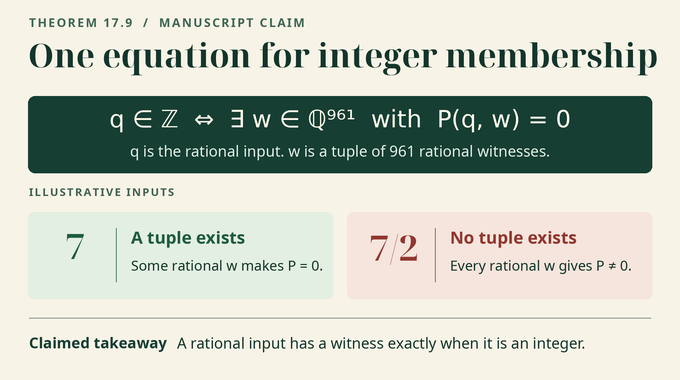
Theorem 17.9 states the defining property of the smaller quartic under the arithmetic results used in Theorem 17.8. Here is the set of ordinary integers, is the rational field, and is any rational input. The polynomial has integer coefficients.
The input takes one slot. The other 961 slots are rational witnesses that may depend on the input. Completeness means that every integer, including zero and the negative integers, admits a witness tuple. Soundness means that a fraction with a reduced denominator greater than one admits none. For instance, the claim guarantees a tuple for 7 and excludes every tuple for . The equivalence supplies no runtime bound for finding a tuple. It describes the image of the rational zero set under projection onto the input coordinate.
5. The Elliptic Curve That Encodes Integer Arithmetic
The original construction works over , where , and . The construction uses the following elliptic curve.
Proposition 3.1 identifies the subgroup of doubles as the infinite cyclic group generated by , with coordinates given below.
The paper writes for the code of the multiple . The point at infinity has a special identity code. Each affine code stores the two rational coefficients of each coordinate in the basis , plus an affine flag. Equality in the quadratic field becomes two rational equations. The rank calculation and a finite height-and-square test establish that the chosen point generates the full doubled subgroup.
For a worked addition, adding the points with labels 2 and 3 gives the point with label 5 by the curve’s group law. Taking the inverse of the point with label 2 gives the label −2. Producing the label 6 from 2 and 3 requires an additional relation. This is where the arithmetic of the indices goes beyond the geometry of adding points.
6. The Six-Contact Height Estimate
Section 4 of the original construction uses the contacts . Write in lowest terms with positive denominator. Its logarithmic height is . The valuation counts the exponent of a prime in the numerator minus its exponent in the denominator. For , the product counts each prime outside the finite exceptional set once if the valuation of is positive and odd for some contact . The set includes all primes up to 324.
The constant depends on the allowed choices of and the size parameter , which are fixed before the estimate is applied. The estimate says that a large numerator or denominator requires enough odd contact at the unexcluded primes, measured by their product. As a simple example, at the contact zero the rational number 331 has valuation one at the prime 331, so that prime contributes if it lies outside the exceptional set. At zero, the same prime has valuation two for the input 109,561, so that contact does not contribute it. The proof relates these valuations to ramification and reduction of a family of abelian surfaces, then uses bounds on their heights to control the original rational parameter.
7. Pole Predicates and the Multiplication Construction
The pole predicate is an existential polynomial test on a rational input . Away from five exceptional primes it rules out negative odd valuations for a nonzero accepted input. This gives the proof an algebraic way to detect odd powers in reduced denominators. For completeness, Theorem 5.2 supplies witnesses when the denominator is a square, the input lies strictly between zero and one half, and it is sufficiently divisible at the five exceptional primes.
The completeness proof uses descent to construct two twists with the required Selmer data. Theorem 5.3 asserts a restricted converse for positive squarefree twist parameters congruent to 11 modulo 12. In that family, 2-primary Selmer corank one implies a simple central zero of the elliptic curve’s L-function. The elliptic curves used here are modular, connecting their arithmetic to modular forms. For background on that connection, see our elliptic-curve modularity explainer. The proof develops theta forms, establishes nonvanishing under specified local support conditions, and compares actual arithmetic classes with central data. These steps supply the converse needed for the pole witnesses. The broader rank question is discussed in our Birch and Swinnerton-Dyer explainer.
Multiplication in Section 6 compares truncated elliptic logarithm ratios at suitable contact primes, including comparisons on the conjugate side. The tests force prime-power divisibility of the error in the proposed product of indices. The height inequality confines any accepted false triple to a fixed bounded box of indices. A polynomial guard excludes each false triple in that box by forbidding its exact point codes. The exponent matters. The contact primes divide the error to order at least 25, while the height bound uses the 24th power of their product. With the error at most quadratic in the largest index, this gives a height bound growing strictly more slowly than the quadratic canonical height of the corresponding elliptic point. The gap makes the exclusion list finite. The prime-pattern construction and pole completeness supply witnesses for genuine products.
8. From Elliptic-Curve Labels to Ordinary Rational Values
Sections 10 and 11 compile exact integer computations, including the required precision calculation, into polynomial constraints on point codes. The ordinary-value argument then links a rational candidate to an encoded index through one shared nonzero shift . A real approximation test makes their distance smaller than for a prescribed bound . Local tests with that same shift force the contact-prime product to divide , where . The six-contact estimate gives .
In this inequality is reduced with . If differs from the integer , the numerator of the difference is a nonzero integer and has absolute value at least one. The resulting lower bound contradicts the strict approximation test. For example, differs from 3 by one tenth, exactly the lower bound coming from its denominator. For completeness the proof first chooses a shift that passes the local tests for the true value, then obtains the approximation for that very shift. Six exceptional integer inputs have separate branches.
9. From 293 Billion Variables to a 962-Variable Quartic
Elliot Glazer’s November 5 announcement highlighted the original polynomial. Version 8 retains that expression tree alongside two quartics. In the table, the double arrow denotes a power tower. The smaller construction shares elliptic comparison points across local tests and uses a Lucas recurrence test and a simultaneous prime theorem. The five-contact height bounds use exponent 24 for the 962-variable construction and exponent 19 for the 4,973-variable version. The smaller quartic’s source tests an auxiliary scalar , so proving that scalar integral also forces the rational input to be integral. The rational number has denominator one whenever is an integer.
| Construction | Total Variables | Degree and Nonzero Monomials |
|---|---|---|
| Original expression tree | 292,890,231,905 | Degree less than . No expanded monomial count. |
| Expanded quartic | 4,973 | Degree 4 with 72,925 nonzero monomials |
| Shared-point quartic | 962 | Degree 4 with 55,409 nonzero monomials |
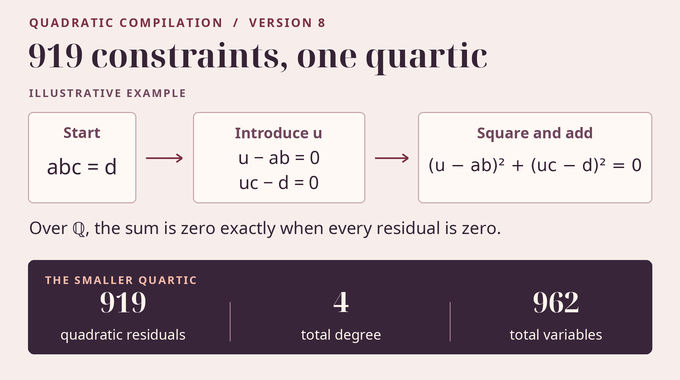
Quadratic compilation assigns a variable to an intermediate product. For example, to impose , introduce and enforce and . The sum of the squares of the two residuals vanishes over the rationals exactly when both do. In the smaller quartic, the analogous sum contains 919 quadratic residuals. The 4,973-variable table writes its coefficients out as integers. The 962-variable table records its largest coefficient, , in exact power notation. Fewer variables and monomials are measures of algebraic size, while actual witness search remains a separate computational question.
Section 18 gives a degree obstruction independent of the construction’s arithmetic inputs. Its quadratic case uses lines and rational conics to rule out infinitely many exclusively integer input values. For cubics it removes cone directions, uses rational parametrization in the sense of unirationality for eligible higher-dimensional cubics, and applies integral Hilbert irreducibility in the plane-curve case. The conclusion concerns total degree of one defining polynomial. The minimum number of variables remains open in the manuscript.
10. How the Polynomial Would Contradict Mazur’s Conjecture
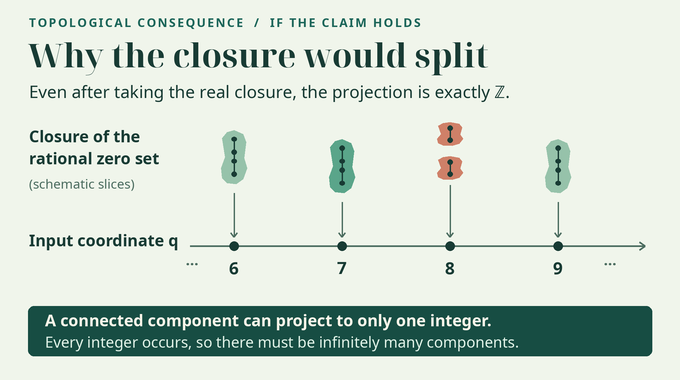
Take the affine zero locus of the defining equation over the rationals and equip it with its reduced variety structure, which leaves its real and rational points unchanged. Write for this variety, for the closure of its rational points inside its real locus, and for the continuous projection onto the input coordinate. The defining equivalence says . Since the integers are closed in the real line, their inverse image is closed and contains every rational point of the variety. It therefore also contains the closure of those points. Every integer was already attained, so .
A continuous image of a connected set is connected. The only nonempty connected subsets of the integers are singletons, so each component of the closure lies over one integer. In particular, witnesses for 7 and 8 must lie in different components. With a component required for every integer, the closure has infinitely many, contradicting the finite connected components conjecture if the defining theorem holds.
11. Beyond Hilbert’s Tenth Problem and the Verification Status
An integer-solvability problem would reduce to one rational-solvability problem by imposing the new membership equation separately on each unknown. Section 13 also combines the definition with MRDP to obtain one universal rational Diophantine polynomial. Fix a machine index and give the polynomial an ordinary integer input. Rational witnesses exist exactly when that machine halts on that input. In the reverse direction, a machine can enumerate rational tuples and halt on finding a zero. Together these translations would make rational solvability many-one equivalent to the halting set. Our explainer on Turing degrees discusses the broader idea of comparing problems by reductions.
The project repository and verification files report independent finite checks of the gate compilation, coordinate changes, eliminations and coefficient expansion. The Lean snapshot contains 48 accepted helper modules, and the main bounded-polynomial declaration still contains sorry, a placeholder for an unfinished proof. The projection theorem also depends on the manuscript’s arithmetic arguments, including the restricted converse and the shared-point prime construction. For comparison, see our coverage of the Lean formalization of Fermat’s Last Theorem. The finite checks establish algebraic facts about the specified polynomial. Independent verification of the full arithmetic proof remains outstanding.
12. The Mazur Conjecture and the Remaining Proof Obligation
The new claim ties the Mazur Conjecture to a concrete zero set. If the arithmetic characterization holds, the 962-variable quartic accepts exactly the ordinary integers and its rational points force infinitely many components in their real closure. The question for reviewers is whether each arithmetic step establishes that exact projection. Follow Binary Verse AI’s coverage of AI and mathematical discovery for research explainers that trace claims back to the evidence behind them.
1. Has Mazur’s conjecture been disproved?
A November 2026 manuscript claims a counterexample to Mazur’s conjecture on the connected components of the closure of rational points. Its construction would disprove the conjecture if correct. Independent verification of the full arithmetic proof remains outstanding.
2. Which of Mazur’s conjectures does the new paper challenge?
It challenges Conjecture 3 in Barry Mazur’s 1995 paper Speculations about the Topology of Rational Points: An Up-date. The conjecture predicts finitely many connected components in the real-topological closure of rational points on a variety over the rationals. The Fontaine–Mazur conjecture concerns Galois representations, and Mazur’s torsion theorem classifies rational torsion on elliptic curves.
3. How does the new result relate to Hilbert’s tenth problem?
OpenAI’s October 2026 preprint claimed undecidability of polynomial solvability over the rational numbers. The November manuscript claims an existential polynomial definition of the integers inside the rationals. This would give a many-one reduction that converts each integer polynomial solvability instance into a single rational polynomial solvability instance.
4. What does Z is Diophantine in Q mean?
One fixed polynomial with integer coefficients characterizes the integers. A rational input is an integer exactly when suitable rational witnesses make the polynomial zero. Version 8 specifies a quartic with 962 variables in total, including the input.
5. Why would this polynomial refute Mazur’s conjecture?
The rational points of the polynomial’s zero set project exactly onto the integers. Since the integers are closed in the reals, the real closure still projects onto the integers. Each connected component can project to only one integer, so there must be infinitely many components.
6. Is the 962-variable quartic the smallest possible polynomial?
The manuscript proves a lower bound of four on the total degree of a single polynomial defining the integers in the rationals. The manuscript leaves open whether a quartic with fewer variables could work.
7. Has the proof been formally verified in Lean?
The Lean formalization is incomplete. The repository contains supporting Lean developments and reproducible checks of the polynomial construction. The main bounded-polynomial declaration still has a proof placeholder, and the finite checks cover the algebraic compilation and coefficient data.