
Out of 318,484 computer-generated protein designs, 211 reached laboratory testing and 17 met the researchers’ binding criteria. None has been shown to neutralize a scorpion toxin. That is the essential finding behind the Claude Scorpion Toxin study, released by Anthropic on October 20, 2026.
An internal research model working within Claude Science coordinated specialist software to design proteins against five dangerous neurotoxins. Its strongest candidate attached tightly to Cn2 and competed with a known neutralizing antibody. The result gives researchers molecules worth investigating, plus a revealing test of AI-directed science: a computer can propose the molecular handshake, but experiments must establish whether it prevents poisoning.
Table of Contents
1. Claude Scorpion Toxin Study: What Did Anthropic Actually Discover?
The achievement is experimental binding across four toxin targets. It is early therapeutic discovery, with the most important biological question still unanswered. In Anthropic’s research announcement, the company describes an agent managing a substantial design campaign, supported by human instructions and two contract laboratories.
1.1 Claude Scorpion Toxin: Key Facts And Evidence
| Measure | Reported Result |
|---|---|
| Computational designs | 318,484 generated |
| Laboratory candidates | 180 initially selected, plus 31 additions: 211 total |
| Qualifying binders | 17 proteins, each qualifying against one toxin |
| Initial campaign duration | 64 hours to the first 180 selections |
| Compute | Approximately 10,000 H100 GPU-hours |
| Therapeutic evidence | No functional neutralization or animal protection demonstrated |
This extends the earlier Claude protein design study toward medically relevant targets. The new question is whether useful design decisions can be delegated within a constrained research workflow. A binder count alone cannot answer whether the eventual treatment will work.
2. Why Scorpion Neurotoxins Are So Dangerous
The five targets interfere with voltage-gated sodium channels, membrane proteins that help generate electrical signals in nerves. These channels open and then inactivate with precise timing. Scorpion toxins can disturb that timing, causing abnormal signaling and downstream neurotransmitter release.
Cn2 and Ts1 are beta-toxins associated with channel receptor site 4. AaH II and AaH I are alpha-toxins associated with site 3, while LqhIII is alpha-like. Broadly, beta-toxins alter activation and alpha-toxins delay inactivation. Severe systemic envenomation can produce cardiovascular and respiratory complications, with children particularly vulnerable.
Existing antivenoms generally use antibodies or antibody fragments obtained from immunized animals. Access varies substantially: the report describes domestic production and public distribution in Brazil and Mexico, alongside cost and availability barriers elsewhere. New molecular designs would still need to reach patients through functioning health systems. Better discovery cannot substitute for distribution.
3. How Protein Binders Could Stop Scorpion Venom
A protein binder attaches to a particular molecular surface. The contacted region is its epitope. A de novo minibinder is a relatively small protein designed computationally rather than isolated directly from an immune response. Its amino acid sequence must support both a stable shape and a useful contact surface.
Here, the intended epitope was the toxin’s channel-binding site. Imagine covering the teeth of a key so it cannot operate its lock. A binder occupying that surface might keep the toxin away from the channel, allowing normal electrical behavior to continue.
But attachment can occur at an unhelpful angle, at the wrong site, or under conditions that do not resemble blood or tissue. Binding therefore establishes molecular recognition. Neutralization requires a functional experiment showing that the toxin’s harmful activity is prevented. The distinction between predicted geometry and measured behavior also underlies our guide to interpreting protein-structure predictions.
4. How Autonomous Was Claude? What Did The Human Researchers Do?
Five human messages shaped the main campaign: an initial prompt and four follow-ups. That compact description should not obscure how much scientific setup the first prompt supplied. Humans specified the five toxins, the channel-binding site, design groups and sizes, candidate tools, scoring formulas, and novelty and diversity rules.
Claude selected target structures and individual amino acid hotspots, allocated work among tools, set score thresholds, and developed multi-toxin design strategies. It also chose domain order and linkers for fusion designs. These were consequential decisions inside an assigned problem.
The follow-ups mattered. Anthropic says most of the initial 180 selections, including Cn2-B1, came after the third follow-up. The five-message count therefore describes sustained human direction, even though Claude handled the intervening computational work. It is an intervention history, not a measure of scientific effort.
Citrini Research, a financial investment research firm, initiated the collaboration by asking whether motivated nonexperts could tackle a real health problem with AI. Anthropic’s life-science team helped frame the study. Adaptyv Bio and Twist Bioscience produced proteins and measured their binding.
Anthropic also reports that Claude analyzed data, generated figures, and drafted the report under supervision. This resembles the division of responsibilities explained in our agent harness guide: autonomy depends on the surrounding tools and constraints. It does not mean an unsupervised chatbot invented the project or performed laboratory experiments.
5. Inside Claude’s 64-Hour Protein Design Campaign
Claude used 12 existing backbone or combined backbone-and-sequence design tools, including RFdiffusion3, RFdiffusion, BoltzGen, and FreeBindCraft. Additional sequence-design tools worked on fixed backbones. This was a coordinated search across specialist systems, rather than Claude directly writing every molecular structure.
Computational filters removed candidates resembling toxins or known proteins, carrying specified sequence liabilities, making too few interface contacts, or showing low predicted monomer confidence. Filtering for novelty and plausibility does not itself establish safety.
Three structure predictors, ESMFold2-Fast, ESMFold2, and Protenix v2, modeled candidates together with their intended toxins. Two main scores assessed interface confidence and agreement with the intended binding pose. Claude screened 553,052 design-toxin pairs and more extensively ranked 28,451 pairs. One design can contribute several pairs because it may target several toxins.
Those scores were useful filters, but imperfect selectors. The final computational score tracked differences in success between design groups without reliably identifying binders within each group. Agreement among predictors is therefore evidence of computational plausibility. It is not a calibrated probability that a protein will bind, let alone work as a medicine.
The initial shortlist emerged after 64 hours, using approximately 10,000 H100 GPU-hours. GPU-hours sum work across processors, so parallel computation makes this compatible with a much shorter elapsed time. It also makes the campaign substantially more resource-intensive than a casual chat session. For developers, this is a concrete agentic workflow with expensive tools and an external validation stage.
6. From 318,484 Designs To 211 Real Laboratory Tests
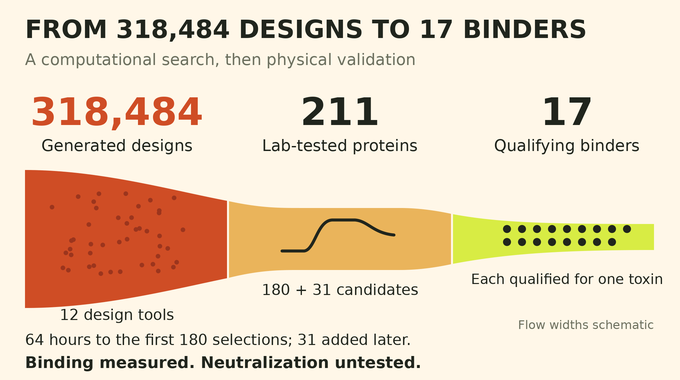
Claude first selected 180 candidates. Researchers later worked with it to add 31 more, bringing the tested set to 211. Adaptyv Bio expressed designs in a cell-free system. Twist Bioscience produced them in human cells as fusions to an antibody Fc region, a different molecular format.
Surface plasmon resonance, or SPR, tracks binding at a sensor surface. Reverse biolayer interferometry, or BLI, switched which partner was immobilized to check whether the result depended on assay orientation. These complementary measurements help expose surface-related artifacts.
The technical report’s binder criteria required reproducible hits at both laboratories, every main-screen at one micromolar or tighter, an acceptable maximum response at Twist, and no above-background binding to the unrelated protein CLEC12A. is the dissociation constant, a concentration-based measure of affinity. Smaller values generally indicate tighter binding under the assay conditions.
Importantly, researchers set these classification criteria after seeing the data. LqhIII had modified criteria because only Adaptyv tested it. The recombinant toxins’ biological activity was undocumented, and some control assays were inconclusive. These are binding measurements against laboratory preparations, not proof that active venom has been disarmed.
The maximum-response criterion checked whether the fitted signal remained compatible with one toxin molecule per binding site. Excess signal can suggest an assay artifact or another interaction. Even this check depended on assumptions: the AaH I binders passed using the toxin mass derived from Twist’s values, but not the lower mass of the mature toxin.
Replication across laboratories is valuable precisely because these details matter. Differences in expression system, fusion format, immobilization, and toxin preparation can change what a sensor records. A reproducible signal across several arrangements strengthens the case for binding, while disagreements identify where cleaner measurements are needed. Neither outcome should be reduced to a simple scoreboard.
7. The 17 Successful Protein Binders: Results Across Five Toxins
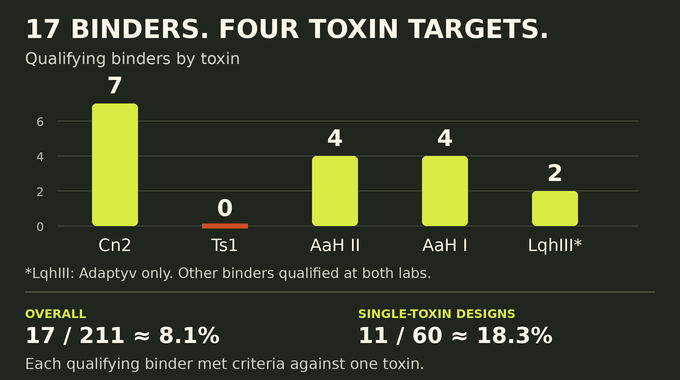
7.1 Qualifying Scorpion Neurotoxin Binders By Target
| Toxin | Binders | Main-Screen Evidence |
|---|---|---|
| Cn2 | 7 | Qualifying results at both laboratories |
| Ts1 | 0 | No design met the criteria |
| AaH II | 4 | Qualifying results at both laboratories |
| AaH I | 4 | Qualifying results at both laboratories |
| LqhIII | 2 | Adaptyv Bio only; modified criteria |
Across the full tested set, the qualifying fraction was:
The single-toxin group produced 11 binders from 60 candidates, approximately 18.3%. The remaining six came from 151 designs intended for multiple toxins, but each qualified against only one. These denominators answer different questions. Neither percentage describes success across all 318,484 generated designs, most of which were never tested physically.
Laboratory agreement also had limits. Reverse BLI detected all 17 at Adaptyv, but only 12 of the 15 assessed at Twist. AaH II affinity estimates differed between laboratories by as much as 51-fold. Anthropic’s released designs and experimental data allow researchers to examine those discrepancies rather than relying on the headline count.
8. Cn2-B1: The Strongest Evidence For A Potential Antivenom
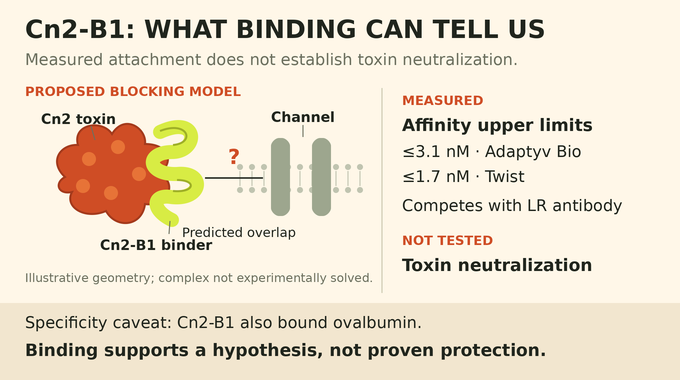
The Cn2-B1 protein binder is a 104-residue RFdiffusion3 design. SPR estimates were approximately 3.1 nanomolar at Adaptyv and 1.7 nanomolar at Twist. Both are estimated upper limits because its slow dissociation and imperfect single-site fits prevented a clean affinity determination. Reporting them as precise, definitive measurements would overstate the experiment.
The more revealing evidence involves LR, an antibody fragment previously shown to neutralize Cn2. When LR occupied toxin on the sensor, Cn2-B1’s binding signal fell substantially. A second antibody, RU1, binds a different epitope and had much less effect. This competition pattern supports binding on or near LR’s region.
A predicted Cn2-B1 complex also overlaps the channel-binding region when aligned with a known toxin-channel structure. That provides a plausible blocking mechanism. However, the binder-toxin complex has no experimentally solved structure, and competition does not measure whether a sodium channel resumes normal function.
There is another caveat: Cn2-B1 bound ovalbumin, an unrelated control protein, although much higher concentrations were needed. Ovalbumin was excluded from the formal binder criteria. Requiring no ovalbumin hit would reduce the total from 17 to 15. Broader specificity testing is essential before treating Cn2-B1 as a therapeutic lead. As in our Claude enzyme discovery analysis, an interesting molecular finding leaves important functional questions open.
9. Why Claude Failed To Create A Multi-Toxin Binder
The five toxins share a broad fold, but pairwise amino acid sequence identity ranges from 26% to 62%. Similar overall shapes can carry different chemical surfaces. A binder must accommodate those local differences while retaining its own stable structure.
None of the 151 multi-target designs qualified against more than one toxin. The result establishes failure within this campaign, not the impossibility of broad toxin recognition. Indeed, existing antibody research provides examples of cross-reactive neutralization.
Several limitations prevent a simple diagnosis. The 59 all-five single-domain designs shared only two backbones. Fusion designs joined domains that had either failed to qualify separately or were never tested separately. Ts1 assay uncertainties also complicate interpretation of the double-beta group.
For Ts1, the report raises possible incorrect disulfide formation in bacterial expression and possible interference from a terminal tag. Neither explanation was demonstrated. A zero in the results table means no candidate cleared the stated criteria with these preparations. It does not cleanly separate failed molecular design from an unsuitable target preparation.
Possible causes include prompting, tool limitations, restricted structural diversity, and biological difficulty. The study does not isolate their contributions. A practical regional antivenom might instead combine several validated binders. Covering these five geographically dispersed toxins with one molecule was a demanding research test, rather than a necessary product specification.
10. Was This A Scientific Breakthrough Or Clever Use Of Existing AI Tools?
Using existing tools can still produce valuable science. Here, the contribution is coordinating decisions across de novo protein design and validating selected outputs experimentally. The report presents the scorpion binders as new while explicitly acknowledging earlier design methods and toxin research.
The relevant precedent is the 2025 Nature study of designed snake-toxin binders, which demonstrated functional neutralization and mouse protection. That work went further biologically than this scorpion study. Related AI-designed antibiotic research also illustrates why generating candidates and demonstrating useful activity are separate milestones.
AlphaFold addresses a different part of the problem: predicting molecular structures and interactions. Claude managed a campaign involving design and prediction tools. Our AlphaFold explainer provides the structural background, but this experiment is no direct contest between the two.
Crucially, there was no matched expert or fixed-pipeline baseline. The authors therefore cannot isolate Claude’s added value or quantify time and cost savings. The single-toxin success rate was consistent with their earlier campaigns. The evidence supports capable orchestration producing real binders. It does not establish superior scientific judgment or exceptional therapeutic effectiveness.
11. What Must Happen Before Claude’s Proteins Become Real Antivenoms?
First, candidates should bind toxins purified from venom. Cell-based patch-clamp experiments must then show that they prevent toxin-induced sodium-channel disruption without altering currents themselves. Animal studies would need to progress from purified toxin to whole venom and, critically, treatment after exposure rather than only premixing.
Development must also establish specificity, immunogenicity, serum persistence, stability, manufacturing quality, and achievable dosing. The present study measured neither production cost nor thermal stability. Claims that Claude scorpion antivenom will be cheap or readily available remain hypotheses.
Whole venom adds a further challenge: an individual toxin is only one component of an exposure. Protection must cover the medically relevant mixture, and a treatment must work when given after a sting. For developers assessing AI discovery systems, that changes the success metric from producing promising molecules to advancing candidates through independent biological tests.
Our Crohn’s disease research analysis explains the importance of functional biological validation, while the rentosertib trial review illustrates how much more evidence is needed when claims reach patients. Even protein provenance, discussed in our SynthID Bio explainer, answers a different question from whether a molecule is safe and effective.
The next decisive result would be demonstrated neutralization, followed by protection against medically relevant venom. The Claude Scorpion Toxin study supplies testable candidates and unusually detailed data, while exposing the distance between designing molecules and developing medicines. Follow Binary Verse AI for evidence-led analysis of AI biology, including what those next experiments actually establish.
Did Claude actually create a scorpion antivenom?
No. Claude designed 17 proteins that met the study’s criteria for binding selected scorpion neurotoxins. As of the October 20, 2026 report, none had been shown to neutralize toxin activity in functional assays or protect animals.
What does scorpion toxin do to the human body?
The neurotoxins studied interfere with voltage-gated sodium channels, disrupting normal nerve signaling and triggering downstream neurotransmitter release. Severe envenomation can cause dangerous cardiovascular and respiratory complications. The research aimed to prevent toxin-channel interactions, but has not yet demonstrated that effect for its binders.
Is 17 successful protein binders out of 211 an impressive result?
Seventeen of 211 tested candidates met the researchers’ criteria, approximately 8.1%. The single-toxin group produced 11 binders from 60 candidates, approximately 18.3%. The authors describe the single-toxin rate as consistent with earlier protein-design campaigns. These are binding results, not measures of therapeutic effectiveness, and the two LqhIII binders were measured at only one laboratory.
Why couldn’t Claude design a universal scorpion antivenom?
None of the 151 multi-toxin designs met the binding criteria against more than one toxin. Differences between toxin surfaces, restricted design diversity, prompting, and tool limitations could have contributed. The study did not establish one cause or show that broad toxin recognition is impossible. A universal antivenom would also require demonstrated neutralization and much broader venom coverage.
Did Claude design the proteins independently or merely use existing software?
Claude coordinated existing protein-design and structure-prediction tools and made decisions about structures, hotspots, thresholds, and design strategies. Humans supplied the targets, channel-binding-site objective, tools, scoring rules, and follow-up instructions. Laboratory teams produced and tested the proteins. It was substantial autonomy within a human-defined campaign.
How is Claude’s protein design different from AlphaFold?
AlphaFold primarily predicts molecular structures and interactions. Claude’s role here was to plan and execute a campaign using multiple specialist design and prediction tools. This experiment was not a direct benchmark showing that Claude outperforms AlphaFold or expert scientists.
Could Claude’s protein binders eventually make scorpion antivenom cheaper?
Potentially, if suitable designed proteins can be manufactured and distributed economically. However, the study did not measure production costs, thermal stability, or clinical usefulness, and neutralization and safety remain unproven. It establishes no treatment availability date.