
A finite list of rules can describe an infinite group. The hard question is whether that group can also be simple while containing every operation of another group faithfully. OpenAI’s September 23, 2026 manuscript presents a positive proof of the Boone Higman conjecture: a finitely generated group has a decidable word problem exactly when it embeds in a finitely presented simple group.
The missing requirement was finite presentation of the simple container itself. The 35-page research paper builds that container through algebras, elementary matrices, and a permutation action. OpenAI reports a full Lean formalization too. Those are specific, inspectable claims, rather than evidence that every step has received independent review.
Table of Contents
1. What Is the Boone Higman Conjecture?
A group combines elements through an associative operation, with an identity and inverses. It is finitely generated when finitely many elements and their inverses produce every element. A finite presentation additionally supplies finitely many defining relations. Finite generation gives an alphabet. Finite presentation gives a finite rulebook.
The word problem asks whether a string of generators represents the identity. For integers under addition, a string of positive and negative unit steps represents zero precisely when its net displacement is zero. Decidability requires an algorithm that terminates with the correct answer for every input, with no speed requirement.
A simple group is nontrivial and has no normal subgroups except itself and the identity subgroup. “Simple” describes this internal structure, not computational ease. An embedding is an injective homomorphism, preserving multiplication without identifying distinct elements. The target requirement is:
Here is the input group, and must be both finitely presented and simple.
1.1. Boone Higman Conjecture: Key Facts
| Item | Verified Manuscript Scope |
|---|---|
| Manuscript | Finite Algebraic Envelopes and the Boone–Higman Conjecture |
| Date and length | September 23, 2026; 35 pages |
| Input | Finitely generated group supplied with a word-problem decider |
| Claimed target | Nontrivial finitely presented simple group |
| Formalization | Full equivalence reported in OpenAI’s scope notes |
| Efficiency | No general efficient runtime guarantee established |
2. The 53-Year Barrier: Why the Original Theorem Wasn’t Enough
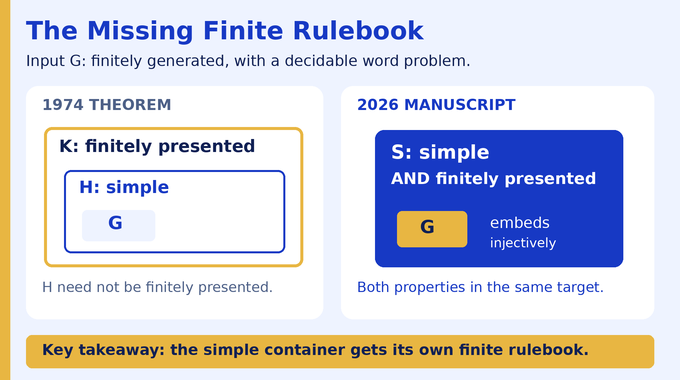
The conjecture first appeared in print in 1973. Boone and Higman’s 1974 theorem established a chain:
Here is simple and is finitely presented. Finite presentation does not generally pass to subgroups, so the finite rulebook for supplies no finite rulebook for . The researchers’ historical survey explains this distinction and the conjecture’s origins.
Higman’s 1961 embedding theorem addresses groups with computably enumerable defining relations. Such an enumeration can certify equality eventually, but need not decide inequality. Thompson later obtained a finitely generated simple overgroup with decidable word problem. Finite generation still left the presentation problem open.
Earlier positive cases covered substantial families, including hyperbolic groups and contracting self-similar groups. The proposed advance handles arbitrary finitely generated inputs with a decider. Readers of our Cannon conjecture analysis will recognize hyperbolic groups, although the geometric question there differs from this embedding problem.
3. What OpenAI’s Boone Higman Conjecture Proof Establishes
Theorem 1.1 states the exact equivalence for every finitely generated group. The constructive direction takes a finite generating set and a word-problem decider. The input need not itself be finitely presented.
Theorem 1.2 supplies a stronger intermediate structure: an embedding into a finitely presented group acting faithfully and two-transitively on a countably infinite set, with finitely generated point stabilizers. Faithfulness means only the identity fixes everything. Two-transitivity means any ordered pair of distinct points can be moved to any other.
An established criterion proved by Zaremsky converts such an action into an embedding in a finitely presented simple group. It needs finitely many orbits on unordered pairs, which two-transitivity supplies. Thus the new construction must deliver a suitable action. The final simple-group machinery already exists.
That dependency matters when assigning credit. The paper combines earlier embedding technology with new algebraic and computational constructions, rather than rebuilding every ingredient from scratch.
OpenAI’s release announcement attributes the collection to an internal frontier model. It does not provide a separate production history for every mathematical step in this manuscript. The technical assessment therefore rests on its statements, dependencies, and accompanying artifacts, rather than assumptions about how autonomously the proof was found.
4. The HNN Extension: Preparing the Group for an Embedding
Lemma 2.1 enlarges the input to an auxiliary group containing two copies of . An HNN extension adds a stable letter that conjugates the diagonal copy to the second factor. Britton’s lemma ensures the original product group survives injectively.
Using the convention , the relation gives:
This turns each original element into a controlled commutator, preparing the later matrix embedding.
The enlarged group retains a decidable word problem. The input decider tests membership in the diagonal and second factor. Each available HNN reduction removes two stable letters. A reduced word still containing a stable letter is nontrivial. Otherwise, its two coordinates can be tested directly.
The construction preserves exactly the computational input needed downstream. Losing decidability here would invalidate the algebraic construction that follows, even if the abstract group embedding remained valid.
5. Finite Algebraic Envelopes: Building the Required Algebraic Data
Theorem 2.2 works over , the field with two elements. It constructs a finitely presented algebra containing a simple subalgebra , whose unit group contains . Algebraic simplicity concerns two-sided ideals, rather than normal subgroups.
An injective nonunital homomorphism sends its entire image into . Nonunital means it need not preserve the identity. Its support differs from . This will make shifts between successive stages detectable.
Two splitting pairs commute with the coefficient image and divide that support into equivalent pieces. Separately, a vector detects every nonzero tensor coefficient after applying the induced map. These are independent requirements, each solving a different obstruction.
5.1. Algebraic Ingredients and Their Jobs
| Ingredient | Required Property | Role in the Proof |
|---|---|---|
| Simple subalgebra | Every nonzero two-sided ideal contains its identity | Enables operations between nonzero vectors |
| Finite algebraic presentation | Finitely many generators and defining relations for the ambient algebra | Supplies the finite group presentation |
| Injective nonunital map | Image lies in the simple subalgebra; support differs from the ambient identity | Preserves elements and makes stage shifts detectable |
| Commuting splitting pairs | Two equivalent pieces divide the image support | Annihilate the Steinberg matrix kernel |
| Separating vector | Every nonzero tensor coefficient is detected after the transition | Establishes faithful matrix action |
The construction distinguishes a monoid’s absorbing zero from the zero vector of its algebra. That bookkeeping controls injectivity. Our Kaplansky group-algebra explainer provides related background on coefficients and cancellation, although its zero-divisor question is separate.
6. The Monoid Construction and Self-Referential Compiler
A monoid has associative multiplication and an identity, but inverses are optional. The paper constructs a finitely presented monoid and a finitely generated, decidable monoid that encode one another.
Their contracted monoid algebras use nonzero monoid elements as basis vectors, interpreting an absorbing-zero product as the zero vector. Selectors isolate one term from any finite sum while annihilating the others. Consequently, every nonzero ideal of the relevant algebra contains its identity, proving simplicity. A separate separator preserves ordered pairs of basis terms, preventing distinct tensor contributions from becoming indistinguishable.
The apparent circularity is addressed explicitly. A finite presentation is compiled from a program index before assuming the program terminates. Kleene’s recursion theorem then supplies a self-referential index. Long encodings force evaluations needed at word length to depend only on strictly shorter inputs. Induction establishes termination, consistent normalization, and compatibility with multiplication.
Appendix A also checks malformed machine configurations and equations used backwards. A successful simulated run alone would not prove the monoid claims. This is where the construction’s computational foundations receive their detailed justification.
7. From Coefficient Rings to a Finitely Presented Affine Steinberg Group
The coefficient ring combines left and right multiplication:
The superscript denotes the opposite algebra, with reversed multiplication. A coefficient acts on by . Finite sums give combinations of such operations.
Elementary matrices add a coefficient multiple of one vector coordinate to another. The Steinberg group encodes these operations through generators and relations, mapping onto the elementary matrix group. Existing finite-presentation results apply to this noncommutative coefficient ring.
The paper then proves that the affine group is finitely presented. Its translation subgroup is the additive group of six-coordinate vectors. Crucially, the proof supplies finite relations governing both translations and their interaction with elementary operations. Finite presentation of the separate ingredients would not automatically establish finite presentation of their semidirect product.
This establishes a finite rulebook for a sufficiently rich action. The remaining problem is that some nontrivial Steinberg elements may act as identity matrices.
8. The Decisive Breakthrough: Annihilating the Steinberg Kernel
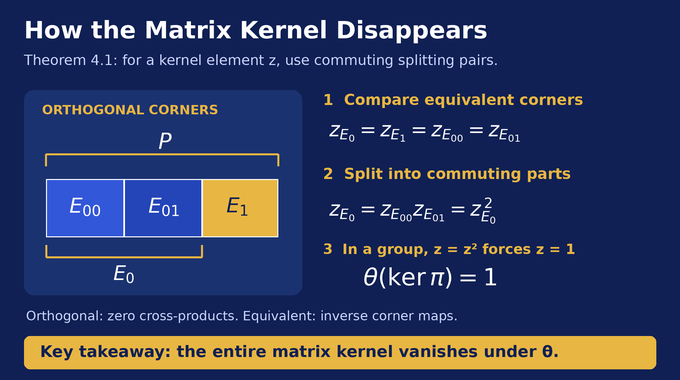
Let denote the map from the Steinberg group to elementary matrices. Its kernel consists of elements whose matrix image is the identity. Such elements threaten faithfulness: the abstract group could contain operations invisible to the intended action.
The coefficient map induced by defines a Steinberg endomorphism . Theorem 4.1 proves:
The calculation uses equivalent orthogonal corners, meaning subalgebras supported on idempotents whose cross-products vanish. It establishes centrality for particular corner images through explicit Steinberg relations, without assuming the original kernel is central.
The four-corner comparison involves a support corner, two pieces, and a further splitting of one piece. Equivalent corners yield equal images of a kernel element. Orthogonal splitting makes the parent image the product of its child images. Hence that image equals its own square and must be the identity in a group. The other piece also vanishes, killing the whole kernel image.
This is the exact cancellation the later construction needs. Merely shrinking the kernel would leave the action’s faithfulness unresolved.
9. The Mapping Torus: Preserving Finite Presentation While Removing the Obstruction
The transition endomorphism combines the coordinate map with the Steinberg map. It need not be injective, precisely because the latter kills the kernel. The paper handles this using a mapping torus, adjoining a stable letter that implements the transition through conjugation.
Only finitely many new relations are needed, one for each chosen generator of the finitely presented base. Lemma 5.1 proves the resulting group has a direct-limit description even for a noninjective endomorphism. It does not assume the entire base embeds unchanged.
In that limit, the Steinberg kernel disappears. The elementary-matrix transition remains injective because the coefficient map is injective. Its formula preserves the full identity matrix while applying the nonunital map to deviations from that identity.
The result is a finitely presented group combining translations, surviving elementary matrices, and a stage shift. Each ingredient has a distinct purpose: move points, control relative positions, and connect successive copies of the algebra.
10. Why the New Group Action Is Faithful and Two-Transitive
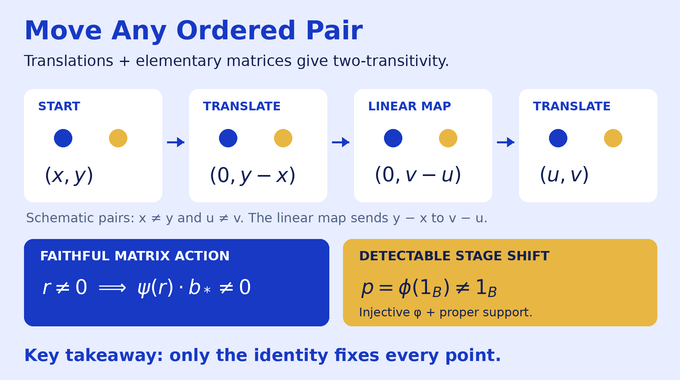
The action takes place on , where is the additive direct limit of under . Finite generation over a finite field makes each stage countable. Proper support makes successive stages strictly larger, so their union is countably infinite.
The separating vector detects any nonzero entry of a nonidentity matrix after one transition. Injectivity ensures the detected difference survives. Evaluating an affine operation at zero detects its translation. A nonzero stage shift cannot masquerade as an affine operation, because affine elements eventually preserve individual stages while the shift moves them.
For two-transitivity, move two nonzero vectors to a common stage and advance once into . If a coordinate is nonzero, simplicity says finite sums of left and right multiples of produce any element of . Elementary operations use that coordinate to set another coordinate to the identity and then clear the others. Every nonzero vector reaches the same standard vector.
Translations finish the ordered-pair argument. The zero stabilizer is a finitely generated quotient of the whole group, and other point stabilizers are conjugate to it.
11. Completing the Proof: From Elementary Matrices to a Simple Group
The original group must still embed in this action group. Units of are first converted into units of by adding the complementary identity, then into units of the coefficient ring.
Balanced elementary diagonal matrices put a unit and its inverse in two coordinates. Taking commutators on overlapping coordinate pairs cancels the unwanted entries. Lemma 2.1’s controlled commutator leaves exactly the original group element in one diagonal position. This defines an injective homomorphism, and injective matrix transitions preserve it through the limit.
Now every hypothesis of Zaremsky’s criterion is available: finite presentation, faithfulness, finitely generated point stabilizers, and one orbit on unordered pairs. The twisted Brin–Thompson construction embeds the action group in a nontrivial finitely presented simple group. Composing embeddings gives the required target.
The Thompson connection is structural. Our Thompson’s group F analysis discusses a different member of that broader family and a different question. The endpoint here uses twisted Brin–Thompson groups, not a claim that F itself supplies the desired simple container.
12. Why the Converse Holds and What the Proof Does Not Establish
For a nontrivial finitely presented simple group, run two searches in parallel. One enumerates proofs that the input word is the identity. The other adds that word as a relator and searches for proofs that every generator becomes the identity.
If the word is nontrivial, simplicity makes its normal closure the whole group, so the second search succeeds. If it is trivial, the first succeeds and the second cannot trivialize the original nontrivial group. Substituting words for a subgroup’s finite generators transfers this decider to the subgroup.
The construction requires a decider as input. It neither identifies all qualifying groups automatically nor promises efficient execution. Unlike the explicit complexity guarantees examined in our subset sum analysis, this is a structural characterization with no demonstrated general runtime advantage.
For developers, a useful distinction is that accepting a supplied decider does not include proving arbitrary programs terminate. For researchers, the immediate payoff is a proposed general embedding method whose hypotheses can be checked against their particular group. Neither implication supplies a benchmark for symbolic computation software.
As checked on October 13, 2026, OpenAI’s formalization scope notes report the full equivalence, and the comparator configuration points to a separate solution module. This article does not reproduce that verification or establish independent peer review. Our Fermat formalization explainer discusses why statement alignment and mechanical checking both matter.
The Boone Higman conjecture connects an algorithmic property with a finite algebraic container. Its proposed resolution gives researchers a concrete dependency chain to inspect. Follow Binary Verse AI’s AI mathematical proof coverage for explanations that trace the construction and distinguish published evidence from reproduced verification.
1. What is the Boone–Higman conjecture?
The Boone–Higman conjecture states that a finitely generated group has a decidable word problem if and only if it can be embedded in a finitely presented simple group. A decidable word problem means there is an algorithm that determines whether any given word in the group’s generators represents the identity.
2. Has the Boone–Higman conjecture been solved?
OpenAI’s September 23, 2026 paper, Finite Algebraic Envelopes and the Boone–Higman Conjecture, presents a positive proof of the full conjecture. Its central theorem establishes both directions of the equivalence. The manuscript is publicly available, although independent peer review and formal verification are separate from the proof presented in the paper.
3. What prevented earlier mathematicians from proving the Boone–Higman conjecture?
The original Boone–Higman theorem embedded groups with decidable word problems into simple groups contained within finitely presented groups. The unresolved difficulty was ensuring that the simple containing group itself had a finite presentation. Earlier results established this for important classes of groups, but not all finitely generated groups with decidable word problems.
4. How does OpenAI’s proof overcome the finite-presentation barrier?
The proof constructs a finitely presented affine Steinberg group using a simple algebra embedded in a finitely presented algebra. A coefficient endomorphism eliminates the Steinberg kernel, while a mapping torus produces a finitely presented group with a faithful, two-transitive action and finitely generated point stabilizers. An existing twisted Brin–Thompson construction then provides the finitely presented simple group.
5. Does the proof provide an algorithm for embedding every finitely generated group into a simple group?
No. The constructive direction requires a finitely generated group together with an algorithm deciding its word problem. From that input, the paper constructs an embedding into a finitely presented simple group. It does not assert that every finitely generated group qualifies, nor does it establish a general efficient running-time bound for the construction.