A personalized mRNA cancer vaccine has just crossed a line cancer researchers have been trying to reach for years.
On August 19, 2026, Moderna and Merck announced that intismeran autogene, a made-to-order mRNA treatment combined with Keytruda, met key efficacy endpoints in a large Phase 3 melanoma trial. It reduced the risk of cancer returning and spreading compared with Keytruda alone. It is the first positive late-stage result of its kind for an individualized mRNA cancer therapy.
The part getting less attention is how personalized the treatment actually is. Moderna uses AI algorithms to analyze sequencing data from each patient’s tumor and blood, rank cancer-specific mutations, and select up to 34 neoantigens for that patient’s mRNA treatment. AI is also used to coordinate the unusually complex manufacturing process.
That doesn’t mean “AI cured cancer.” The tumors in this study had already been surgically removed, overall-survival data are still pending, and melanoma is only one cancer. But strip away the hype and something genuinely important remains: a personalized mRNA cancer vaccine, partly designed through AI-assisted mutation analysis, has now shown clinical benefit in Phase 3.
Table of Contents
1. What Moderna’s Phase 3 mRNA Cancer Vaccine Actually Achieved
The study, called INTerpath-001, tested intismeran autogene (V940, formerly mRNA-4157) alongside pembrolizumab, better known as Keytruda.
Patients had high-risk stage IIB to IV melanoma that had been completely removed by surgery. The question wasn’t whether the vaccine could make large metastatic tumors disappear. It was whether the combination could stop hidden residual cancer cells from eventually bringing the disease back. The topline result says it did better than Keytruda alone.
mRNA Cancer Vaccine Phase 3: Key Trial Facts and Results
The distinction between those endpoints matters. Recurrence-free survival (RFS) measures how long patients remain alive without the cancer returning. Distant metastasis-free survival (DMFS) looks specifically at cancer spreading to distant parts of the body. Neither is the same as proving that patients live longer overall.
The companies have not yet released the complete Phase 3 numerical dataset, and overall-survival results aren’t available yet. Those details are expected to matter heavily when the full results are presented.
There’s also a useful distinction between the new Phase 3 result and older data that are already circulating online.
mRNA Cancer Vaccine Results: What the Phase 2 and Phase 3 Data Actually Show
The five-year Phase 2b results are impressive, but they are relative risk reductions, not an “mRNA cancer vaccine success rate” of 49% or 59%.
2. How Moderna Used AI to Personalize the Treatment
This is where the story becomes as much a computing problem as a drug-development problem. Cancer isn’t one fixed target. Even two people with the same diagnosis can carry very different tumor mutations. That makes a universal target difficult to choose.
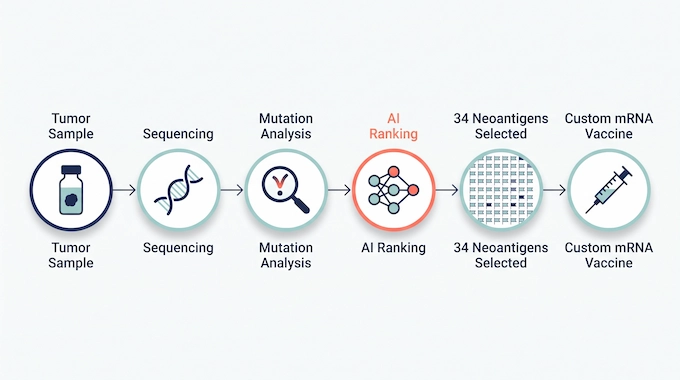
Moderna’s approach starts with sequencing data from the patient’s tumor and blood. Its AI system reviews the mutations and predicts which resulting neoantigens are most likely to trigger a useful immune response. Up to 34 neoantigens can then be selected and encoded into that patient’s custom mRNA therapy. The basic pipeline looks like this:
Tumor sample → sequencing → mutation analysis → AI-assisted neoantigen ranking → up to 34 targets selected → custom mRNA produced → treatment administered
A neoantigen is essentially a molecular flag created by a tumor mutation. Because normal cells shouldn’t carry the same abnormal target, neoantigens give the immune system something relatively specific to hunt.
The AI assisted mRNA cancer treatment claim is therefore real. It isn’t simply a trendy label added after the fact. But AI isn’t doing every step.
Sequencing identifies genetic changes. Biological and immunological constraints matter. Manufacturing still has to produce the molecule. And the therapy ultimately works through the patient’s immune system. AI’s key design job is helping decide which mutations are worth turning into immune targets.
3. This Wasn’t ChatGPT Designing a Cancer Drug
The internet quickly jumped from “AI-assisted” to assumptions about Transformers, large language models, and generative AI. There is no public evidence supporting that leap.
Moderna describes “fully integrated AI algorithms” for neoantigen prediction, but its public explanation does not identify the architecture as a Transformer, LLM, mixture-of-experts system, or anything resembling ChatGPT. That’s an important distinction. The problem being solved is closer to biomedical prediction and ranking:
Given thousands of tumor mutations, which resulting neoantigens are most likely to provoke the immune response we want?
That’s very different from asking a language model to invent a treatment from a prompt.
The timeline also kills the idea that this somehow appeared because of the recent generative-AI boom. Moderna and Merck were already developing this individualized cancer-vaccine platform years before ChatGPT. INTerpath-001 itself started in July 2023. AI in biology has a much longer history than AI chatbots.
4. From One Tumor to One Personalized mRNA Cancer Vaccine
The word personalized is doing serious work here. This isn’t simply a standard vial selected according to a patient’s diagnosis. The treatment is designed around the mutation signature of an individual patient’s cancer.
Moderna says its platform uses both DNA and RNA sequencing information to identify neoantigens created by tumor mutations. Those selected targets are encoded into synthetic messenger RNA.
After injection, cells use those mRNA instructions to produce the selected antigens. The immune system can then learn to recognize them and mount a T-cell response against cells carrying the matching tumor signals. In other words, the mRNA acts less like a conventional drug molecule and more like a temporary set of instructions. The drug changes because the patient’s cancer changes.
That’s what makes a personalized mRNA cancer vaccine scientifically attractive, and operationally awkward.
5. Why Intismeran Autogene Needs Keytruda
One misleading way to describe the result would be:
Moderna’s vaccine beat cancer.
The Phase 3 treatment was actually a combination.
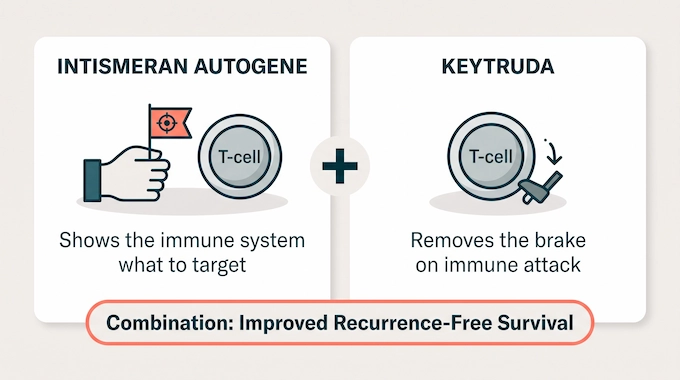
Intismeran autogene provides tumor-specific targets. Keytruda, Merck’s anti-PD-1 checkpoint inhibitor, helps T cells stay active against the tumor.
A simplified way to think about it is:
- Intismeran helps tell the immune system what to look for.
- Keytruda helps remove one of the brakes that can stop the immune system from attacking it.
That distinction matters because INTerpath-001 did not compare the mRNA therapy alone with no treatment. It compared intismeran plus Keytruda against Keytruda alone. The Phase 3 breakthrough is therefore evidence that the personalized vaccine adds something meaningful on top of an established immunotherapy.
6. Did the mRNA Cancer Vaccine Cure Cancer?
No.
That answer should not be softened, because “AI cured cancer” is already an irresistible headline waiting to outrun the evidence. First, the trial involved melanoma, not cancer as a single universal disease.
Second, patients underwent surgery to remove their tumors before receiving the experimental therapy. This was an adjuvant treatment designed to reduce the chance that remaining microscopic disease would cause recurrence.
Third, we don’t yet know whether the Phase 3 combination improves overall survival. The trial is continuing to evaluate that endpoint. So the correct interpretation is narrower, but still significant:
In high-risk patients whose melanoma had been completely resected, adding an individualized mRNA therapy to Keytruda significantly improved measures of recurrence and distant spread. That’s not “cancer cured.”
It is, however, exactly the kind of result you’d hope to see on the path toward keeping more patients cancer-free after treatment.
7. Why Stage IV Doesn’t Mean It Cured Widespread Metastatic Cancer
Seeing “stage IIB-IV melanoma” in the trial description creates another easy misunderstanding. Stage IV normally evokes advanced metastatic disease. But INTerpath-001 enrolled people whose melanoma had been completely resected.
The study therefore doesn’t demonstrate that doctors can inject the Moderna melanoma vaccine into someone carrying widespread active metastatic tumors and make those tumors disappear.
It asks a different question: after surgeons have removed detectable disease, can the immune system be trained to eliminate or suppress the malignant cells that may still remain?
ClinicalTrials.gov describes INTerpath-001 specifically as an adjuvant study designed to determine whether intismeran plus pembrolizumab prevents cancer from returning better than pembrolizumab alone.
That is a major medical goal, but it shouldn’t be confused with treating unresected metastatic disease.
8. Why Melanoma Was Such an Important First Test
If personalized neoantigen vaccination worked in melanoma, can we simply copy the recipe to every cancer?
Probably not.
Melanoma was an attractive proving ground partly because it tends to carry a high number of mutations. More mutations can mean more abnormal neoantigens for the immune system to recognize. Melanoma has also been one of the cancers where checkpoint immunotherapy has produced particularly important advances.
That makes it unusually suitable for combining a personalized vaccine with Keytruda. Reuters reported that melanoma specialists see its high mutation burden as one reason it was selected for this strategy.
Other tumors may offer fewer useful targets, present those targets differently, or create immune environments that are much harder to penetrate. So melanoma is evidence that the platform can work. It isn’t evidence that every tumor will cooperate.
9. Could the Same Approach Work Against Other Cancers?
This is now one of the most interesting questions. Moderna and Merck aren’t stopping at melanoma. Moderna’s current pipeline includes intismeran studies in non-small-cell lung cancer, kidney cancer, bladder cancer, metastatic melanoma, and other solid-tumor settings. Several NSCLC programs are already in Phase 3.
Reuters also reports that Roche and BioNTech are developing a similar personalized mRNA approach in colon and pancreatic cancers. The bigger scientific implication of the Moderna cancer vaccine Phase 3 result may therefore be platform validation.
Before this study, personalized mRNA neoantigen therapy had promising earlier-stage evidence. Now there is a positive Phase 3 signal. If similar results begin appearing in lung, bladder, kidney, pancreatic, or colorectal cancer, the story changes from “one successful melanoma vaccine” to a new treatment class.
We’re not there yet.
10. AI Is Also Solving the Manufacturing Problem
Choosing the neoantigens is only half the computing story. Imagine running a drug factory where thousands of patients need treatments, but almost every batch contains a different product. The schedule itself becomes a systems problem.
Moderna says its Maestro platform tracks manufacturing, clinical operations, quality control, shipping, and patient-specific dose dates. An AI scheduling algorithm places individual batches into production while accounting for real-time manufacturing constraints.
This matters because personalized medicine fails as a commercial model if a scientifically perfect treatment arrives too late. Moderna has been scaling a dedicated manufacturing facility in Marlborough, Massachusetts, and reported that it began supplying clinical batches of intismeran in 2025.
So AI’s less glamorous contribution may prove just as important as neoantigen prediction: keeping thousands of one-patient manufacturing workflows from turning into logistical spaghetti.
11. Safety, Cost, and FDA Approval Are Still Open Questions
The Phase 3 announcement said no new safety signals had emerged from adding intismeran to Keytruda. That’s encouraging, but the complete Phase 3 safety dataset has not yet been presented. Long-term evidence is also still developing. The Phase 2b study now has roughly five years of follow-up, while Phase 3 follow-up continues. Then there’s cost.
Moderna has not announced a commercial price. That’s important because this isn’t mass manufacturing in the familiar vaccine sense. Each patient’s tumor must be sequenced, analyzed, turned into a custom design, manufactured, quality checked, and delivered.
Finally, anyone searching “mRNA cancer vaccine approved by FDA” should get a clear answer:
No, intismeran is not FDA approved as of August 20, 2026.
Merck and Moderna are already speaking with regulators. Moderna executives have said the therapy could potentially become available as soon as 2027 if approved, but that is a possible launch window, not a promised approval date. So for anyone asking when will mRNA cancer vaccine be available, the answer is: potentially next year for this melanoma indication, but only if the regulatory process goes well.
12. Why This Phase 3 Result Matters Beyond the Headlines
The most interesting part of this story isn’t that AI suddenly woke up and discovered a cure for cancer. It didn’t. The more consequential development is quieter.
We now have a large Phase 3 trial in which a patient’s cancer is sequenced, computational systems help select a set of individualized targets, a unique mRNA medicine is manufactured around those targets, and that treatment improves clinical outcomes when added to established immunotherapy.
That’s an unusually tight loop between genomics, machine learning, manufacturing software, mRNA engineering, immunology, and clinical medicine.
The unanswered questions are substantial. We still need the full Phase 3 numbers. We need overall-survival data. We need regulatory review. We need evidence that the platform transfers beyond melanoma. And personalized manufacturing has to prove it can work at commercial scale.
But those caveats don’t make the result less interesting. They tell us what the next tests are.
For AI readers, that may be the real lesson. Some of the most important uses of AI won’t look like chatbots or autonomous agents. They’ll sit deep inside specialized workflows where prediction quality, biological validation, logistics, and human expertise all have to work together.
If this mRNA cancer vaccine becomes an approved treatment, AI won’t deserve all the credit. Neither will mRNA, immunotherapy, sequencing, or manufacturing on its own.
The breakthrough is that all of those systems finally worked together well enough to survive Phase 3.
Follow BinaryVerse AI for evidence-first analysis of the AI systems moving from research papers into real-world science, medicine, and engineering.
1. Is there an mRNA vaccine for cancer?
There are several experimental mRNA cancer vaccines in clinical development. Moderna and Merck’s intismeran autogene is an individualized mRNA-based neoantigen therapy; as of August 20, 2026, it remains investigational rather than an FDA-approved cancer vaccine.
2. When will the mRNA cancer vaccine be available?
There is no guaranteed availability date. Following the positive Phase 3 melanoma results, Merck and Moderna are discussing the data with regulators. A 2027 launch has been discussed as a possibility, but regulatory approval must come first.
3. What cancer types are targeted by mRNA vaccines?
The technology is being studied across several cancers. Intismeran itself is being evaluated in melanoma, non-small-cell lung cancer, kidney cancer, bladder cancer and other solid-tumor settings.
4. What are the long-term effects of mRNA cancer vaccines?
Long-term evidence for individualized mRNA cancer vaccines is still developing. Intismeran now has five-year Phase 2b follow-up data, but the larger Phase 3 study will require continued follow-up to establish longer-term efficacy, safety and overall survival.
5. Could mRNA cure cancer?
mRNA-based individualized vaccines could become an important component of cancer treatment, but the current Moderna results do not demonstrate a universal cancer cure. INTerpath-001 tested whether treatment after melanoma surgery could reduce recurrence and distant spread, not whether an mRNA vaccine alone could eliminate every form of active cancer.