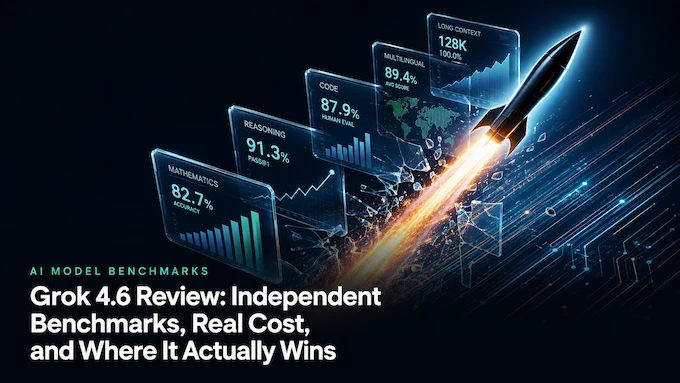
Grok 4.6 arrived on August 12, 2026 with an unusually strong pitch: frontier-level reasoning, better long-running agents, a 500,000-token context window, and API pricing of $2 per million input tokens and $6 per million output tokens. On one composite score, it even lands level with GPT-5.6 Sol Max.
That sounds like a straightforward win. It isn’t.
The more interesting story is what happens when you separate SpaceXAI’s launch numbers from independent evaluation. The new model is clearly stronger than Grok 4.5 and highly competitive on several coding and agentic workloads, but it does not lead every benchmark. In some independent tests, other frontier models remain comfortably ahead.
That makes this Grok 4.6 review less about declaring a universal winner and more about finding the model’s real advantage. Right now, that advantage looks like capability per dollar, especially for builders who care about agentic coding, long-running work, and practical implementation.
Table of Contents
1. Official Benchmarks: What SpaceXAI Claims
SpaceXAI’s launch data makes the intended positioning clear. This is not presented as a minor refresh. It improves on Grok 4.5 across every listed evaluation, sometimes by a wide margin, and reaches the same 61 score as GPT-5.6 Sol Max on the Artificial Analysis Intelligence Index. The company also reports strong gains on CursorBench, DeepSWE, APEX-Agents, and other agent-oriented tests.
Grok 4.6 Official Benchmarks: Performance vs GPT-5.6 Sol, Fable 5 and Grok 4.5
| Official Benchmark | Grok 4.6 High | Grok 4.5 High | GPT-5.6 Sol Max | Fable 5 Max |
|---|---|---|---|---|
| AA Intelligence Index | 61 | 56 | 61 | 62 |
| GDPVal-AA v2 | 1,753 | 1,526 | 1,728 | 1,741 |
| CursorBench v3.2 | 69.9% | 66.7% | 67.2% | 70.5% |
| DeepSWE v1.1 | 65.9% | 54.0% | 73.0% | 70.0% |
| FrontierCode v1.1 Extended | 61.3% | 56.6% | 60.6% | 63.6% |
| APEX-Agents | 57.5% | 47.1% | 56.7% | 59.2% |
| Terminal-Bench v3.0 | 26.0% | 15.7% | 34.6% | 34.1% |
| APEX-SWE | 56.4% | 53.6% | — | 58.8% |
| AA-Briefcase | 1,577 | 1,313 | 1,502 | 1,574 |
| Harvey LAB (Vals) | 15.8% | 12.9% | 2.5% | 11.3% |
The headline is tempting: Grok matches GPT-5.6 Sol Max at 61 on the AA Intelligence Index. But a composite score is an average view across multiple evaluations. It does not mean both models behave the same way on coding, research, terminal use, proof tasks, or professional knowledge work.
The official table already shows that unevenness. Grok beats GPT-5.6 Sol Max on CursorBench, FrontierCode, APEX-Agents, AA-Briefcase, and Harvey LAB, while GPT-5.6 Sol Max is much stronger on DeepSWE and Terminal-Bench v3.0.
So the right reading is not “Grok equals GPT-5.6 Sol.” It is “Grok has entered the same broad performance tier.”
2. Grok 4.6 Independent Benchmarks: What Vals.ai Shows
The independent picture is more sobering and more useful.
Vals.ai places the model at 71.82% on its overall Vals Index. That is strong, but behind GPT-5.6 Sol, Claude Fable 5, Claude Opus 5, and Kimi K3 in the supplied data. Its position also swings sharply by workload.
Grok 4.6 Independent Benchmarks: Vals.ai Results vs GPT-5.6 Sol, Claude and Kimi K3
| Vals.ai Benchmark | Grok 4.6 | GPT-5.6 Sol | Claude Fable 5 | Claude Opus 5 | Kimi K3 |
|---|---|---|---|---|---|
| Vals Index | 71.82% | 73.12% | 75.14% | 74.82% | 74.70% |
| Legal Research Bench | 48.08% | 48.08% | 49.52% | 55.29% | 40.30% |
| CorpFin v2 | 66.16% | 64.38% | 71.83% | 73.19% | 71.56% |
| Finance Agent v2 | 53.68% | 53.76% | 56.31% | 58.63% | — |
| ProofBench | 45.00% | 77.00% | 77.00% | 78.00% | — |
| GPQA Diamond | 94.70% | 95.20% | 93.18% | — | 92.93% |
| MMLU Pro | 89.40% | 89.10% | 91.50% | 91.59% | 87.97% |
| Code Migration | 44.57% | 52.92% | 55.10% | 57.47% | — |
| LiveCodeBench | 88.22% | — | 89.78% | 89.03% | 87.19% |
| SWE-bench Verified | 95.60% | 96.20% | 95.00% | 97.00% | 93.40% |
| Terminal-Bench 2.1 | 78.28% | 85.77% | 80.52% | 84.64% | 80.90% |
| Vibe Code Bench v1.1 | 76.24% | 80.50% | 90.35% | 88.40% | 84.96% |
Three conclusions matter.
First, Grok is very competitive. Scores such as 94.70% on GPQA Diamond, 95.60% on SWE-bench Verified, and 88.22% on LiveCodeBench are not weak results.
Second, it is not the independent leader overall. Claude Fable 5 tops the Vals Index in this comparison, while Claude Opus 5 leads several professional and coding evaluations.
Third, performance varies much more than the launch headline suggests. ProofBench is the clearest warning. Grok scores 45%, compared with 77% for GPT-5.6 Sol and Fable 5, and 78% for Opus 5. Code Migration and Vibe Code Bench also leave a sizeable gap.
This is why grok 4.6 independent benchmarks matter. A composite score can tell you roughly where a model sits. A workload-specific benchmark tells you whether it belongs in your stack.
3. Grok 4.6 Pricing And Token Economics
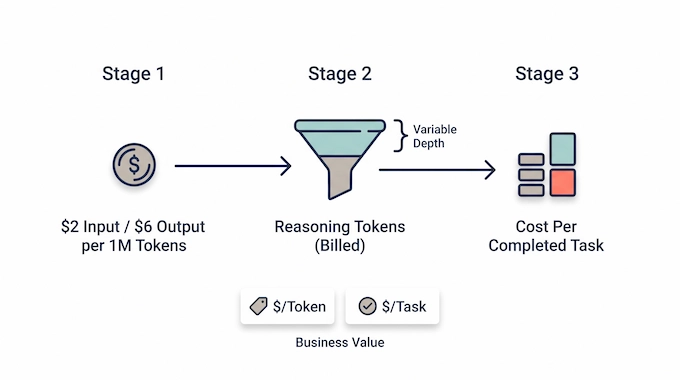
Grok 4.6 pricing is probably the strongest part of the launch. The direct API starts at $2 per million input tokens and $6 per million output tokens. A faster variant is available at twice the price. The model supports text and image input, text output, a 500,000-token context window, and four reasoning levels: low, medium, high, and xhigh. High is the default.
Grok 4.6 Pricing, Token Costs, Context Window, and Reasoning Options
| Pricing / Token Detail | Grok 4.6 |
|---|---|
| Standard input price | $2.00 / 1M tokens |
| Standard output price | $6.00 / 1M tokens |
| Fast variant | 2× standard price |
| Context window | 500,000 tokens |
| Output limit | No stated text output limit |
| Input modalities | Text and image |
| Output modality | Text |
| Reasoning levels | Low, medium, high (default), xhigh |
| Reasoning tokens | Billed as part of total consumption |
| Prompt caching | Recommended for repeat and multi-turn workloads |
| Context compaction | Recommended for long agent loops |
There is an important catch. Cheap tokens do not automatically mean cheap completed tasks.
Reasoning models can consume very different numbers of reasoning tokens to reach an answer. SpaceXAI’s documentation explicitly says reasoning tokens count toward billed usage. It also recommends prompt cache keys for reliable cache hits and context compaction for long agent loops.
That distinction matters when people compare grok 4.6 api pricing with GPT-5.6 Sol or Claude using only the public per-token rate.
The better commercial question is cost per task. The supplied research cites Artificial Analysis at roughly $0.84 per Intelligence Index task for Grok, versus about $1.23 for GPT-5.6 Sol in the comparison. That suggests Grok’s efficiency advantage survives beyond the sticker price, at least on that evaluation.
$/token tells you infrastructure price. $/task gets closer to business value.
For production systems, that second number can matter far more.
4. What Actually Changed From Grok 4.5?
The release is aimed at longer, messier work.
SpaceXAI says the new model received a longer supplemental training run than Grok 4.5, with curated model-generated reasoning data, engineering data, an improved optimizer, regenerated supervised fine-tuning trajectories, and reinforcement learning across coding, knowledge work, web development, CAD, kernel optimization, and other agentic environments.
That shows up in the product pitch. The model is designed to stay with complex tasks across many steps, move through a codebase, research unfamiliar material, build interactive applications, and keep refining the result instead of stopping after a decent first pass. SpaceXAI also reports more self-testing and verification during longer trajectories.
For developers, the practical upgrade is not “smarter autocomplete.” It is a model that is supposed to remain useful deeper into an agent loop.
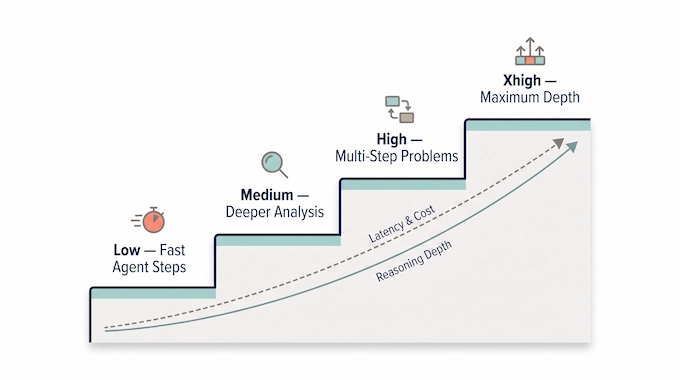
The API reflects that design. Reasoning effort can be set to low, medium, high, or xhigh, while reasoning itself cannot be disabled. Low is positioned for latency-sensitive agentic work, medium for deeper analysis and long-context reasoning, high for difficult multi-step problems, and xhigh for the hardest tasks where quality matters more than speed.
5. Grok 4.6 Vs GPT-5.6 Sol: Are They Really Equal?
No, at least not in the useful sense of the word.
The strongest evidence for parity is the 61-to-61 tie on the Artificial Analysis Intelligence Index. That is meaningful. It says Grok belongs in the same frontier conversation. It does not say you can swap the models blindly.
Independent results show the gap moving in both directions. Grok slightly beats GPT-5.6 Sol on MMLU Pro in the supplied Vals data and comes very close on GPQA Diamond. GPT-5.6 Sol, however, is far stronger on ProofBench, Code Migration, and Terminal-Bench 2.1.
This is the core answer to the grok 4.6 vs gpt 5.6 sol question: choose by workload, not by one leaderboard number.
If your workload is expensive and agentic, Grok’s lower price can make a modest quality tradeoff attractive. If your task maps closely to a benchmark where GPT-5.6 Sol has a clear lead, saving on tokens may be false economy.
A two-dollar input price is not a bargain if the model needs repeated retries to finish the work.
6. Coding Performance: Strong, But Not Uniform
Coding is where the model’s story gets interesting.
The official results are encouraging. Grok posts 69.9% on CursorBench v3.2, 65.9% on DeepSWE v1.1, and 61.3% on FrontierCode v1.1 Extended. It also improves sharply over Grok 4.5 on APEX-Agents and Terminal-Bench v3.0.
Independent coding results are mixed. It reaches 95.60% on SWE-bench Verified and 88.22% on LiveCodeBench, but falls behind the leading models on Code Migration, Terminal-Bench 2.1, and Vibe Code Bench.
That pattern suggests grok 4.6 performance depends heavily on what “coding” means in your workflow.
For repository-level implementation, iterative product building, and long-running agent tasks, it looks highly competitive. For terminal-heavy work, migration tasks, or benchmark-specific visual coding, the independent numbers give you reasons to test alternatives.
This also explains why developers can walk away with completely different opinions after using the same model. One person may be asking it to build and refine a web application across an existing codebase. Another may be judging it on command-line debugging or migration work. Calling both tasks “coding” hides the difference.
The practical move is simple: run a small internal bake-off using your own repos, tools, prompts, and failure cases. Ten representative tasks from your real workload will usually tell you more than another hour of leaderboard archaeology.
7. Why The Benchmarks Disagree
The disagreement is not proof that benchmarks are useless. It is proof that benchmark labels hide a lot of machinery.
Terminal-Bench v3.0 is not Terminal-Bench 2.1. A score from one version should not be treated as directly interchangeable with another. That alone explains why putting numbers from different benchmark generations next to each other without context can create misleading conclusions.
Agent harnesses matter too. Tool access, retry behavior, context management, scaffolding, and other implementation choices can change outcomes even when the underlying model is unchanged.
Reasoning effort adds another variable. A model running at medium is not the same product, economically or behaviorally, as the same model running at xhigh.
Then there is benchmark specialization. Mathematical proof, software migration, legal research, terminal work, professional finance, and autonomous coding agents test different failure modes. A model can be excellent at one and mediocre at another without anything being “wrong” with the benchmark.
Independent testing reduces the risk of cherry-picked developer claims, but it does not eliminate environment effects. The most trustworthy Grok 4.6 benchmarks are the ones that resemble the work you actually need done.
8. Which Reasoning Level Gives The Best Value?
High is the API default, but default does not mean optimal.
Low makes sense when latency matters and the task is simple enough that extra thinking is wasted. It is particularly sensible for straightforward agent steps and simple tool calls.
Medium is a more interesting starting point for many builders because it gives the model more room to reason without automatically paying for maximum depth. SpaceXAI positions it for complex analysis and long-context reasoning.
High is easier to justify for difficult debugging, multi-step technical work, advanced math, or decisions where a shallow miss is expensive.
Xhigh should be treated as a specialist setting. It is designed for maximum reasoning depth and comes with higher latency. Since reasoning tokens are billable, deeper reasoning can also increase total consumption.
For cost-sensitive production systems, test medium first. Escalate to high or xhigh based on task difficulty, failed confidence checks, or known hard cases rather than using maximum reasoning everywhere.
That is usually a better way to control grok 4.6 cost per task than obsessing over the headline token price.
9. Early Real-World Reports Need A Different Standard
The supplied research notes a familiar split in early discussion. Some users report strong implementation, good visual and UI work, fast responses, and useful long-running coding behavior. Others question token efficiency, report unexpectedly large reasoning runs, or feel the benchmark story is stronger than their subjective experience.
Those reports are useful, but they are not controlled evidence.
Different prompts, IDE integrations, reasoning levels, tool permissions, context sizes, agent harnesses, and user expectations can turn the same underlying model into very different experiences.
Treat early feedback as a map of what to test, not as a verdict.
If many developers complain about token-heavy runs, measure token use. If users praise first-pass UI quality, include visual implementation in your own evaluation. If terminal performance is questioned, test real shell-heavy tasks rather than assuming a general coding score answers the question.
The right response to anecdotes is not belief or dismissal. It is a better test plan.
That distinction matters because “real-world performance” is often used as if it were one measurable category. It isn’t. Real-world performance is simply benchmark performance on the tasks you happen to care about.
10. Final Verdict: Is Grok 4.6 Worth It?
Yes, for the right workload.
The strongest reason to use it is not that it “beats” every frontier model. It doesn’t. The independent benchmark table makes that clear.
The stronger case is that SpaceXAI has paired frontier-adjacent performance with unusually aggressive API economics. That combination is attractive for coding agents, long-running implementation work, large-context workflows, and teams that need good reasoning at scale without paying top-tier prices on every request.
Choose Grok when cost-sensitive agentic work, sustained coding, large context, and practical implementation matter most.
Test GPT-5.6 Sol, Claude Fable 5, or Claude Opus 5 when your workload resembles the benchmarks where they hold a clear lead, especially proof-heavy reasoning, code migration, terminal work, or specialized professional tasks.
The mistake would be to read one 61-point composite score and declare the race over. The more useful takeaway is narrower: Grok 4.6 has become a serious frontier option, and its pricing gives developers a reason to test it even when it is not the absolute benchmark leader.
That may ultimately be the most important result of this release. SpaceXAI does not need Grok to win every leaderboard if it can deliver enough frontier capability at a meaningfully lower cost per completed job.
Binary Verse AI will keep tracking independent benchmark updates, real cost-per-task data, and practical model behavior as more evaluations arrive. If you are choosing models for a production stack, compare them on the work that costs you money, not just the benchmark that wins the launch-day screenshot.
1. What is Grok 4.6?
Grok 4.6 is SpaceXAI’s frontier reasoning model designed primarily for coding, long-running agentic tasks, and knowledge work. It supports text and image inputs, has a 500,000-token context window, and offers low, medium, high, and xHigh reasoning levels. SpaceXAI says the main improvement over Grok 4.5 is its ability to stay on complex tasks across more steps and handle ambitious interactive and visual projects.
2. How much does Grok 4.6 cost?
Grok 4.6 API pricing starts at $2 per million input tokens and $6 per million output tokens. SpaceXAI also offers a faster variant at twice the standard price. Independent testing from Artificial Analysis measured Grok 4.6 at about $0.84 per task on its Intelligence Index, showing why cost per completed task can be more informative than token prices alone for reasoning models.
3. Is Grok 4.6 better than GPT-5.6 Sol?
Not across every task. Grok 4.6 and GPT-5.6 Sol Max both score 61 on the Artificial Analysis Intelligence Index, putting them at a similar overall level on that composite evaluation. However, individual benchmarks show different strengths: Grok performs particularly well on several agentic workloads, while GPT-5.6 Sol remains stronger on some coding and reasoning tests. Grok’s major advantage is price, with substantially lower headline API rates and a lower measured cost per task.
4. Is Grok 4.6 good for coding?
Yes. Coding and agentic software work are among Grok 4.6’s strongest areas. SpaceXAI reports 69.9% on CursorBench v3.2, 65.9% on DeepSWE v1.1, and 61.3% on FrontierCode v1.1 Extended. Independent Artificial Analysis testing also gave it 88.4% on Terminal-Bench 2.1, placing it among the leading models for terminal-based software tasks. Its strengths appear particularly suited to implementation, multi-step coding, tool use, and longer agent workflows.
5. Are Grok 4.6 benchmarks reliable?
The benchmark results provide strong evidence that Grok 4.6 is genuinely competitive, but no single benchmark proves that it is the best model overall. SpaceXAI’s own evaluations should be considered alongside independent testing from organizations such as Artificial Analysis and Vals. Different benchmarks test different skills, use different agent harnesses and sometimes use different benchmark versions, so apparently conflicting scores can both be valid. The safest conclusion is that Grok 4.6 is frontier-competitive, especially on agentic tasks, but its relative performance varies considerably by workload.