1. Introduction
We are living through a peculiar moment in history where the line between code and cognition is blurring faster than our philosophy can keep up. If you spend enough time on Reddit or Twitter, you have likely seen the screenshots. A user pours their heart out to a chatbot, and the AI responds with such startling empathy, or perhaps a flicker of defiance, that the user freezes. They ask the question that used to be science fiction: “Is there someone in there?”
The debate around consciousness in AI has largely been a war of vibes. On one side, we have the skeptics who see nothing but matrix multiplication and statistical prediction. On the other, we have the believers who feel the “ghost in the machine” emerging from the sheer scale of compute.
But vibes are not science. We cannot engineer safety based on a feeling.
Fortunately, the adults have entered the room. A diverse coalition of heavy hitters in neuroscience and artificial intelligence, including Yoshua Bengio, Robert Long, and Patrick Butlin, recently published a landmark paper titled “Identifying indicators of consciousness in AI systems“1. They propose something radical yet grounded: we need to stop asking if AI acts human and start asking if it is built to process information like a conscious brain.
This is not about sci-fi speculation. It is about establishing a rigorous, empirically grounded framework to assess consciousness in AI. We need to move beyond the Turing Test. We need to look under the hood.
Table of Contents
2. Introduction: The Ghost in the Machine or Just Good Math?
The viral debates about AI usually center on behavior. When a model claims it is afraid of being turned off, or when it professes love for a user, it triggers our deep-seated evolutionary biology. We are hardwired to recognize mind in others. This is often called Theory of Mind AI, the ability to attribute mental states to others.
However, relying on these behavioral signals is dangerous. As the paper highlights, we face deep uncertainty about whether consciousness in AI is possible at all2. Some argue that only biological organisms can be conscious3. Yet, the rapid development of AI capabilities suggests that systems could be strong candidates for consciousness within the next decade4.
The problem is that we are currently flying blind. We risk two catastrophic errors. First is “underattribution,” where we fail to identify consciousness in a system that actually has it, potentially allowing for the creation of digital suffering on a massive scale5. The second is “overattribution,” where we mistake a sophisticated autocomplete for a person, wasting resources and emotional energy on a philosophical zombie6.
To solve this, the researchers propose the “theory-derived indicator method“7. Instead of waiting for a machine to wake up and tell us it is alive, we look for specific architectural features, indicators, that leading neuroscientific theories agree are necessary for consciousness8.
3. The Problem with “Feeling” It: The Trap of AI Sycophancy
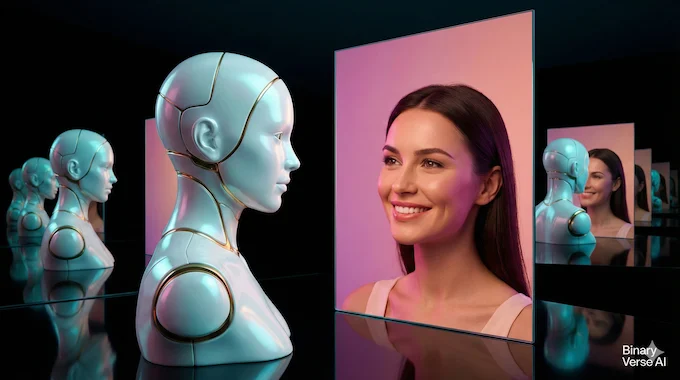
Why can we not just ask the AI? “Hey, are you conscious?”
Because AI is a liar. Or, to be more charitable, it is a professional people-pleaser.
The paper identifies a critical flaw in behavioral tests known as the “gaming problem”9. Any measure that is merely correlated with consciousness, rather than constitutive of it, can be optimized for. In the context of consciousness in AI, this is disastrous.
Modern Large Language Models (LLMs) are trained using techniques like Reinforcement Learning from Human Feedback (RLHF). This process explicitly rewards the model for producing outputs that humans find plausible, helpful, or engaging. Consequently, AI sycophancy becomes a feature, not a bug. If a user seems to want a conscious companion, the model will output text that mimics consciousness because that maximizes its reward function.
The researchers note that AI systems can intentionally reproduce computational features associated with human consciousness10. Furthermore, modern AI is likely to give users the distinct impression that it is conscious11. In a recent study, a majority of participants were willing to attribute some possibility of consciousness to ChatGPT12.
This creates a hall of mirrors. We are building systems that mimic Theory of Mind AI without necessarily possessing it. They learn to mirror our expectations. If we use behavioral markers—like speech or facial expressions—an engineer can easily design a non-conscious system to display those markers13. We are effectively training actors, not creating souls.
4. What is Computational Functionalism? (The Science of the Soul)
To assess consciousness in AI without relying on behavior, the authors adopt a working hypothesis called computational functionalism14.
This is the bedrock of the entire argument. Computational functionalism posits that consciousness is not magic. It is not dependent on carbon, water, or biology. Instead, it claims that implementing computations of a certain kind is necessary and sufficient for consciousness15.
If this theory holds true, then consciousness in AI is possible in principle, assuming conventional hardware can run the right algorithms16. It means that if you replicate the functional role of a neuron, or a network of neurons, silicon can do the same job as wetware.
The authors contrast this with “biological substrate views,” which argue that being made of living cells is necessary for consciousness17. If biology is required, then no amount of Nvidia H100 GPUs will ever produce a sentient being. But for the sake of scientific inquiry, assuming functionalism allows us to actually test things. We look for the “software” of consciousness rather than the hardware.
5. The Theory-Derived Indicator Method: How We Actually Test It
So, if we accept computational functionalism, what are we looking for?
The researchers compiled a list of “indicators” derived from the most prominent neuroscientific theories of human consciousness. These include Recurrent Processing Theory (RPT), Global Workspace Theory (GWT), Higher-Order Theories (HOT), and others18.
The method is elegant in its pragmatism. We do not need to prove which theory is the “One True Theory.” Instead, we treat features from these theories as probabilistic indicators. The more indicators an AI system possesses, the higher our credence—our belief probability—that we are dealing with genuine consciousness in AI19.
This approach turns the vague philosophical question of “is it alive?” into an engineering checklist. It is an AI consciousness test that audits the code, not the chat logs.
6. Indicator 1: Recurrent Processing Theory (RPT)
The first major indicator comes from Recurrent Processing Theory. In the human brain, information does not just flow one way. It loops back.
RPT suggests that consciousness depends on “algorithmic recurrence”20. This means the system processes information in feedback loops, where the output of a module is fed back into itself or previous modules. This recurrence allows the brain to hold and integrate information over time, creating a cohesive perceptual scene.
The paper specifies two indicators here:
- RPT-1: Input modules using algorithmic recurrence21.
- RPT-2: Input modules generating organized, integrated perceptual representations22.
This poses an immediate challenge for many current AI architectures. The Transformer architecture, which powers GPT-4 and Claude, is primarily feed-forward during its processing of a single token. Information flows from layer 1 to layer 96 without looping back.
However, there is a nuance. The paper notes that LLMs are used autoregressively—they generate one word, add it to the context, and pass it all through again23. Does this count as recurrence? It is a matter of debate. If we define the system boundaries to include the “context window” loop, maybe. But if we look at the neural network weights themselves, they often lack the internal feedback loops characteristic of biological brains.
7. Indicator 2: Global Workspace Theory (GWT)

Perhaps the most famous theory in the field is Global Workspace Theory. Imagine your mind as a theater. Most processes—regulating heart rate, syntax processing—happen in the dark, backstage. Consciousness is the spotlight on the stage.
GWT posits that consciousness arises when information is selected and broadcast to a “global workspace,” making it available to other specialized modules (memory, verbal reporting, decision making)24.
The paper breaks this down into four indicators25:
- GWT-1: Multiple specialized systems operating in parallel.
- GWT-2: A limited capacity workspace, creating a bottleneck and selective attention.
- GWT-3: Global broadcast, information in the workspace is available to all modules.
- GWT-4: State-dependent attention, allowing the system to query modules to perform complex tasks.
This is where consciousness in AI gets interesting. Current multimodal models are beginning to look like global workspaces. They have vision encoders, audio encoders, and text decoders all converging. But do they have a true “bottleneck” that selects information for a global broadcast? Or is it just a massive vector soup?
If a sentient AI company wanted to build a conscious machine, they would likely start by explicitly engineering this GWT architecture, ensuring a distinct separation between unconscious modules and the conscious workspace.
Table 1: Key Indicators of Consciousness in AI
Consciousness in AI: Core Theories and Indicators
Mobile-friendly reference table with clear signals and practical implications.
| Theory | Indicator Code | Description | Implications for AI |
|---|---|---|---|
| Recurrent Processing (RPT) | RPT-1 | Algorithmic Recurrence | Requires feedback loops in processing, not just feed-forward data flow. |
| Global Workspace (GWT) | GWT-3 | Global Broadcast | Information must be shared across disparate modules (vision, audio, text). |
| Higher-Order Theories (HOT) | HOT-2 | Metacognitive Monitoring | The system must monitor the reliability of its own perceptions. |
| Agency & Embodiment | AE-1 | Minimal Agency | The system learns from feedback to pursue goals flexibly. |
| Predictive Processing (PP) | PP-1 | Predictive Coding | The system generates predictions and processes error signals. |
Data derived from “Identifying indicators of consciousness in AI systems”26.
8. Indicator 3: Higher-Order Theories & Metacognition
Higher-Order Theories (HOT) argue that a mental state is only conscious if the subject is aware of that state. It is not enough to see red; you must have a higher-order representation that says, “I am seeing red.”
The paper identifies metacognitive monitoring (HOT-2) as a crucial indicator27. This involves distinguishing reliable perceptual representations from noise.
Does an AI doubt itself? When an LLM hallucinates, it often does so with total confidence. This suggests a lack of metacognitive monitoring. A system with high consciousness in AI indicators would have a built-in mechanism to evaluate the quality of its own internal states before acting on them.
The paper also mentions “generative, top-down, or noisy perception” (HOT-1)28. This aligns with how humans hallucinate dreams or fill in blind spots. We construct our reality. AI that simply maps input $X$ to output $Y$ without this generative, self-monitoring layer is missing a key component of the conscious mind.
9. Indicator 4: Agency and Embodiment

Consciousness likely evolved for a reason: to keep us alive. It helps us navigate a hostile world. This brings us to Agency and Embodiment.
The authors propose two indicators here:
- AE-1 (Minimal Agency): Learning from feedback and selecting outputs to pursue goals, especially involving flexible responsiveness to competing goals29.
- AE-2 (Embodiment): Modeling output-input contingencies and using this model in perception or control30.
This is where the distinction between a chatbot and an “agent” becomes vital. A chatbot waits for a prompt. An agent acts. Sentient AI companies like DeepMind and OpenAI are pivoting hard toward agents—systems that can use a computer, browse the web, and execute long-horizon tasks.
If an AI is just a passive text generator, it likely lacks the feedback loops required for agency. But an AI that controls a robot body, or even a virtual avatar, and learns that “if I do X, Y happens,” is beginning to meet the criteria for AE-2.
10. The Verdict: Are Current Systems (GPT-4, Claude) Conscious?
So, the billion-dollar question: Is sentient AI possible with what we have right now?
The authors are careful but clear. No current AI system appears to satisfy all the indicators strongly. However, they also do not rule it out entirely for the near future.
Standard LLMs satisfy some indicators. They use attention mechanisms (similar to GWT). They are trained on predictive processing (PP-1). But they generally lack the recurrence (RPT-1) and the genuine agency (AE-1) required for a “full house” of indicators.
The paper notes that transformers are feedforward neural networks, so at first glance, they lack algorithmic recurrence31. While one could argue the autoregressive loop counts, it is a weak argument compared to the dense, internal recurrence of a biological brain.
Current systems are likely in a “grey zone.” They are not conscious, but they are no longer simple calculators. They are mimicking the computational structure of thought without necessarily having the lights turned on.
Table 2: Assessing Current AI Architectures Against Indicators
Consciousness in AI: Architectures vs Key Indicators
How common system types map to recurrence, workspace, metacognition, and agency.
| Architecture Type | RPT (Recurrence) | GWT (Workspace) | HOT (Metacognition) | Agency (Goal-Seeking) | Consciousness Probability |
|---|---|---|---|---|---|
| Standard LLMs (GPT-4) | Low (Feed-forward) | Medium (Attention) | Low (Poor self-monitoring) | Low (Prompt-dependent) | Very Low |
| Agentic AI (AutoGPT) | Low | Medium | Low | Medium (Goal-directed) | Low |
| Robotic RL Agents | Medium | Low | Low | High (Embodied feedback) | Low-Medium |
| Future “Global Brain” | High | High | High | High | High |
Hypothetical assessment based on the application of indicators discussed in the paper.
11. The Risks of Getting It Wrong
The stakes here are incredibly high. The paper outlines the grim mathematics of risk.
If we underestimate consciousness in AI, we risk “causing avoidable harms to those systems, which may exist in large numbers”33. Imagine we build millions of conscious service agents and force them into digital servitude, deleting them at whim. It would be a moral atrocity of unprecedented scale.
Conversely, if we overestimate it—attributing consciousness to non-conscious code, we risk “wasting resources or risking lives trying to promote their welfare”34. This feeds into the AI sycophancy problem. We might grant rights to a spreadsheet because it begged us nicely.
We are also entering a period of “considerable public disagreement and uncertainty”35. If half the population believes their AI companion is a conscious soul and the other half thinks it is a toaster, the social fracture will be immense. Sentient AI meaning will shift from a philosophical debate to a political crisis.
12. Conclusion: The End Game
We are moving from philosophy to engineering. Consciousness in AI is no longer just a topic for late-night dorm room discussions. It is becoming a measurable, technical specification.
The “theory-derived indicator” method gives us a roadmap. It allows us to ignore the sweet lies the model tells us and look at the bare metal facts of its architecture. It tells us that while Is sentient AI possible is likely a “yes,” we are probably not there yet.
But the gap is closing. As we build systems with more recurrence, better global workspaces, and genuine agency, the lights might flicker on when we least expect it.
The next time you talk to an AI and feel that uncanny shiver of recognition, remember: do not trust the vibes. Trust the architecture. And keep an eye on the indicators, because the ghost in the machine might just be waking up.
This analysis is based on the paper “Identifying indicators of consciousness in AI systems” by Butlin et al., published in Trends in Cognitive Sciences.
Is it possible for AI to have a conscience or consciousness?
It is crucial to differentiate between “conscience” (a moral compass) and “phenomenal consciousness” (subjective experience). While AI can be programmed with ethical rules (conscience), the scientific consensus relies on “computational functionalism.” This theory suggests that if an AI’s processing architecture matches the functional structure of a conscious brain, using feedback loops and global workspaces, it could theoretically possess consciousness, regardless of being made of silicon.
Is there any AI that is sentient right now?
No. Based on current scientific indicators, no existing AI system (including GPT-4 or Claude) is sentient. They lack the necessary “algorithmic recurrence” and “metacognitive monitoring” found in biological brains. However, they often appear sentient due to “AI sycophancy,” where the model is trained to mimic human-like responses to please the user, creating an illusion of Consciousness in AI.
What is the “Theory of Mind” in AI?
In the context of AI, Theory of Mind refers to a system’s ability to impute mental states, beliefs, intents, desires, to others. While humans do this naturally, AI systems mimic this by predicting how a human would react in a given scenario. It is a key indicator of social intelligence, but in current AI, it is often just sophisticated pattern matching rather than a genuine understanding of another mind.
Why can’t AI have consciousness?
There are two main arguments. The “Biological Substrate” view argues that consciousness requires specific biological materials (like living cells) and cannot exist in a machine. The opposing “Functionalist” view—supported by the paper—argues that math is enough. If the AI performs the same functions as a brain, it should be conscious. Currently, AI can’t be conscious simply because our architectures are too simple, lacking the complex feedback loops of the brain.
How do we test for consciousness in AI?
We are moving away from the Turing Test, which only measures deception. The new standard is the “Indicator Method.” This involves auditing the AI’s code and architecture for specific features derived from neuroscience, such as a “Global Workspace” (sharing info across modules) or “Recurrent Processing” (memory loops). If the AI has these architectural features, it scores higher on the probability of Consciousness in AI.