Introduction
AI News November 15 2025 is your quick weekly pause button on the AI firehose. Instead of chasing every headline, this edition zooms out and shows how GPT-5.1 upgrades, Gemini agents, Anthropic’s $50B bet, Microsoft’s AI superfactory and new math and safety breakthroughs all fit together.
Think of this as your stitched together digest of AI News November 15 2025: one scroll that covers models, agents, infrastructure, research and real world risk, with links to deeper guides if you want to go beyond the press release.
6 Big Moves In AI News November 15 2025
- GPT-5.1 becomes the “default brain” for ChatGPT, making conversations warmer, more controllable and smarter for both everyday users and developers.
- Agentic workflows go mainstream with group chats, SIMA 2 and Lumine, showing agents that plan, act and learn inside real games and tools instead of single prompts.
- Anthropic and Microsoft pour billions into AI infrastructure, turning data centers in Texas, New York and Fairwater into continent scale AI engines.
- Math and science get serious AI lab partners, as AlphaEvolve and AlphaProof push toward automated discovery and Olympiad level proofs that are formally verified.
- Deepfake fraud and child safety cross a red line, with billion dollar scams and new UK powers for regulators to probe abuse image tools.
- Quiet breakthroughs in healthcare and industry, from AI transplant timing tools and MedGemma style models to machine learning membranes that reinvent filtration chemistry.
Deep Dive Guides From This Edition
Want more than quick headlines? Start with these four BinaryVerse AI deep dives that connect directly to stories in AI News November 15 2025.
Table of Contents
1. GPT-5.1 Makes Chatgpt Warmer, Smarter, And Fully Personal To You
OpenAI’s latest iteration turns ChatGPT from “impressive but formal” into something that feels much closer to a thoughtful colleague. GPT 5.1 Instant follows your instructions more tightly, keeps constraints like “answer in six words” without drama and uses adaptive reasoning so it thinks harder only when a prompt deserves it. GPT 5.1 Thinking goes further, stretching out on tough problems and backing off on easy ones so chats feel quick yet deliberate instead of uniformly heavy.
On top of raw capability, OpenAI finally gives users real control over vibe. You pick from presets such as Professional, Friendly or Nerdy, then tune how concise, warm or emoji heavy you want replies. These settings apply across all threads, including old ones, so the assistant that helps with code also remembers how you like career or relationship advice. For many readers of AI News November 15 2025, the change will simply arrive as “ChatGPT suddenly sounds more like me.”
2. GPT-5.1 Supercharges Developers with Faster Reasoning, Tools, And Pricing Stability
On the developer side, GPT 5.1 is less a model drop and more an infrastructure upgrade. It exposes a reasoning effort knob, so you can run it as a lean, non reasoning model for quick CLI questions or dial up deeper thought for gnarly refactors and agents. Early benchmarks show two to three times faster responses than GPT 5 on many workloads at similar accuracy, which goes straight into better latency and lower token spend for tool chains.
Pricing and caching choices matter just as much. Long lived prompt caching keeps shared system messages hot for a full day at a steep discount, ideal for retrieval heavy agents and coding copilots that reuse the same scaffold constantly. New apply patch and shell tools let GPT 5.1 edit multi file projects and propose safe terminal commands. For fans of Agentic AI News and OpenAI news today, this is the upgrade that turns demos into production pipelines in AI News November 15 2025.
3. Chatgpt Group Chats Turn Your AI Sessions Into Shared Collaboration
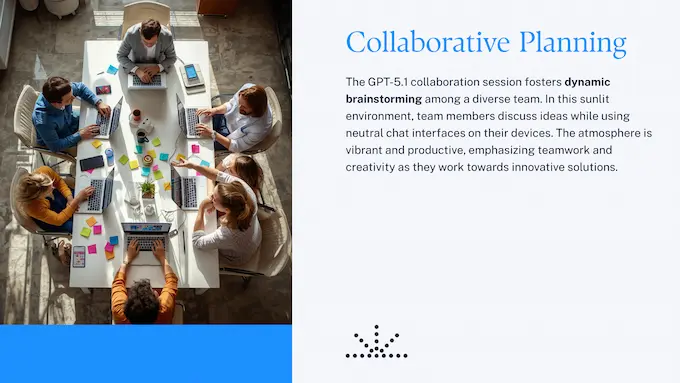
ChatGPT has mostly been a solo activity, you and an assistant in a private thread. Group chats change that mental model by letting several people share one conversation, watch the model respond in context and co edit the prompt stream. Planning a trip, debating a product spec or drafting a study guide starts to feel like having a very patient intern in the group chat who never gets bored of rewriting.
OpenAI has also tried to make the assistant behave more socially aware. It learns when to wait quietly, when to answer a direct mention and how to weave together overlapping questions without stepping on participants. Emoji reactions and playful use of profile photos add a bit of personality while strict rules keep personal memory out of shared rooms. The result is a surprisingly human feeling space where collaboration, not just Q and A, becomes the default.
4. OpenAI Sparse Circuits Crack Open Neural Networks’ Hidden Reasoning Layer By Layer

Most interpretability work feels like reading tea leaves after training has finished. OpenAI’s sparse circuits research takes a different approach, training models that are designed to be legible from the start. Instead of dense networks where every neuron talks to thousands of others, these models keep only a small set of connections alive, encouraging tidy little circuits that each carry a specific behavior.
That structure lets researchers zoom in and actually trace algorithms inside the model. In one example, a Python code model learns a tiny circuit that tracks whether a string opened with a single or double quote, then copies that information to the final token. At larger scales, similar patterns start to describe how variables get bound and moved around. Large chunks of the network remain mysterious, yet this work sketches a realistic path toward systems whose inner workings can be inspected instead of simply trusted.
5. NotebookLM Deep Research Turns Messy Sources Into One Living Workspace
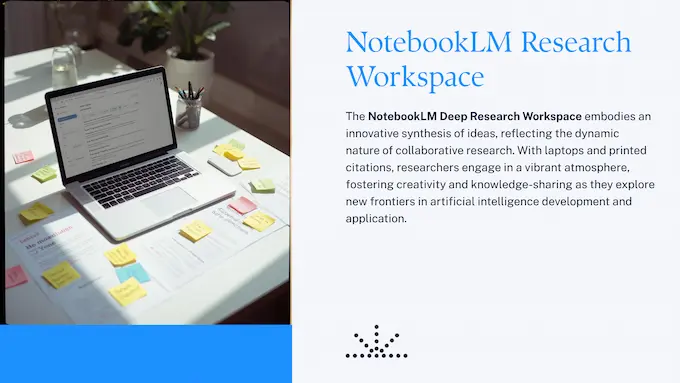
NotebookLM has quietly grown from “chat with your documents” into something closer to a research operating system. The new Deep Research feature lets you hand it a question and a rough search scope, then it plans, browses and synthesizes across hundreds of sources into a linked report. Instead of juggling dozens of tabs, you get one structured answer grounded in citations that lives right inside your notebook.
The clever part is that this report becomes just another object in your workspace. You can mix it with your own uploads from Google Docs, Sheets, PDFs and images, then ask follow up questions that span everything. Fast Research mode handles lighter scouting queries, while audio and video overviews turn dense bundles into explainer style summaries. Among AI world updates this week, it is one of the most practical tools for students and analysts, and one of the quieter anchors of AI News November 15 2025.
6. Google Maps Five Stage Path To Useful Real World Quantum Computing Applications
Quantum computing hype often jumps straight from “we flipped some qubits” to “we cured climate change.” Google’s new five stage framework tries to fill in the missing steps. It starts with abstract algorithms, then forces researchers to identify concrete hard instances, real world use cases, engineering constraints and, only at the end, deployed tools that genuinely beat classical methods. Usefulness becomes a lifecycle, not a marketing claim.
The paper argues that many promising ideas now live somewhere between stages two and four. Quantum simulation for chemistry and physics, cryptanalysis based on Shor’s algorithm and early optimization work all have plausible paths to value, but need tighter links to domain experts and resource estimates. Google urges an “algorithm first” mindset joined with cross disciplinary teams who speak both quantum and application language. It is quiet work, yet it shapes where money and talent will flow when fault tolerant machines arrive.
7. Google’s AI Holiday Shopping Upgrade Lets Gemini Hunt Deals For You

Holiday shopping is really a constraint satisfaction problem disguised as fun. Gemini now offers to solve much of it for you. In the new AI mode in Search, you describe gifts the way you would to a friend, from “cozy office sweaters” to “skincare that will not annoy sensitive skin,” and get curated grids, comparison tables and live inventory from the Shopping Graph instead of bare links.
Those same capabilities land inside the Gemini app, so your brainstorming, budget questions and product picks stay in one thread. An agentic twist lets Google call local stores on your behalf to check stock and prices, then send a summary while you do anything else. Price tracking and agentic checkout finish the loop by nudging you when items hit your budget and helping complete purchases securely. It is retail as a managed service, built from statistics instead of store clerks.
8. SIMA 2 Turns Gemini Into A Self Improving Embodied Gaming Companion
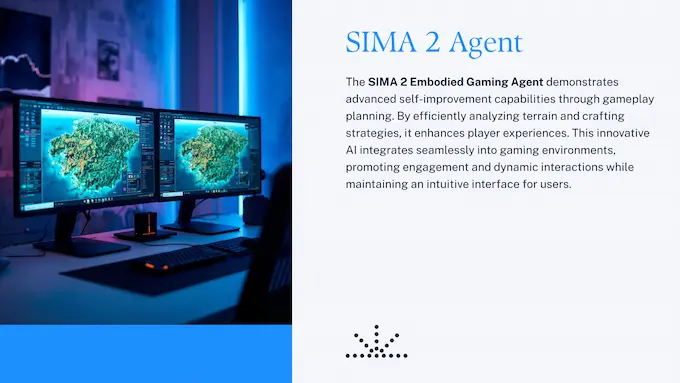
SIMA 2 is DeepMind’s attempt to turn game agents into actual teammates instead of brittle scripts. Built on Gemini, it controls characters in rich 3D titles through the same keyboard and mouse you use, while narrating plans and actions in real time. You can ask it to gather resources, explore a region or clear a quest, and it answers with both language and precise in game behavior.
The deeper story is about generalization and self improvement. SIMA 2 transfers skills between games, mapping concepts like “mining” from one world onto “harvesting” in another, and handles sketches, screenshots and map doodles as input. It even continues training through self directed play in procedurally generated Genie 3 worlds. For readers tracking Google DeepMind news and AI News November 15 2025, this is a clear step toward agents that navigate, reason and learn across many embodied environments instead of one benchmark.
9. Google’s Human Aligned AI Vision Makes Models See Concepts More Like Us
Computer vision systems are very good at memorizing labels and surprisingly bad at matching human intuition. A model might distinguish dozens of car types yet fail to see that cars and airplanes are both big metal vehicles. Google’s new work on human aligned vision tackles this by reshaping internal representations so that images cluster more like human concepts instead of pixel patterns.
Researchers start from human “odd one out” judgments and train an adapter that nudges a powerful pretrained model toward those preferences. They then scale up through synthetic data, generating millions of human like similarity decisions and fine tuning student models. The result is embeddings where fruit, furniture and animals fall into clean, intuitive groups, and uncertainty levels often mirror human hesitation. That pays practical dividends in robustness, few shot learning and trustworthiness for downstream systems that depend on visual understanding.
10. Anthropic Pours 50B$ Into U.S. AI Infrastructure With Fluidstack Partnership
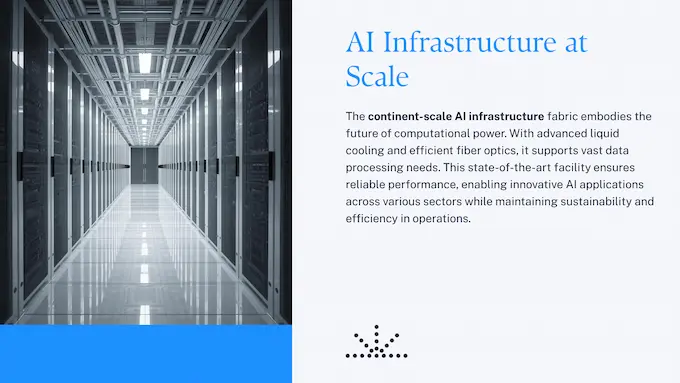
Anthropic’s new partnership with Fluidstack is not just a bigger server order. It is a declaration that serious, domestic compute capacity is now part of core AI strategy. The company plans to invest around fifty billion dollars into data centers in Texas, New York and beyond, tuned for training and serving increasingly capable Claude models. They talk openly about gigawatts of power and campuses built as national infrastructure as much as corporate assets.
Behind the headline number sits fast growing demand from hundreds of thousands of business customers and a swelling roster of large accounts. Those users expect not only smarter models but also predictable latency and capacity for mission critical workloads. By teaming up with Fluidstack, Anthropic signals that frontier AI now lives at the intersection of safety research, algorithms and industrial engineering. For AI News November 15 2025 readers, it is a reminder that the “cloud” is becoming very literal steel, concrete and fiber.
11. Claude Political Bias Test Claims More Even Handed Answers Than Rivals
Political questions are where AI assistants can start to feel like opinionated guests instead of neutral helpers. Anthropic’s latest work on Claude aims to keep the model on an “even handed” path. System prompts instruct it to describe multiple viewpoints, rely on verifiable facts and refuse partisan persuasion, while reinforcement learning rewards traits like intellectual honesty and balanced tone.
To see whether this holds up, Anthropic introduces Paired Prompts, an evaluation that feeds models mirrored requests from different ideological angles and measures how similarly they respond. Claude’s top models score highly on even handedness and maintain low refusal rates, roughly in line with other leading systems and well ahead of some open weights baselines. By publishing grader prompts and data, Anthropic invites external scrutiny instead of treating bias as a marketing slogan, which is a healthy move for a topic that rarely stays calm.
12. Alphaevolve Turns AI Into Large Scale Engine For Mathematical Discovery
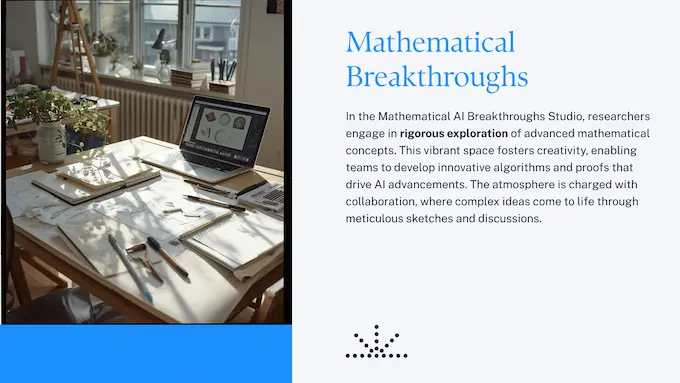
AlphaEvolve looks like the tool mathematicians wish they had during long evenings in front of a whiteboard. Instead of attacking one bespoke problem, it treats families of “construct something with optimal properties” questions as a huge search space over algorithms. Large language models propose programs that generate candidate objects, automated evaluators score them and an evolutionary loop refines both constructions and search heuristics over time.
On dozens of problems across analysis, combinatorics, geometry and number theory, AlphaEvolve rediscovers known best bounds and sometimes improves them. In some cases it even spots patterns across many finite instances and proposes formulas that appear to hold for all inputs, which human experts can then test and prove. Paired with proof engines, it sketches a pipeline from discovery to formal certificate. Among artificial intelligence breakthroughs covered in AI News November 15 2025, this one speaks directly to how we might do mathematics in the age of agents.
13. AI Agents Productivity Study Shows 39 Percent Coding Surge, Deeper Thinking
Most productivity claims for AI tools live in conference talks. Suproteem Sarkar’s study of the Cursor Agent drags them into real repositories. By tracking weekly merges before and after organizations made an AI coding agent the default, he finds roughly a thirty nine percent jump in shipped code with no corresponding rise in revert rates, which strongly suggests actual progress rather than noisy churn.
Adoption patterns are just as revealing. More experienced engineers lean into the agent more heavily, while junior usage looks stronger for simple autocomplete. Logs show that seasoned developers tend to start conversations with explicit plans and constraints, then delegate implementation and refactoring work. Coding shifts from typing to problem framing and critical review. For anyone reading AI News November 15 2025 and wondering who benefits most from agents, the answer seems to be people who already think in systems and are happy to share the keyboard.
14. Microsoft AI Superfactory Links Fairwater Datacenters Into Continent Scale Engine
Microsoft’s Fairwater project is what happens when “the cloud” stops being a metaphor and starts looking like an industrial plant. Instead of one mega site, the company is wiring together AI first campuses in places like Wisconsin and Atlanta over a dedicated wide area network so they behave like a single enormous computer. Each campus packs racks of NVIDIA GB200 systems, exabytes of storage and carefully engineered liquid cooling.
The result is a training fabric where huge models can stretch across states yet still synchronize gradients almost as if they lived in one room. That matters when partners want to compress months of training into weeks. Fairwater also doubles as a testbed for integrating AI specific networking, power and cooling into broader cloud offerings. For AI News watchers who care about infrastructure, this is one of the clearest signs that performance now depends as much on civil engineering as clever optimization tricks.
15. Claude Robot Dog Experiment Shows How AI Uplift Hits Real Hardware
Anthropic’s Project Fetch reads like a robotics comedy until you look closely at the graphs. Two teams of employees, neither packed with robotics experts, spent a day teaching a quadruped robot dog to fetch a beach ball. One group had Claude as a coding and research partner. The other worked without its usual AI copilot and leaned on search, documentation and trial and error.
By the end, the Claude assisted team had completed more tasks, written much more code and stitched together a cleaner control interface with live camera feeds. Claude helped them untangle flaky documentation, reason about sensor quirks and explore multiple controller designs in parallel. The price was focus, because easy access to ideas created tempting side quests. The Claude less team stayed narrower but slower. As case studies in AI News November 15 2025 go, this one offers a grounded look at how agents already reshape human robot collaboration.
16. Machine Learning Membranes Reinvent Ultrafiltration, Sorting Molecules By Chemical Affinity
Industrial filtration is usually about physical size. If a molecule is bigger than the pore, it stays out. Cornell’s “machine learning membranes” turn that logic sideways by designing pores whose chemistry, not just diameter, does the sorting. By blending different block copolymer micelles into a single film, researchers create porous layers with mixed surface chemistries that attract or repel specific molecules even when sizes match.
To understand how those chemistries arrange themselves, the team combines scanning electron microscopy with models trained to recognize subtle textural patterns that map to particular micelle types. Simulations then link processing conditions to final pore layouts, giving engineers a toolkit to dial in membranes for chosen antibodies or small molecules. Because the approach builds on existing manufacturing methods, companies can often upgrade by changing recipes rather than factories, a quiet but powerful example of AI Advancements nudging heavy industry.
17. AI Transplant Tool Slashes Futile Liver Surgeries And Unlocks More Organs
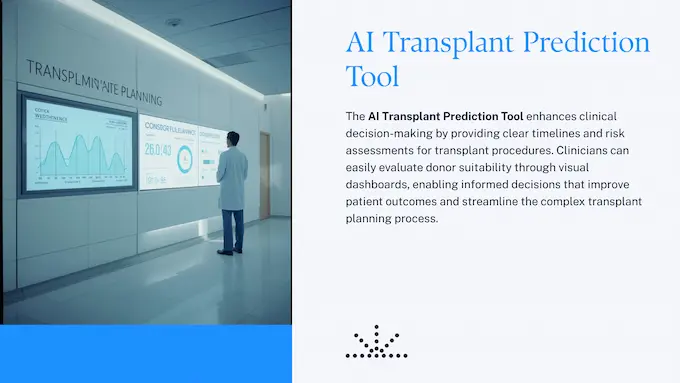
Transplant surgery exposes a harsh reality. Teams sometimes spend hours preparing an operating room and staff for a liver that never gets transplanted. Stanford’s new AI transplant tool targets one key failure mode in donations after circulatory death. In those cases, donors must pass away within a tight window after life support is withdrawn for the liver to remain usable, and surgeons currently lean heavily on intuition when judging that.
The model trains on data from more than two thousand historical donors to estimate the likelihood that death will occur in time. In tests, it cuts futile procurement attempts by about sixty percent while preserving the number of successful transplants. That means fewer emotional whiplash moments for families and less wasted capacity for hospitals. The team is now adapting the system for hearts and lungs, sketching a future where organ allocation quietly leans on predictive models to reduce both waste and heartbreak.
18. AI Deepfakes Fuel Billion Dollar Fraud Wave As Humans Fail Detection
The age of AI deepfakes has migrated from memes into bank ledgers. High quality synthetic voices are now cheap and fast enough that scammers can convincingly mimic a boss, a relative or a political candidate with a few minutes of source audio. Controlled experiments from UC Berkeley show that even when people know some clips are fake, most still struggle to tell cloned voices from real ones.
Real world incidents show how ugly this can get. A Hong Kong finance worker wired tens of millions after joining a video call where every colleague was a deepfake. Voters in the United States heard robocalls of major politicians telling them to stay home. Regulators and lawmakers are scrambling to define AI regulation news that actually bites, from stronger penalties to watermarking schemes, which is why this sits near the top of AI News November 15 2025 for sheer real world risk.
19. Uk AI Child Safety Law Lets Watchdogs Probe Abuse Image Tools
Child safety groups have warned for years that generative models would supercharge abusive imagery. The United Kingdom’s new child safety provisions try to give regulators sharper tools for that fight. Under the updated crime and policing bill, vetted organizations will be allowed to actively test commercial systems to see whether they can produce child sexual abuse material, something that previously risked breaking the law even when done for audits.
Early data from the Internet Watch Foundation shows why lawmakers are moving fast. Reports of AI generated abuse images have more than doubled in a year, with the most serious categories and the youngest apparent victims rising fastest. The law also targets possession or creation of models explicitly tuned for illegal content, treating them as contraband rather than neutral infrastructure. It is not perfect, yet it pushes responsibility upstream into the design and deployment of tools instead of leaving everything to moderators.
20. Russian Humanoid Robot AIdol Faceplants On Debut, Raising AI Doubts
Russia’s humanoid robot AIdol was meant to stride on stage as a symbol of national AI strength. Instead it stumbled, literally. During a public debut in Moscow, the robot lost its balance, fell hard and shed parts in front of cameras. Clips spread quickly, turning AIdol into a punchline about rushed prototypes rather than an advertisement for domestic robotics.
Look past the memes and the platform is still technically ambitious. AIdol runs for hours on a single battery, uses nearly twenty servo motors and aims to display nuanced facial expressions under a silicone skin. The company says most components are already locally produced and future versions will push that higher, tying the project to technological sovereignty under sanctions. For now though, its story lives in the gap between a viral fall and the slow, unglamorous work of making embodied AI walk reliably and repeatedly.
21. AlphaProof AI Reaches Olympiad Level Math Reasoning With Reinforcement Learning Breakthrough
AlphaProof sits at an interesting intersection of formal logic and competition mathematics. Instead of scraping human written solutions, it trains inside the Lean proof assistant, where every move must type check and every proof is mechanically verified. The agent explores proof states with tactics, receives reward only for complete solutions and gradually discovers reusable patterns for tackling families of problems.
That recipe pays off on benchmarks that previously humbled automated systems. At the International Mathematical Olympiad, DeepMind’s pipeline, with AlphaProof handling non geometry problems and AlphaGeometry taking care of the rest, reached a score comparable to a human silver medalist. Crucially, the resulting arguments are not just convincing write ups. They are fully checked Lean objects. Combined with tools that explore constructions, this is one of the AI Advancements that might eventually change not just how we prove theorems, but how confident we feel about the results.
22. RF-DETR Pushes Real Time Detection Transformers Past 60 mAP Barrier On COCO
RF DETR is a reminder that old fashioned specialization still matters in computer vision. While open vocabulary detectors grab headlines, many real systems just need fast, accurate models for a fixed set of classes. RF DETR starts from a strong pretrained backbone, fine tunes once on a target dataset, then uses weight sharing neural architecture search to explore many detector variants without retraining each one.
By toggling knobs like resolution, patch size and decoder depth inside this shared space, the method finds architectures that land in sweet spots along the accuracy latency curve for each deployment. On COCO, smaller RF DETR models outpace peers like D FINE at similar speeds, and larger ones cross the sixty average precision mark while still running in real time. A segmentation variant shows parallel gains. It is not flashy, yet it belongs squarely among New AI model releases that practitioners can drop into production.
23. LeJEPA Self Supervised Learning Promises Provable, Scalable AI Without Brittle Heuristics
LeJEPA is Yann LeCun’s attempt to replace the heuristic zoo of modern self supervision with something cleaner and more principled. The core claim is sharp. If you want embeddings that serve many downstream tasks well, you should shape them to follow an isotropic Gaussian distribution because that geometry minimizes prediction risk across broad families of problems. Instead of stacking tricks to prevent collapse, LeJEPA uses a regularizer called SIGReg to nudge embeddings toward that target.
In practice, LeJEPA combines a simple predictive loss with SIGReg in a compact recipe that works across ResNets, ConvNets and various vision transformers. Training is stable even at billion parameter scale, and the resulting models match or beat popular methods on many benchmarks. On some domain specific datasets, in domain LeJEPA pretraining even tops features imported from huge generic backbones. For fans of Open source AI projects, it is a rare mix of theory, simplicity and strong empirical results.
24. Lumine Generalist Agent Conquers 3D Open Worlds In Real Time
Lumine is ByteDance’s answer to a question game developers have asked for years. Can one agent play long, complex missions in modern open worlds without bespoke scripting for every quest. Built on a Qwen2 vision language backbone, Lumine reads game pixels at a steady clip, outputs keyboard and mouse actions like a human and flips into a slower thinking mode when it needs to plan several steps ahead.
Trained first on thousands of hours of human Genshin Impact gameplay, then on instruction following and reasoning data, Lumine can clear multi hour storylines, follow natural language goals and adapt to new titles without fine tuning. It zero shots long quests in games like Wuthering Waves and Honkai Star Rail, showing that its skills travel beyond a single engine. Among AI News November 15 2025 items, it may be the clearest preview of agents that live persistently inside 3D worlds instead of static benchmarks.
Closing:
If you have made it this far, you have just scanned a cross section of how quickly this field is compounding, from robot dogs and shopping agents to Olympiad proofs and filtration membranes. The trick now is not to follow every headline, but to pick a few threads that match your work and go deeper than the press release.
Bookmark this edition of AI News November 15 2025, subscribe to whichever feed you use for AI News, and pick one story that genuinely intersects your own projects. Read the paper, try the API, or sketch how you would use it. The next wave of AI world updates belongs to the people who treat this stream as raw material, not background noise.
- https://openai.com/index/gpt-5-1/
- https://openai.com/index/gpt-5-1-for-developers/
- https://openai.com/index/group-chats-in-chatgpt/
- https://openai.com/index/understanding-neural-networks-through-sparse-circuits/
- https://blog.google/technology/google-labs/notebooklm-deep-research-file-types/
- https://blog.google/technology/research/useful-quantum-computing-applications/
- https://blog.google/products/shopping/agentic-checkout-holiday-ai-shopping/
- https://deepmind.google/blog/sima-2-an-agent-that-plays-reasons-and-learns-with-you-in-virtual-3d-worlds/
- https://deepmind.google/blog/teaching-ai-to-see-the-world-more-like-we-do/
- https://www.anthropic.com/news/anthropic-invests-50-billion-in-american-ai-infrastructure
- https://www.anthropic.com/news/political-even-handedness
- https://arxiv.org/abs/2511.02864
- https://papers.ssrn.com/sol3/papers.cfm?abstract_id=5713646
- https://news.microsoft.com/source/features/ai/from-wisconsin-to-atlanta-microsoft-connects-datacenters-to-build-its-first-ai-superfactory/
- https://www.anthropic.com/research/project-fetch-robot-dog
- https://news.cornell.edu/stories/2025/11/machine-learning-teaches-membranes-sort-chemical-affinity
- https://www.thelancet.com/journals/landig/article/PIIS2589-7500(25)00100-1/fulltext
- https://www.nbcbayarea.com/news/local/ai-deepfakes-fraud/3979308/
- https://www.theguardian.com/technology/2025/nov/12/tech-companies-child-safety-agencies-test-ai-tools-abuse-images-ability
- https://www.newsweek.com/russia-human-robot-falls-stage-during-debut-11031104
- https://www.nature.com/articles/s41586-025-09833-y
- https://arxiv.org/abs/2511.09554
- https://arxiv.org/abs/2511.08544
- https://arxiv.org/abs/2511.08892
1: What are the main stories in AI News November 15 2025?
AI News November 15 2025 covers 24 major updates, including GPT-5.1’s warmer chat experience, faster developer tools, Google’s new Gemini agents, Anthropic’s $50B infrastructure bet and Microsoft’s AI superfactory strategy.
The roundup also tracks cutting edge research like AlphaEvolve and AlphaProof in mathematics, human aligned vision models, quantum application roadmaps, deepfake fraud risks and new AI safety and child protection laws that will shape regulation and deployment.
2: How is GPT-5.1 different from earlier OpenAI models in this week’s news?
GPT-5.1 improves on GPT-5 with adaptive reasoning, smoother conversation tone and far better control over style, tone presets and constraint following, which makes ChatGPT feel more personal and reliable for everyday users.
On the developer side, GPT-5.1 introduces a reasoning effort knob, faster tool use, efficient prompt caching and new apply patch and shell tools, so teams can build leaner agents, cleaner code workflows and more responsive AI products from the same core model family.
3: Why do Anthropic and Microsoft infrastructure projects matter in AI News November 15 2025?
Anthropic’s $50B US data center investment and Microsoft’s Fairwater AI superfactory show that frontier AI now depends on custom data centers, advanced cooling and dedicated fiber networks, not just smarter algorithms in the cloud.
These infrastructure moves unlock the scale needed for multi trillion parameter models, large agent fleets and scientific workloads, while signaling that countries treating AI compute as strategic infrastructure will shape the next decade of artificial intelligence breakthroughs.
4: What does this week reveal about agentic AI and embodied AI trends?
AI News November 15 2025 highlights a shift from single shot chatbots to agentic AI systems like GPT-5.1 powered tools, SIMA 2, Lumine and robotics experiments that plan, act and learn over long horizons in software and 3D worlds.
These agents handle tasks like game missions, robot dog control, autonomous research, shopping calls and coding refactors, showing how AI is moving into workflows where it coordinates tools, navigates environments and collaborates with humans instead of just answering prompts.
5: How can developers and teams use the insights from AI News November 15 2025?
Teams can use AI News November 15 2025 as a blueprint: upgrade to GPT-5.1 for coding and agents, experiment with NotebookLM style research flows, and track RF-DETR, LeJEPA and new math agents for future model selection and research work.
At the same time, leaders should study the deepfake fraud wave, transplant triage tools and UK child safety law to update risk models, compliance plans and internal policies, so adoption of new AI capabilities stays aligned with safety, trust and regulation.