Introduction
If you wanted to build a robot coworker for the future, you probably would not start in a factory. You would start in a game. Games give you physics, objectives, tools, chaos, and human players who do unexpected things. That is exactly why Google DeepMind built SIMA, and why SIMA 2 is such an important step. It looks like an AI in a video game, yet it is really a testbed for the next generation of AI agents that can act in the real world.
SIMA 2 is not chasing high scores. It is learning how to see, reason, and act across many virtual worlds so that one day the same ideas can power robots, assistants, and entire fleets of digital teammates. It behaves like a player sitting at a desk, reading the screen, listening to your instructions, and then trying to help you reach your goal.
In this guide, I will walk through what SIMA 2 actually is, how it works, why it matters for AI in gaming, and why researchers see it as a bridge from pixels to robots.
Table of Contents
1. What Is SIMA 2 From Instruction Follower To Reasoning Companion
1.1 From SIMA To SIMA 2
The first SIMA, short for Scalable Instructable Multiworld Agent, was a generalist AI agent that could follow short natural language commands across several games. It learned skills like “turn left,” “climb the ladder,” and “open the map,” and it carried them out using the same tools you use, a keyboard and mouse.
SIMA 2 keeps that basic recipe, but gives it a much stronger brain. At its core sits a Gemini model from Google DeepMind. The result is an AI gaming companion that does not just execute commands. SIMA 2 can talk about goals, plan several steps ahead, and explain what it is doing while it plays.
In other words, SIMA 2 is evolving from an obedient instruction follower into a reasoning collaborator. It is still a generalist AI agent operating in 3D virtual environments, but now it has the language and planning ability to feel more like a teammate and less like a bot.
1.2 Why Games Are The Right Testbed
Video games are a perfect stress test for an AI agent. They combine fast feedback, noisy visuals, partial information, and constantly shifting objectives. For Google DeepMind, the agent is a way to push embodied AI without risking anything in the physical world. If the agent falls off a cliff in a game, you just hit reload.
By training SIMA 2 across many titles instead of a single benchmark, the team is trying to answer a bigger question. Can one system learn a vocabulary of actions that transfers from game to game, and later from games to real machines.
2. Generalization Power How SIMA 2 Plays Games It Has Never Seen Before

2.1 From One Game To Many
Most game bots are specialists. They dominate one title and fail completely when moved to another. SIMA 2 is built to do the opposite. It is designed as a generalist AI agent that can carry skills from one world into another.
In internal tests, the agent tackled new environments such as ASKA and MineDojo, which it had not seen during training. It approached tasks like finding a campfire or gathering resources in ways that looked surprisingly human. The key is that SIMA 2 does not just memorize patterns. It builds concepts, such as “mining,” then reuses them in similar contexts, such as “harvesting” in a different game.
2.2 Comparing SIMA 1, SIMA 2, And Humans
To understand where SIMA 2 stands, it helps to compare it with both its predecessor and human players.
SIMA 2 Agent Comparison Table
| System | Strengths | Weaknesses | Typical Use Today |
|---|---|---|---|
| SIMA 1 | Basic instruction following, simple skills across games | Limited reasoning, struggles with long instructions | Early research on language driven control |
| SIMA 2 | Rich language understanding, transfer to new games, self-improving AI loop | Still fragile on very long tasks, imperfect control fidelity | Research platform for AI in gaming and robotics |
| Humans | Flexible reasoning, deep priors about the world, exploration instincts | Limited speed, fatigue, inconsistent performance | Players, designers, and teachers for AI agents |
SIMA 2 closes a significant part of the gap to human performance on short and medium tasks. It still trails humans on multi hour missions, but that is exactly where the research is headed.
3. SIMA 2 In Imagined Worlds Genie 3 As The Ultimate Stress Test
3.1 Dropping SIMA 2 Into Brand New Universes
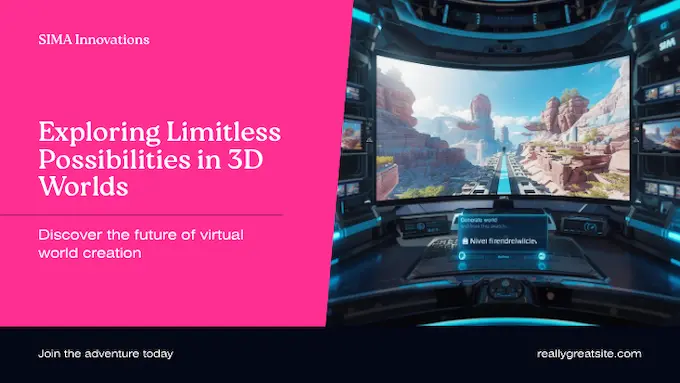
If you want to test generalization, you eventually run out of existing games. That is where Genie 3 comes in. Genie 3 can spin up a new 3D world from a single image or text prompt. Drop SIMA 2 into these freshly created environments and you get a very pure test. There is no way the agent has seen this exact layout before.
The result is striking. the agent can still orient itself, read your instruction, and move with purpose. It may not play perfectly, yet it understands enough of the scene to treat it like another place to explore. For a generalist AI agent, that kind of adaptability is gold.
3.2 Why This Matters For Generalization
Being able to handle unseen Genie 3 worlds means SIMA 2 is not narrowly tied to the quirks of specific titles. It is starting to reason over structure, not surface detail. That is the kind of capability you want if your long term goal is an AI agent that can step out of screens and into factories, homes, and labs.
4. The Virtuous Cycle Inside SIMA 2 As A Self Improving AI
4.1 From Human Demos To Self Play
Early in training, the agent learns from people. Human players demonstrate tasks while narrating what they are doing. The system rewatches those clips, aligns the language with the actions, and practices.
Once a base skill set is in place, the loop changes. The agent starts playing on its own, guided by high level tasks from Gemini and feedback signals that score its behavior. When it fails, the experience still matters. Those episodes go into a growing bank of data that later versions of the agent can learn from.
4.2 Why Self Improvement Changes The Game
This virtuous cycle is more than a neat trick. It is the start of scalable self-improving AI. Instead of waiting for humans to produce more labeled demos, the agent can invent new challenges, attempt them, judge its own performance, and feed that experience back into training.
For embodied AI, this matters a lot. You want agents that can refine their behavior over months and years, not just between dataset releases. SIMA 2 is an early signal that such loops can work in practice, across many tasks and many worlds.
5. How SIMA 2 Actually Works Vision, Language, And Virtual Controls
5.1 Not A Cheat Bot
A common question from developers is simple. Is SIMA 2 just peeking into the game engine. The answer is no. The agent interacts with a game the same way a human does.
It sees pixels on the screen. It reads natural language instructions from the user. It sends virtual keyboard and mouse actions as output. There is no secret API, no hidden units, no access to game state that a regular player would not have.
5.2 The Perception And Control Loop
Behind the scenes, SIMA 2 runs a tight perception action loop.
- Vision, capture a slice of the screen and encode it into features.
- Language, combine that visual state with the latest instruction or dialogue.
- Planning, let the Gemini based core reason about the next action sequence.
- Action, emit a burst of keyboard and mouse events to carry out the plan.
- Reflection, in some modes, narrate what it is doing so the user stays in the loop.
This loop is what turns the agent from a chat model into an embodied AI system that actually pushes buttons in the world, even if that world is made of polygons.
6. From Virtual Worlds To Embodied AI How SIMA 2 Connects To Robots

6.1 Why Games Are A Proxy For The Real World
If you squint, a complex game looks like a robotics lab. There are objects to pick up, maps to navigate, tools to use, and long term quests to complete. The big difference is that nobody gets hurt when the AI agent makes a mistake.
SIMA 2 learns skills that map nicely onto real robots. Navigation, tool use, long horizon planning, collaboration with a human partner. Everything an AI assistant would need to run a warehouse robot or a household helper first shows up in simplified form inside these games.
6.2 From Pixels To Physical Embodiment
Google DeepMind is explicit about the goal. SIMA 2 is not only about AI in gaming. It is also about charting a path to robots that share the same core ideas. Once you trust that a generalist AI agent can survive and improve across dozens of virtual worlds, you can start giving similar systems real sensors and actuators.
The research community calls this embodied AI, intelligence that lives inside a body and acts through it. SIMA 2 is one of the cleanest examples so far of how to bootstrap such agents in safe, controllable environments before letting them interact with real hardware.
7. Your Future AI Teammate What SIMA 2 Means For AI In Gaming
7.1 Beyond Scripted NPCs
Gamers are used to non player characters that repeat the same lines, follow predictable paths, and break if you step outside their script. SIMA 2 hints at a different future. Imagine an AI gaming companion that can explore with you, learn your habits, and adapt its tactics over time.
Because the agent can chat, reason, and act in the same space, it can feel much closer to a real teammate. The line between “character,” “assistant,” and “friend who happens to be an AI agent” starts to blur.
7.2 The Good, The Weird, And The Risks
The upside is obvious. Richer co op experiences, evolving worlds, NPCs with their own goals, and a constant sense that the game is alive. The downside is that the same tools could be misused for cheating in multiplayer or for building manipulative systems.
Google DeepMind is taking the slow route here, keeping the agent in research preview, working with studios, and testing safety mechanisms before it shows up in consumer facing AI in gaming features. The hope is to get the upside, an AI gaming companion that feels genuinely smart, without flooding every leaderboard with bots.
8. The Current Limits Of SIMA 2 Why It Is Powerful But Not Magic
8.1 Where SIMA 2 Still Struggles
For all the impressive demos, SIMA 2 is not a wizard. It still has a short memory, constrained by the context window of its underlying model. Ask it to track a very long quest line with many moving parts and it will lose some threads.
It can also fumble fine grained control. Tapping the exact right key at the exact right time, or aligning the camera with pixel perfect accuracy, remains hard. Humans have spent a lifetime tuning their motor systems. The agent has not.
8.2 Why These Limits Are Useful
The gaps are not a bug. They are a to do list. Research on SIMA 2 helps clarify which pieces of embodied AI are still missing. Better memory, richer world models, more precise control, more robust safety. Each limitation is a concrete challenge for the next generation of systems.
9. When You Might Actually Use SIMA 2
Right now, SIMA 2 lives inside labs and partner studios. It is a research system, not a downloadable product. A few academic groups and game developers are experimenting with it under controlled conditions, exploring what it is like to design with a generalist AI agent at the table.
For the rest of us, the visible impact will arrive gradually. Ideas tested in the agent will start to show up in tools that help developers script smarter worlds, in assistants that understand both words and screens, and in robots that grew up inside games before entering the real world.
10. Where SIMA 2 Points The Future Of AI Agents
SIMA 2 is a glimpse of how AI agents will feel in a few years, not just in research demos but in everyday products. It combines language, vision, control, and a self-improving AI training loop into one coherent system that can live in many worlds.
That makes the agent more than a clever lab project. It is a concrete example of how to build a generalist AI agent that learns by doing, carries knowledge across environments, and keeps getting better through its own experience.
If you care about AI in gaming, robotics, or the future of digital work, keep an eye on SIMA 2 and on Google DeepMind. The next wave of embodied AI will not arrive as a single breakthrough moment. It will arrive as a series of systems like this one, agents that start in games, learn alongside humans, and eventually step out of the screen to work with us in the real world. Now is a good time to decide what kind of AI teammate you want, and to start building in that direction.
Can AI agents like SIMA 2 actually play any video game?
No AI agent can truly play every game yet, but SIMA 2 has already shown it can jump into new 3D titles it never trained on and still complete tasks. It transfers skills from its training portfolio to unfamiliar games such as ASKA and MineDojo, which is a big step toward a more universal gaming AI agent that generalizes rather than memorizes.
What is a “generalist AI agent”?
A generalist AI agent is a single system trained to understand language and act across many different environments and tasks instead of being hard coded for one game. SIMA 2 is a textbook example. It follows natural language instructions, reasons about goals, and controls characters with keyboard and mouse in a wide range of 3D worlds, all while using the same Gemini powered core. This is very different from a narrow bot that only plays one title or one mode.
Is self improving AI like SIMA 2 possible?
Yes. SIMA 2 already uses a self improving AI training loop. It starts by learning from human demonstration videos, then switches to self directed play where Gemini proposes tasks, scores behavior, and feeds those experiences back into the next generation of the agent. Over time, SIMA 2 becomes better at tasks it used to fail, even in new Genie 3 worlds, which shows that iterative, trial and error improvement is not just theory but working in practice.
Is AI the future of gaming?
AI is on track to become a core layer of gaming rather than a side feature. Systems like SIMA 2 hint at AI gaming companions that understand goals, talk to players, and adapt in real time, while future NPCs could have unscripted lives and evolving behaviors. At the same time, researchers and studios are testing guardrails so these agents enhance co op play instead of turning into overpowered tools for cheating in competitive modes.
How does training an AI agent in a game help build real world robots?
Training an AI agent in games gives you a safe, cheap, and infinitely restartable sandbox for teaching skills that robots also need. In 3D games, SIMA 2 practices navigation, object interaction, tool use, and multi step planning while seeing only pixels and language, just like a robot would see cameras and instructions. Once those policies work in virtual environments, the same ideas can be adapted to embodied AI systems that move through factories, homes, and cities.