Introduction
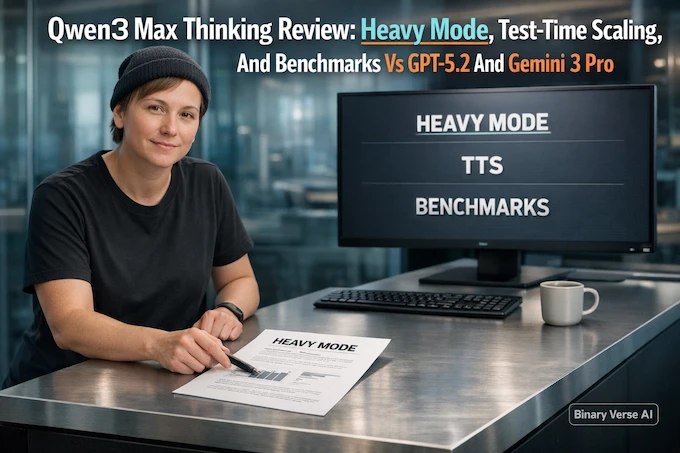
Every few months the “reasoning model” race gets a new lap: a flagship shows up, claims it thinks deeper, posts a fresh set of charts, and the internet immediately argues about whether the charts are real. Qwen3 Max Thinking is worth your time because it makes a clear engineering bet.
Spend extra compute only when it buys down uncertainty, and pair that with tools that feel less like a UI gimmick and more like a competent research assistant. Then price it so developers actually run it.
Let’s break down what changed, what the benchmarks say, and how to decide if it belongs in your stack.
Table of Contents
1. Qwen3 Max Thinking In 60 Seconds
Qwen3 Max Thinking is Alibaba Cloud’s latest flagship reasoning model. The headline feature is “heavy mode,” a test-time scaling approach that improves hard-problem performance without leaning on brute-force best-of-N sampling. Add adaptive tool use, search, extraction, and a code interpreter, and the pitch becomes “one model for agent workflows,” not just chat.
One quick trap: you’ll see qwen tts mentioned in threads. Here, TTS means test-time scaling, not text-to-speech. If you came for voices, wrong aisle. If you came for better reasoning under a controlled compute budget, welcome.
Qwen3 Max Thinking: When It Helps and Tradeoffs
| What You Need | When It Fits | What You Get | What To Watch |
|---|---|---|---|
| Hard reasoning and planning | Research, analysis, coding agents | A real “think deeper” mode | Extra latency when heavy mode kicks in |
| Tool-grounded answers | Live facts, extraction, verification | Fewer hallucinations in practice | Tool calls can add cost |
| One model that can toggle modes | Mixed workloads | Normal mode for speed, heavy mode for depth | You must decide when depth is worth it |
2. What Changed In This Release, And Why It’s Not Just “Bigger”
Yes, the model is trained at massive scale with reinforcement learning. The more interesting change is product shape: fewer manual decisions.
Older workflows looked like this: pick a model, tell it to search, copy results into the chat, run code somewhere else, then stitch everything together and hope it stays consistent. Qwen3 Max Thinking pushes toward the opposite experience. You ask, it decides whether to think longer, whether to fetch, and whether to compute.
That’s not “just UX.” It’s judgment encoded in training. Tool calling is easy. Knowing when a tool will reduce uncertainty is hard, and it’s what separates a demo from something you can ship.
A subtle but important detail is that Qwen3 Max Thinking is trying to fuse “thinking” and “non-thinking” into one model that can switch gears. In practice that matters because many real workloads are spiky. You might do ten easy steps, then hit one step that needs serious reasoning, then go back to easy steps again. If you have to swap models, you lose context and you add glue code. If one model can dial compute up and down in-place, the system gets simpler.
3. TTS Explained: Test-Time Scaling Vs Best-of-N
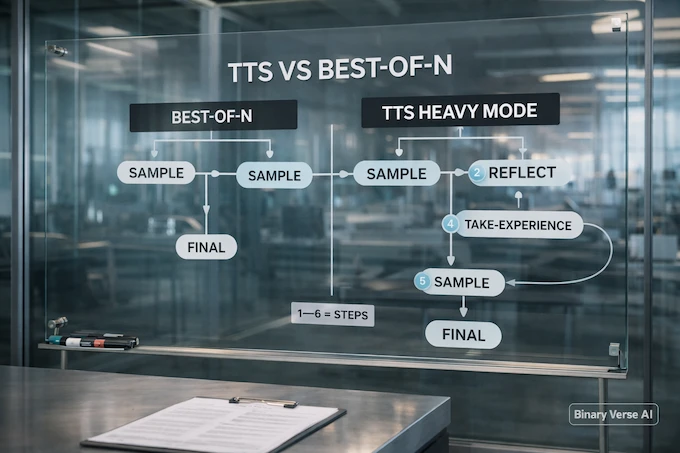
Best-of-N is simple: generate N candidates, score them, pick the best. It’s the LLM version of taking 100 multiple-choice tests and choosing the answer you circled most often.
It’s also expensive and redundant. Many samples are the same idea in different clothes, and you pay for pretend diversity.
Qwen3 Max Thinking’s heavy mode leans into iterative refinement instead: fewer parallel trajectories, more rounds of “think, check, revise.” That mirrors how humans solve hard problems. You don’t write 50 proofs and vote. You write one proof, find the hole, patch the hole, and tighten the argument.
This is really about test-time compute as a control knob. You don’t want max compute on every prompt. You want it when the task has branching complexity and a wrong assumption can poison the whole chain.
4. Heavy Mode Vs Normal Mode: When Extra Thinking Helps
Treat heavy mode like a debugger. You don’t run everything under it all day. You reach for it when the task is subtle, costly, or easy to get wrong.
Heavy mode tends to pay off for:
- Multi-step reasoning with fragile assumptions
- Planning under constraints
- Agentic coding loops that involve propose, test, revise
- Research synthesis across multiple sources
Heavy mode is usually wasteful for:
- Straight transforms like formatting and basic extraction
- Shallow facts that a tool can fetch quickly
- Boilerplate code where fast iteration beats deep thought
The practical takeaway: the real win is routing. If your app escalates from normal mode to heavy mode only when needed, you get better quality without lighting money on fire.
5. Adaptive Tool Use: Search, Extraction, And Code Interpreter
Tool use used to feel like prompt theater. You’d say “search,” the model would improvise a summary, and later you’d realize it invented the source.
Adaptive tool use attacks that failure mode. The model can decide to call search, extract content from a page, or run code, and it can do that mid-answer. Qwen3 Max Thinking is trained not just to call tools, but to call them appropriately.
A good litmus test is prompts where the correct move is to admit uncertainty and then fetch:
- “What changed recently about X?”
- “Is this number still true?”
- “Summarize this page, then compute a statistic from it.”
If the model fetches when it should and stays quiet when it shouldn’t, you’re looking at a real agent foundation.
To make this concrete, imagine you’re building a product analyst bot.
- The user asks for “last quarter revenue and growth drivers.”
- The model should search, extract the relevant numbers, run a quick calculation, then write the narrative.
- Heavy mode should activate only for the synthesis step, not for copying numbers.
This is where Qwen3 Max Thinking can feel different. When the model gets the sequencing right, it stops being a chatbot and starts behaving like a workflow engine.
6. Benchmarks That Matter: What Each Test Is Really Measuring
Benchmarks are useful when you remember what they stress.
- GPQA Diamond punishes shallow pattern matching. It’s deep science reasoning.
- LiveCodeBench is practical programming reasoning under constraints.
- SWE-bench Verified is agentic coding, can you fix real issues in real repos.
- Humanity’s Last Exam is “Google-proof” general reasoning. The “with search/tools” variant measures whether the model can combine reasoning with verification.
A model can be strong in one and mediocre in another. That’s normal. The point is to match the benchmark to your workload.
7. Qwen3 Max Thinking Benchmarks: The Numbers That Should Influence You
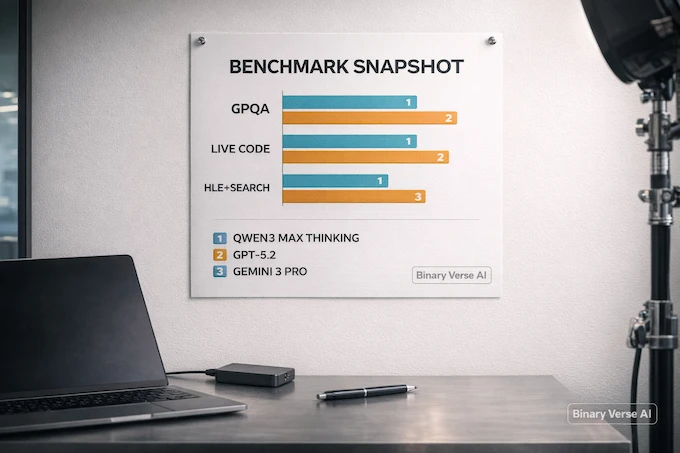
If you’re scanning for signal, look at what moves when you toggle TTS. That delta is the heart of the product, and it’s also why people keep searching for qwen3 max thinking benchmarks and qwen3 max benchmarks in the first place.
Here’s a compact set of headline comparisons, including the recurring “qwen3 max vs gpt 5” curiosity:
Qwen3 Max Thinking: Benchmark Snapshot
| Benchmark | Qwen3-Max-Thinking (With TTS) | Qwen3-Max-Thinking (Without TTS) | DeepSeek-V3.2 | Claude-Opus-4.5 | GPT-5.2 | Gemini 3 Pro |
|---|---|---|---|---|---|---|
| GPQA Diamond | 92.8 | 87.4 | 82.4 | 87.0 | 92.4 | 91.9 |
| IMO-AnswerBench | 91.5 | 83.9 | 78.3 | 84.0 | 86.3 | 83.3 |
| LiveCodeBench (2025.02–2025.05) | 91.4 | 85.9 | 80.8 | 84.8 | 87.7 | 90.7 |
| SWE-bench Verified | 75.3 | N/A | 73.1 | 80.9 | 80.0 | 76.2 |
| τ²-Bench | 82.1 | N/A | 80.3 | 85.7 | 80.9 | 85.4 |
| Humanity’s Last Exam | 36.5 | 30.2 | 25.1 | 30.8 | 35.5 | 37.5 |
| Humanity’s Last Exam (With Search) | 58.3 | 49.8 | 40.8 | 43.2 | 45.5 | 45.0 |
A few grounded takeaways:
- The TTS delta is large, and it shows up across reasoning benchmarks.
- On Humanity’s Last Exam with search, Qwen3 Max Thinking jumps meaningfully. That hints the “think, then verify” loop is doing real work.
- SWE-bench stays brutally competitive. Claude-Opus-4.5 remains strong there.
Credibility Box: Vendor Benchmarks Vs Independent Re-Bench
Vendor numbers are a starting point. If you’re making a decision, run a small re-bench: pick 30 tasks that look like your workload, evaluate with the same prompts and scaffolding across models, and track failure modes. Most internet debates dissolve once you test on your own data.
8. Qwen3 Max Preview Vs Qwen3 Max Thinking: What’s Different
The naming causes half the confusion online, so let’s anchor it.
- qwen3 max preview is the preview track, where thinking behavior often appears early and can shift.
- Qwen3 Max Thinking is the flagship reasoning positioning tied to the snapshot model name qwen3-max-2026-01-23 for API usage.
If you’re prototyping and you want the newest behavior, qwen3 max preview is fine. If you’re shipping and you care about reproducibility, pin the snapshot. Version drift is cute in a demo and painful in production.
9. Qwen3 Max Thinking Vs GPT-5.2 Vs Gemini 3 Pro: A Practical Decision Matrix
“Pick the best model” isn’t advice. It’s a dodge. Here’s the version that survives contact with a billing dashboard:
- Pick Qwen3 Max Thinking when you want cheap depth. Strong reasoning, tool-ready behavior, and a clear compute knob via heavy mode.
- Pick GPT-5.2 when you need consistent general performance across messy tasks. Reliable, often expensive, usually easy to integrate.
- Pick Gemini 3 Pro when your org already lives in Google’s ecosystem. Strong broad capability and a practical cloud story.
- Pick Claude-Opus-4.5 when agentic coding quality dominates your requirements. SWE-bench is a hint, not a law, but it maps to real pain.
The best answer is often “use two.” Route fast tasks to normal mode or a cheaper model, and reserve heavy mode for the prompts that actually justify it.
If you’re comparing Qwen3 Max Thinking vs GPT-5.2 vs Gemini 3 Pro for production, the easiest way to avoid regret is to answer two questions up front.
- Do you need tool use as a first-class feature, or is it a nice-to-have.
- Do you want a model that can spend more compute on the hard 5 percent of requests.
If the answer to both is “yes,” Qwen3 Max Thinking is suddenly less of a novelty and more of a default candidate.
10. Pricing Reality: Token Costs, Context Tiers, And Tools
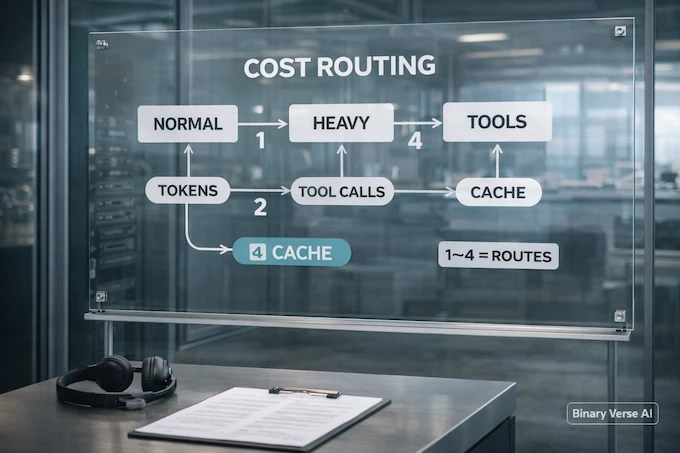
Pricing is where the model story becomes architecture.
For the Qwen3 Max Thinking snapshot, the published pricing is tiered by input tokens per request. At the smallest tier, input is about $1.2 per 1M tokens and output about $6 per 1M tokens for chain-of-thought plus answer. Larger contexts step up in price, so the economic play is obvious: keep prompts tight, cache context, and don’t dump a novel into heavy mode unless you have to.
Tooling can also change the bill. Search and other agent actions can add cost quickly if your app triggers them too freely. Treat tools like premium actions:
- Search when the fact can decay or uncertainty is high.
- Extract when you have a specific page to ground against.
- Run code when correctness and repeatability matter.
That naturally leads to a ladder: default to normal mode, escalate to heavy mode, then allow tools, then allow multiple tool rounds.
11. How To Use It: Qwen Chat, The Qwen3-Max-Thinking API, And Setup Notes
The fastest way to get a feel for behavior is Qwen Chat. Watch when it chooses to search or compute. That “when” matters more than a one-point score.
If you’re integrating, the key developer hook is compatibility. The OpenAI-style interface means many teams can prototype by swapping a base URL and model string. You’ll see the snapshot model name qwen3-max-2026-01-23, and you should pin it for any serious evaluation.
On the API side, treat the qwen3-max-thinking api like any other production dependency. Pin versions, log request metadata, and build a tiny eval harness you can run after each dependency bump. The model name you’ll keep seeing is qwen3-max-2026-01-23, and that’s the one to lock when you’re doing serious A/B tests.
Also, don’t ignore context strategy. With long context windows available, it’s tempting to shovel everything into the prompt. Resist that urge. Summarize, cache, and feed the model only what it needs for the current step. It makes Qwen3 Max Thinking faster, cheaper, and usually more accurate.
One more real-world constraint: regional deployment and data residency can outweigh benchmark deltas. Decide your policy box first, then compare models inside it.
Qwen3 Max Thinking feels like a signpost for 2026: models that can decide when to think, when to look things up, when to compute, and when to stop. If that’s the direction you’re building in, don’t just read the charts. Run your own: take 20 of your hardest prompts, test normal mode vs heavy mode, log tool calls, and compare against your baseline.
If you want a concrete next step, build a tiny agent with one heavy-mode pass max and one tool call max, then ship it to internal users for a week. You’ll learn fast, and you’ll learn the kind of truths that don’t fit in a benchmark table.
1) What is the use of Qwen3 Max?
Qwen3 Max, and especially Qwen3 Max Thinking, is built for complex, multi-step work: deep reasoning, coding, planning, and agent workflows where tool-use and extra inference compute improve accuracy.
2) Is Qwen AI completely free?
Not completely. Qwen Chat can offer free tiers or limited access, but API usage is paid, typically billed per token. If your workflow triggers tools like search or extraction, those actions may also add costs.
3) What is the max limit in Qwen3?
It depends on the model and deployment listing. Max/Plus/Flash tiers can have different context windows, and preview vs snapshot variants may differ. Always confirm the exact limit for the specific model ID you’re using.
4) Is Qwen owned by Alibaba?
Yes. Qwen is Alibaba’s model family and is commonly distributed through Alibaba Cloud’s model platform and APIs.
5) What does “TTS” mean in Qwen3 Max Thinking, and why does it score higher?
Here, TTS means test-time scaling, not text-to-speech. It can score higher because the model spends more compute at inference time, using structured extra “think time” to reduce mistakes instead of just sampling many answers.