Hilbert’s 16th Problem: Did OpenAI Finally Prove Uniform Bounds for Limit Cycles?
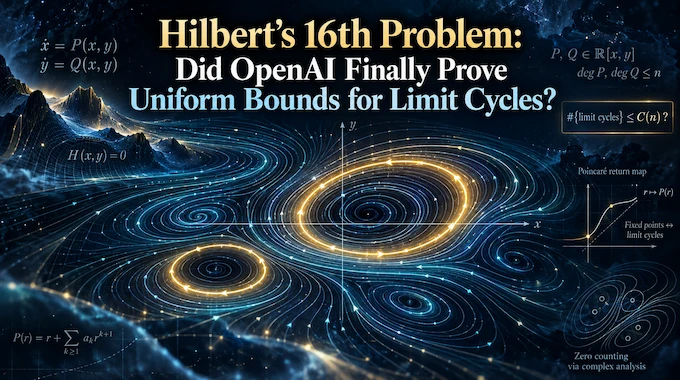
Glowing limit cycle ring under a ceiling line, visualizing Hilbert’s 16th Problem and OpenAI’s uniform bound claim

A mathematical question can survive 126 years not because nobody knows how to count, but because nobody knows whether the counting can ever get out of control. That is the tension behind Hilbert’s 16th Problem, and it sits at the center of a striking new OpenAI manuscript. Released in OpenAI’s October 2026 mathematics collection and … Read more
Free Group Factor Isomorphism Problem: How OpenAI’s Proof Absorbs an Extra Generator

Feature illustration of the free group factor isomorphism problem: a third strand absorbed into a two-strand helix

Can a mathematical structure forget how many independent ingredients built it? For free group factors, that question has resisted decades of research. OpenAI’s proposed answer is yes, and the interesting part is how it makes the extra ingredient recoverable from the others. The free group factor isomorphism problem asks whether operator algebras associated with free … Read more

Thompson’s Group F: How OpenAI Tackles the Decades-Old Amenability Mystery

Thompson’s group F visualized through binary trees, dyadic interval transformations, and a broken invariant balance.

A mathematical object can be easy to describe and remarkably difficult to understand. Thompson’s group F fits that description almost too well. Its elements stretch and compress an interval according to a short list of rules. Yet a basic question about averaging over those transformations resisted resolution for decades. OpenAI’s manuscript, dated September 23, 2026, … Read more

Unitary Synthesis Problem: The Boolean Oracle Behind OpenAI’s Surprising Answer

Compact quantum circuit reading a huge binary data wall, illustrating the unitary synthesis problem and Boolean oracle.

OpenAI claims a positive answer to the unitary synthesis problem: a quantum computer can approximate any quantum unitary efficiently when supplied with a suitably chosen classical Boolean oracle. The qualification belongs in the opening sentence. The paper does not show how to construct that oracle efficiently. That still makes this a striking claim. The problem … Read more

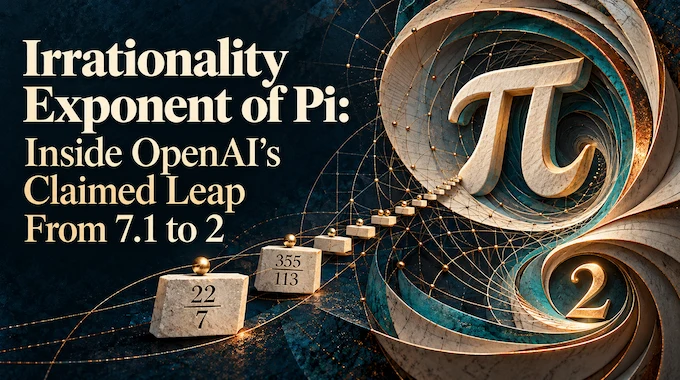
Irrationality Exponent of Pi: Inside OpenAI’s Claimed Leap From 7.1 to 2

Editorial cover showing the irrationality exponent of pi as a pi symbol squeezed between two glowing bounds, 7.1 to 2

The fraction 355/113 gets astonishingly close to π using just three digits in its denominator. It also points to a question mathematicians have struggled with for decades: how often can fractions achieve that kind of accuracy as their denominators grow? OpenAI’s manuscript The Irrationality Exponent of π Is 2, dated September 24, 2026, claims an … Read more

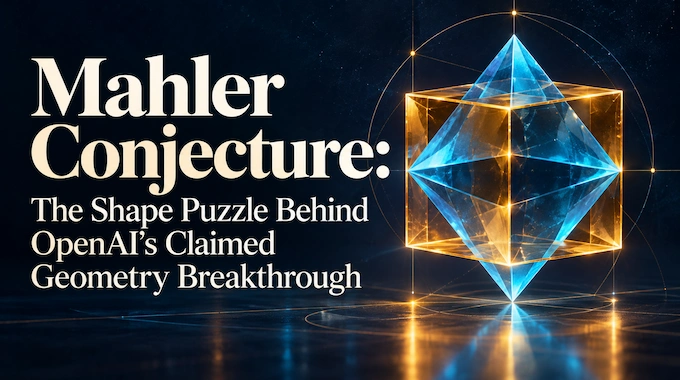
Mahler Conjecture: The Shape Puzzle Behind OpenAI’s Claimed Geometry Breakthrough

Glowing wireframe cube and octahedron illustrating the Mahler conjecture and its polar duality

A cube looks ordinary until you ask a question mathematicians have spent decades trying to answer: can any symmetric convex shape beat it at a particular geometric balancing act? The Mahler conjecture concerns a shape and its polar, a mathematical partner whose size changes in response to the original. Multiply their volumes, and you get … Read more

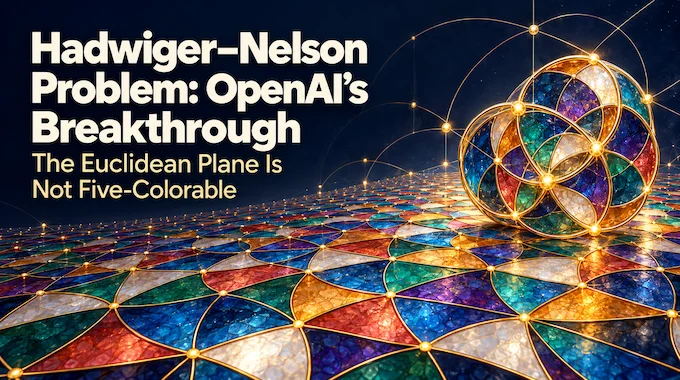
Hadwiger–Nelson Problem: OpenAI’s Breakthrough Shows the Euclidean Plane Is Not Five-Colorable

Hadwiger–Nelson Problem cover art: a unit-distance graph on a plane with five colors failing at one point

A flat surface, a fixed distance, and a handful of colors. That sounds like an afternoon puzzle. Mathematicians have been wrestling with it since 1950. The Hadwiger–Nelson Problem asks how many colors are needed to color every point in the plane so that points exactly one unit apart never share a color. OpenAI’s manuscript, The … Read more