Kakeya Conjecture: How OpenAI Claims to Break the 4D Barrier
Kakeya Conjecture feature image: glowing line segments forming a four-dimensional wireframe in every direction

How tightly can you pack a line segment pointing in every possible direction? The question sounds like a puzzle involving a pencil and an unusually patient afternoon. Its answer reaches into the mathematics of waves, Fourier analysis, and the limits of geometric compression. On October 6, 2026, OpenAI released a manuscript claiming to resolve the … Read more

OpenAI Matrix Multiplication: The Proof Behind the 2.25 Leap

OpenAI Matrix Multiplication cover art: a dense cubic grid reshaped into a leaner lattice for the 2.25 bound

AI runs on an extraordinary amount of matrix multiplication. Training models, processing attention and transforming hidden representations all depend on combining grids of numbers efficiently. A better mathematical bound for that operation deserves attention, even when it doesn’t arrive with a CUDA kernel attached. The OpenAI Matrix Multiplication paper, dated October 2, 2026, establishes an … Read more

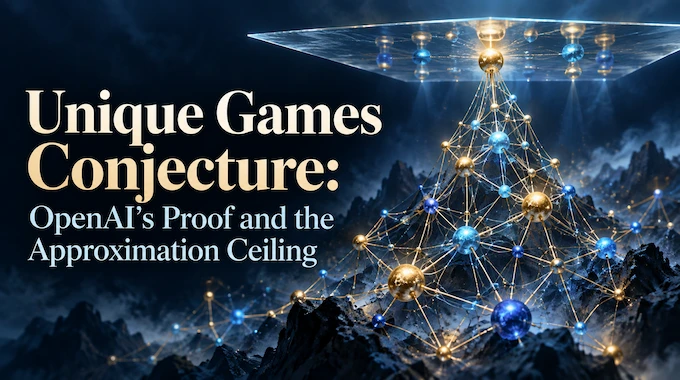
Unique Games Conjecture: OpenAI’s Proof and the Approximation Ceiling

Glowing graph lattice meeting a glass ceiling, symbolizing the Unique Games Conjecture and the approximation limit

When an algorithm gives you a pretty good answer, the obvious next question is whether a cleverer algorithm could do better. Sometimes the obstacle is engineering. Sometimes it may be a mathematical ceiling. The Unique Games Conjecture sits at that boundary. OpenAI has published a manuscript claiming to prove it, alongside formalization materials describing the … Read more

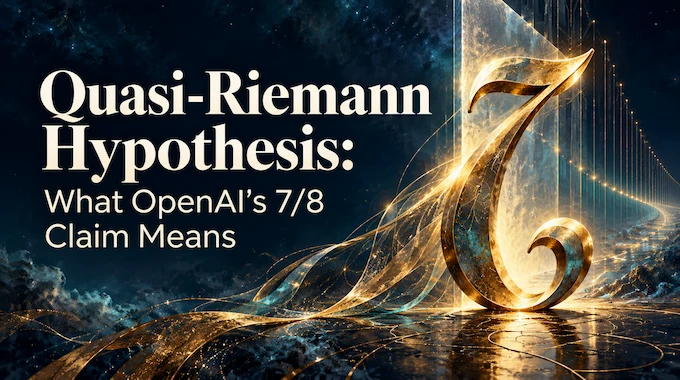
Quasi-Riemann Hypothesis: What OpenAI’s 7/8 Claim Means

Quasi-Riemann Hypothesis cover showing a glowing barrier wall holding back points of light at the 7/8 line

The Riemann hypothesis remains unsolved. Clay Mathematics Institute still lists it as an open Millennium Prize Problem. OpenAI’s new Quasi-Riemann Hypothesis manuscript addresses a weaker statement, but “weaker” hardly means small. If its argument holds, it establishes a fixed limit on where certain mathematical zeros can occur, tightening our understanding of prime numbers. Released on … Read more

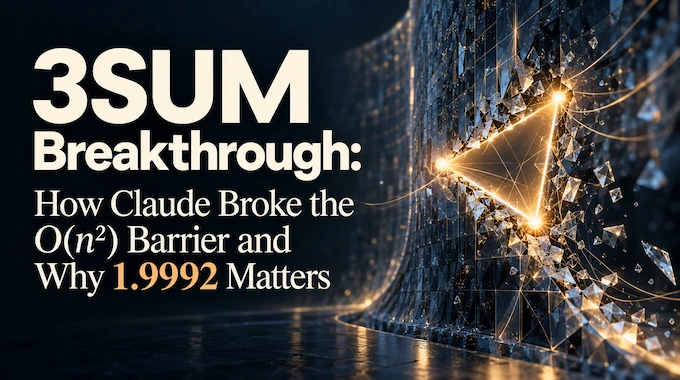
3SUM Breakthrough: How Claude Broke the O(n²) Barrier and Why 1.9992 Matters

3SUM breakthrough illustrated by three connected light nodes piercing a crystalline barrier beneath the article title.

Given a list of numbers, can you find three that add up to zero? That’s the 3SUM problem. The familiar solution takes quadratic time, roughly proportional to the square of the input size. A new paper credits Claude with discovering an algorithm that pushes the exponent below two. The headline result is a deterministic running … Read more

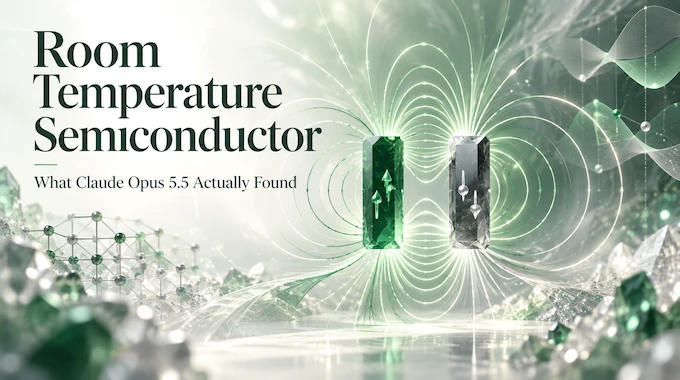
Room Temperature Semiconductor: What Claude Opus 5.5 Actually Found

Room Temperature Semiconductor crystal showing opposing magnetic spins and AI-guided materials discovery.

An AI “discovered a room temperature semiconductor” is the kind of headline that almost guarantees confusion. Silicon already works at room temperature, and this result has nothing to do with room-temperature superconductivity. What a team of Claude Opus 5.5 agents actually identified is more specific, and arguably more interesting: two candidates for room-temperature magnetic semiconductors … Read more