Irrationality Exponent of Pi: Inside OpenAI’s Claimed Leap From 7.1 to 2
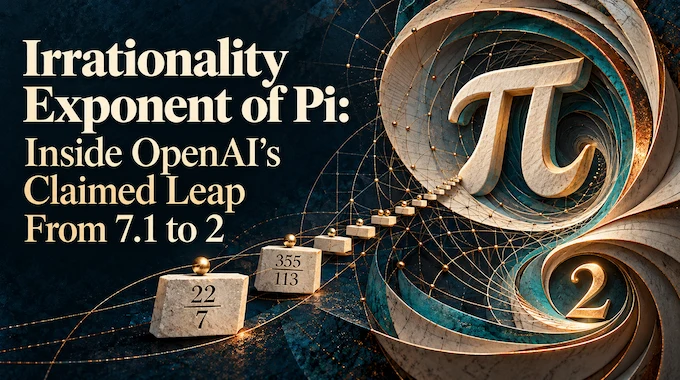
Editorial cover showing the irrationality exponent of pi as a pi symbol squeezed between two glowing bounds, 7.1 to 2

The fraction 355/113 gets astonishingly close to π using just three digits in its denominator. It also points to a question mathematicians have struggled with for decades: how often can fractions achieve that kind of accuracy as their denominators grow? OpenAI’s manuscript The Irrationality Exponent of π Is 2, dated September 24, 2026, claims an … Read more
Mahler Conjecture: The Shape Puzzle Behind OpenAI’s Claimed Geometry Breakthrough

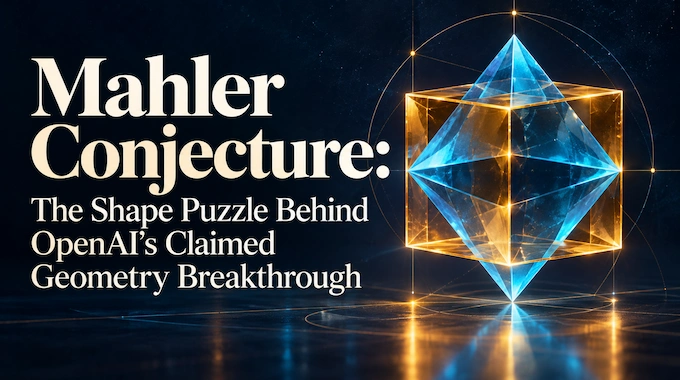
Glowing wireframe cube and octahedron illustrating the Mahler conjecture and its polar duality

A cube looks ordinary until you ask a question mathematicians have spent decades trying to answer: can any symmetric convex shape beat it at a particular geometric balancing act? The Mahler conjecture concerns a shape and its polar, a mathematical partner whose size changes in response to the original. Multiply their volumes, and you get … Read more

Hadwiger–Nelson Problem: OpenAI’s Breakthrough Shows the Euclidean Plane Is Not Five-Colorable

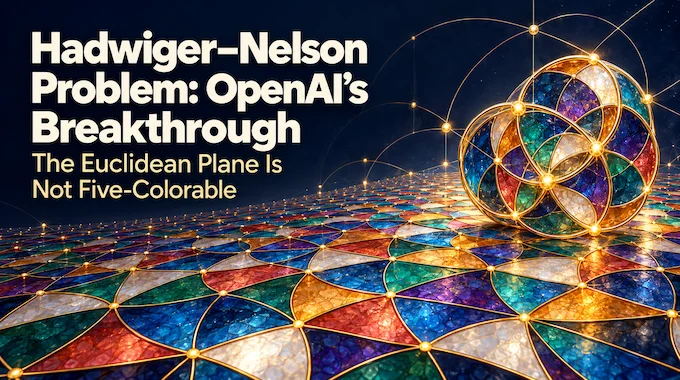
Hadwiger–Nelson Problem cover art: a unit-distance graph on a plane with five colors failing at one point

A flat surface, a fixed distance, and a handful of colors. That sounds like an afternoon puzzle. Mathematicians have been wrestling with it since 1950. The Hadwiger–Nelson Problem asks how many colors are needed to color every point in the plane so that points exactly one unit apart never share a color. OpenAI’s manuscript, The … Read more

Derandomization of Logarithmic Space: Inside OpenAI’s Bold L = RL = BPL Breakthrough Claim

Dice becoming one light path through a narrow memory slot: derandomization of logarithmic space

Randomness is a useful shortcut in computing. A few coin flips can help a memory-starved algorithm explore possibilities without recording every step. For decades, theoretical computer scientists have asked whether those random bits provide genuine extra power when an algorithm has almost no working memory. OpenAI says the answer is no. In a 108-page manuscript … Read more

Hilbert’s 10th Problem Over the Rationals: OpenAI’s Unexpected Proof Strategy

Hilbert's 10th problem cover art: a glowing lattice of fractions before a sealed gateway with no verdict light

Hilbert’s 10th problem has acquired a striking AI twist. OpenAI has published a proposed proof concerning its rational-number extension: whether an algorithm can always determine if a polynomial equation has a solution made of fractions. The paper’s answer is no. That sounds odd for a breakthrough. An AI system helps produce mathematics explaining why algorithms … Read more

Barnette’s Conjecture: Inside OpenAI’s Surprising Proof and Why It Matters

Glowing loop through a planar graph illustrating Barnette’s Conjecture and OpenAI’s proof claim

A graph can give every vertex exactly two selected connections and still leave you going around several separate loops. Getting one loop through the entire graph is the hard part. For decades, that distinction has kept a deceptively simple mathematical question open. Barnette’s Conjecture asks whether every cubic, bipartite, planar, 3-vertex-connected graph contains a Hamiltonian … Read more

OpenAI Integer Multiplication: A Tiny Crack in the n log n Barrier

OpenAI integer multiplication concept: a glowing hairline crack splitting a vast n log n barrier wall

The improvement is so small that rounding it casually would erase it. The mathematical claim is large enough to challenge a conjecture that has stood since 1971. OpenAI integer multiplication research claims an exact, deterministic algorithm for multiplying two (n)-bit integers in less than (n\log n) asymptotic time. The saving sits in the exponent of … Read more