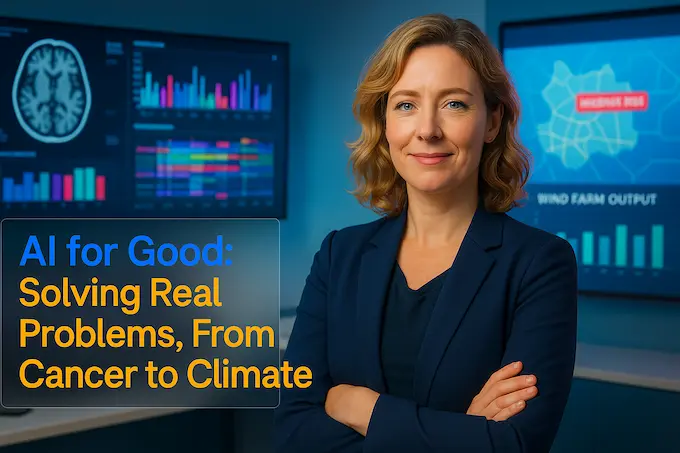
“Hello, I’m Professor Brian Cox. Welcome to ‘A Question of Science’…” That opening lands like a friendly knock on the lab door. Then comes the challenge that matters: “So how can we ensure that AI is a force for good and not the author of our destruction?” It is the right question, and it deserves a clear answer that respects your time.
This essay is about AI for good. Not hype. Not sci-fi. Real systems that help clinicians catch disease earlier, help researchers test ideas faster, help teachers focus on students, and help communities make better decisions. We will keep the promise simple. Define what AI for good is. Show concrete, positive uses of AI with real-world texture. Acknowledge risks without melodrama. Then leave you with steps you can act on today.
“In 1950, Alan Turing asked whether it would ever be possible to construct a machine whose responses would be indistinguishable from those of a human being?” As Professor Brian Cox reminds us, that question still echoes. The better question for 2025 is closer to home. Where does AI for good already work, and how do we scale the parts that make society smarter, fairer, and healthier?
Table of Contents
1. What “AI For Good” Actually Means
AI for good is not a slogan. It is a practical stance. Use machine intelligence to reduce suffering, expand access, and solve problems that markets under-serve or ignore. Think of wildfire prediction rather than ad clicks. Think of prosthetics that learn, not just photo filters that amuse. The center of gravity is public value, not novelty.
Three principles define this space.
- Problem First, Not Model First. Start with human needs. A radiology backlog. A coastal flood map that is ten years out of date. A school with one counselor for six hundred students. Then evaluate AI only if it helps the people who do the work.
- Evidence Over Demos. A polished demo can hide fragility. AI for good favors clinical trials, A/B tests, and stress checks. If a tool saves 20 minutes per patient note while maintaining accuracy, ship it. If it dazzles but confuses users, fix it or shelve it.
- Ethical AI By Design. Privacy, fairness, and transparency are built in, not bolted on. If you cannot explain a decision that changes someone’s life, do not deploy it. That is the baseline for ethical AI.
If you want a short definition, try this. AI for good is a disciplined way to apply machine intelligence to public interest problems with measurable outcomes and governance that people can trust.
2. How AI Accelerates Scientific Discovery
AI is not a magic wand. It is a pattern engine that turns data into candidate insights, then partners with experts to test what holds up. The result is acceleration. AI in scientific research takes jobs that were once limited by human time and gives them throughput.
2.1 Personalized Medicine That Learns From You
Precision medicine lives or dies by signal quality. Genomic variants, lab histories, imaging, clinician notes, and lifestyle data all carry faint hints about what will help a specific patient. Models that fuse those streams can propose treatment paths and side-effect risks that match the person, not the average.
Here is the punch line. Doctors are not replaced. They are leveled up. A tool proposes a ranked list of therapies with citations, uncertainty, and cohort analogies. The clinician keeps authority, reviews the evidence, and decides. That is AI for good in a high-stakes setting, and it keeps the human in the loop where it belongs.
2.2 Climate And Energy, The Data Problem

Climate work is a data problem at planetary scale. Satellites stream petabytes. Local sensors trickle messy signals. Regional models disagree at the edges where policy lives. Modern AI helps reconcile resolutions, fill missing data, and spot early pattern breaks that warn municipalities before trouble lands. In energy research, control systems that learn can stabilize volatile plasma in fusion experiments and optimize wind-farm output under changing conditions. Faster iteration means faster science. That is a quiet win for AI in scientific research.
2.3 The Lab Notebook Goes Digital
A modern lab is part bench, part software. Large language models can read method sections, synthesize experimental plans, and propose variations that increase expected yield or reduce cost. Agents can schedule instruments, check calibration history, and flag anomalies that ruin runs. Scientists stay in control. The notebook simply got smarter.
All of this reads like a simple idea. It is. Turn ambient complexity into tractable workflows. That is AI for good when you strip away the buzzwords.
3. Transforming Healthcare, From Diagnosis To Accessibility
Healthcare mixes the precise and the deeply human. The best outcomes come when tools amplify clinicians without getting in their way. This is where AI in healthcare shines, as long as safety is the first constraint.
3.1 Imaging That Catches Problems Earlier

A trained radiologist can see patterns most of us miss. An imaging model trained on millions of scans can see weak signals even experts overlook on busy days. The combination is powerful. Models pre-label regions of interest, score malignancy risk, and surface relevant priors from the history. Radiologists review, confirm, and correct. Time to decision drops. False negatives drop. Patients get answers sooner. That is one of the clearest positive uses of AI.
3.2 Accessibility As Standard, Not A Niche
Accessibility belongs in the main product, not the add-on menu. Real-time audio description for the visually impaired. Live captioning with domain-specific vocabulary for engineering lectures. Prosthetics that adapt their control curves to the wearer’s gait over weeks, not years. These are not prototypes anymore. They are what it looks like when AI for good centers inclusion.
3.3 What Safety Looks Like In Practice
Safety is not a vibe. It is a checklist that passes audits.
- Data governance. Train on consented data. Encrypt at rest and in transit. Minimize retention by default.
- Robustness testing. Hammer the model with counterfactuals and adversarial cases. Keep a living battery of hard examples.
- Human oversight. Record who approved what, when, and why. Make reversal cheap.
- Monitoring. Drift detection with alerts routed to the team that can act in minutes, not next quarter.
Do that, and you move AI for good from aspiration to standard of care.
4. AI For Learning, Education That Adapts To You
One-size-fits-all instruction leaves most students behind or bored. The fix is feedback. Tools that watch how you learn and respond in kind transform outcomes. This is AI for learning in practice.
4.1 Personal Tutors At Scale
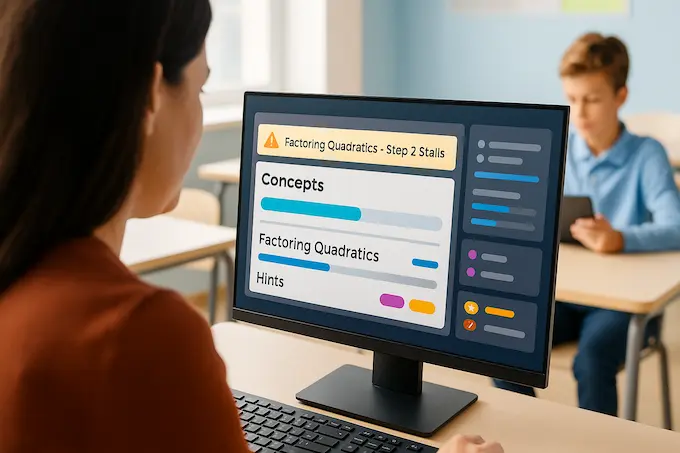
Adaptive tutors identify where a student actually gets stuck. Not “algebra is hard,” but “factoring quadratic expressions stalls at the second step.” The system adjusts pace, shows worked examples that align with the student’s approach, and checks for genuine understanding instead of pattern mimicry. Teachers get dashboards that show which concepts need a quick intervention. Students get confidence.
4.2 Languages, Labs, And Lifelong Learning
Language apps have moved beyond flashcards. Conversational practice with instant correction gives learners the feedback loop they used to get only with a patient friend. In science classes, simulation sandboxes let students run safe experiments with real equations and real constraints. This is one answer to why is AI good for society. It expands opportunity without waiting for perfect classroom ratios.
4.3 Teachers With Time For Teaching
Ask any teacher what steals their time. It is paperwork. The right system drafts lesson plans that match curriculum goals, constructs differentiated assignments, and pre-grades routine items with line-level feedback. The human approves and edits. The class gets more face time. In that world, harnessing AI for good means giving teachers back their craft.
5. The Hard Parts, Risks You Should Care About
You cannot be credible on AI for good without naming the tradeoffs in plain language.
5.1 Bias, Privacy, And Security
Bias is not an abstract debate. A hiring screen that reflects yesterday’s discrimination will hurt people tomorrow. Privacy is not a checkbox. Sensitive data leaks change lives. Security is not optional. Once an attacker can steer a model, you no longer control outcomes.
Mitigation is work. Start with representative data, bias audits, and clear red-team goals. Use privacy-preserving learning where it fits. Build least-privilege access and rotate secrets. None of this is glamorous. All of it is required for ethical AI.
5.2 Misinformation And Deepfakes
Generative models make persuasive media cheap. That cuts both ways. Education campaigns, accessibility features, creative tools. Also scams, propaganda, and harassment at scale. Defense is layered. Provenance standards with cryptographic signatures. Detection tools that flag synthetic artifacts before content spreads. Platform rules with teeth. Public literacy so people recognize tactics. This is not a one-and-done sprint. Keep improving the shield as the sword evolves.
5.3 Jobs, Power, And Alignment With Society
AI does not “take” jobs. Organizations choose to redeploy people when technology changes incentives. That choice should come with retraining, transparent outcomes, and social safety nets that respect dignity. Concentrated power is the bigger threat. When a handful of firms control the infrastructure of thought, everything downstream is distorted. The antidote is competition, open standards, interoperable systems, and public institutions strong enough to negotiate on society’s behalf. If you believe in AI for good, you invest in all four.
6. How To Participate In AI For Good
This part is practical. Choose one action that fits your role, then take it this month. Every small fix compounds.
6.1 For Builders And Researchers
- Pick a problem with a real customer. Ask a clinic what ruins their Mondays. Ask a city analyst what takes three weeks that should take three hours. Ship there.
- Measure what matters. Latency is not impact. Time saved, errors avoided, access expanded, dollars conserved. Those are the numbers that justify trust in AI for good.
- Open what you can. Datasets with consent, code for evaluation harnesses, model cards that document failure modes. The more independent scrutiny, the safer your system.
- Design for handoffs. Humans must be able to stop, correct, and override. Build UX that invites intervention instead of hiding it.
6.2 For Students And Career Switchers
- Use AI for learning with intention. Ask a model to quiz you, not to do your homework. Make it explain each step, then teach the idea back in your own words.
- Build a small public project. A climate-map explainer for your city. A healthcare-literacy bot for a local clinic, built with their input and safeguards. You will learn more by shipping than by scrolling.
- Study the social stack. Privacy law, safety standards, usability testing. The future belongs to people who combine model intuition with human factors and policy basics. That is how AI for good grows up.
6.3 For Everyone, Daily Habits That Compound
- Push for transparency where you live. Ask your school board how AI is used. Ask your hospital for its model governance policy. Ask your city how it vets algorithms that affect services.
- Choose tools that respect you. Products that publish evaluation results, support data export, and provide clear appeal paths are a better bet.
- Join the conversation with grace. Skepticism is healthy. Cynicism is cheap. The goal is not to cheerlead. The goal is to direct momentum toward outcomes you would be proud to explain to a patient, a parent, or a friend.
That is the culture that sustains AI for good beyond the first news cycle.
7. The Future Is A Choice
We began with a simple question and a voice that many of us trust. Professor Brian Cox frames the stakes clearly: “So how can we ensure that AI is a force for good and not the author of our destruction?” The answer is not mystical. It is a sequence of habits that any serious field adopts. Define the problem precisely. Test results in the open. Center the people who live with the outcomes. Keep improving the product until it disappears into the background and life gets better.
Some people will still ask why is AI good for society. Point them to earlier cancer detection, to students who finally click with fractions, to neighborhoods that evacuate before the flames, not during. These are not edge cases. They are proof that AI for good is already here when we build responsibly.
Turing’s old question about indistinguishability still has charm. The more urgent question is about direction. Do we keep using machine intelligence to invent distractions, or do we pour it into the work that keeps communities healthy and curious? I know where I stand. Use models to make experts more capable, and to make expertise more accessible. Use models to widen the circle of people who get great care, great education, and a fair chance at a good life.
Here is the call to action. Choose one problem in your domain, then run the AI for good playbook on it. Ship a bias audit that actually changes a pipeline. Replace a weekly chore with a trustworthy agent and give that time back to humans. Publish a compact report so others can replicate your result. Repeat. Bring a colleague along next time. This is how fields change, not with headlines, but with teams that keep solving the next concrete thing.
AI will not write the story of our future on its own. We will. Choose to write a chapter that earns the name AI for good.
What is AI for good?
AI for good is the intentional use of artificial intelligence to reduce harm and improve outcomes in areas like healthcare, climate, education, and public services. It couples measurable impact with ethics, transparency, and human oversight so communities benefit, not just companies.
How is AI for good used in healthcare?
AI for good supports earlier detection, triage, and accessibility, think imaging assist, clinical documentation, and captioning tools, while keeping clinicians in control. Effective programs pair validation, privacy, and monitoring with clear governance to protect patients.
Why does AI for good matter for climate and energy?
Because AI can fuse satellite, sensor, and grid data to forecast risks, optimize renewables, and target resilience funding where it helps most. The best projects publish methods and results so others can replicate impact.
What risks come with AI for good projects?
Risks include biased outcomes, privacy breaches, and overpromising. Independent evaluation, bias audits, data governance, and community input reduce harm and keep “AI for good” from becoming mere branding.
How can an organization start with AI for good?
Define a public-interest problem, gather representative data, run small pilots with clear metrics, and publish results. Partner with domain experts and align work to ethical guidelines and SDGs to ensure benefits reach real people.