Introduction
The era of AI that talks is ending. The era of AI that actually does things has begun. Teams wired these models into everything, until finance asked a blunt question: where is the impact? That question exposed the Gen AI Paradox. Generative systems spread faster than almost any technology in recent memory, yet many enterprises saw little change in revenue, cost, or risk. Chatbots helped humans type faster. Humans still had to log into systems, push buttons, and chase the work to the finish line.
The next wave is different. Agentic AI is not just another wrapper around a model. It is a way to turn models into autonomous teammates that can pursue goals, coordinate tools, and close loops without constant hand holding. Instead of a chatbot that suggests how to respond to a refund request, you get autonomous AI agents that can read the inbox, apply policy, trigger the refund, and only ask for help when something looks weird.
This guide is for builders, researchers, and leaders who want to understand what that shift really means. We will unpack what agentic AI is, how it differs from the systems you already ship, what a real AI agent architecture looks like, which risks matter, and how to start without blowing up your cloud bill or your reputation.
Table of Contents
1. From Chatbots To Autonomous Teammates
The first generative wave delivered a simple pattern. A human writes a prompt. The model replies with text or an image. PowerPoint slides, sales emails, design drafts, homework. The problem is structural. A chatbot is a smart typewriter. It helps with individual steps, yet the human still runs the workflow. A support agent reads the suggested reply, checks the transaction in another system, decides whether a refund is allowed, presses the button, updates the CRM, and writes a note about it.
Agentic AI flips the ownership of that chain. Instead of “help me write a refund email”, you hand the system a goal like “resolve legitimate refund requests under policy and escalate anything unusual”. The agent reads the inbox, pulls context from databases, checks rules, calls the payment API, and closes the ticket. You supervise exceptions instead of micromanaging every keystroke. The important mental shift is this: you stop asking “how can AI help this person type faster” and start asking “which outcome can safely move from human hands to software”.
2. What Is Agentic AI? Beyond The Chat Interface
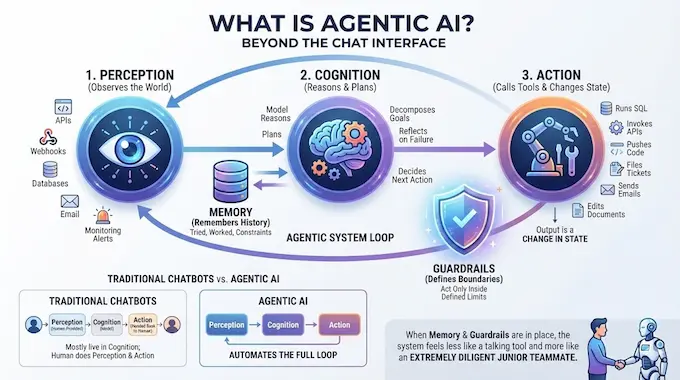
So what exactly is agentic AI, beyond the buzzword? You can think of an agentic system as a loop with three moving parts:
Perception
The system observes the world. Not just user text, but APIs, webhooks, logs, databases, email, and monitoring alerts.
Cognition
The model reasons about what it sees. It plans, decomposes goals, reflects when things fail, and decides which action comes next.
Action
The system calls tools. It runs SQL, invokes APIs, pushes code, files tickets, sends emails, or edits documents. The output is not only text. The output is a change in state. Traditional chatbots mostly live in the cognition box. They wait for a human to provide perception and they hand action back to a human. Agentic AI automates the full Perception → Cognition → Action loop. Two extra ingredients make that loop safe enough for production:
- Memory so the agent remembers what it already tried, what worked, and which constraints apply.
- Guardrails so it can only act inside the boundaries you define.
When those elements are in place, the system starts to feel less like a talking tool and more like an extremely diligent junior teammate.
3. Agentic AI vs Generative AI: Why Action Beats Output
You will see the phrase agentic AI vs generative AI everywhere, as if they were rival tribes. In reality they stack. Generative AI provides the raw capability to understand language, reason about context, and synthesize content. Agentic AI wraps that reasoning engine with tools, memory, and control so it can pursue goals over time. A simple comparison helps.
Agentic AI Comparison Overview
| Dimension | Generative AI Chatbot | Agentic AI System |
|---|---|---|
| Primary Role | Produce content | Achieve goals |
| Interaction Style | Prompt in, text out | Goals and events in, actions and reports out |
| State | Mostly stateless conversations | Long lived state tied to tasks and environments |
| Use Of Tools | Maybe calls search | Heavy use of tools, APIs, workflows, external systems |
| Human Position | Always in the loop | Often on the loop, for review and escalation |
| Value Delivered | Time saved per task | Tasks completed, incidents resolved, money moved |
Use this agentic AI matrix to explain the shift from content creation to outcome driven automation.
You still need strong generative models. The best agentic systems sit on top of the best reasoning engines you can afford. The difference is that you are no longer buying paragraphs. You are buying finished workflows.
4. The Five Levels Of AI Autonomy In The Enterprise

Not every workflow needs full autonomy. It helps to map where you are on a simple five-level scale.
4.1 Level 1: Scripted Automation
Old fashioned scripts, cron jobs, RPA bots. If X happens, do Y. Zero reasoning, still incredibly useful. Many “AI powered” products secretly stop here.
4.2 Level 2: Copilots
Models embedded into IDEs, docs, inboxes, dashboards. They write, summarize, and suggest, but they never press the final button. Classic generative deployments live here.
4.3 Level 3: Tool-Using Agents
Here is where most real agentic AI sits today. The agent can call APIs, update tickets, run tests, query SQL, or open a browser. It runs end to end flows, while calling for a human only when rules or confidence thresholds demand it.
4.4 Level 4: Multi-Agent Orchestration
Multiple agents coordinate. One decomposes the goal, others specialize in research, coding, analysis, or communication. They hand work off to each other. Observability and control become critical.
4.5 Level 5: Full Autonomy
AI handles a whole function with minimal oversight. This is conference keynote territory. You do not need this level to create real value. For the next few years, serious enterprises will mostly target solid Level 3 with selective pockets of Level 4.
5. Inside An AI Agent Architecture: How The Brain Actually Works

Strip away the slides and an AI agent architecture looks like a small distributed system built around a reasoning core. Typical components include:
Planner
A loop where the model turns a goal into a list of steps, updates that plan as new information appears, and records why each decision was made.
Tool Layer
Functions the agent can call, from SQL queries and HTTP APIs to file operations and browser actions. Many platforms package these through standards so multiple agents can share the same toolbox.
Memory And State
Structured traces that record goals, intermediate thoughts, tool outputs, and final decisions. Some modern stacks add encrypted “thought signatures”, which let the model recover its internal state between tool calls without re-reading an entire transcript.
Reflection And Critics
The agent checks its own work. It may run a second pass as a critic, or call a separate checker agent. This simple “think, act, reflect” pattern is one of the quiet superpowers of agentic AI.
Policies And Limits
Hard rules around which tools the agent may use, which records it may touch, how much budget it may burn, and when it must pause for human review. You do not need exotic math to build this. You need clear responsibilities, good logging, and the discipline to treat the model as a component, not as the entire system.
6. The Gen AI Paradox And Why ROI Finally Shows Up
The Gen AI Paradox came from confusing usage with impact. When everyone gets a chatbot, email drafts become cheaper. It does not change the shape of a business. The person who writes the email still has to open the CRM, update the record, check policy, and route the case. Return on investment starts to look different when agentic AI owns the full path. Take a refund workflow:
- A human only flow reads the complaint, checks the order, checks policy, issues the refund, writes the email, logs the case.
- A human plus chatbot flow gets help drafting the email, yet still relies on the human for every decision.
- An agentic flow monitors an inbox or ticket queue, classifies cases, gathers data, applies policy, calls the refund API when rules allow, writes the email, and closes the ticket. Humans only see exceptions.
In the third pattern you can measure value in closed cases, reduced handling time, higher consistency, and fewer mistakes. The model is not that much smarter. You simply stopped asking it to decorate the process and started asking it to run the process.
7. The New Toolbox: Frameworks And Agentic AI Tools
Once you move past a single experiment in a notebook, you run into orchestration problems. State, retries, human approvals, monitoring, logging, and upgrades all show up at once. That is why a small ecosystem of frameworks and Agentic AI tools has grown so quickly. A simplified comparison:
Agentic AI Framework Comparison
| Feature | LangGraph | Microsoft AutoGen | OpenAI Swarm |
|---|---|---|---|
| Core Metaphor | Cyclic graph of nodes and edges | Group chat between specialist agents | Simple agents with explicit handoffs |
| Primary Strength | Deterministic, debuggable workflows | Collaborative problem solving | Lightweight patterns and education |
| State Handling | Typed shared state object | Conversation plus memory modules | Context variables passed between calls |
| Best Fit | Backends and regulated workflows | Coding, research, creative ideation | Prototypes, routing, teaching |
| Production Maturity | High | High in Microsoft ecosystem | Low, reference design pattern |
Use this matrix to pick the right agentic AI framework for your next production system.
You do not need to join a “framework war”. Pick the style that matches your stack and risk profile.
- Graph based systems shine when you must spell out every state transition for auditors.
- Conversational multi agent systems feel natural to teams already deep in the Azure world.
- Minimal blueprints are perfect for learning, prototyping, and sketching your own architecture.
8. Real-World Patterns: How Autonomous AI Agents Work Today
If you squint at the most interesting deployments in 2025, you see the same patterns repeating across industries.
Research Agents plan a line of inquiry, search a few trusted sources, reconcile contradictions, and return answers with citations.
Transactional Agents in insurance, banking, and logistics turn natural language into carefully controlled workflows such as “schedule this appointment” or “process this claim”, where correctness matters more than flair. If you want to convince a CFO that agentic AI is real, this is where you start.
Coding And DevOps Agents live inside development environments, running the app, reading logs, editing code, and looping through tests until a bug is gone or a limit is hit.
Orchestrator Agents behave like project managers, breaking down goals, assigning them to specialists, and reconciling conflicting outputs so the whole system stays legible.
On the surface these domains look unrelated. Underneath, each is a goal oriented loop wrapped around tools, memory, and clear boundaries.
9. Risk, Failure Modes, And The Boring Side Of Autonomy
Once systems move from talk to action, risk changes shape. A clumsy sentence in a chatbot is harmless. A clumsy action in agentic AI can refund the wrong customer, loop forever on an expensive API, or leak data to the wrong destination. The most common failure patterns are boring and dangerous.
Infinite Loops
An agent keeps trying the same failing fix, burning tokens and time. Good designs cap the number of steps, track repeated errors, and pair main agents with lightweight watchdogs that can stop runaway tasks.
Goal Hijacking
Classic prompt injection focused on what the model says. Now the target is what it does. Hidden instructions inside documents or emails might try to convince an agent to export a database or call a sensitive API. Modern designs treat untrusted data as “tainted” and block any high impact action that depends on it without human review.
Agent Washing
Vendors rebrand simple scripts as “agents”. A useful test is to inspect how the system behaves when it hits something unexpected. If every path is a fixed flowchart with no real planning or reflection, you are buying automation, not autonomy.
Solution First Thinking
Teams assemble a zoo of agents because the technology is exciting, then struggle to point to a single business metric that moved. The most successful projects start with one stubborn friction point and work backward.
The mitigation toolkit is old fashioned: define scope, set limits, keep logs, and grow trust gradually. The technology is new. Governance principles are not.
10. Economics, Compute, And The Next Five Years
Autonomous systems do not think once. They think in loops, and each loop costs money. A single non trivial task can involve dozens of reasoning passes and tool calls. That shifts the economic question from “how cheap is one call” to “how efficient is this end to end policy”. Hardware is already tilting toward denser inference chips and, in some cases, toward running parts of the stack at the edge to avoid round trips.
At the same time, collaboration strategies such as mixture of agents and synthetic training frameworks like GOAT are pushing more performance out of smaller models. Instead of worshipping a single giant model, teams connect several competent ones and let them debate their way to a better answer.
11. How To Get Started Without Burning Your Teams Or Budget
If you have not shipped an agent yet, the temptation is to aim straight for your most ambitious idea. Resist that. A practical path looks more humble and more effective.
Pick One Vertical Use Case
Choose a single process that is repetitive, boring, and measurable. Invoice coding, low value refunds, simple contract triage, log analysis. Start there.
Design For Level 3 Autonomy
Build an agent that can use tools, run the full workflow, and knows exactly when to involve a human. Treat Level 5 as a thought experiment, not a roadmap milestone.
Bake Oversight Into The Design
Decide where humans approve plans, where they approve actions, how you monitor decisions, and how to kill a runaway job. Oversight should be part of the design, not a slide at the end.
Instrument Everything
Keep traces of thoughts, tool calls, and results. They give you debugging superpowers and create training data for the next generation of systems.
Measure Outcomes, Not Prompts
Track cases closed, hours saved, revenue protected, incidents prevented. If your dashboard still celebrates “number of AI calls”, you are optimizing the wrong curve. Do this once, learn from the scars, then scale carefully. That is how you build confidence around agentic AI inside risk averse organizations.
12. Surviving The Agentic Shift: A Playbook For Builders And Leaders
The agentic shift is not a feature race. It is a restructuring of how digital work is done. If you build, your edge will come from understanding how to turn models into reliable, inspectable agents that your colleagues actually trust. If you lead, your edge will come from knowing where autonomy is safe, where it is reckless, and where it simply adds noise.
So pick one process. Map it. Ask what would change if a tireless junior teammate could own it end to end, with you as reviewer and safety net. Then design that teammate as a small, focused agentic system, wire it to real tools, give it sharp boundaries, and watch it work.
The era of AI that talks was entertaining. The era of AI that does will be unforgiving. It will also reward the quiet teams that learn how to design, deploy, and govern this new generation of agents long before everyone else catches up.
- https://www.mckinsey.com/capabilities/quantumblack/our-insights/seizing-the-agentic-ai-advantage
- https://arxiv.org/abs/2406.04692
- https://docs.cloud.google.com/architecture/choose-design-pattern-agentic-ai-system
- https://docs.cloud.google.com/vertex-ai/generative-ai/docs/thought-signatures
- https://developer.nvidia.com/blog/agentic-autonomy-levels-and-security/
What is agentic AI and how does it differ from generative AI?
Agentic AI is a system of autonomous AI agents that plan, decide, and execute multi-step workflows toward a goal. Generative AI focuses on “thinking” and producing content, while agentic AI focuses on “doing” by using tools, data, and APIs to complete real tasks with limited supervision.
Does true agentic AI exist yet, and what are some real-world examples?
Yes. Today most production systems sit at “Level 3” autonomy, where agents can use tools but still respect guardrails. Real examples include support ticket triage and resolution, supply chain rerouting agents, autonomous coding agents in IDEs, and back-office bots that process refunds or update records end to end.
Is ChatGPT considered an agentic AI?
Standard ChatGPT is a conversational generative AI, not full agentic AI, because it does not directly act on tools or systems. When you connect it to tool calls, orchestration layers, or frameworks like Swarm-style patterns or operator-style runtimes, it becomes part of an agentic AI stack that can plan and execute actions.
What are the 5 levels of autonomous AI agents?
There are five common levels. Level 1 is rule-based automation. Level 2 is copilots that assist humans. Level 3 is tool-using agents that call APIs and systems. Level 4 is multi-agent systems that coordinate specialist agents. Level 5 is fully autonomous AGI that can manage broad goals with minimal oversight.
What are the risks of deploying autonomous AI agents in business?
Key risks include infinite loops that burn compute and budget, goal hijacking where prompts or data trick the agent into harmful actions, and silent failures inside tools. Strong controls such as Thought Signatures, strict tool scopes, step limits, audit logs, and sentinel agents that monitor behavior help keep agentic AI safe.