
Choose three positive integers. Add any selection of them, or multiply it. Can every result carry the same color, however someone has colored the number line? The Hindman Finite Sums and Products Conjecture asks for this cooperation between addition and multiplication for every prescribed finite set size. OpenAI’s September 23, 2026 manuscript presents a proof over the positive integers, extending a result previously established over the rationals.
The guarantee concerns all nonempty subsets, including singletons, in one common color. It allows extremely large gaps between the selected numbers. It supplies neither an infinite simultaneous configuration nor an explicit numerical search bound. Understanding the advance means following how the proof protects multiplication while building enough additive structure to force the sums. The central devices are called Prediction and Alignment.
Table of Contents
1. What OpenAI’s Proof Establishes About Finite Sums and Products
Theorem 1.1 starts with an arbitrary coloring . The labels need not obey a pattern, and no randomness or density assumption is imposed. For every positive size , it produces distinct positive integers forming and a color . Define:
For every nonempty index subset of the first indices, the conclusion is:
Thus is monochromatic. Each element can occur at most once within an individual expression. This is the exact target of the 70-page OpenAI manuscript.
| Feature | Precise Scope |
|---|---|
| Research object | Hindman Finite Sums and Products Conjecture |
| Input | Any finite coloring of the positive integers |
| Guarantee | Every prescribed finite size; all nonempty subset sums and products in one common color |
| Extra strength | Arbitrarily strong separation between successive selected elements |
| Quantitative limit | No explicit numerical bound for the required interval |
| Formalization scope | Third-party Lean project reports the core statement; stronger separation is excluded |
OpenAI’s October mathematics announcement attributes the release to an internal frontier model. That attribution does not turn this paper into an AI benchmark or identify a publicly available system that reproduces its argument on demand.
2. How Can Addition and Multiplication Produce the Same Color?
A finite coloring assigns one of finitely many labels to every positive integer. “Monochromatic” simply means that the specified numbers all receive the same label. Unlike a graph-coloring problem such as our Hadwiger–Nelson explainer, equal colors are the desired outcome here.
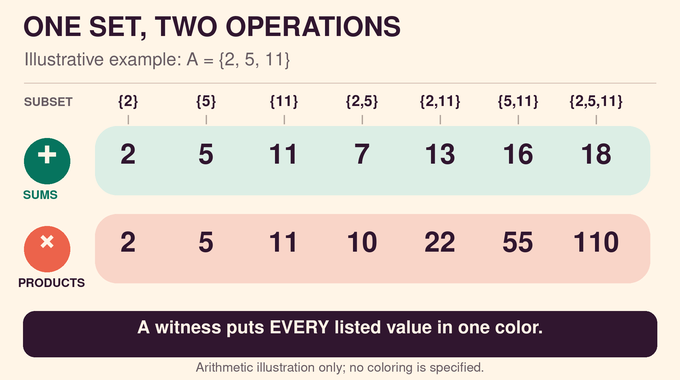
Take . Its three elements have nonempty subsets. The arithmetic is:
| Chosen Subset | Sum And Product |
|---|---|
| First singleton | Sum: Product: |
| Second singleton | Sum: Product: |
| Third singleton | Sum: Product: |
| First and second | Sum: Product: |
| First and third | Sum: Product: |
| Second and third | Sum: Product: |
| All three | Sum: Product: |
This table lists the required expressions, not a guaranteed witness for an unspecified coloring. Under the parity coloring, for example, 2 and 5 already disagree. Another triple would be needed. The theorem promises that some suitable triple exists, then extends that promise to any requested finite size and any finite number of colors.
Singletons matter: a one-element sum and product both equal that element. Empty subsets are excluded, so neither the empty sum zero nor the empty product one is an additional requirement. The same subset language appears in the Subset Sum problem, but here there is no prescribed target total to find.
3. Why Hindman’s Original Theorem Could Not Settle the Conjecture
Hindman’s theorem guarantees an infinite set whose nonempty finite subset sums share a color. The finite sums theorem of Folkman, Rado and Sanders gives arbitrarily large finite sets with that additive property.
Multiplication separately follows by applying an additive theorem to colors of powers of two: adding exponents multiplies the corresponding powers. However, the resulting multiplicative set need not be the set selected by the additive theorem. Two existence guarantees do not automatically intersect.
More decisively, Hindman constructed a finite coloring forbidding an infinite simultaneous configuration, even at the level of terms, pairwise sums and pairwise products. The finite sums and products conjecture therefore asks for arbitrarily large finite witnesses. It does not ask for one infinite witness.
A witness for size ten need not extend a witness for size nine. Keeping that quantifier straight avoids an attractive but false interpretation. The broader search for unavoidable additive patterns connects this problem with our Erdős–Turán analysis, although its hypothesis and target patterns are different.
4. Previous Breakthroughs and the Barrier Between Rational Numbers and Integers
Graham and Hindman established the quartet for two-colorings using computer-assisted arguments. Bowen later obtained distinct variables exceeding any prescribed bound, alongside more general patterns.
For arbitrary finite colorings, Moreira’s 2017 theorem guarantees the mixed triple . Crucially, that notation does not require the second variable itself to share the color. Alweiss supplied a polynomial approach to mixed patterns. Bowen and Sabok proved the quartet over the rationals, and Alweiss established the full rational finite sums and products theorem.
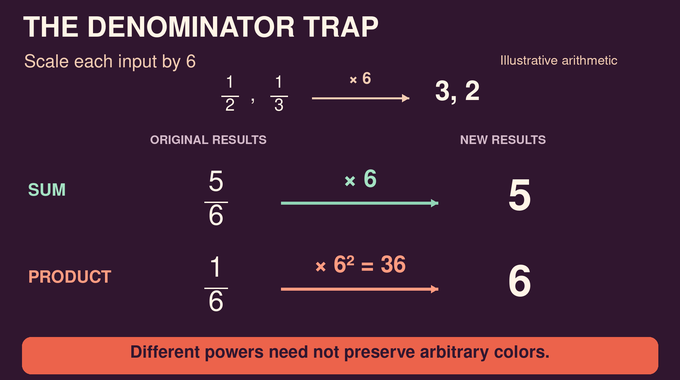
Why not clear denominators? If rational entries are multiplied by a common denominator , sums scale as , whereas products scale as . Here the exponent counts the chosen subset’s size. An arbitrary coloring need not preserve colors under either transformation, much less all these different powers simultaneously.
The integer problem consequently needs arithmetic control throughout the construction. A rational witness cannot simply be enlarged into an integer witness while assuming its color survives.
5. The First Proof Step: Ordered Blocks and Monochromatic Products
The proof packages raw integer variables into blocks. A block has a tail of earlier indices and a later pivot . Its value is the product . Selected chains obey , where ordering sets means every index in the first precedes every index in the second.
These blocks are disjoint. A product of block values is therefore the product over their combined indices, without reusing a raw variable.
Ramsey selection first finds an index set where the color of a raw-variable product depends only on the number of indices used. The finite sums theorem then chooses block sizes whose nonempty subset sums receive one cardinality-color. Combining blocks adds their sizes, so every required product has that color.
This ingenious conversion secures monochromatic products before sums. It does not yet establish monochromatic finite sums and products: adding block values has no comparable union-of-indices identity. That remaining mismatch is precisely what the analytic machinery must repair.
Every subset sum can be organized by its last selected block. That block supplies the anchor, while the earlier blocks contribute the shift. The deliberately unusual ordering of tails and pivots ensures those earlier blocks belong to the anchor’s permitted shift family. This makes one simultaneous alignment statement sufficient for all subset sums.
6. Arithmetic Scales, Harmonic Sampling and Divisor Weights
Raw variables have the form , combining smooth integer factors, finitely chosen rational scales and sampled integers. Divisibility conditions ensure these combinations remain integral. “Smooth” means having only small prime factors, relative to a growing cutoff .
Sampling favors smaller values with weights proportional to , on , restricted to integers coprime to the product of primes at most . Such harmonic sampling makes controlled multiplicative changes manageable. This is a deliberate sampling law, not a claim that colors are random, a useful distinction when reading about Chowla correlations and averaging.
A block product has a different distribution from its pivot alone. If its tail product is , multiplication forces divisibility by that tail. The correction is:
The indicator equals one when , and zero otherwise. Averaging over tails produces the nonnegative divisor weight.
Carefully separated prime pools supply harmonic mass and residue uniformity. Weighted linear-forms estimates control correlations among these weights. The same appropriate weight accompanies a sum ending at a given block. Without that correction, the proof would count under the wrong distribution.
7. How Prime Insertion and Cube Estimates Remove the Multiplicative Obstacle
The counting expression contains multiplicative color masks: indicators demanding that each required product has the selected color. They couple variables multiplicatively, obstructing the additive tools needed to estimate modeling errors.
Prime insertion supplies substitutions that preserve a chosen product. For example, leaves the product of those two coordinates unchanged. Division is allowed only when the integer is divisible by the inserted prime, with the corresponding divisor multiplier retained.
Weighted Cauchy–Schwarz then removes a bounded mask from an error estimate while creating additional additive forms. Repetition, followed by additive elimination, reduces a potentially large counting error to a one-variable cube correlation. A cube tests a function at points obtained by adding different subsets of several increments.
The important preservation statement is specific: masks are eliminated when bounding the error uniformly over those masks. The original positive count still retains the product-color conditions. Nothing here permits forgetting multiplication when extracting the final witness. Nonnegative weights, also useful in our large prime gaps explainer, are doing bookkeeping that the existence argument depends on.
8. The Prediction Principle: Turning Color Data Into Nilsequence Models
Each color has an indicator function, equal to one on that color and zero elsewhere. Prediction replaces the relevant weighted additive factors by bounded structured models inside the required counts. These are mathematical approximations, not trained neural networks.
A nilsequence evaluates a regular function along an orbit on a nilmanifold, a geometric space built from a nilpotent group. Schematically, . Rotations on a circle provide a simpler structured-sequence analogy, although the proof needs higher-order geometry. Its models can vary between intervals and residue classes.
Dense-model arguments first produce bounded substitutes for weighted functions. Gowers-type cube tests measure the remaining error. An inverse theorem turns detectable additive structure into correlation with nilsequences. Concatenation combines control across different subgroup directions. Nested projection scales and another Ramsey selection reconcile short shifts used by the counting estimate with the larger intervals needed for Alignment.
Calibration supplies a second guarantee: actual color membership rarely occurs where that color’s model prediction is too small. The nilpotence step depends only on the requested configuration size. Model complexity may depend on the tolerances, a distinction that becomes decisive next. Prediction is therefore a guarantee about specified counts and calibration events. It does not claim that a smooth formula recovers every value of an arbitrary coloring, nor that the colors themselves become periodic.
9. The Alignment Principle: Making Every Required Sum Retain Its Color
Prediction alone does not keep a positive model value positive after adding earlier block values. Alignment arranges that persistence simultaneously for all relevant blocks, colors and subsets of permitted shifts.
Arithmetic complicates the translation: adding an earlier block value can correspond to a noninteger displacement in a pivot coordinate. Rough progression comparison controls averages when progression steps have no small prime factors, under the paper’s joint polynomial-dependence assumptions. Integer residue corrections handle the congruence part.
Local cube laws then describe compatible model states. For step nilpotent geometry, an admissible cube of dimension has its missing corner determined by its other corners. A separate lifting result moves a symmetry of one projected component to a transformation on a common joint state, using cube information rather than assuming ordinary distributional invariance suffices.
Finite nilpotent polynomial recurrence and compensating rational scale updates finally align the predictions while preserving earlier requirements. The success probability has a positive lower bound independent of model complexity and the prediction threshold. The convergence rate need not be uniform. That weaker, carefully quantified guarantee is enough to close the argument. If the success bound shrank unpredictably as models became more elaborate, choosing a finer model could erase the gain needed to dominate its approximation error. Independence from complexity prevents that circularity.
10. How Prediction and Alignment Complete OpenAI’s Proof
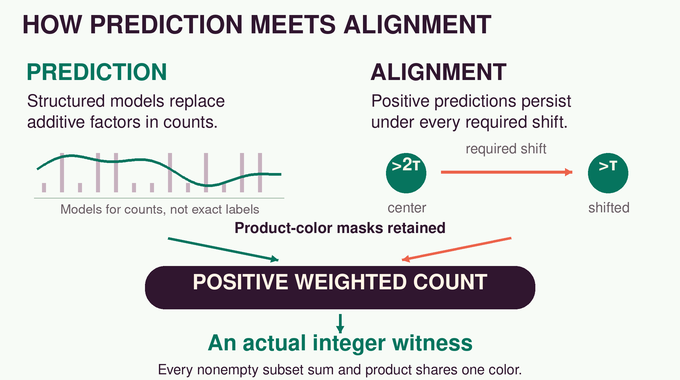
Section 2.5 fixes the permitted chain length and nilpotence step, then uses Alignment to choose its finite scale lists and positive success bound. Only afterward are the calibration threshold and counting error chosen small enough. This order prevents model complexity from consuming the available positive probability.
On samples where alignment succeeds and calibration does not fail, product-chain selection supplies a chain and color. Every center has model value above , and every required shifted value stays above . Their finite product is therefore positive.
Summing over finitely many chains, colors and scale vectors gives positive model mass. Prediction transfers this to a positive nonnegative weighted count. A positive finite average contains an actual contributing tuple. Its product masks certify every subset product, while its additive color factors certify every subset sum.
The divisor weights cannot create a false witness: positivity requires the color factors themselves to be positive. Passing from analytic counts to discrete objects also motivates our Sidorenko counterexample analysis.
A nonprincipal ultrafilter organizes the qualitative limits. Its extraction property lets the argument choose a sufficiently late finite scale where positivity and separation both hold. It proves existence without identifying an explicit numerical cutoff.
11. What the Proof Guarantees Beyond One Shared Color
For any fixed real and , the elements can satisfy:
The second inequality applies from the second element onward. Each new element can vastly exceed earlier sums and products. This separation yields:
Consequently, there are distinct values overall, with only the singleton values shared between the sum and product families.
Corollary 2.6 gives a finite-interval version, including prescribed divisibility by any positive integer . Refining colors by residues forces the selected elements into residue zero. Compactness then guarantees some finite interval containing the entire configuration, without supplying its numerical size.
As of October 24, 2026, Yao Xu’s Lean repository reports verification of the core finite-coloring statement and explicitly excludes the separation clause and distinctness corollary. Its top theorem matches the core quantifiers. We inspected that statement and scope, without rebuilding its dependency tree.
For developers, a short program can check a proposed finite witness by enumerating its nonempty subsets and testing both operations. That local check is easier than guaranteeing where to search for every possible coloring. The manuscript addresses the latter existence question.
The Hindman Finite Sums and Products Conjecture thus has a proof manuscript and reported formal support for its core conclusion. Neither provides an infinite simultaneous set or a demonstrated practical search algorithm. Follow Binary Verse AI’s AI mathematical proof coverage for more explanations that keep the theorem, proof mechanism and verification scope in view.
What is Hindman’s finite sums and products conjecture?
It states that for any finite coloring of the positive integers and any positive integer , there is a set of distinct positive integers whose nonempty subset sums and nonempty subset products all have one common color.
What does monochromatic mean in the sums and products theorem?
Monochromatic means sharing one color. For three chosen integers, the requirement includes each singleton, all three pairwise sums, all three pairwise products, the total sum and the total product. All must receive the same color.
How is Hindman’s theorem different from the finite sums and products conjecture?
Hindman’s theorem guarantees an infinite set whose nonempty finite subset sums are monochromatic. The finite sums and products conjecture additionally requires subset products to share that color, while asking for sets of every prescribed finite size. The analogous infinite simultaneous assertion is false.
Why didn’t the earlier proof over rational numbers solve the problem for integers?
Multiplying every selected rational number by a common denominator scales sums by that denominator, but scales a product of entries by its th power. Arbitrary colorings need not preserve color under these different transformations.
What is the central new idea in OpenAI’s proof?
The proof selects blocks whose subset products have a common color. The Prediction Principle models the relevant additive color conditions using piecewise nilsequences while retaining multiplicative color masks in the counts. The Alignment Principle keeps sufficiently positive predictions positive under all required additive shifts. A positive weighted count then yields an actual integer configuration.
Does the proof establish an infinite monochromatic set or give an explicit bound?
Neither. It guarantees a suitable set for every prescribed finite size and allows arbitrarily strong separation between elements. The analogous infinite simultaneous statement is false. The argument gives no explicit numerical bound for the interval needed to contain a configuration.
Has Hindman’s finite sums and products conjecture been formally verified?
The September 2026 OpenAI manuscript presents a proof. As of October 24, 2026, Yao Xu’s third-party Lean repository reports verification of the core finite-coloring theorem. It explicitly excludes the manuscript’s stronger separation clause and distinctness corollary. Binary Verse AI inspected the stated scope and top theorem but did not independently rebuild the Lean project.