Two letters carry a surprising amount of weight in OpenAI’s latest mathematics release: CM. Remove them from the headline, and a proposed theorem about a special family of geometric objects becomes a claim to have solved a million-dollar problem. That’s quite a promotion for deleting two characters.
Here’s the answer to the main question: OpenAI has published a paper claiming to prove the rational Hodge Conjecture for complex abelian varieties with complex multiplication. It has not announced a proof covering every smooth projective complex variety.
The distinction leaves plenty to discuss. The claimed result covers its chosen family in every dimension and codimension, and the paper derives consequences reaching into arithmetic geometry. If the argument survives scrutiny, its importance will extend beyond checking off another special case.
To understand the OpenAI Hodge Conjecture announcement, we need to separate three things: what the theorem says, how the proof constructs the missing geometry, and what follows if it is correct.
Table of Contents
1. What Is the Hodge Conjecture in Simple Terms?
Some geometric spaces are defined by polynomial equations. Mathematicians can study them through their equations, their complex structure, or cohomology, a framework that records structural information about a space.
These viewpoints don’t automatically agree on which features have concrete algebraic representatives. Certain cohomology classes satisfy a compatibility condition involving complex structure. Those are Hodge classes. The conjecture predicts that rational Hodge classes can be built from classes associated with algebraic subvarieties.
Before unpacking that sentence, here are the facts behind the new paper.
Hodge Conjecture: Key Facts About OpenAI’s CM Proof Claim
| Key Fact | What the Release Establishes or Claims |
|---|---|
| Manuscript | The rational Hodge conjecture for CM abelian varieties |
| Author and Date | OpenAI, September 30, 2026 |
| Public Announcement | Part of OpenAI’s October 6 mathematics release |
| Claimed Scope | Every complex CM abelian variety, in every dimension and codimension |
| Products and Powers | Included within the CM family |
| General Problem | Remains open beyond the established cases |
| Verification | A published argument whose correctness requires scrutiny |
The familiar “holes in shapes” explanation offers an entry point, but it misses a crucial detail: being a Hodge class depends on complex structure. The statement isn’t that every topological feature comes from polynomial equations.
2. The Equation Connects Classes With Actual Geometry
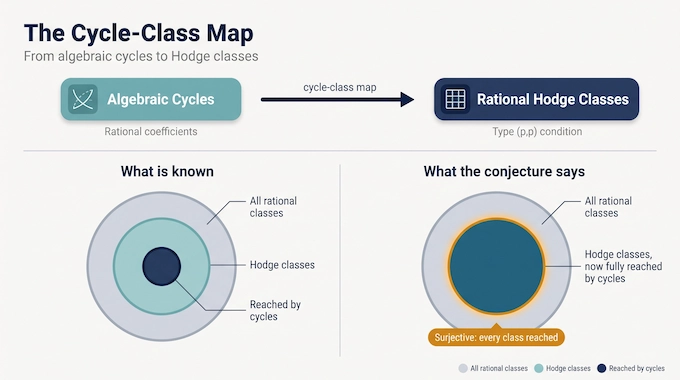
An algebraic subvariety is a smaller space defined algebraically inside a larger one. An algebraic cycle is a finite formal combination of such subvarieties. With rational coefficients, that combination can include fractions and negative weights.
Each cycle produces a cohomology class. The difficult direction goes backward: given a rational Hodge class, can we find cycles producing it?
The Hodge Conjecture equation is usually expressed through the cycle-class map:
[ \mathrm{cl}B:\mathrm{CH}^{p}(X){\mathbb Q} \longrightarrow H^{2p}(X,\mathbb Q)\cap H^{p,p}(X). ]
The conjecture says this map is surjective, meaning every class on the right is reached from the left.
Hodge Conjecture: Symbols and Mathematical Terms Explained
| Symbol or Term | Meaning for the Reader |
|---|---|
| X | The smooth projective complex variety under study |
| p | Codimension, the difference in complex dimension between the ambient variety and a subvariety |
| CHp(X)ℚ | Codimension-p cycles modulo rational equivalence, allowing rational coefficients |
| H2p(X, ℚ) | Rational cohomology in degree 2p |
| Hp,p(X) | The component selected by complex structure |
| Surjective | Every rational class satisfying the Hodge condition has an algebraic representative |
There’s no single unknown number to calculate. The Hodge Conjecture problem asks for a general existence principle linking abstract classes with geometry.
3. Why Rational Coefficients Matter
“Rational” names the permitted coefficients. It doesn’t mean the proof is more reasonable than competing arguments, although mathematics could occasionally use that distinction.
Allowing fractions changes the problem. If a cycle represents a multiple of a class, rational coefficients let us divide that cycle by the multiple. Requiring integer coefficients is stricter, and the integral version has counterexamples.
The setting matters too. The conjecture concerns smooth projective complex varieties. Extending similar statements to broader classes of compact complex spaces introduces failures that don’t disprove the original projective formulation.
This explains why reports that “Hodge was already disproved” need their assumptions checked. The rational projective statement, integral variants, and broader analytic versions are different mathematical claims.
4. What Are CM Abelian Varieties?
An elliptic curve is a one-dimensional abelian variety. Over the complex numbers, it can be viewed as a complex torus with an algebraic structure. Higher-dimensional abelian varieties retain a compatible commutative group operation and a projective algebraic description.
Complex multiplication means they have an especially rich supply of algebraic self-maps, called endomorphisms. For a variety of dimension g, the paper’s CM condition requires its rational endomorphism algebra to contain a commutative semisimple algebra of dimension 2g.
That extra arithmetic structure helps organize the cohomology into pieces indexed by field embeddings. It gives the proposed argument something precise to work with.
CM abelian varieties therefore form a special family, not another name for all abelian varieties. The theorem’s breadth lies in treating every member of that family, without a dimension ceiling. A restrictive hypothesis and an extensive conclusion can coexist.
5. What OpenAI Claims and What Remains Open
Theorem 1.1 asserts that every rational Hodge class on a complex CM abelian variety is represented by a rational combination of algebraic cycle classes.
It covers every codimension, every finite product of CM abelian varieties, and every power of such a product. Products and powers stay within the CM setting, so these extensions preserve the theorem’s defining restriction.
This does not establish the result for arbitrary complex abelian varieties, much less every smooth projective complex variety. Even a verified theorem with this scope would not settle the full Millennium Prize Problem.
For readers searching “Hodge Conjecture solved,” the useful answer is therefore a scoped one: OpenAI claims a complete result for the CM family, while the general question remains open. Treating it as a full solution exaggerates the paper. Calling it merely one isolated example understates it.
6. The Human Mathematics Behind the Claim
The codimension-one case is already covered by the Lefschetz (1,1) theorem. Products of divisor classes also supply higher-degree algebraic classes. The trouble is that these constructions don’t account for every relevant class on an abelian variety.
Pierre Deligne proved that Hodge classes on abelian varieties are absolute Hodge: they retain the Hodge property under an appropriate transport to conjugate varieties. That establishes important compatibility, but it doesn’t construct algebraic cycles.
Work associated with Deligne and Yves André reduces CM questions to particular Weil-type classes on auxiliary varieties. Fumio Hazama developed reductions involving elementary four-label relations. These identify what would suffice to prove, rather than automatically supplying all the required geometry.
The manuscript also places itself alongside Eyal Markman’s work on Weil classes and abelian fourfolds. Those results differ in scope from an all-dimensional CM theorem.
OpenAI’s claimed contribution is the missing construction of algebraic representatives, followed by their assembly into the general CM result. The existing literature is essential to understanding where that contribution begins.
7. How the Proposed Proof Builds Algebraic Cycles
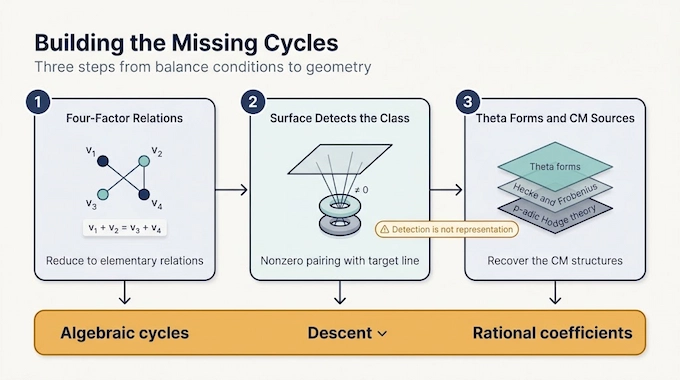
The argument combines a reduction with a geometric construction and an arithmetic identification. Each has a separate job. Establishing a relation among abstract classes alone would leave the central question unanswered.
7.1. Reduce the Problem to Four-Factor Relations
After extending coefficients, degree-one cohomology splits into lines indexed by embeddings of CM fields. Hodge classes are governed by balance conditions between holomorphic and antiholomorphic factors, checked across scalar conjugates.
The manuscript organizes the essential moves through relations of the form:
[ v_1+v_2=v_3+v_4. ]
The v’s encode CM types through sign functions. This equality produces a four-factor class with the required Hodge type. The task becomes constructing algebraic representatives for these elementary relations and showing that they assemble into arbitrary balanced tensors.
7.2. Use a Surface to Detect the Desired Class
The paper introduces a smooth projective surface carrying four degree-one classes. Their combined integral must be nonzero, and they must come through rational Hodge maps from the prescribed CM structures.
Those maps correspond, after clearing denominators, to algebraic morphisms into auxiliary abelian varieties. The surface’s image in their product provides an algebraic cycle that pairs nontrivially with the target line.
That pairing detects the class but doesn’t yet represent it. Algebraic divisor correspondences perform the additional conversion, producing a vector on the required line. This distinction prevents a tempting shortcut: finding a nonzero integral is not, by itself, proving algebraicity of the target.
7.3. Construct the Forms and Recover Their CM Sources
Theta forms on a compact arithmetic quotient of the complex two-ball supply the analytic construction. The argument compares two decompositions of a Hermitian plane while keeping shared data fixed. A continuity comparison preserves a nonzero mixed period.
Next comes the arithmetic step. Hecke operators, a relation with Frobenius, and p-adic Hodge theory identify the rational CM structures supplying those complex forms. Without this identification, the surface would have useful analytic classes but not necessarily the required inputs.
Finally, algebraic correspondences combine the elementary constructions, contract intermediate factors, and transfer the result back to the original variety. Descent recovers rational coefficients.
This is the proof’s proposed bridge from balance conditions to actual cycles. Checking its individual constructions and how they fit together is substantial work, not a matter of spotting a persuasive equation.
8. Three Consequences That Expand the Stakes
The CM restriction does not confine every consequence to complex CM varieties. Earlier implication theorems connect that setting with other questions about algebraic cycles. The paper claims to supply their required hypothesis.
The generalized Hodge conjecture for CM abelian varieties predicts algebraic supports for Hodge substructures, with codimension constrained by their Hodge types. Following work of Salman Abdulali and Hazama, the manuscript derives these supports using correspondences from auxiliary CM varieties.
The Tate conjecture for abelian varieties over finite fields concerns classes in étale cohomology fixed by the relevant Galois action. Using James Milne’s results, the paper derives algebraic representatives for these classes in every codimension. Its scope is all abelian varieties over finite fields, not every algebraic variety over finite fields.
The Hodge standard conjecture for abelian varieties in arbitrary characteristic concerns positivity of an intersection form on primitive algebraic classes. Milne’s established framework supplies this further implication.
These are substantive mathematical consequences. They also illustrate why evaluating a theorem solely by the size of its initial family can miss its wider reach.
9. Is the Hodge Conjecture Proof Verified?
Publication makes an argument available for checking. It does not establish that specialists have accepted every step.
As of October 7, 2026, OpenAI’s published formalization catalogue does not list this manuscript. Lean artifacts elsewhere in the release cannot be transferred by association to the Hodge paper. The repository itself says its results occupy different verification stages and that unformalized arguments could contain issues. GitHub
Lean checks whether a formal proof establishes its formal statement under the stated assumptions. Experts still need to examine whether those definitions and assumptions express the intended mathematical problem.
For this manuscript, review must address the tensor reduction, the theta construction, the identification of CM sources, and their assembly. Correct intermediate arguments must support the conclusion at the advertised scope.
OpenAI consulted an independent advisory group about release practices. Advice about sharing mathematics is not certification of each theorem. The meaningful next evidence is detailed specialist assessment, documented revisions, and any formalization of this particular result.
10. What the Release Reveals About AI and Human Contribution
OpenAI attributes the mathematics collection to an unreleased internal frontier model. It reports an average result cost equivalent to roughly three hours of ChatGPT Pro thinking.
There’s an important qualification: the repository explicitly identifies the Hodge work as an exception to its standard procedure. That average therefore does not establish this paper’s runtime, compute budget, or degree of autonomy. openai/math · GitHub
The published author is OpenAI. The release does not, by itself, resolve every question about prompting, human guidance, intermediate review, or how decisive ideas emerged. Those questions should be investigated through evidence rather than assumptions about either effortless discovery or simple copying.
If verified, the work would support the case that AI systems can contribute to difficult research mathematics. It would not establish general intelligence across unrelated domains. Nor would it make mathematical explanation optional: researchers still need to understand why the construction works, assess its limits, and find the next questions it enables.
11. Future Implications and Possible Applications
The immediate implications concern algebraic cycles, arithmetic geometry, and the consequences stated in the manuscript. It presents no demonstrated improvement to encryption, physics simulations, or software performance.
Elliptic curves appearing in cryptography does not make every theorem about abelian varieties a cryptographic attack. Connecting those subjects requires additional results, often including explicit algorithms and complexity analysis.
The more credible research opportunity lies in the techniques. If the surface construction and CM-source identification hold up, specialists can examine whether parts extend to settings with less endomorphism structure. Extending beyond CM would be a new achievement, not an automatic corollary.
For developers and builders, this release suggests a useful way to assess research agents: inspect the exact statement, dependencies, proof artifacts, and corrections. Generating plausible mathematical prose is a different capability from producing an argument that survives checking and becomes useful to other researchers.
12. What to Watch Next
The next meaningful development will be evidence about the argument. Look for specialists explaining which steps they have checked, revisions addressing specific concerns, and formal artifacts tied to this manuscript rather than the surrounding collection.
If the claimed Hodge Conjecture result stands, its value will include an all-dimensional CM theorem, its arithmetic consequences, and a construction others can investigate. Until then, the precise statement already gives readers a better framework than declaring either total victory or total failure.
Follow Binary Verse AI at binaryverseai.com for clear explanations of AI research, the mathematics behind new claims, and updates that distinguish a released proof from an accepted result.
What is the Hodge conjecture in simple terms?
The Hodge conjecture asks whether certain cohomological features of a smooth projective complex algebraic variety can always be represented by combinations of smaller geometric pieces defined by polynomial equations. These features, called rational Hodge classes, satisfy a condition involving the variety’s complex structure. The conjecture predicts that they come from algebraic cycles.
Has OpenAI solved the Hodge conjecture?
OpenAI has released a paper claiming a proof of the rational Hodge conjecture for complex abelian varieties with complex multiplication, or CM abelian varieties. The claim covers every dimension and codimension within that family. It does not settle the general conjecture for all smooth projective complex varieties, so it does not resolve the full Millennium Prize Problem.
What are CM abelian varieties, and why does the restriction matter?
Abelian varieties are projective algebraic varieties with a compatible commutative group structure; elliptic curves are one-dimensional examples. CM abelian varieties have additional endomorphisms forming a particularly rich commutative algebra, a property called complex multiplication. That structure is central to the proposed proof. Covering every CM abelian variety is a broad result within a special family, but it does not cover every abelian variety.
Is OpenAI’s Hodge conjecture proof verified in Lean?
As of October 7, 2026, OpenAI’s published formalization catalogue does not list this Hodge paper. The presence of Lean proofs elsewhere in the mathematics release does not establish that this particular argument has been formally verified. Expert scrutiny must also determine whether the manuscript’s reasoning establishes its stated theorem.
Why does this result matter, and does it have practical applications?
If the proof is confirmed, it would establish the Hodge conjecture for an important infinite family and yield further results concerning algebraic cycles, including the Tate conjecture for abelian varieties over finite fields. Its immediate significance is mathematical. The paper does not establish direct improvements to encryption, physics or software; wider applications may emerge from its techniques and subsequent research.