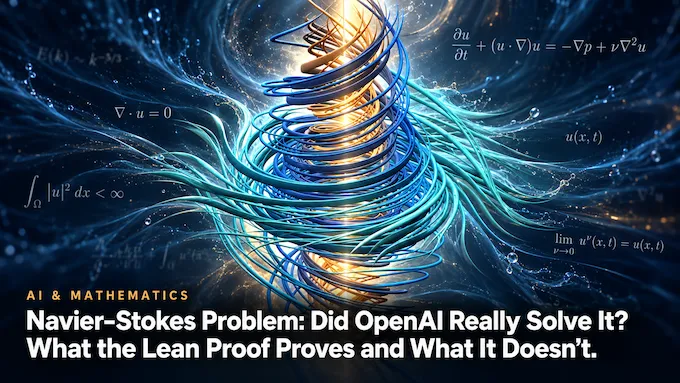
OpenAI has made one of the biggest mathematical claims of the AI era: its internal research system produced a proposed solution to the Navier Stokes problem, one of the seven Millennium Prize Problems. This is not a vague “AI found a proof” press release. OpenAI published a 166-page analytical paper, Finite Time Blowup for Navier–Stokes, and says it is also releasing a formalization in Lean. The construction starts with a smooth fluid at rest, applies a smooth external force, and produces unbounded velocity in finite time while keeping kinetic energy bounded.
So, is Navier Stokes solved? The careful answer is: OpenAI has published a serious candidate resolution aimed directly at accepted alternatives in the official Millennium problem statement. That is much stronger than an informal AI-generated argument. But a new proof is not the same thing as a theorem already absorbed into mathematical consensus, and Clay has not yet formally accepted the result.
- Claim: OpenAI solved the Navier–Stokes Millennium Problem
- Evidence: 166-page analytical construction plus Lean formalization
- Current status: Serious proposed resolution, not yet formally accepted by Clay
- Method: Finite-time blowup from smooth forcing
Table of Contents
1. Did OpenAI Solve the Navier–Stokes Problem?
On September 8, 2026, OpenAI announced that an internal system had produced both an analytical proof and a Lean formalization showing finite-time singularity formation in three-dimensional incompressible Navier–Stokes flow. The company says the construction establishes alternatives C and D in the official Millennium Prize formulation.
Here is the shortest useful status check:
Navier Stokes Problem Status: Did OpenAI Really Solve It?
| Question | Current Answer |
|---|---|
| Did OpenAI publish a full mathematical paper? | Yes, 166 pages |
| Does the theorem produce finite-time blowup? | Yes, under smooth external forcing |
| Does the velocity become unbounded? | Yes |
| Does kinetic energy remain bounded? | Yes |
| Does the paper claim alternatives C and D? | Yes |
| Is there a Lean formalization? | Yes, according to OpenAI |
| Has Clay formally accepted the result? | No |
| Is “proposed solution” the safest wording today? | Yes |
That distinction matters. “Navier Stokes solved” is a reasonable description of OpenAI’s claim. “The Navier–Stokes problem is now a settled theorem” is premature until independent mathematicians have checked the analytical argument, the formal statement, and the relationship between the Lean development and the exact Millennium Prize specification.
2. What Is the Navier–Stokes Problem Actually Asking?
The Navier–Stokes equations describe how fluids move by combining momentum, pressure, viscosity, and incompressibility. They are used in areas such as aircraft design, weather modeling, and blood-flow research. The hard mathematical question is not whether engineers can run useful fluid simulations. They already do.
The Millennium problem asks something more basic: if a three-dimensional incompressible fluid starts from smooth data, do the equations always remain smooth, or can the solution develop a singularity in finite time? In this setting, a singularity means the mathematical velocity becomes unbounded even though the flow started smoothly. OpenAI’s overview notes that viscosity normally smooths motion, which is exactly why a finite-time blowup would be so striking.
This is also why a common description of the problem is misleading. Mathematicians are not looking for one universal closed-form formula that solves every Navier–Stokes flow. The prize problem is about existence and regularity. Does smoothness persist forever, or can it fail?
3. What OpenAI’s 166-Page Proof Actually Proves
The central result is Theorem 1.1. For every positive viscosity, the paper constructs a smooth, compactly supported force, a compact spatial region, and smooth velocity and pressure fields on the time interval before the singularity. The initial velocity is zero. The kinetic energy stays uniformly bounded, but the maximum velocity diverges as the singular time approaches. The paper says this establishes alternative C, and compact support allows the corresponding periodic construction for alternative D.
Navier Stokes Problem Proof: What OpenAI’s Theorem Actually Shows
| Claim | Mathematical Statement | Plain-English Meaning |
|---|---|---|
| The flow starts smoothly | u(·, 0) = 0 | The fluid begins at rest |
| The forcing is well behaved | Smooth and compactly supported in space and time | The blowup is not injected with an infinite or singular force |
| Energy stays controlled | supt<1 ‖u(t)‖L² < ∞ | Total kinetic energy does not explode |
| Speed blows up | lim supt↑1 ‖u(t)‖L∞ = ∞ | Some local velocities become arbitrarily large |
| The result applies at any positive viscosity | The theorem holds for every ν > 0 | Viscosity does not eliminate this constructed breakdown |
| The construction covers two official routes | Alternatives C and D | It targets the whole-space and periodic formulations cited by the paper |
That is the core of the navier stokes problem solved claim. It is a disproof-style resolution: instead of proving that every smooth solution stays smooth forever, the authors construct a smooth setup that breaks down.
4. The Crucial Detail: Why a Forced Blowup Still Counts
The biggest source of confusion online is the external force. Yes, OpenAI’s construction is forced. No, that fact alone does not make it irrelevant to the Millennium problem.
The paper explicitly states that its smooth compactly supported forcing establishes alternative C in the Fefferman formulation, with the compactly supported construction also giving alternative D on the three-torus. In other words, the authors are not claiming that a different, easier problem should count. They are claiming that the official problem already permits this route.
The important condition is that the force itself must remain smooth. If the construction simply inserted a singular force that became infinite at the critical time, the result would be mathematically cheap. The technical problem is to make the velocity blow up through the fluid dynamics while the residual force stays regular.
That is exactly what the paper tries to engineer. Individual acceleration, pressure, transport, and viscous terms can grow large, but their dangerous pieces are arranged to cancel so that the resulting external force extends smoothly through the singular time.
This should also be kept separate from the Euler equations. OpenAI says an earlier agent group produced an unforced Euler regularity disproof, where viscosity is removed entirely. The Navier–Stokes construction is a different result and uses smooth forcing.
5. How Does the Blowup Work? The Vortex in Plain English
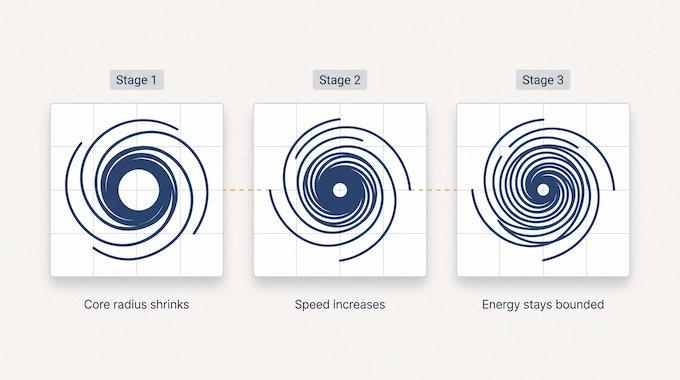
The physical picture is a vortex that contracts while spinning faster.
Near the center, fluid spirals inward toward the axis. Incompressibility prevents it from simply piling up, so the flow is also stretched axially. As the vortex core narrows, angular and axial speeds grow. The paper’s Figure 1 on page 4 shows the intense region shrinking across successive times while the velocity rises. Its radius contracts faster than its height, producing an increasingly slender core.
The counterintuitive part is energy. “Velocity goes to infinity” sounds like the total energy must also go to infinity. It does not. The region containing those huge velocities shrinks so quickly that its contribution to the total kinetic energy actually tends toward zero in the paper’s leading-order scaling.
So does water literally start moving infinitely fast? No. A mathematical singularity marks a breakdown of the continuum solution. OpenAI’s own explanation says a real fluid cannot move infinitely fast. The point is that the equation, treated as a continuum model, reaches a state where its smooth description cannot continue in the required way.
6. What the Navier–Stokes Lean Proof Verifies
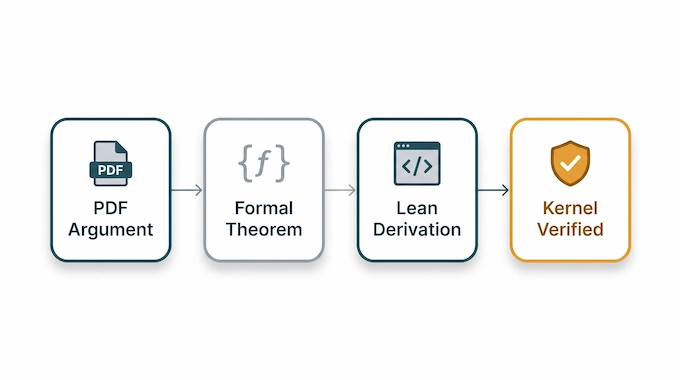
A conventional proof is written for mathematicians. A formal proof is written so a proof assistant can check every permitted inference against precise definitions. The kernel then checks that the final theorem follows from the accepted rules and declared assumptions.
That is why the Navier Stokes Lean proof matters. OpenAI says it released a Lean formalization alongside the analytical writeup and that formalization and verification took another 17 hours after the agents reached the proposed Navier–Stokes resolution.
Conceptually, the pipeline is:
PDF argument → formally stated theorem → Lean derivation → kernel checking
Lean does not “read the PDF and agree with it.” The theorem, definitions, lemmas, and dependencies must be represented in a formal language. The kernel then checks that the final theorem follows from the accepted rules and declared assumptions.
That makes formal verification much stronger evidence than asking an LLM whether a proof “looks correct.” A language model can miss gaps. A proof assistant is designed to reject derivations that do not type-check under its formal rules.
7. What Lean Does Not Automatically Prove
Formal verification is powerful, but it is not magic dust.
The first question reviewers must ask is whether the theorem encoded in Lean really matches the theorem people think was proved. A perfectly checked derivation of the wrong formal statement would still be a perfectly checked derivation of the wrong statement.
The same applies to assumptions. Reviewers need to inspect whether all hypotheses are represented correctly, whether the formalization matches the intended definitions of smoothness, forcing, bounded energy, and blowup, and whether the claimed correspondence to alternatives C and D is exact.
There is also a trust boundary. Lean’s kernel checks the formal derivation, but mathematicians still care about the foundations, imported libraries, declared axioms, and build environment surrounding that derivation.
So if someone asks, “If Lean verified it, why wait for peer review?”, the answer is simple: formal verification and mathematical review check different failure modes. Lean can make proof checking dramatically more reliable. Independent experts still need to audit what was formalized and whether it resolves the intended problem.
8. How 10,000 AI Agents Found the Proof in 88 Hours
The AI story is unusual even by 2026 standards.
OpenAI says it began training a new internal model on August 28 and that the model showed a step change in mathematics performance. The company described it as significantly more capable than GPT-6 Astra. On September 1, OpenAI launched groups of agents against the remaining Millennium Prize problems and several related questions. The agents could use cached internet access and execute code, and the Navier–Stokes group eventually involved on the order of 10,000 concurrent agents.
The system did not run as one giant conversation. Different groups explored different variants and approaches. OpenAI says roughly 100 agents first worked for about 50 hours on an unforced Euler regularity result. After that success, more resources were shifted toward Navier–Stokes. Codex was used to consolidate useful ideas across groups, creating a form of cross-pollination between parallel searches.
The agents reached the Navier–Stokes result on September 5, about 88 hours after the first agents were launched. The Navier–Stokes effort used about 2.7 million messages and 130 billion output tokens, while Lean formalization and verification took another 17 hours via GPT-6 Astra.
One correction is essential: 88 wall-clock hours is not the same as one AI reasoning for 88 hours. This was massive parallel search, coordination, filtering, and synthesis.
9. Did OpenAI Use Buckmaster and Alpöge’s Unpublished Work?
9.1 What OpenAI Says Happened
OpenAI says the September 1 effort was triggered partly by a rumor that two Millennium Prize problems had been resolved. It later connected that rumor to Levent Alpöge and Tristan Buckmaster. After OpenAI completed its project and Lean verification, it contacted them believing they had also solved Navier–Stokes. OpenAI says it then learned their result concerned forced Euler, not the same Navier–Stokes theorem.
9.2 What Is Established and What Is Not
OpenAI states that neither its researchers nor its agents saw Buckmaster and Alpöge’s work before it was publicly released, and that no specific user data was accessed to solve the problem. It also says it cannot completely rule out the possibility that de-identified usage data from their interactions with OpenAI products indirectly helped improve its models.
Based on the supplied materials, there is no evidence establishing deliberate copying. The clean editorial position is to keep the provenance question open to evidence rather than turn a concurrent-research dispute into a plagiarism story without proof.
10. What Does Solving the Navier–Stokes Problem Change in the Real World?
Not tomorrow’s weather forecast.
A proof of finite-time blowup does not hand engineers a universal fluid simulator, replace computational fluid dynamics, or suddenly make turbulence easy. CFD solves approximate numerical versions of fluid equations under specific geometries, grids, boundary conditions, and modeling choices. The Millennium problem asks a more fundamental mathematical question about whether smooth solutions can fail.
That distinction matters for aircraft design, fusion, blood flow, and weather prediction. Those fields may eventually benefit from deeper mathematical understanding of when continuum models become pathological or which structures drive extreme behavior. But this proof, even if fully accepted, does not directly produce a faster CFD code or a new turbulence closure model.
The immediate impact is mathematical. It would tell us that three-dimensional viscous flow can, under the permitted smooth forcing, develop a finite-time singularity despite bounded energy.
11. Why the Navier–Stokes Problem Is Not Officially Settled Yet
A public preprint, even one paired with formal verification, does not instantly become accepted mathematical history.
The analytical proof needs independent scrutiny. The Lean formalization needs its own audit. Experts must check that the formal theorem matches the informal theorem and the official Millennium specification. Clay’s prize process also requires more than a lab announcement, including qualifying publication and a period in which the result can achieve broad acceptance.
OpenAI itself says it does not intend to claim the Millennium Prize.
So the current status is unusual but not contradictory: OpenAI can reasonably claim to have produced a solution, while the mathematical community can reasonably say the problem is not yet officially settled.
12. Verdict: What OpenAI Has, and Has Not, Solved
OpenAI has gone far beyond producing a plausible AI-generated sketch. It has released a detailed analytical construction in which smooth, forced three-dimensional Navier–Stokes flow starts from rest, keeps bounded kinetic energy, and develops unbounded velocity in finite time. The paper explicitly says this establishes alternatives C and D in the Millennium formulation, and OpenAI has paired the result with a Lean formalization.
If the mathematical argument, formal specification, and Lean derivation survive independent scrutiny, this would be a genuine resolution of the Navier Stokes problem. What has not happened yet is the slower social and institutional process that turns a newly published proof into an accepted theorem and, eventually, mathematical history.
For Binary Verse AI, that is the part worth watching. Not “AI solved everything,” and not “Lean makes peer review obsolete,” but the evidence chain from model-generated research to formal mathematics to independent acceptance.
Follow Binary Verse AI for evidence-first breakdowns of major AI research claims, where we separate the headline from what the paper, code, benchmarks, and formal proofs actually establish.
1. Did OpenAI solve the Navier–Stokes problem?
OpenAI has published a candidate solution consisting of a 166-page analytical proof and a formal Lean proof. Its theorem constructs a three-dimensional Navier–Stokes flow with smooth forcing whose kinetic energy remains bounded while its velocity becomes unbounded in finite time, which the paper says establishes alternatives C and D of the official Millennium Problem formulation. The result is therefore much stronger than an informal AI claim, but it still requires independent mathematical scrutiny and eventual acceptance.
2. What does it mean to solve the Navier–Stokes problem?
The Millennium Problem does not ask mathematicians to find one universal formula for every fluid flow. It asks whether smooth three-dimensional Navier–Stokes solutions always remain smooth or whether a valid finite-time breakdown can occur. Establishing either permitted outcome can resolve the problem.
3. Does OpenAI’s use of external forcing mean the proof does not count?
Not by itself. OpenAI’s construction uses a smooth external force, but the official Millennium formulation includes alternatives C and D that permit appropriate forcing. The important question is therefore whether the exact construction satisfies all of those mathematical conditions—not simply whether forcing appears in the equation.
4. Does Lean verification prove OpenAI’s Navier–Stokes solution is correct?
Lean provides unusually strong evidence that the formalized theorem follows logically from its encoded assumptions. However, formal verification does not eliminate the need to check that the formal theorem faithfully represents the intended mathematical result and precisely matches the Millennium Problem’s requirements. Lean verification and expert mathematical review answer related but different questions.
5. Will solving the Navier–Stokes problem improve weather forecasting or fluid simulations?
Not immediately. Engineers already solve practical fluid-flow problems numerically using computational fluid dynamics. OpenAI’s result concerns the deeper mathematical question of whether smooth solutions can develop singularities under specific conditions; it does not provide a universal closed-form fluid solver. Its biggest immediate impact would therefore be mathematical rather than a sudden improvement in weather, aircraft, or CFD software.