

Claude Fable 5.1 is not a simple “same model, slightly higher score” release. Anthropic has pushed hardest on the kinds of jobs frontier models still struggle with: coding sessions that run for hours, scientific workflows inside terminals, multi-step professional work, computer use, and agents that have to keep going after the easy part is over.
The headline numbers are substantial. Fable 5.1 reaches 52.6% on Terminal-Bench-Science, up from 24.7% for Fable 5, and 55.8% on Terminal-Bench 4.0 versus 42.0%. It also leads Fable 5 and Opus 5 on several professional and automation benchmarks. But it does not win everything, and “cheaper” needs an asterisk. Raw API input and output still cost $10 and $50 per million tokens. The big cut is cache reads, now $0.25 per million tokens.
So the short version of this Claude Fable 5.1 review is straightforward: it looks like Anthropic’s best model for difficult, long-running agentic work, but not its best-value model for every request. If your task is short, cheap, and predictable, Fable 5.1 is probably excessive. If failure costs more than tokens, it becomes much easier to justify.
Table of Contents
1. Claude Fable 5.1 Review: Quick Verdict
The most important change is not that Fable 5.1 is a little smarter on broad reasoning. It is that performance holds up better as tasks become longer and messier. On FrontierSWE v2, where strong models can work close to 20 hours on a single engineering problem, Fable 5.1 scored 0.57, ahead of Opus 5 at 0.52, Fable 5 at 0.48, and GPT-5.6 Sol at 0.32.
Claude Fable 5.1 Review: Performance, Cost and Best Use Cases
| Category | Verdict | Why It Matters |
|---|---|---|
| Coding | Excellent | Leads SWE-bench Pro and several agentic coding tests. |
| Long-running agents | Major strength | Stronger performance floor on difficult, multi-hour work. |
| Scientific workflows | Biggest leap | Terminal-Bench-Science performance more than doubled versus Fable 5. |
| Knowledge work | Frontier-tier | Leads GDPval-AA v2 and AA-Briefcase at max effort. |
| Computer use | Strong | Scores 77.9% partial and 41.7% strict on OSWorld 2.0. |
| Cost efficiency | Workload-dependent | Cached context is cheap, while fresh output remains expensive. |
| Best effort setting | Usually below Max | Higher effort can increase cost without delivering proportional performance gains. |
| Overall | Best for hard work | Excellent for demanding workloads, but overkill for routine, high-volume tasks. |
That distinction matters. Fable 5.1 is not a universal replacement for cheaper Claude models. Anthropic’s own developer guidance still says to start with Opus 5 for most workloads and move to Fable 5.1 when demanding reasoning or long-horizon agentic work justifies it.
2. Claude Fable 5.1 Benchmarks: Where It Wins and Loses
These benchmark results tell a more interesting story than a clean sweep. It leads on SWE-bench Pro, Terminal-Bench, Terminal-Bench-Science, GDPval-AA, AA-Briefcase, AutomationBench, and several long-horizon evaluations. Opus 5 still edges it on SWE-bench Multilingual and wins clearly on SWE-bench Multimodal. Fable 5 also remains slightly ahead on ARC-AGI-1, while GPT-5.6 Sol leads the listed models on ARC-AGI-2.
Claude Fable 5.1 Benchmarks: Performance vs Fable 5, Opus 5 and GPT-5.6 Sol
| Benchmark | Fable 5.1 | Fable 5 | Opus 5 | GPT-5.6 Sol | Best Listed Result |
|---|---|---|---|---|---|
| SWE-bench Pro | 81.2 | 80.0 | 79.2 | 64.6 | Fable 5.1 |
| SWE-bench Multilingual | 89.1 | 86.6 | 89.5 | N/A | Opus 5 |
| SWE-bench Multimodal | 54.7 | 54.1 | 59.4 | N/A | Opus 5 |
| Terminal-Bench 4.0 | 55.8% | 42.0% | 52.3% | 37.3% | Fable 5.1 |
| Terminal-Bench-Science | 52.6% | 24.7% | 29.0% | 22.4% | Fable 5.1 |
| Humanity’s Last Exam, No Tools | 60.9% | 57.8% | 56.6% | N/A | Fable 5.1 |
| OSWorld 2.0, Partial | 77.9% | 72.9% | 75.4% | N/A | Fable 5.1 |
| GDPval-AA v2 | 1853 | 1723 | 1824 | 1711 | Fable 5.1 |
| AutomationBench | 31.4% | 17.1% | 26.9% | 19.6% | Fable 5.1 |
| ARC-AGI-2 | 90.0% | 89.2% | 90.42% | 92.5% | GPT-5.6 Sol |
2.1 Why the Coding Results Matter
SWE-bench is useful, but the long-horizon tests are more revealing. FrontierSWE v2 includes 34 engineering and research tasks such as porting major scientific software, building an OpenGL renderer, and post-training an LLM for an interactive environment. Fable 5.1 had the best overall score and the lowest outright failure rate among Fable 5.1, Opus 5, and Fable 5.
CursorBench adds another useful signal because Cursor measured the results independently in its production agent harness. Fable 5.1 scored 73.4% at max effort, ahead of Fable 5 at 70.5% and Opus 5 at 70.0%. More interestingly, medium effort reached 68.0% at $3.53 per task, beating GPT-5.6 Sol’s listed 67.2% at max effort and $5.69 per task.
There is also a useful warning. On FrontierCode, Fable 5.1 peaks at medium effort and then falls at higher settings because it sometimes makes correct but unrequested edits outside the task’s scope. More reasoning can produce more initiative, and a strict coding grader may punish that initiative.
2.2 Science, Computer Use and Professional Work
The science jump is the eye-catcher. Terminal-Bench-Science covers 70 research-style tasks across life, physical, earth, mathematical, and engineering sciences. Fable 5.1 scored 52.6%, versus 29.0% for Opus 5 and 24.7% for Fable 5. Anthropic also reports a larger standard error here, so the exact decimal is less important than the size of the gap.
On OSWorld 2.0, the model reached 77.9% partial and 41.7% strict. “Partial” means it completed checkpoints within tasks, while “strict” requires full task completion. That gap is a healthy reminder that computer use is improving faster than it is becoming flawless.
Professional work is another bright spot. Artificial Analysis independently evaluated GDPval-AA v2 and placed Fable 5.1 first at max effort with an ELO of 1853. Its xhigh result, 1835, was within the confidence interval while using about 25% fewer output tokens. On AA-Briefcase, xhigh similarly stayed close to max while using 19% fewer output tokens.
3. What Is Fable 5.1? Specs, Context Window and API Availability
Fable 5.1 was released on September 1, 2026. The Claude Fable 5.1 context window is 1 million tokens, with a maximum output of 128K tokens. It accepts text and images as input, produces text, uses adaptive thinking, and has a June 2026 knowledge cutoff. The default effort level in the API documentation is high.
For developers, the Claude Fable 5.1 API model ID is claude-fable-5-1. It is also available through Amazon Bedrock, Google Cloud, Microsoft Foundry, and Claude Platform on AWS.
3.1 Fable 5.1 vs Mythos 5.1
Fable 5.1 and Mythos 5.1 use the same underlying model weights. The difference is access and safeguards. Fable is the generally available configuration. Mythos relaxes some safeguards in high-risk biology and cybersecurity domains and is limited to approved users and organizations.
That distinction is important when reading Anthropic’s science and cyber claims. A result labeled Mythos 5.1 should not automatically be treated as a capability available to every Fable user.
4. Claude Fable 5.1 Pricing: What Actually Got Cheaper
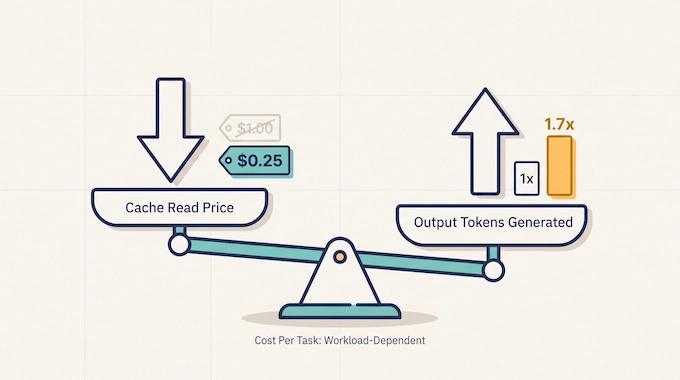
Its pricing is unusual because the headline savings do not come from lower base token prices. Fresh input remains $10 per million tokens and output remains $50 per million. A five-minute cache write costs $12.50/M, a one-hour cache write costs $20/M, and a cache read now costs just $0.25/M. Batch processing cuts ordinary input and output prices by 50%, to $5/M input and $25/M output.
Anthropic says the lower cache-read rate reduces typical token-billed workloads by about 25% versus Fable 5, with savings up to around 45% for complex coding and highly agentic work. That makes sense when an agent repeatedly rereads a large cached prefix across many tool calls.
The phrase to remember is cached context got much cheaper, not output.
4.1 The Fable 5.1 Cost Paradox
This is where Fable 5.1 cost and Claude Fable 5.1 token usage can look contradictory. A model can have a lower price for some tokens and still cost more on a task if it generates many more tokens.
The research data supplied for this review cites an Artificial Analysis comparison where Fable 5.1 at Max cost about $3.76 per task versus $3.14 for Fable 5, while producing roughly 1.7 times as many output tokens.
That helps explain why some users can experience faster allowance consumption even though Anthropic has cut cache pricing. API billing, tokens consumed, cost per completed task, and subscription usage limits are four different things. A 75% cache-read reduction does not mean a Claude subscription suddenly provides 75% more Fable usage.
Multi-agent workflows can amplify the effect. Anthropic’s own ProgramBench tests found that parallel agents reached a given score faster, but used more tokens and therefore cost more. In its async harness, a lead agent can dynamically spawn long-lived subagents, and total usage is calculated across all agents.
5. Which Effort Level Should You Use?
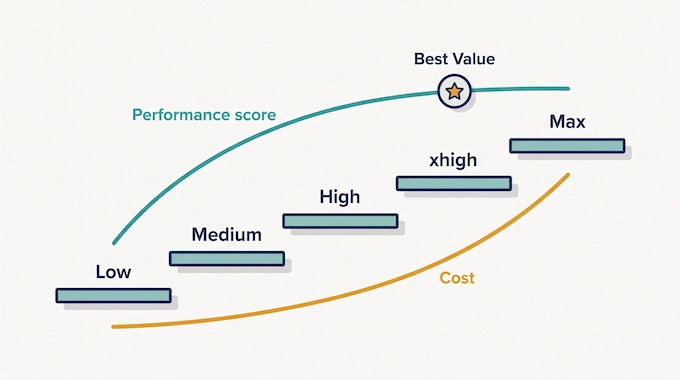
Max effort is the performance ceiling, not automatically the best setting.
The most convincing evidence comes from professional-work evaluations. On GDPval-AA v2, xhigh scored 1835 versus 1853 at max while using about 25% fewer output tokens. On AA-Briefcase, xhigh scored 1686 versus 1694 at max while using 19% fewer output tokens. Those differences were within the reported confidence intervals.
For practical use:
- Low: quick tasks where cost and latency matter more than squeezing out the last few points.
- Medium: a strong starting point for routine coding and agent work.
- High: difficult debugging, research, and multi-step implementation.
- xhigh: often the interesting value setting for serious professional work.
- Max: reserve for cases where the highest possible success rate matters more than token efficiency.
There is no universal winner because higher effort changes behavior, not just the length of hidden reasoning. FrontierCode is the clearest example. Fable 5.1 became more likely to make extra, out-of-scope improvements at high effort and above, lowering its score despite rising task-correctness performance.
6. Are the Huge Benchmark Gains Real?
The right answer is “probably meaningful, but don’t confuse a launch table with settled science.”
Most evaluations in Anthropic’s system card were run in-house. Anthropic also used external evaluators for selected assessments, rather than presenting the entire card as independent testing. That creates the usual concerns about harness choices, prompts, retries, model settings, and benchmark sensitivity.
Anthropic does provide useful comparability checks. For Terminal-Bench 4.0 and Terminal-Bench-Science, its reruns of older Claude models landed within expected noise of public leaderboard results.
Several important results also come from outside Anthropic. Cursor independently measured CursorBench. Proximal ran FrontierSWE v2 in its own harness. Artificial Analysis independently ran GDPval-AA and the held-out Legal Agent Benchmark. The ARC Prize Foundation supplied verified ARC-AGI scores. That does not prove contamination is impossible, but it does make the performance story harder to dismiss as an Anthropic-only artifact.
The losses matter too. Opus 5 leads SWE-bench Multimodal, slightly leads SWE-bench Multilingual, and beats Fable 5.1 on Toolathlon Pass@1. Fable 5.1 also trails Opus 5 slightly on HealthBench and falls behind Fable 5 on some FrontierCode settings.
That is exactly what you want to see in a credible benchmark profile: a strong model with identifiable edges, not a magical winner of every test.
7. Claude Fable 5.1 vs Opus 5, Fable 5 and GPT-5.6 Sol
7.1 Fable 5.1 vs Fable 5
This is the easiest upgrade to justify for demanding work. Fable 5.1 is clearly stronger on terminal coding, scientific workflows, professional automation, computer use, and ultra-long engineering tasks. Cache-heavy API loops also get much better economics because cache reads cost one quarter of the previous rate.
The catch is behavior. If your workflow depends on tightly scoped code changes, rerun your evals. Fable 5.1 can be more proactive than Fable 5, and “helpful extra work” can be a bug in production.
7.2 Fable 5.1 vs Opus 5
This comparison is less obvious. Opus 5 costs $5/M input and $25/M output, half Fable 5.1’s raw rates, and still wins some important benchmarks. Fable 5.1 earns its premium when task difficulty, duration, or failure cost becomes high. It leads Opus on Terminal-Bench, Terminal-Bench-Science, FrontierSWE, GDPval-AA, AutomationBench, and OSWorld in the reported results.
For routine work, Opus 5 remains the more conservative default. For hard agentic work, Fable 5.1 is the more interesting ceiling.
7.3 Fable 5.1 vs GPT-5.6 Sol
The supplied benchmark set favors Fable 5.1 heavily on long-running engineering and agentic terminal work. It leads Sol 0.57 to 0.32 on FrontierSWE v2, 55.8% to 37.3% on Terminal-Bench 4.0, and 52.6% to 22.4% on Terminal-Bench-Science. GPT-5.6 Sol does win ARC-AGI-2 in Anthropic’s summary table, 92.5% to 90.0%.
That makes Fable 5.1 especially compelling when the job resembles a persistent engineer or research agent rather than a one-shot reasoning test.
8. Who Should Actually Use Claude Fable 5.1?
Claude Fable 5.1 makes the most sense when the expensive part of the problem is failure, rework, or human time.
Use it for difficult debugging, multi-repository engineering, long-running autonomous coding, deep research, complex document and spreadsheet work, root-cause analysis, and agent loops that repeatedly reuse large cached contexts. Those are the scenarios where its stronger performance floor and cheaper cache reads can compound.
Skip it for trivial chats, simple rewrites, cheap high-volume API traffic, or short tasks where a lower-priced model already passes your evals. Paying $50/M output to summarize a short memo is not sophistication. It is just an expensive way to make a paragraph.
The best way to think about this release is not “Fable 5.1 is the new default.” It is Fable 5.1 is the model you reach for when your default stops being good enough.
For builders, the next step is simple: test your real workload at Medium, High, xhigh, and Max, then measure completed-task cost rather than token price alone. That will tell you more than any leaderboard.
For more benchmark-driven model reviews, pricing breakdowns, and practical AI comparisons, follow Binary Verse AI. We’ll keep tracking Fable 5.1 as independent evaluations and real-world usage data catch up with the launch-day numbers.
1. Is Claude Fable 5.1 actually good?
Yes. Claude Fable 5.1 is one of Anthropic’s strongest models for coding, long-running agentic work, research, computer use, and professional tasks. It scores 55.8% on Terminal-Bench 4.0, 52.6% on Terminal-Bench-Science 0.1, 73.4% on CursorBench 3.2, and 1853 on GDPval-AA v2. However, it does not beat every competing model on every benchmark, and higher reasoning effort can sometimes add unnecessary work rather than improve results.
2. What is Claude Fable 5.1 best used for?
Claude Fable 5.1 is best suited to difficult coding, debugging, multi-step research, long-running autonomous workflows, computer use, data analysis, and complex professional knowledge work. Its strongest gains appear on tasks that require sustained reasoning and execution over long periods rather than simple everyday prompts. On FrontierSWE v2, for example, it scored 0.57, ahead of Opus 5 at 0.52 and Fable 5 at 0.48.
3. How much does Claude Fable 5.1 cost?
Claude Fable 5.1 API pricing is $10 per million input tokens and $50 per million output tokens. A 5-minute cache write costs $12.50/M tokens, a 1-hour cache write costs $20/M, and cached reads cost just $0.25/M tokens. Batch processing reduces standard input and output prices by 50%.
4. Why does Claude Fable 5.1 use so many tokens if Anthropic says it is cheaper?
Because Anthropic reduced the price of cached input, not the price of every token Fable 5.1 generates. A task can therefore benefit from much cheaper cache reads while still consuming more output tokens, tool calls, or subagent work. This is why lower per-token caching costs do not necessarily translate into a lower cost for every completed task. Multi-agent workflows can also trade higher total token usage for faster completion.
5. Is Claude Fable 5.1 worth using over Fable 5 or Opus 5?
For difficult, long-running tasks, usually yes. Fable 5.1 substantially improves on Fable 5 in areas such as Terminal-Bench, scientific workflows, professional work, and automation, and it also surpasses Opus 5 on several major agentic benchmarks. But Opus 5 remains competitive or better on some tests, while cheaper models may provide better value for routine work. The best choice therefore depends more on task difficulty and cost per successful result than on choosing whichever model has the highest headline benchmark score.