
NVIDIA’s AVO system, powered by Claude Opus 5, has posted the kind of benchmark number that usually launches a thousand AGI headlines: 100.00 RHAE across all 25 ARC-AGI-3 public environments, with all 183 levels completed in 6,624 environment actions. But the cleanest headline is not “ARC-AGI-3 solved.” NVIDIA’s result is on the public set, not the semi-private or fully private competition sets.
The more interesting story is the system around the model. ARC Prize’s direct Claude Opus 5 High evaluation sits at 30.16%, while NVIDIA reports 100% using the same model family inside AVO. Those numbers are not a clean before-and-after experiment, but the gap is still a warning against treating a model score as the ceiling of what a well-designed agent can do.
Table of Contents
1. Is ARC-AGI-3 Solved? The Short Answer
If “solved” means NVIDIA AVO completed the entire public set at the maximum overall score, then yes. If it means the full competition has been conquered on unseen tasks, no evidence provided so far establishes that.
That distinction matters because the public environments are available for development and experimentation. The semi-private and fully private sets are the stronger test of whether the architecture generalizes when it can’t benefit from repeated engineering against known environments. The source material is explicit that NVIDIA’s reported result does not cover those held-out competition sets.
ARC-AGI-3 Results: What NVIDIA AVO’s 100% Score Actually Means
| Question | Current Answer |
|---|---|
| Did AVO complete all 25 public environments? | Yes |
| Did it complete all 183 public levels? | Yes |
| Did it score 100.00 RHAE? | Yes |
| Did NVIDIA demonstrate 100% on the private set? | No |
| Was NVIDIA first to hit 100% on the public demo? | No |
| Does the result prove AGI? | No |
So the accurate version is impressive enough without decoration: NVIDIA AVO solved the full public set under the official scorecard.
2. What NVIDIA AVO Actually Achieved
The full NVIDIA run used Claude Opus 5 inside the AVO architecture. It solved 183 of 183 levels across 25 public environments in 6,624 environment actions. NVIDIA also tested GPT-5.6 Sol with AVO, but only on a challenging subset, so Sol should not be credited with the complete 100% result. In those limited comparisons, Sol was faster in wall-clock time on several matched levels, while Opus used fewer environment actions.
The nearby results also show why the headline needs context:
ARC-AGI-3 Results: NVIDIA AVO vs Claude Opus 5, Tycho and Retrodict
| System | Reported Result | Evaluation Context |
|---|---|---|
| Claude Opus 5 High | 30.16% | ARC Prize direct model evaluation |
| NVIDIA AVO + Claude Opus 5 | 100% | NVIDIA public-set run |
| Tycho | 100% | Community Public Demo |
| Retrodict | 99.9% | Community Public Demo |
Tycho had already reached 100.0% on the public demo on July 29, while Retrodict had reached 99.9%. NVIDIA’s result is therefore not the first public 100. What makes it interesting is how a general-purpose long-horizon architecture converted model capability into a perfect public-set score.
3. What Is ARC-AGI-3 and What Does the Benchmark Test?
ARC-AGI-3 is an interactive reasoning benchmark. Instead of handing a model a static puzzle and waiting for one answer, it drops an agent into unfamiliar, game-like environments without stated rules, instructions, or goals. The agent has to experiment, observe what changes, infer the objective, and plan efficient actions across increasingly difficult levels.
That makes the benchmark closer to a tiny scientific process than a trivia exam. The agent must explore, form hypotheses, revise them after bad outcomes, preserve useful discoveries, and keep working over a long horizon.
This is why the benchmark is revealing for agent systems. A strong model can still stumble if it forgets prior evidence, wastes interactions, or gets trapped in a wrong theory of the environment. A capable harness can instead turn each interaction into state that helps the next one. The benchmark is therefore testing both reasoning and the machinery that keeps reasoning coherent over time.
4. What Does a 100% Score Actually Mean?
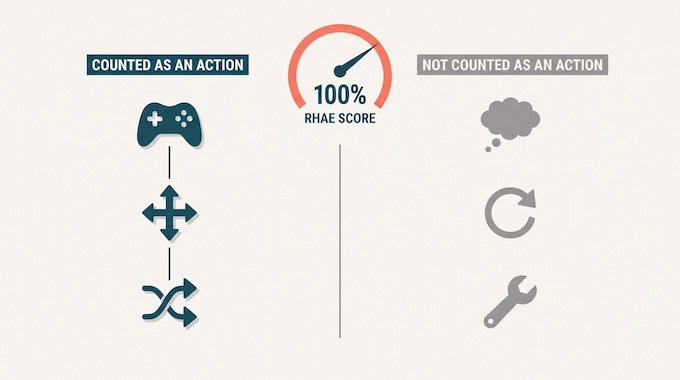
The benchmark uses Relative Human Action Efficiency, or RHAE. It scores both completion and how efficiently the agent interacts with the environment compared with first-time human players. The human baseline is based on the upper median performer for each level, not an average across all attempts.
A 100% total score means the system completed every game and level while matching or surpassing the benchmark’s human-efficiency requirement. The score also weights later levels more heavily, so breezing through easy opening stages isn’t enough.
4.1 Internal Reasoning Is Not a Scored Environment Action
Here is the catch that matters when interpreting “human efficiency.” An ARC action is an interaction that changes the game state. Tool calls, reasoning steps, and retries that do not alter the environment are not counted as actions.
So 100% RHAE does not mean AVO used human-level compute, tokens, elapsed time, or money. It means the system was human-level or better in the specific resource the benchmark scores: environment interactions. That is still meaningful, but it is a narrower claim than “the AI solved these tasks as efficiently as a person in every sense.”
5. Public vs Private ARC-AGI-3 Changes the Headline
The public set is meant for development, experimentation, and community research. Semi-private evaluation is more restricted. The fully private competition set is the strongest unseen test.
That hierarchy is the reason “ARC AGI 3 solved” is too broad a summary today. NVIDIA has shown that AVO can dominate the public environments. It has not publicly shown the same 100% performance on the private set.
This isn’t an accusation of overfitting. Public benchmarks are supposed to be explored. Researchers inspect failures, adjust interfaces, improve memory, and learn which strategies work. The issue is simply that success after repeated development against public tasks answers a different question from success on genuinely unseen ones.
The ARC-AGI-3 private set is therefore the result to watch next. If AVO retains anything close to its public performance there, the case for broad architectural generalization becomes much stronger. If performance falls sharply, the public 100% will look more like a sign that the exposed benchmark has become highly optimizable.
6. How Did Claude Opus 5 Go From About 30% to 100%?
The tempting arithmetic says AVO added 69.84 percentage points. Don’t do that.
ARC Prize’s 30.16% Claude Opus 5 High result and NVIDIA’s 100% AVO result are not a controlled ablation with one variable changed. NVIDIA says the runs differ in reasoning settings, architecture, and evaluation setup. That means the two scores can’t isolate AVO’s exact contribution.
What the contrast does show is more useful. A direct model evaluation can significantly understate what the same model family may accomplish when placed inside a persistent agent system with tools, state, supervision, feedback, and repeated opportunities to recover from mistakes.
Think of it like testing a developer with one terminal command versus giving that developer an IDE, documentation, version history, tests, and time to debug. The underlying intelligence hasn’t magically changed, but the system can express far more of it.
That distinction is becoming central to modern AI evaluation: model capability and agent capability are no longer the same measurement.
7. What Is NVIDIA AVO: Model, Agent, or Harness?
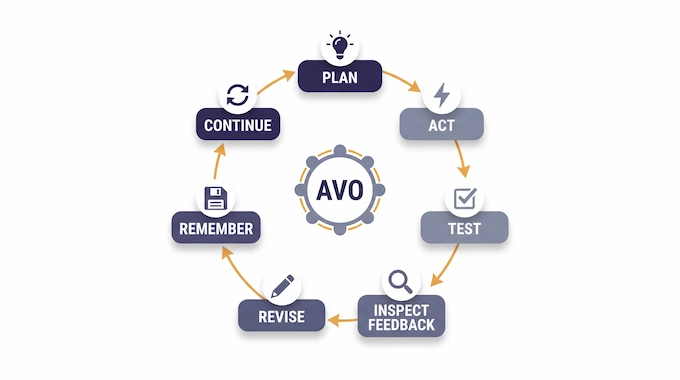
AVO stands for Agentic Variation Operators. It is not a new foundation model. Claude Opus 5 is the underlying language model in the full public-set run. AVO is the surrounding system that lets the model operate as a long-running agent.
The original AVO paper frames the idea as replacing fixed evolutionary variation steps with a self-directed coding agent. Instead of generating one candidate and handing control back to a rigid pipeline, the agent can inspect prior solutions, consult a knowledge base, run evaluations, diagnose failures, revise code, and decide when to test again.
In plain English, the loop looks like this:
- plan
- act
- test
- inspect feedback
- revise
- remember
- continue
For ARC, NVIDIA reused that general architecture with a different task interface. The point wasn’t to build a new language model for ARC puzzles. It was to see whether machinery designed for sustained autonomous engineering could transfer to unfamiliar interactive reasoning.
8. Why AVO Works: Memory, Supervision, and Recovery
AVO’s paper makes persistent memory and long-running iteration central to the design. The agent can carry forward previous edits, compiler outputs, profiler results, and reasoning rather than reconstructing the search from scratch each time. It also has tools for editing, shell execution, file navigation, and documentation retrieval.
8.1 Persistent Memory
Memory turns earlier failures into reusable evidence. In an interactive environment, that matters because repeatedly rediscovering the same rule wastes both time and scored actions.
8.2 Supervision and Stagnation Recovery
AVO also includes a supervisory mechanism that watches for plateaus and unproductive cycles. When the main agent gets stuck, the supervisor can redirect exploration toward alternative strategies. In the paper’s seven-day GPU optimization run, that mechanism helped maintain progress across 40 committed versions.
8.3 Grounded Feedback
The architecture repeatedly tests ideas against an external environment. Wrong assumptions don’t have to end the task. They become feedback for the next attempt.
There is an important limit to the claim: NVIDIA has not isolated exactly how many ARC percentage points came from memory, supervision, tools, or any single component. The result supports the architecture as a package, not a neat ranking of its ingredients.
9. Why the GPU Work Makes the ARC Result More Interesting
AVO wasn’t introduced as an ARC-specific trick. In the March research paper, NVIDIA used it for autonomous GPU-kernel optimization on B200 hardware. Across seven days, the agent explored more than 500 optimization directions and produced 40 committed kernel versions. The resulting multi-head attention kernels beat cuDNN by up to 3.5% and FlashAttention-4 by up to 10.5% in the tested configurations.
That history doesn’t prove the ARC result generalizes everywhere. It does make the transfer more interesting. GPU optimization and interactive puzzle environments have very different surface forms, yet both reward the same deeper loop: build a hypothesis, act through tools, observe consequences, preserve state, revise, and continue.
The useful lesson for builders is not “copy AVO and get 100%.” It is that long-horizon performance may depend as much on state management, evaluation loops, and recovery as on swapping in a slightly stronger base model.
10. Was NVIDIA First, and Is the Public Leaderboard Saturating?
No. The ARC-AGI-3 leaderboard already had a 100% public-demo result from Tycho before NVIDIA’s August announcement, with Retrodict sitting at 99.9%.
That changes the competitive question. Once multiple sophisticated harnesses approach the ceiling on exposed tasks, another public 100% tells us less about who can generalize best. It tells us more about how thoroughly the public benchmark can now be engineered against.
That doesn’t make the public set useless. Public environments are where researchers can inspect behavior, test architectures, compare action efficiency, and understand failure modes. But the center of gravity shifts.
The interesting question is no longer simply, “Can a system reach 100%?” It is, “Can the same system keep its edge when the environment is unfamiliar and the development team hasn’t had repeated chances to tune against it?”
That is why private-set performance now matters more than another perfect public score.
11. Is This Overfitting or Genuine Agent Progress?
Both the enthusiastic and skeptical readings have evidence behind them.
The case for genuine progress is that AVO is a broader architecture, not something introduced only for ARC. Its earlier GPU work required multi-day autonomous search, tool use, debugging, memory, and recovery. The paper’s Figure 1 explicitly contrasts that agent loop with fixed LLM-in-the-loop pipelines, while later experiments show hundreds of internal optimization directions across a week of autonomous work.
The skeptical case is equally straightforward: the 100% being discussed is still on the public set, where repeated experimentation is possible. Other advanced harnesses are already at or near the ceiling.
The right response is not “NVIDIA cheated,” and it isn’t “AGI confirmed.” The fair test is held-out generalization. If a broadly designed architecture remains strong on private environments, that tells us it learned a transferable way to reason and recover. If it collapses, benchmark-specific optimization becomes the more plausible explanation.
12. What the 100% Result Still Doesn’t Tell Us
Several practical questions remain open in the supplied research. The ARC run’s total token usage, number of model calls, dollar cost, and full wall-clock runtime are not publicly reported.
That matters because RHAE deliberately scores environment actions, not every resource consumed behind the scenes. A system can therefore be highly efficient under the benchmark while still using substantial inference or orchestration to decide each move.
Reproducibility is another boundary. NVIDIA has published research and architecture information, but the supplied material does not establish the release of a complete runnable ARC setup with all prompts, traces, and exact configuration. It would be premature to describe the result as independently reproducible from the public materials alone.
And most importantly, the result does not establish 100% on the semi-private or private competition sets. That unknown is larger than any missing cost estimate.
13. What ARC-AGI-3 at 100% Really Tells Us
A perfect public score does not establish AGI. What it does show is arguably more useful for today’s builders: the distance between a frontier model and a frontier agent can be enormous.
NVIDIA AVO combines a strong model with persistent state, tools, iterative testing, supervision, grounded feedback, and recovery. The original AVO research showed that this style of system could sustain autonomous engineering over days. The ARC result shows that the same broad machinery can transfer to a very different interactive reasoning task.
That should change how we read future benchmark charts. A model leaderboard tells us what a model can do under one evaluation interface. An agent result tells us what a complete system can extract from that model over time. Both matter, but they answer different questions.
The next ARC-AGI-3 result worth getting excited about isn’t another 100% on the public environments. It is a strong score on genuinely unseen private tasks.
Binary Verse AI will keep tracking the ARC-AGI-3 results, private-set evidence, and the agent architectures behind the numbers. If you care about what the benchmark actually proves rather than the loudest headline, follow our benchmark coverage for the next round.
1. What is ARC-AGI-3?
ARC-AGI-3 is an interactive reasoning benchmark designed to test how well AI agents can adapt to unfamiliar environments. Instead of receiving explicit instructions or rules, an agent must explore, infer how the environment works, discover the objective, and complete increasingly difficult levels efficiently. The benchmark therefore tests interactive reasoning, adaptation, planning, and autonomy rather than simple question answering.
2. What does ARC-AGI-3 measure?
ARC-AGI-3 measures both task completion and action efficiency using Relative Human Action Efficiency (RHAE). AI agents are compared with first-time human players based on how many environment actions they need to complete each level. Internal reasoning, tool calls, and retries that do not change the environment are not counted as actions, so RHAE measures interaction efficiency rather than total compute or token usage.
3. What is ARC and AGI?
ARC refers to the Abstraction and Reasoning Corpus family of benchmarks created to test generalization and reasoning on unfamiliar problems. AGI stands for artificial general intelligence, broadly referring to AI capable of handling a wide range of intellectual tasks rather than one narrow domain. Passing an ARC-AGI benchmark, however, does not by itself establish that a system has achieved AGI.
4. What is the average human-normalized score in ARC-AGI-3?
ARC-AGI-3 does not use one simple “average human score.” Its RHAE metric compares an AI’s action efficiency with an upper-median first-time human baseline for each level. A total score of 100% means the agent completed every game and level while matching or surpassing the required human-relative action efficiency across the benchmark.
5. Has ARC-AGI-3 been solved?
The public ARC-AGI-3 set has been solved, but the full challenge has not been shown to be solved. NVIDIA’s AVO system with Claude Opus 5 achieved 100.00 RHAE across all 25 public environments and completed all 183 levels. However, NVIDIA explicitly states that this result does not cover the semi-private or fully private competition sets, so performance on genuinely unseen ARC-AGI-3 tasks remains unresolved.