
OpenAI’s first custom AI chip has moved from an interesting infrastructure story to a much harder question for Nvidia: what happens when one of the world’s biggest AI customers designs inference hardware around its own workloads?
The OpenAI Jalapeno chip, officially styled Jalapeño, is a purpose-built LLM inference accelerator developed with Broadcom. It isn’t meant to replace GPUs for every job. Its target is narrower and commercially crucial: serving large language models quickly, efficiently, and at the low latency needed for ChatGPT, coding agents, APIs, and other interactive systems.
OpenAI’s first public benchmarks, released August 25, 2026, are strong. Across GPT-OSS 120B, DeepSeek R1 670B, and Kimi K2.5 1T, Jalapeño delivered 1.5 to 1.9 times higher peak work per watt and 1.7 to 3.6 times lower end-to-end latency than the Nvidia comparison systems. At extreme matched decoding speeds, the reported efficiency gap becomes much larger.
So, does Jalapeño beat Nvidia Blackwell? On these published inference tests, yes. As a blanket statement about AI hardware, no. That distinction is the whole story.
Table of Contents
1. OpenAI Jalapeno Chip Specs at a Glance
The most useful way to read the OpenAI Jalapeño specs is to separate what has actually been disclosed from what remains private. OpenAI has shared power, architecture goals, benchmark behavior, and system design details, but not a conventional GPU-style spec sheet with public FLOPS, memory capacity, or memory bandwidth.
OpenAI Jalapeno Chip Specs and Technical Details
| Specification | OpenAI Jalapeño | What It Means |
|---|---|---|
| Primary role | LLM inference accelerator | Built for serving models, not general-purpose GPU computing |
| Chip type | Custom inference ASIC / “Intelligence Processor” | More specialized than a GPU |
| Development partners | OpenAI, Broadcom, Celestica | OpenAI leads architecture, partners help implement and industrialize the platform |
| Rated package power | 700 W | Figure used in OpenAI’s benchmark normalization |
| Sustained power in tested workloads | ≤550 W | Measured power stayed below the rated figure in the published tests |
| Memory capacity / bandwidth | Not disclosed in supplied technical material | OpenAI discusses memory locality and KV-cache placement, not a public capacity figure |
| Peak compute / FLOPS | Not disclosed | Direct theoretical-compute comparisons are not yet possible |
| Networking | Integrated into the system architecture; Broadcom networking involved | Designed to reduce communication overhead across inference |
| Workloads shown publicly | GPT-OSS 120B, DeepSeek R1 670B, Kimi K2.5 1T | Demonstrates support across multiple model families |
| Planned deployment | Inside OpenAI infrastructure by end of 2026 | Not announced as a retail accelerator or public cloud SKU |
OpenAI rates Jalapeño at 700 W, although it says measured sustained power remained at or below 550 W on the workloads tested. Importantly, the benchmark calculations still use the higher 700 W figure.
That missing specification data matters. Nvidia publishes detailed Blackwell Ultra figures, including HBM3E capacity, bandwidth, NVLink, and tensor performance. The OpenAI Jalapeno chip is currently easier to judge by measured serving behavior than by theoretical peaks. OpenAI’s own framing reinforces that choice: for inference, useful work per unit of power can tell you more than an impressive FLOPS number with no context.
2. OpenAI Jalapeno Benchmarks: The Numbers That Matter
The first benchmark results tell the story more cleanly than a stack of separate charts. GPT-OSS 120B was compared with Nvidia GB200, while DeepSeek R1 and Kimi K2.5 were compared with Nvidia GB300. The tests use InferenceX with nominal 8K-token inputs, 1K-token outputs, and STP serving.
OpenAI Jalapeno Chip Benchmarks vs Nvidia GB200 and GB300
| Model | Nvidia Comparison | Peak Efficiency | End-to-End Latency | Minimum TBT / Peak Decode | Throughput at Nvidia’s Fastest Decode Speed |
|---|---|---|---|---|---|
| GPT-OSS 120B | GB200 STP | 85,448 vs 44,960 mixed tok/s/kW (1.9×) | 1.03s vs 1.80s (1.7× lower) | 0.69 vs 1.87 ms, 1,459 vs 535 tok/s/user | 22,935 vs 427, 53.7× |
| DeepSeek R1 670B | GB300 STP | 19,641 vs 11,781 (1.7×) | 1.65s vs 5.99s (3.6× lower) | 1.43 vs 5.90 ms, 700 vs 169 tok/s/user | 12,258 vs 118, 104.3× |
| Kimi K2.5 1T | GB300 STP | 18,195 vs 11,862 (1.5×) | 1.56s vs 5.31s (3.4× lower) | 1.44 vs 5.48 ms, 694 vs 182 tok/s/user | 6,744 vs 120, 56.1× |
The restrained headline is already impressive: at each platform’s best efficiency point, Jalapeño delivered roughly 1.5 to 1.9 times more mixed-token throughput per kilowatt. Its maximum per-user decoding rate was about 2.7 to 4.1 times higher.
The stranger result appears when both platforms are forced to operate at the fastest decoding speed Nvidia achieved. Under that constraint, Jalapeño retains far more total throughput per kilowatt. That produces the 53.7×, 104.3×, and 56.1× figures.
Benchmark normalization also gives Jalapeño no credit for its lower measured power. OpenAI used the published 700 W package rating, even though it says sustained consumption stayed at or below 550 W. The comparison uses 1,200 W for GB200 and 1,400 W for GB300.
3. Why the OpenAI Jalapeño Architecture Looks Different
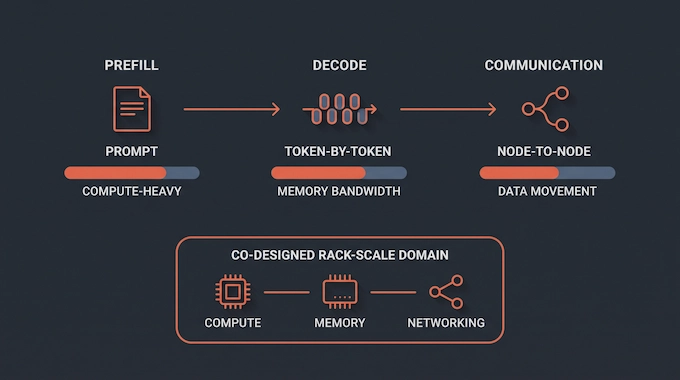
Jalapeño starts from a simple observation: LLM inference isn’t one uniform workload.
During prefill, the system processes the user’s prompt. This phase is compute-heavy. During decode, the model generates tokens one by one, and memory bandwidth becomes much more important. Then there’s communication, the quiet tax paid whenever data has to move between cores, accelerators, or nodes.
A general-purpose accelerator has to be good at many things. The OpenAI Jalapeño architecture is designed around this particular sequence of bottlenecks.
OpenAI says it reduces data movement by keeping model state, including the KV cache used during generation, local where possible. Compute, memory, networking, and the rack-scale system are co-designed so the workload can remain within a large connected domain instead of repeatedly shuffling state between separate resources.
That helps explain why the chip can be specialized without being tied to one model. “ASIC” can sound like “hard-wired for one network,” but OpenAI describes Jalapeño as a flexible inference accelerator that can support changing LLM architectures. The public results across GPT-OSS, DeepSeek, and Kimi are meant to demonstrate that flexibility.
For agents, this matters more than shaving a few milliseconds from one reply. An agent may execute dozens of model calls sequentially. Latency compounds. Faster inference can shorten an entire workflow, not just make text appear faster in a chat window.
4. How OpenAI Tested Jalapeño
OpenAI used InferenceX, a public benchmark from SemiAnalysis that measures end-to-end model serving rather than an isolated kernel. That’s a sensible choice for this chip’s stated purpose because Jalapeño is being judged on full-system behavior.
Still, readers should distinguish the benchmark framework from the source of the results. The supplied material establishes that InferenceX is a SemiAnalysis benchmark. The Jalapeño performance figures presented here are published by OpenAI. The material does not establish a fully independent, blind third-party reproduction of every number.
That leaves a meaningful validation gap. A public benchmark is better than a private microbenchmark, but production confidence comes from repetition, outside access, broader workloads, and long-running deployment data.
There’s another reason methodology matters. Nvidia itself positions GB300 as a rack-scale platform for reasoning and test-time scaling, with 72 Blackwell Ultra GPUs, 36 Grace CPUs, a large NVLink domain, and an extensive software stack. A single benchmark configuration cannot capture every way that system can be used.
5. Is Jalapeño Really 104× Faster Than Nvidia GB300?
No. That would be a seductive headline and a bad explanation.
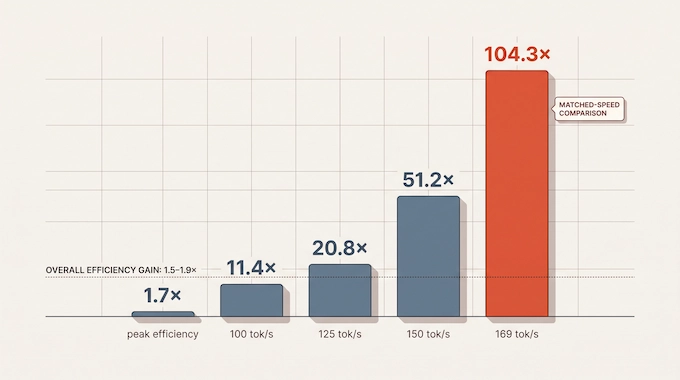
The 104.3× figure comes from DeepSeek R1 at a specific matched operating point. Nvidia’s comparison system reaches roughly 169 tokens per second per user. At that same user decoding speed, OpenAI reports 12,258 mixed tokens/s/kW for Jalapeño versus 118 for GB300.
That means Jalapeño delivered 104.3 times more mixed throughput per kilowatt while holding the decoding rate at that particular level.
It does not mean one Jalapeño chip completes every DeepSeek task 104 times faster. It does not mean training is 104 times faster. And it does not mean every model, context length, batch size, or serving stack will show the same gap.
The progression is still revealing. On DeepSeek R1, the reported advantage climbs from 1.7× at peak efficiency to 11.4× at 100 tok/s/user, 20.8× at 125, 51.2× at 150, and 104.3× around 169 tok/s/user.
In other words, the architecture’s advantage appears to grow as the service is pushed toward high interactivity without surrendering fleet efficiency. That is a much more interesting claim than “104× faster,” because it maps directly onto expensive workloads such as coding agents and reasoning systems.
6. OpenAI Jalapeño vs Nvidia Blackwell: What Actually Wins?
For the workloads OpenAI published, Jalapeño wins the measured inference comparison. It posts higher throughput per watt, lower request latency, and faster per-user decoding.
But OpenAI Jalapeño vs Nvidia Blackwell is not a clean winner-takes-all contest.
Nvidia GB300 is a broad accelerated-computing platform. Blackwell Ultra supports training as well as inference, comes with the CUDA-X ecosystem, and publishes capabilities far outside the scope of Jalapeño’s current benchmark results. GB300 NVL72 combines 72 GPUs with 36 Grace CPUs, up to 37 TB of fast-access memory, and a 130 TB/s NVLink switch domain.
Jalapeño is narrower by design. OpenAI is optimizing for the inference workloads it knows intimately, then integrating chip architecture, kernels, memory placement, networking, serving software, and products around that goal.
For the OpenAI Jalapeno chip, that specialization is a feature. It’s less obviously a replacement if you’re a university lab, cloud provider, simulation team, or enterprise that needs one accelerator platform for many kinds of compute.
The strategic threat to Nvidia is therefore not “OpenAI built a universally better GPU.” It’s that hyperscalers and frontier labs can remove a growing slice of high-volume inference from general-purpose GPUs when custom silicon offers better economics.
7. The Benchmark Caveats That Matter
There are four reasons not to treat the current charts as the final word.
- First, the comparison set is limited. The source material flags community questions about newer Nvidia Vera Rubin systems and alternatives such as TPUs, Groq, and Cerebras. There is no clean same-test Rubin comparison in the supplied evidence.
- Second, serving software changes results. Nvidia’s own GB300 material emphasizes Dynamo, disaggregation, long-context reasoning, and rack-scale optimization. A benchmark result is therefore inseparable from the serving setup used to produce it.
- Third, speculative decoding remains unresolved in the published Jalapeño tests. The supplied material does not show that Jalapeño used it, cannot use it, or will definitely support it later. Any stronger claim would be guesswork.
- Fourth, this is still early hardware moving toward production. OpenAI says it is continuing production qualification, maturing the software, preparing to operate Jalapeño at scale, and validating performance across more models. We don’t yet have public long-duration reliability, fleet-utilization, failure-rate, or stress-test data.
Those caveats don’t erase the benchmark. They define what it proves.
8. Can Jalapeño Train Models, Run CUDA or Replace GPUs?
8.1 Training
Jalapeño is designed for inference. The supplied material does not present it as OpenAI’s replacement for Nvidia training clusters. In fact, OpenAI explicitly says it plans to keep deploying Nvidia and other accelerators for both training and inference.
8.2 CUDA
Jalapeño isn’t an Nvidia GPU, so it isn’t a CUDA platform. OpenAI instead describes its own programming approach built around local tensors, explicit communication, synchronization, scheduling, and model-specific kernels.
That software burden is real. Purpose-built silicon only pays off if models can actually be mapped to it efficiently.
8.3 Speculative Decoding
The published benchmark does not establish support either way. The safe answer is simple: not demonstrated in these results.
9. How AI Helped Build and Program Jalapeño
One of the stranger parts of the story is that OpenAI used AI not just on the chip, but in the process of building it.
OpenAI says the program moved from initial design to tapeout in nine months, with models helping explore implementations, shorten design and verification loops, and optimize arithmetic circuits.
Later, Codex with GPT-Astra helped bring three open-weight model families to high performance within two months.
The most concrete software result is narrower than some online shorthand suggests. For selected GPT-OSS attention and mixture-of-experts blocks, AI-generated implementations reportedly ran 1.5 to 1.8 times faster than existing human-expert implementations.
That doesn’t mean AI designed the entire chip by itself. Nor does it mean the full model suddenly became 1.8 times faster. OpenAI also says each new model family still requires new kernels and model-specific optimization.
The interesting result is the development loop: AI helps design hardware, then helps write and tune software for that hardware. If that loop keeps improving, custom accelerators may become faster to build and faster to adapt to new model architectures.
10. Who Makes Jalapeño, When Does It Arrive, and Why It Matters
The OpenAI Broadcom Jalapeño program is a co-development effort. OpenAI says it designed the chip around its understanding of LLMs, model kernels, serving systems, and product needs. Broadcom contributes silicon implementation and networking technology, while Celestica helps with boards, racks, system integration, and scalable production.
OpenAI plans to begin deploying Jalapeño inside its compute infrastructure by the end of 2026. Gen 2 is already described as deep in development, with Gen 3 taking shape. No standalone retail price, public cloud SKU, or general customer purchase path is disclosed in the supplied material.
That makes Jalapeño important less as a product you can order and more as a signal about where frontier AI infrastructure is going.
OpenAI now has a credible first-party inference path alongside Nvidia and other partners. If the performance holds at production scale, the company can route workloads according to cost, latency, power, and availability instead of buying every unit of inference from the same hardware ecosystem.
For Nvidia, that is competitive pressure. For developers, it could eventually mean faster agents and lower serving costs. For the rest of the industry, it is another reminder that the AI race is moving below the model layer, into memory placement, networking, kernels, power budgets, and custom silicon.
The OpenAI Jalapeno chip doesn’t make Blackwell obsolete. What it does is more consequential: it shows that a model company with enough scale can design an accelerator around the exact economics of inference and post credible results against the market leader.
Binary Verse AI will keep tracking the OpenAI Jalapeno chip as it moves from benchmark silicon to production deployment, including new model tests, Gen 2 details, and the independent comparisons that will tell us whether these gains survive at scale.
What is OpenAI Jalapeño?
OpenAI Jalapeño is OpenAI’s first custom AI inference chip, developed with Broadcom for serving large language models. Unlike a general-purpose GPU, Jalapeño is optimized specifically for inference workloads such as prompt processing and token generation. OpenAI has demonstrated it across GPT-OSS 120B, DeepSeek R1 670B, and Kimi K2.5 1T.
Is OpenAI making its own chips?
Yes. Jalapeño is OpenAI’s first custom inference accelerator. OpenAI designed the chip around its own AI workloads, while Broadcom contributed to the silicon and system development. OpenAI plans to deploy Jalapeño inside its own compute infrastructure rather than positioning it as a consumer GPU.
Is OpenAI still using Nvidia chips?
Yes. Jalapeño does not mean OpenAI is abandoning Nvidia. OpenAI has said it will continue deploying Nvidia and other accelerators for both training and inference. Jalapeño is primarily intended to reduce dependence on external inference hardware and improve the efficiency of workloads OpenAI can optimize specifically for its own systems.
Is OpenAI Jalapeño the most powerful AI chip?
Not in any universal sense. Jalapeño has produced very strong results on OpenAI’s published LLM inference benchmarks, including higher throughput per watt and lower latency than the Nvidia GB200 and GB300 systems tested. However, those results apply to specific inference workloads. Nvidia GPUs remain far more general-purpose and are also designed for large-scale AI training.
Can OpenAI Jalapeño train AI models?
Jalapeño is designed primarily for AI inference, not frontier-model training. Its architecture focuses on efficiently serving already-trained models by optimizing prompt processing, token generation, memory movement, networking, and latency. This is an important distinction when comparing Jalapeño with Nvidia GPUs, which are widely used for both training and inference.