
Introduction
For the past decade, the tech industry has been governed by Moore’s Law on silicon and a less discussed but equally ruthless law of thermodynamics on Earth. We are running out of power. We are running out of water. And frankly, we are running out of patience with the zoning boards in Northern Virginia.
Enter the billionaires. Jeff Bezos wants to move heavy industry to orbit to save the planet. Elon Musk wants to build a backup drive for civilization. But recently, the conversation has shifted from vague sci-fi terraforming to a very specific, capital-intensive infrastructure play: space data centers.
The pitch sounds like a fever dream. Launch thousands of GPUs into Low Earth Orbit (LEO). Power them with unfiltered sunlight. Cool them by dumping heat into the infinite void. Train the world’s smartest AI models in zero gravity and beam the weights back down to Earth. Is this genius? Or is it the ultimate grift designed to justify the existence of massive rockets?
A deep dive into recent research from Google, alongside the movements of startups like Starcloud, suggests the physics actually works. The economics, surprisingly, might work too. But the engineering challenge sits right on the bleeding edge of what is possible.
Table of Contents
1. The Terrestrial Bottleneck: Why Musk, Bezos, and Google Are Looking Up
To understand why anyone would tolerate the headache of orbital mechanics, you have to look at the gridlock down here. The rise of generative AI has caused an explosion in demand for AI computing. This is not just about buying more GPUs. It is about feeding them.
Data centers are thirsty. They are power-hungry. In some regions, utility companies are already telling hyperscalers that the gigawatts they need simply do not exist. Google, for instance, has been investing in geothermal and nuclear power just to keep the lights on for Gemini. But even with nuclear, you are fighting for land and dealing with the thermal byproduct of all that thinking.
Space changes the equation. The Sun is the largest energy source in our solar system, outputting $3.86 \times 10^{26}$ Watts. That is 100 trillion times humanity’s total electricity production. In space, you do not need to negotiate a power purchase agreement. You just unfurl a solar panel. In certain orbits, those panels receive up to 8x more solar energy per year than a panel located on Earth.
This is the “New Space Race.” It is not about flags and footprints anymore. It is about FLOPS. Musk sees a future where space data centers are the lowest-cost way to do AI computing within five years. Bezos sees it as the logical next step for Amazon’s infrastructure. The bottleneck on Earth is physics and bureaucracy. In space, the only bottleneck is how much mass you can shove into a fairing.
2. How Space Data Centers Work: The Engineering Behind the Hype
The concept of space data centers relies on stripping away the redundancies required on Earth. You do not need massive concrete shells. You do not need diesel backup generators. You do not need grid interconnects. You need three things: power, cooling, and connectivity.
The orbit is the first design choice. Google’s research team proposes a “dawn-dusk” Sun-Synchronous Orbit (SSO). This is the “Goldilocks zone” for orbital compute. In this specific orbit, the satellite rides the terminator line between day and night, meaning it stays in perpetual sunlight. There is no night. You do not need massive, heavy batteries to survive the dark side of the Earth. You just drink from the firehose of the sun, 24/7.
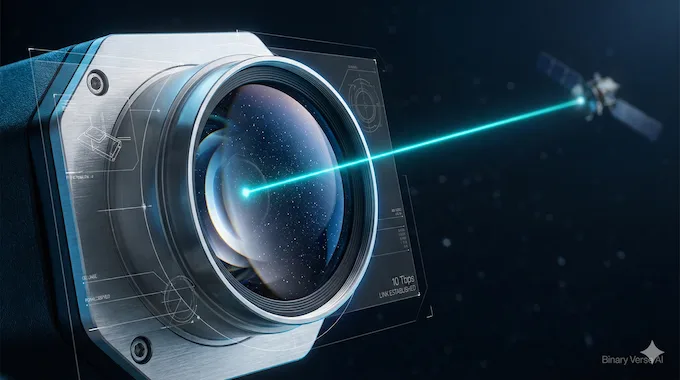
Connectivity is where things get interesting. On Earth, fiber optics are the gold standard. But light travels roughly 31% slower in glass fiber than it does in a vacuum. In space, space data centers can use Free-Space Optical (FSO) inter-satellite links.
We are talking about lasers in a vacuum. Google envisions satellites flying in close formation—a swarm of 81 satellites with a cluster radius of just 1km. By keeping them this close, they can achieve bandwidths that make terrestrial networks blush. We are looking at aggregate bandwidths of 10 Terabits per second (Tbps) using off-the-shelf technology.
Because the distance is so short (under 10km), the beam spot size is small. This allows engineers to use spatial multiplexing, fitting multiple independent laser beams into the same telescope aperture. It is like running a bundle of fiber cables between racks, except the cables are made of light and the racks are moving at 17,000 miles per hour.
3. Myth-Busting the Cooling Controversy: Can You Cool Chips in a Vacuum?

Go to any forum about space data centers, and you will find the same objection pasted in the comments: Space is cold, but there is no air. Convection doesn’t work. The chips will melt.
This is the “Thermo 101” objection. It is technically true that data center cooling in space cannot rely on fans blowing air over a heatsink. Vacuum is a fantastic insulator. That is why your coffee stays hot in a thermos.
But engineering is about tradeoffs. While you lose convection, you gain a pristine environment for radiative cooling. All objects emit heat as infrared radiation. The rate of this cooling scales with the fourth power of temperature.
Google’s proposed design tackles this head-on. The cooling system uses heat pipes to move thermal energy from the TPU (Tensor Processing Unit) chips to large radiators. These radiators face deep space, which has a background temperature of about 3 Kelvin (-270°C).
The challenge is surface area. To cool a high-performance chip, you need a large radiator. But you also need to make sure that radiator never points at the Sun or the Earth. Google’s design involves maintaining a specific orientation where the solar panels face the sun and the radiators face the cold void.
Is data center cooling in space “free” as Musk suggests? Not exactly. You pay for it in mass. The radiators add weight. But it is solvable. The James Webb Space Telescope cools its instruments to near absolute zero using passive radiation. We do not need our GPUs to be that cold; we just need them to not catch fire. The physics allows for it, provided your radiator is big enough and your pointing control is precise.
4. The Radiation Problem: Will Cosmic Rays Fry the Hardware?
If heat is the slow killer, radiation is the sniper. Space data centers operate in a shooting gallery of high-energy protons and galactic cosmic rays.
On Earth, our magnetosphere and atmosphere protect us. In orbit, sensitive electronics are exposed. A single energetic particle can strike a transistor and flip a bit, changing a 0 to a 1. In a JPEG, that is a glitch. In a billion-parameter AI training run, that can be a disaster known as Silent Data Corruption (SDC).
Google took their Trillium TPU chips and blasted them with a 67 MeV proton beam to see what would happen. The results were surprisingly optimistic.
The chips survived a total ionizing dose equivalent to a 5-year mission in LEO with standard shielding (10mm of aluminum). They did not die. The logic cores held up well. The weak point, predictably, was the High Bandwidth Memory (HBM).
Memory is dense. That makes it a big target for particles. Google found that HBM showed uncorrectable errors at a rate of about one per 50 rads. For inference (running a model), this is acceptable. You can tolerate a glitch every 10 million inferences.
For training, it is trickier. Training runs take weeks. If a bit flips in the gradient descent calculation on day 14, you might ruin the whole model. The solution is not just lead walls—which are heavy—but software resilience. Orbital AI systems will need robust Error Correcting Codes (ECC) and “checkpointing” strategies that assume hardware is fallible. We are not building perfect hardware; we are building resilient systems.
5. The Economics: The $200/kg Launch Cost Tipping Point
We can solve the cooling. We can harden the chips. We can link them with lasers. But none of this matters if it costs a billion dollars to put a server rack in orbit. The viability of space data centers comes down to a single number: Starship launch cost per kg.
Historically, launch costs were prohibitive. In the era of the Space Shuttle or early rockets, you were paying upwards of $30,000 per kilogram. You do not launch a GPU at that price. You barely launch an astronaut.
SpaceX changed the curve. The Falcon 9 brought costs down significantly. But to make space data centers cheaper than Earth data centers, the cost needs to drop to about $200/kg.
Here is the math from the Google analysis. If you can get launch costs down to $200/kg, the “launched power price”—the cost to put a kilowatt of power generation into orbit, drops to around $810 per kW.
Compare that to Earth. Building a data center in the US costs between $570 and $3,000 per kW of capacity.
At $200/kg, space becomes cost-competitive with Earth. And remember, once you are up there, the energy is free. You do not get a monthly bill from the utility company. You have a fixed capex (launch + hardware) and near-zero opex (energy).
This is why Starship launch cost per kg is the fundamental economic variable. If Starship hits its targets, the economics of space data centers flip from “billionaire vanity project” to “unbeatable business model.”
Space Data Centers Launch Economics
| Launch Vehicle | Cost to LEO ($/kg) | Economic Viability for AI |
|---|---|---|
| Falcon 1 | >$30,000 | Impossible. Research only. |
| Falcon 9 | ~$3,000 | Prohibitive. Niche military/science use. |
| Falcon Heavy | ~$1,500 | Marginal. Maybe for high-value data. |
| Starship (Target) | ≤$200 | The Holy Grail. Compels mass migration. |
6. Latency vs. Bandwidth: Why Train AI in Space?
Skeptics often point to latency. “I don’t want my chatbot to lag because the signal has to go to space.” They are confusing the use cases. Orbital AI is likely to bifurcate into two distinct workloads: Training and Inference.
Inference is real-time. When you ask ChatGPT a question, you want an answer now. LEO satellites are actually quite good for this—latency is comparable to cross-continent fiber. But the real killer app for space data centers is Training.
Training a massive model like GPT-5 or Gemini Ultra requires months of crunching numbers. It requires massive bandwidth between the chips (which the FSO laser links provide) and massive power (which the sun provides). It does not require low latency to the ground.
You can upload the training data to the constellation. The satellites spend three months crunching the math in the silent vacuum, drinking free sunlight. When they are done, the result is a “model weight” file. This file is small compared to the training data. You beam that file down to Earth.
Google’s paper highlights that for these “tightly-coupled” workloads, the inter-satellite bandwidth is key. With the proposed 10 Tbps laser links, a cluster of satellites acts like a single massive supercomputer. The latency to Earth is irrelevant for the duration of the training run.
7. Key Players to Watch: Starcloud, NVIDIA, and the Hyperscalers

While Google writes papers, others are launching hardware. Starcloud is the startup that has caught the industry’s attention. They recently launched a satellite equipped with an NVIDIA space data center grade chip, specifically the H100 GPU.
This was a major milestone. Putting an H100 in orbit is a statement. It proves that commercial-grade hardware can survive the ascent and operate in the thermal environment of space. Starcloud’s CEO has boldly claimed that in 10 years, nearly all new data centers will be built in outer space.
Then there is NVIDIA itself. They are not ignoring this. The demand for NVIDIA space data center hardware, chips that are radiation-tolerant but still performant, is creating a new product vertical. We are likely to see “Space-H100s” with baked-in ECC and ruggedized packaging.
And we cannot forget the hyperscalers. Google’s paper is a clear signal of intent. They are designing the “reference architecture” for the industry. Amazon, with its Project Leo (formerly Kuiper), has the vertical integration to launch its own AWS instances into orbit.
Space Data Centers Competitive Landscape
| Player | Strategy | Key Advantage |
|---|---|---|
| Starcloud | First-mover startup. Launched actual NVIDIA H100. | Agility. Proving it works today. |
| Research and architecture. Designing the swarm. | Deep pockets. TPU custom silicon. | |
| SpaceX | Infrastructure provider. Starship and Starlink. | Launch cost control. Vertical integration. |
| Amazon (AWS) | Cloud extension. Project Leo. | Existing customer base. Blue Origin lift. |
| NVIDIA | Hardware supplier. | The chip standard everyone uses. |
8. Conclusion: A Necessary Evolution or a Billionaire’s Fantasy?
It is easy to be cynical about space data centers. It sounds like the ultimate excess of a tech industry that has lost touch with reality.
But look at the trend lines. AI models are growing exponentially. Energy grids are growing linearly (at best). We are on a collision course. We can either pave over more of the Earth with data centers, draining our aquifers to cool them, or we can move the heat and the power consumption to a place where energy is infinite and nobody lives. The logic holds up. The physics holds up. The only variable left is the rocket.
If Starship launch cost per kg stays high, this remains a niche curiosity for spies and scientists. But if that cost collapses to $200/kg, gravity loses its grip on our digital infrastructure.
We are watching the construction of a planetary computer. It just happens that the motherboard is going to float 600 kilometers above our heads. The first space data centers are already there, blinking in the night sky. They are waiting for the rest of the fleet to arrive.
It turns out the cloud was the right metaphor all along. We just aimed a little too low.
Why are companies building data centers in space?
Companies are moving to space to escape Earth’s “energy bottleneck” and land constraints. Space offers 24/7 access to unfiltered solar power (up to 8x more effective than on Earth) and eliminates the need for fresh water cooling. This allows massive AI models to scale without overwhelming terrestrial power grids or facing zoning regulations.
How do you cool a data center in a vacuum without air?
Space data centers use radiative cooling to dissipate heat, not convection. Since there is no air to blow across chips, engineers use heat pipes to transfer thermal energy from the processor to large, shadow-facing radiator panels. These panels emit infrared radiation directly into the deep cold of space (approx. 3 Kelvin), a method successfully proven by the International Space Station.
Is orbital AI actually cheaper than building on Earth?
Orbital AI is not cheaper yet, but it will be once launch costs drop below $200/kg. While the initial hardware launch is expensive, the operational expenditure (OPEX) is near-zero because solar energy and radiative cooling are free. Industry analysis suggests that with vehicles like Starship, the total 5-year cost will eventually undercut terrestrial data centers.
Will radiation in space destroy the AI chips?
Radiation is a manageable risk, not a showstopper. Recent testing on Google’s Willow TPU chips proves that modern processors with standard aluminum shielding (10mm) can survive a 5-year mission in Low Earth Orbit. While cosmic rays can cause “bit flips,” these are handled via software-based Error Correction Code (ECC) rather than heavy physical armor.
What is the difference between Starlink and a space data center?
Starlink is designed for connectivity, while a space data center is designed for compute. Starlink satellites act as mirrors to bounce internet signals from one point to another. A space data center (like Starcloud) processes data onboard using GPUs, which reduces the bandwidth cost of sending massive raw datasets back to Earth for processing.