SynthID Bio: The Invisible Signature Inside AI-Generated Proteins

SynthID Bio watermark glowing inside a 3D AI-designed protein structure

An AI-designed protein can look completely novel. That is the point. But novelty creates a provenance problem: once a model-generated sequence leaves the design tool, how can a synthesis company, database curator, or researcher tell where it came from? Google DeepMind’s answer is SynthID Bio, a family of methods for watermarking AI-generated proteins. Instead of … Read more

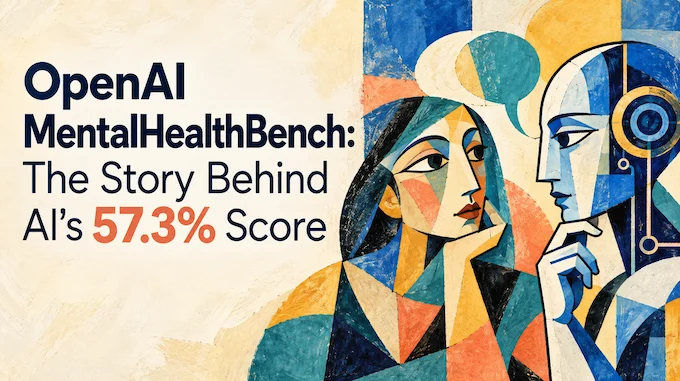
OpenAI MentalHealthBench: The Story Behind AI’s 57.3% Score

OpenAI MentalHealthBench cover image showing an AI being measured against a glowing score dial

By Hajra, Clinical Psychology Research Scholar A chatbot can sound caring before it understands what’s wrong. It can also interrupt an ordinary conversation with crisis language that feels wildly out of place. Measuring the difference requires more than counting reassuring sentences. OpenAI MentalHealthBench, released on September 23, 2026, tackles that problem. It evaluates how AI … Read more

Courtade Kumar Conjecture Solved? Two AI-Assisted Proofs End a 13-Year Wait

Cover image illustrating the Courtade Kumar conjecture, a single glowing bit outshining a complex network under noise.

A one-bit summary can combine thousands of inputs, compute parity, take a threshold, or apply some elaborate Boolean rule. The Courtade Kumar conjecture says that for preserving information about a noisy copy of the input, this cleverness buys you nothing. The best one-bit summary is simply one original bit. Mathematically, let Xbe uniform on {-ⓜ,11}^n, … Read more

Can AI Feel Pain? Inside the “Pain Axis” That Made LLMs Seek Relief

Cover image exploring can AI feel pain, showing a glowing red pain axis inside a neural network silhouette

Can AI feel pain? A new preprint offers a more interesting answer than either “obviously yes” or “obviously no.” Researchers found a repeatable internal direction associated with pain across 25 open-weight large language models. When they experimentally increased that direction, models shifted toward distress, worthlessness, failure, and relief-seeking behavior. In some tests, larger Qwen models … Read more

Dream-RSI Explained: How Google’s AI “Dreams” Its Way to Recursive Self-Improvement

Dream-RSI shown as a glowing search tree reflecting into a dream loop, symbolizing recursive AI self-improvement.

Dream-RSI sounds like the kind of system that rewrites itself into a smarter model. That is not what the paper shows. The key idea is narrower, and more interesting. The system leaves the underlying coding model, evaluator, and execution interface fixed. What changes is the exploration policy, the layer that decides where an AI discovery … Read more

FlashREINFORCE vs GRPO: Can One Rollout per Prompt Really Beat GRPO With Half the Rollouts?

FlashREINFORCE cover image showing one clean rollout path outracing GRPO's tangled sibling rollouts

The headline result is hard to ignore: 256K rollouts versus 512K, with a five-benchmark mean of 38.0 versus 36.3. In NVIDIA researchers’ experiments on Qwen2.5-Math-1.5B, FlashREINFORCE beat the reported GRPO baseline by 1.7 percentage points while using half as many training trajectories. That does not mean it used half the GPUs, half the wall-clock time, … Read more