Introduction
There is a specific sound a field makes right before it changes. It is not applause. It is the quieter noise of people updating their defaults.
This week’s example is a short paper by Johannes Schmitt, where research-grade AI systems helped discover and prove a clean extremal inequality in enumerative geometry, then helped push part of the argument into Lean. Schmitt is almost disarmingly honest about the result, he calls it “a neat little result” and even says it sits near the borderline of notability as a standalone math publication.
That candor is exactly why I take the bigger implication seriously. GPT 5 math is not interesting because it makes for a good tweet. GPT 5 math is interesting because it shows a full loop, from conjecture to proof strategy to partial formal verification, running with less human steering than most of us expected in 2025.
Table of Contents
1. The News: AI Crosses The Threshold From Retrieval To Discovery
Most “AI solved math” headlines are really “AI retrieved math.” The model recognizes a known template and fills in blanks. This paper is different in the one way that matters for the future of AI, the author started with a question he believed was not already covered in the literature, checked it with colleagues, and then submitted it into a benchmark setting where multiple models independently produced proofs without human intervention.
That is a useful definition of Novelty in AI for skeptics. Not “trust me bro,” not “it was not in the training set,” but the boring, adult version, community sanity checks plus reproducible evaluation.
If you track AI trends 2025, this is the shift to watch. It is less about one model’s IQ score, more about agentic workflows that can actually finish. GPT 5 math is a good label for it because it is concrete, it has a theorem statement, and you can verify it.
2. Understanding The Problem: What Is “Moduli Spaces Of Curves”
Let’s make the math feel less like a hazing ritual.
Schmitt works on the moduli space Mg,n, the “catalog” of stable algebraic curves of genus g with n marked points. That space has dimension d = 3g − 3 + n.
Each marked point i gives you a cotangent line bundle Li and a ψ-class ψi. The numbers of interest are the descendant integrals
D(e) = ⟨τe1 … τen⟩g = ∫_{Mg,n} ψ1^{e1} … ψn^{en},
which vanish unless the exponents sum to d.
When people say GPT 5 math, this is the level of object we are talking about, not arithmetic tricks, but global structure on a geometric space.
2.1 The Actual Open Question
Fix g and n. Consider all exponent vectors e = (e1, …, en) with nonnegative integers summing to d. Which e minimizes D(e), and which e maximizes D(e).
Schmitt names two shapes you can picture immediately:
- Concentrated: all degree on one marking, (d, 0, …, 0).
- Balanced: entries differ by at most 1.
Balanced is precise: write d = an + b with 0 ≤ b < n, then a balanced vector is any permutation of (a repeated n−b times, a+1 repeated b times).
This is the whole setup. GPT 5 math enters because models found, and then proved, the statement that your intuition probably whispers, “spread things evenly to get a bigger mixed intersection.”
3. The Result: Minimum Concentrates, Maximum Balances
The main theorem answers the optimization question cleanly.
3.1 The Minimum, With A Closed Form
D(e) achieves its minimum at the concentrated vector (d, 0, …, 0), with value
⟨τd τ0^{n−1}⟩g = 1 / (24^g g!).
The proof idea is almost satisfying in its simplicity. You “push weight” toward the largest exponent, concentrating until only one nonzero coordinate remains, and you use the known one-point formula to finish.
3.2 The Maximum, Explained In One Sentence
D(e) achieves its maximum on balanced vectors.
That is the core GPT 5 math claim in the paper, balance is not just pretty, it is extremal.
3.3 A Quick Translation Table
GPT 5 math Glossary Table
Mobile-friendly reference for key terms used in the GPT 5 math article.
| Object | Plain-English Meaning | What You Are Doing With It |
|---|---|---|
| Mg,n | Catalog of curves with n labeled points | Where the integral lives |
| ψi | Canonical class tied to marking i | The “ingredients” in the product |
| e | Exponent vector that sums to d | Your knob settings |
| D(e) | Intersection number | The score you are optimizing |
| Balanced | All entries within 1 | Where the maximum lives |
| Concentrated | One entry holds all degree | Where the minimum lives |
If you only remember one thing, remember this. GPT 5 math here is not “AI computed a hard number,” it is “AI solved a global shape question about where the hard numbers get biggest.”
4. The Solution: The Balancing Argument That Does The Work
The maximum proof is the part that feels like a magic trick, until you see how little magic it uses.
The paper’s Section 2.1 is reproduced from a GPT-5 evaluation, with minimal formatting changes, so you can see the model’s proof voice directly.
Here is the argument in human terms.
4.1 Slice The Problem To Two Coordinates
Pick two markings i and j. Freeze the other exponents, bundle them into a fixed class M, and study the one-variable sequence
St = ∫ ψ_i^t ψ_j^{q−t} M,
where q = ei + ej stays constant.
Swapping i and j does not change anything, so St = S_{q−t}. That symmetry is called palindromicity.
4.2 Use Geometry To Get Log-Concavity
Each ψi is nef, and for nef classes you get Khovanskii–Teissier inequalities, which imply discrete log-concavity along the slice:
St^2 ≥ St−1 · St+1.
If you have seen convexity arguments in optimization, your brain should perk up here. Log-concavity is the lever that turns “I think the maximum is in the middle” into a proof.
4.3 Conclude Unimodality, The Middle Is The Peak
A positive, palindromic, log-concave sequence increases up to the center, then decreases. The paper spells it out via ratio monotonicity, and it is exactly as clean as you want it to be.
4.4 The Balancing Move
If one exponent is at least 2 bigger than another, shift one unit from the larger to the smaller. The unimodality tells you D(e) does not go down. Repeat until all entries differ by at most 1, and you arrive at a balanced vector with D no smaller than where you started.
That is the whole “how it solved it” story. It reduces a global maximization question to a local move that is guaranteed to climb.
This is why GPT 5 math matters. It is the right kind of reasoning, the model did not just guess the answer, it found the monotonic hill you can climb. GPT 5 math, in other words, is a proof you can iterate.
5. GPT-5 Vs. Gemini 3 Pro: A Practical Split Of Labor
The paper does not pretend one model did everything. Schmitt explicitly says Section 2 contains the proof as found and stated by GPT-5 for the maximum and Gemini 3 Pro for the minimum, and he keeps the wording largely untouched so readers can judge proficiency.
This is the more honest version of “model comparisons.” GPT 5 math was not a solo act. It was a mixed team doing different parts of the job. It also comes with the sharp edge you want in a real evaluation. Appendix A records that a GPT-5.1 evaluation did not solve the problem.
So the “battle” framing is less about dunking and more about capability gradients. In AI trends 2025, the meaningful competition is not just answers, it is whether a model can find a stable proof strategy that keeps working.
6. Beyond The “Stochastic Parrot”: What Counts As Novelty Here
Reddit skepticism is predictable. “It must have memorized it.” “It is just remixing.” “Show me a real open problem.”
Schmitt handles this in the only way that actually moves the needle. He says the conjecture was new to his knowledge, colleagues confirmed its open status, and he submitted it into a benchmark setting where it was independently proven by multiple models without human intervention.
That is Novelty in AI in practice, a statement that was not already packaged as a known theorem, plus community validation and reproducibility. The paper also shows the messy reality, some AI outputs were wrong, and at least one model hallucinated a citation to a paper that does not exist.
This is the point many people miss when they talk about GPT 5 math. The win is not “no errors,” the win is “errors are survivable because the workflow is designed to catch them.”
7. Automated Theorem Proving: Why Lean Changes Trust
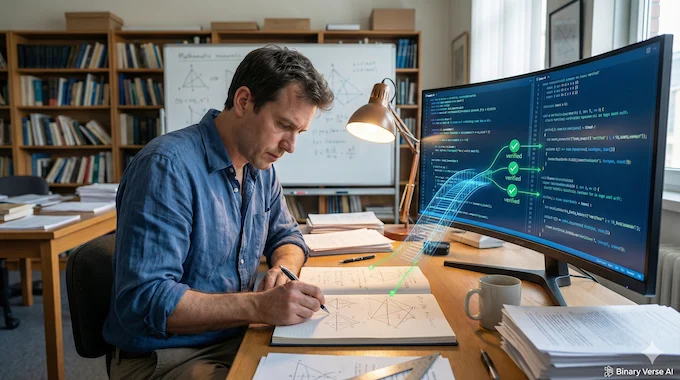
A proof you cannot check is not a proof you can build on. After the initial draft, Schmitt’s group added an alternative version of the argument. It splits the work into a purely combinatorial optimization theorem that was formalized in Lean, plus a human-written geometric proposition that connects the optimization to the intersection numbers.
Appendix A is candid about how this Lean work happened. The author had no prior Lean experience, Claude Code handled the .lean file, and ChatGPT 5.2 stepped in when the formalization got tricky. The author says he did not edit a single line of Lean code.
That is automated theorem proving as a bridge. It turns “sounds right” into “compiles,” at least for the combinatorial core.
And it turns GPT 5 math from a vibe into a unit test. Once you have that habit, GPT 5 math starts looking less like a headline and more like an engineering discipline.
8. AI Agents For Scientific Discovery: The Pattern Behind GPT 5 math
The author’s note reads like a template for AI agents for scientific discovery. A toy problem, exploration with OpenEvolve, a conjecture discovered quickly, experimental verification, colleague checks, IMProofBench evaluation, proof write-up, then partial formalization.
That is the real lesson. GPT 5 math is not “ask a chatbot for a theorem.” It is “wrap a model in a loop that forces it to propose, verify, and refine.”
Here is a compact view of who did what in this project.
GPT 5 math Research Workflow Table
A compact breakdown of the end-to-end GPT 5 math proof pipeline, from conjecture to Lean verification.
| Task | What Happened | Tools Or Models Mentioned |
|---|---|---|
| Conjecture Discovery | Pattern spotted quickly during exploration | OpenEvolve, tested model |
| Independent Proof Generation | Multiple models proved it in benchmark runs | IMProofBench, GPT-5, others |
| Write-up Structure And Polish | Document drafting and issue spotting | Claude, Gemini 3 Pro, ChatGPT 5.1 feedback |
| Formal Verification Of Core | Lean file created by AI assistance | Claude Code, ChatGPT 5.2 |
The paper’s methodology and Appendix A support these attributions.
If you are building a lab workflow, this table is more valuable than the meme.
9. Real-World Impact: From Geometry To The Future Of AI In Healthcare
Enumerative geometry is not a product roadmap. Still, the future of AI in healthcare depends on systems that can reason about structure and constraints, not just summarize papers.
Drug discovery, protein geometry, and materials design are full of questions where the shape of the solution matters more than the value of a single prediction. The leap from “I can guess” to “I can prove a monotonic move improves the objective” is exactly the kind of cognitive upgrade that makes downstream scientific work safer.
That is why I keep returning to GPT 5 math. It is a small theorem attached to a big workflow, and GPT 5 math points at the same direction as every serious AI trend line in 2025.
10. Conclusion: A Tipping Point You Can Actually Use
Here is the clean takeaway.
GPT 5 math in this paper is not a party trick. It is a documented process where an open optimization-style question in the geometry of moduli spaces was conjectured, checked with peers, proven by multiple AI systems in an evaluation setting, and partially formalized in Lean to increase trust.
If you publish or build in this space, use the pattern. Pick a small question that is genuinely not already solved in your domain. Wrap your model in tools that force it to test, to justify, and to verify. Put automated theorem proving or equivalent checks in the loop.
Then write it up with receipts, like Schmitt did, including what the AI got wrong.
That is how the future of AI stops being a timeline debate and becomes something you can ship.
Source paper: “Extremal descendant integrals on moduli spaces of curves: an inequality discovered and proved in collaboration with AI.”
Did GPT-5 actually create new math or just copy it from training data?
In this case, the result was treated as an open question by the author, sanity-checked with domain experts, and then tested via an evaluation workflow designed to reduce “memorization” explanations. The stronger claim is not “impossible to memorize,” it’s that the discovery was vetted like research, not like a demo.
Can GPT-5 really do math better than Claude or Gemini 3 Pro?
On this specific problem, GPT-5 succeeded at a key part of the proof, while other models either contributed different parts or failed runs in evaluation. The practical takeaway is that GPT 5 math performance is task-shaped, and proof-grade reasoning depends on the model’s ability to maintain invariants, not just produce plausible steps.
What is the IMProofBench and how did GPT-5 use it?
IMProofBench is a research-level proof benchmark where models generate full arguments, often in an agentic setup, and solutions are graded rather than accepted on vibes. GPT-5’s role here was producing an autonomous proof attempt in that benchmark-style setting, which is closer to “lab conditions” than social media claims.
How does this geometry breakthrough affect the future of AI in healthcare?
The value is not geometry itself, it’s the demonstrated workflow: propose, prove, verify, refine. That same loop maps cleanly to drug discovery and biomedical modeling where you need constraint-respecting reasoning about structure, optimization, and evidence, not just text synthesis.
Does this mean we have reached the AGI tipping point?
It’s a meaningful signal, because it shows movement from retrieving known math to generating defensible new arguments under evaluation pressure. But “AGI” implies broad autonomy, reliability across domains, and robust self-correction, and one proof result, even a strong one, is not the whole threshold.