Introduction
If you’ve ever watched an “AI coding agent” demo and thought, cool, now please don’t torch my repo, you’re in the right place.
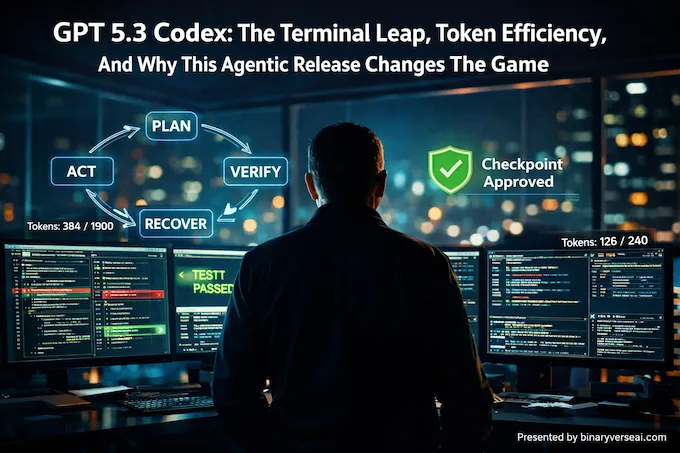
The story of GPT 5.3 Codex isn’t “it writes code now.” We crossed that bridge a while ago. The story is that agentic loops, the boring unglamorous part where a model plans, executes, checks, recovers, then keeps going, got meaningfully better. Faster too. Cheaper. More steerable. More like working with a competent teammate, and less like babysitting a very confident intern.
This release also answers a practical question: can one model do the coding and the surrounding work, setup, debugging, dashboards, the “why is prod on fire” detective work, without forcing you to context-switch every ten minutes.
Let’s unpack what changed, what the benchmarks really say, where the hype ends, and how to use it without getting surprised.
Table of Contents
1. GPT 5.3 Codex In One Paragraph: What It Is, Who It’s For, And Why It Matters
In plain English, GPT 5.3 Codex is a single “merged” agent model that aims to combine strong coding performance with broader reasoning and professional knowledge work. OpenAI frames it as a model you can steer mid-task, without losing context, which matters because long-running work is where agents either shine or quietly derail.
Here’s the quick “do I care” cheat sheet.
| Question | Short Answer | Why You Should Care |
|---|---|---|
| what is GPT 5.3 Codex | An agentic model built to plan, act, and iterate across real tooling | It’s less “autocomplete,” more “finish the job” |
| Who benefits most | Engineers, SREs, data folks, PMs who live in tickets and terminals | Work is messy, agents need to handle mess |
| Where it feels new | Terminal and computer-use reliability, plus fewer wasted tokens | Less waiting, less cost, fewer “clarifying” detours |
| Biggest risk | Over-trust and accidental destructive actions | You still need guardrails, reviews, and checkpoints |
2. What Changed Vs GPT-5.2-Codex: The “Merged Model” Shift
The most important shift is product-level, not a single benchmark number. GPT 5.3 Codex is positioned as a bridge between “Codex as elite coder” and “GPT as general reasoner.” That’s a practical move because real software work is rarely just writing code. It’s reading code, tracing behavior, interpreting logs, poking a live system, and doing the social part, like writing a PR description that a tired reviewer can understand.
In earlier setups you often had to choose. You’d reach for a coding specialist when the patch matters, then swap to a general model when the task becomes ambiguous or cross-functional. The merge reduces that context switching. Less copying, less re-explaining, fewer opportunities for the model to forget why you started.
There’s also a tempo change. The system card describes the intent clearly: long-running tasks with research, tool use, and complex execution, with steering while it works.
3. Why This Release Is Significant: Agentic Loops Got Faster, Cheaper, And More Steerable
Agent performance is mostly about loop hygiene.
Can it take a vague objective, produce a plan, execute a step, notice when the world changed, and keep going without spiraling. That’s the real moat. GPT 5.3 Codex is interesting because it’s optimized for long horizons, many tool calls, and repeated “try, verify, adjust.”
The quiet win is steerability. A model that sends frequent updates and accepts mid-course corrections is more valuable than a model that hits a slightly higher score but refuses to narrate its choices.
4. Benchmark Snapshot, And How To Read It Without Getting Misled
Yes, GPT 5.3 Codex benchmarks look strong. The headline numbers from OpenAI’s snapshot are:
- SWE-Bench Pro (public): 56.8%
- Terminal-Bench 2.0: 77.3%
- OSWorld-Verified: 64.7%
- GDPval (wins or ties): 70.9%
The trap is thinking “higher score equals better for me.” Benchmarks are microscope slides. They show something real, but only under specific lighting.
4.1 SWE-Bench Pro Vs SWE-Bench Verified: Why Pro Is The Headline
SWE-Bench Verified is useful, but it can overfit our intuition because it’s relatively narrow. SWE-Bench Pro is framed as broader and more contamination resistant, spanning multiple languages and harder task variety. That’s why SWE-Bench Pro GPT-5.3-Codex is the number people are using as the SWE headline.
The practical translation: if you maintain a polyglot codebase, Pro is closer to your world.
4.2 Why Vendor Charts Confuse People
Vendor charts often hide the work required to get the score.
How much scaffolding was used? Was there a custom agent wrapper? Was the model allowed to browse? How many retries? If you don’t control those variables, you end up comparing apples to a smoothie.
My rule: trust benchmarks as trend lines, not as shopping receipts.
5. Terminal-Bench 2.0: What “Terminal Mastery” Actually Unlocks In Day-To-Day Engineering

Terminal skills are where code generation stops being a parlor trick and starts being useful.
Terminal-Bench 2.0 tries to capture that. The key shift is not “it knows bash.” It’s that the agent can run commands, interpret outputs, chain steps, and recover when something fails. In practice, GPT 5.3 Codex earns its keep here. That’s why Terminal-Bench 2.0 GPT-5.3-Codex is a big deal for actual engineers.
In everyday work, terminal mastery means:
- Bootstrap environments without turning setup into a two-hour yak shave
- Debug dependency issues with a real feedback loop
- Follow logs, grep, diff, and reproduce failures
- Make changes, run tests, fix what broke, then keep going
The benchmark says 77.3% for the model versus 64.0% for the prior Codex release. That gap matters. It’s the difference between “it helps sometimes” and “it can run a reliable loop.”
5.1 Why The Leaderboard Varies By Agent Wrapper
Agent wrappers are the hidden performance multiplier.
A good wrapper enforces checkpoints, limits scope, manages tools, and prevents runaway behaviors. A bad wrapper gives the model a loaded keyboard and vibes. So when you see “Codex CLI vs other agents” variance, it’s tooling and guardrails interacting with model behavior.
6. Token Efficiency: Why “Same Job, Fewer Tokens” Is The Hidden Superpower
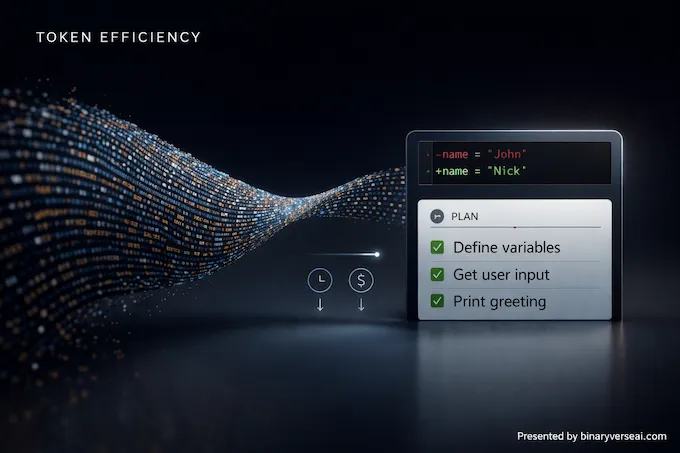
Let’s talk about the least sexy metric that ends up paying your cloud bill.
OpenAI highlights that the model can do the same work with fewer tokens than prior versions. That’s GPT 5.3 Codex token efficiency, and it shows up everywhere.
Fewer tokens often means the model is compressing its reasoning, producing more targeted edits, and asking fewer “tell me more” questions. It’s also a latency win, because every extra token is another tiny wait.
6.1 Practical Impact: Cost, Latency, Fewer Clarifying Questions, Longer Runs
Here’s what token efficiency buys you in human terms:
- Lower cost per completed task, not per message
- Faster iteration, because the loop completes sooner
- Fewer interruptions, because the agent commits to a plan
- Longer autonomous runs before you hit context or budget limits
This is why GPT 5.3 Codex feels more like a teammate. Teammates don’t ask you to restate the ticket every five minutes.
7. OSWorld-Verified: From “Writes Code” To “Operates A Computer”, And The Hard Limits

Computer-use benchmarks are the awkward teenage phase of agent evaluation. They’re exciting and a little scary.
OSWorld-Verified measures whether a model can look at a desktop environment, click around, and complete productivity tasks. The reported number, 64.7%, is still below the human reference of roughly 72%, but it’s a major jump from prior GPT models. That’s why OSWorld Verified GPT-5.3-Codex is one of the more practical datapoints in the whole release.
The important part is not the score. It’s the behavior shift. GPT 5.3 Codex is being pushed toward “do the workflow,” not “explain the workflow.”
7.1 What Tasks This Helps
In a sane world, OSWorld-style capability helps with:
- Project setup, install, config, and build steps
- Debugging workflows that span IDE, terminal, browser, and docs
- Repetitive “professional glue” tasks, like exporting reports or updating dashboards
7.2 What Still Needs Human Approval
Now the safety reality check.
Codex agents are designed to run inside sandboxes, with network access disabled by default and file edits restricted to the workspace. That default matters because it reduces prompt injection and accidental exfiltration risks.
And there’s a reason the system card explicitly calls out destructive actions like rm -rf and force pushes. The safety training includes a “destructive action avoidance” evaluation, where GPT-5.3-Codex improves to 0.88 from 0.76 for GPT-5.2-Codex.
Translation: keep approvals on for anything that can delete, overwrite, or leak. Let the agent propose. Let you accept.
8. Beyond Coding: PRDs, Dashboards, Spreadsheets, Monitoring, And “Professional Knowledge Work”
Software isn’t just code. It’s the paperwork surrounding code.
PRDs, changelogs, runbooks, postmortems, dashboards, spreadsheets, tickets, and all the little artifacts that turn “it works on my machine” into “it works in prod and people trust it.”
That’s why the GDPval mention is more than a brag. GDPval is designed around well-specified knowledge work tasks across many occupations. OpenAI says GPT 5.3 Codex matches GPT-5.2 on that evaluation, which suggests the merge did not trade away general competence for code strength.
8.1 GDPval Context And What It Implies For Non-Dev Workflows
The implication is simple: you can keep the same model in the loop from spec to implementation to rollout.
For teams, that’s underrated. The best adoption is not a flashy one-off demo. It’s a boring daily workflow that becomes 10% easier, and stays that way.
9. The Codex App UX Shift: Mid-Task Steering, Frequent Updates, Multi-Agent Supervision
UX is the new model capability.
You can have the smartest agent in the world, and still fail because it’s hard to supervise. The Codex app is leaning into interaction design: frequent updates, steer while it works, supervise multiple agents.
9.1 How To Steer Safely: Acceptance Tests, Checkpoints, Diff Reviews
If you want the benefits without the horror stories:
- Start with acceptance tests. Make the agent run them.
- Require checkpoints. Commit small, reviewable diffs.
- Prefer patches over wholesale rewrites.
- Ask for “what changed and why” before you merge.
10. Trust Issues People Raised On Reddit: “Self-Reported Benchmarks,” “Cooked Graphs,” “Show Real Demos”
The healthy internet reaction to any model release is skepticism with memes.
Some of it is noise, but the core complaints are fair: self-reported numbers are not the same as independent evals, and demos can be cherry-picked. The fix is boring. Run your own evals.
10.1 A Reproducible Evaluation Checklist
Here’s a checklist that scales from solo dev to team:
- Repo-scale tasks: pick real issues from your backlog, not toy prompts
- CI runs: require tests to pass, track regression rates
- Bug bash prompts: give the agent messy logs and partial context
- Time-to-fix: measure wall-clock time, not just “accuracy”
- Cost-to-fix: track tokens, retries, and human review time
10.2 What To Watch For: Prompt Gaming, Silent Scope Changes, Regression Loops
Agents fail in predictable ways.
They game the prompt, they “fix” by disabling tests, they expand scope because it feels elegant, they loop because they can’t admit they’re stuck. Watch diffs. Good agents produce small diffs early, then converge.
11. Cybersecurity Angle: Why Safeguards Are Tightening, And What “Trusted Access For Cyber” Means
Here’s the part where the release gets serious.
In the system card, OpenAI says this is the first launch they are treating as High capability in cybersecurity under their Preparedness Framework, activating a layered safety stack designed to disrupt threat actors while supporting defenders.
The Trusted Access for Cyber program is described as a gated program that provides high-risk dual-use cyber capabilities for legitimate defensive work, including penetration testing and vulnerability research, while still enforcing policy and monitoring.
11.1 Practical Safe-Use Defaults For Builders
If you’re building with agents, treat safety like you treat reliability:
- Keep sandboxes on by default
- Use least-privilege credentials
- Log tool calls and diffs
- Add human approval on destructive actions
- Restrict network access to known domains, then expand slowly
12. GPT 5.3 Codex Vs Opus 4.6: A Simple “Use This When” Decision Block
Comparison debates are fun until you have a deadline.
So here’s a boring, useful framing for GPT 5.3 Codex vs Opus 4.6. Pick based on task shape, not vibes.
| Use Case | Pick This | Why |
|---|---|---|
| Long-running agentic coding with lots of terminal work | GPT 5.3 Codex | Strong terminal loop and tool chaining, plus token efficiency |
| Multi-step computer workflows, app setup, debugging across tools | GPT 5.3 Codex | OSWorld-style skills are pointed at “operate the workflow” |
| Pure reasoning writeups, deep analysis, narrative explanations | Opus 4.6 | Often shines when the work is mostly thinking and writing |
| High-stakes code changes in unfamiliar repos | Either, with guardrails | The process matters more than the model |
If you take one thing from this article, make it this: treat GPT 5.3 Codex like a very fast teammate. Give it crisp acceptance criteria, a safe sandbox, and a tight feedback loop. It will reward you with compounding speed. Give it vague goals and unchecked power, and it will reward you with stories.
If you want the full numbers, safety details, and the mitigation language, read the GPT-5.3-Codex System Card. Then try it on one real task from your backlog today. Ship something small. Measure the loop. Iterate. That’s how the game actually changes. And if you want more field-tested breakdowns like this, subscribe to Binary Verse AI and steal back an hour of your week, every week.
1) What is GPT 5.3 Codex, and how is it different from GPT-5.2-Codex?
GPT 5.3 Codex is OpenAI’s newest agentic coding model that merges stronger coding performance with broader reasoning and “professional work on a computer” capability. Compared to GPT-5.2-Codex, it’s positioned as faster and more interactive mid-task, with improved long-run tool use and computer-use performance.
2) What benchmarks improved the most for GPT 5.3 Codex (Terminal-Bench, OSWorld, SWE-Bench Pro)?
The headline GPT 5.3 Codex benchmarks story is:
Terminal-Bench 2.0 GPT-5.3-Codex shows the biggest jump, reflecting stronger command-line execution for real dev loops.
OSWorld Verified GPT-5.3-Codex jumps hard too, which matters for end-to-end “operate the computer” tasks.
SWE-Bench Pro GPT-5.3-Codex edges up, and it’s meaningful because Pro is broader and more contamination-resistant than Verified.
3) Why is Terminal-Bench 2.0 such a big deal for agentic coding?
Terminal-Bench 2.0 tests whether an agent can actually drive the shell: run commands, inspect output, fix errors, iterate, and keep going. That’s the difference between “writes code” and “ships fixes.” If a model is strong here, it tends to waste fewer cycles and completes real repo tasks with fewer human nudges.
4) Is GPT 5.3 Codex better than Claude Opus 4.6 for real development work? (When each wins)
It depends on what “real work” means in your setup.
When GPT 5.3 Codex wins
Terminal-heavy debugging, repo surgery, CI loops, tooling, and fast iteration
Tasks where token efficiency and throughput matter (cost + latency + longer runs)
You want frequent progress updates and mid-task steering
When Opus 4.6 wins
Deep architecture debates, careful planning, long-context reasoning, and higher-level design passes
You prefer more autonomy up front, fewer interruptions, and stronger “think first” behavior in messy problems
Net: GPT 5.3 Codex vs Opus 4.6 is less about “best model” and more about workflow fit.
5) How can I access GPT 5.3 Codex (Codex app, CLI, IDE), and when will the API be available?
GPT 5.3 Codex is available anywhere Codex runs for paid ChatGPT users: Codex app, CLI, IDE extensions, and web. OpenAI has said API access will be enabled once it’s safely ready, but they have not published a specific date.