Gemini 3 Deep Think Benchmarks
Comparison of Gemini 3 Deep Think and leading models on reasoning, science and visual puzzles.
Humanity’s Last Exam
Reasoning and knowledge, tools off
GPQA Diamond
Scientific knowledge, tools off
ARC AGI 2
Visual reasoning puzzles
Gemini 3 hub: benchmarks + pricing
1. Setting The Stage For Gemini 3
“The king is dead, long live the king.” Frontier AI now runs on that rhythm. A new model lands, everyone rewrites their rankings, then the cycle repeats. For a while GPT looked untouchable. Then Claude had its moment. Then Gemini arrived.
With Gemini 3, Google is not whispering. It is saying, out loud, that this is its most intelligent model so far. The system debuts with a 1501 Elo on the LMArena leaderboard, a long list of frontier benchmark wins, and a new Deep Think mode that spends extra time reasoning before it answers.
The headline is simple. If you care about getting real work done, not just having a friendly chat, Gemini 3 changes the default choice. It solves harder math and physics problems, understands messy multimodal input, and drives fully agentic coding workflows that feel less like autocomplete and more like a tireless senior engineer.
Table of Contents
2. What Is Gemini 3? Inside Google’s New Flagship
At the center of this launch is Gemini 3.0 Pro, the workhorse configuration that most people will touch first. It runs in the Gemini app, powers AI Mode in Search, and is exposed to builders through Google AI Studio, Vertex AI and the emerging ecosystem around Google Antigravity.
You can think of this generation in three dimensions.
First, reasoning. Earlier releases already leaned into chain of thought. This one pushes deeper. On demanding tests like Humanity’s Last Exam, GPQA Diamond and MathArena Apex, the model behaves more like a patient researcher than a glorified autocomplete engine.
Second, context. Long context is not a bullet point any more, it is the default. The preview tier handles up to 200k tokens, with support for million token windows. That means you can drop in full codebases, multi hour transcripts, stacks of PDFs and screenshots, then ask for a single coherent plan.
Third, native multimodality. Text, images, documents, screens and video go through the same brain. The system tops MMMU Pro for complex image reasoning, Video MMMU for long video understanding and OmniDocBench for OCR quality. In practice, you spend less time coaxing it through visual tasks and more time acting on its answers.
This “full stack” approach matters. The model sits inside Google’s products, search stack and infrastructure, so the path from research benchmark to real user value is shorter than in previous generations.
3. Deep Think Mode And The New Ceiling For Reasoning
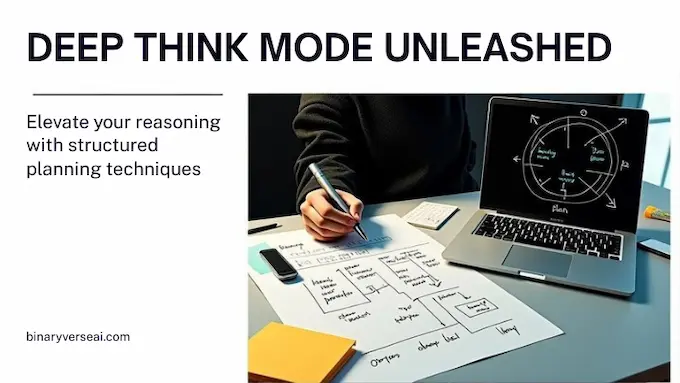
Deep Think is the experimental part of the release, and also the most interesting. In normal mode Gemini 3 responds quickly. In Deep Think mode it allocates more internal steps to a question, explores more candidate solutions and checks its own work before it replies.
On paper, that shows up as higher scores. Deep Think pushes Humanity’s Last Exam to around 41 percent accuracy without tools and GPQA Diamond to roughly 93.8 percent. On ARC AGI 2, a visual reasoning benchmark built to detect actual abstraction rather than pattern matching, it crosses 45 percent with code execution.
In practice, you feel the difference most on problems where you would usually reach for a whiteboard. Hard math, tricky algorithm design, physics riddles, dense research papers. With Deep Think turned on, the model writes out its plan, tests edge cases and occasionally corrects itself mid answer. It is still a language model, yet the behavior looks more and more like System 2 thinking.
If your workload involves proofs, derivations or nontrivial planning, Deep Think is the switch you leave on by default and wait the extra seconds for.
4. Battle Of The Titans: An AI Model Comparison
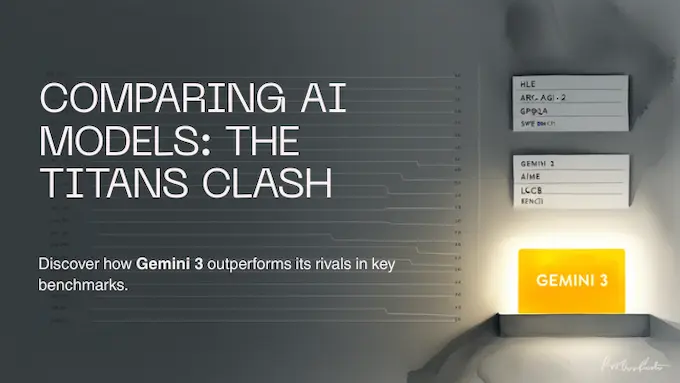
Once the hype threads fade, teams start building slide decks. Almost all of them carry the same title somewhere: Gemini 3 vs GPT-5.1. Claude Sonnet 4.5 still plays an important role for safety conscious use cases, yet the center of gravity for day to day engineering work is shifting.
Read our full, in-depth comparison: Gemini 3 vs GPT 5.1: Which is Better?
On the hardest reasoning and coding benchmarks, the new Gemini 3 model usually sits on top. GPT-5.1 stays competitive on creative writing and some agentic workloads, and Claude still has a distinctive style for careful analysis. Taken together though, the numbers tell a clear story. For logic heavy tasks, Google’s system is the one to beat.
4.1 Benchmark Snapshot Across Frontier Models
Here is a compact view of the current leaderboard across a few critical benchmarks.
Gemini 3 Benchmark Comparison Overview
| Benchmark | What It Measures | Gemini 3 Pro | Gemini 2.5 Pro | Claude Sonnet 4.5 | GPT-5.1 |
|---|---|---|---|---|---|
| Humanity’s Last Exam | Academic reasoning, no tools | ||||
| ARC AGI 2 | Visual reasoning puzzles | ||||
| GPQA Diamond | Graduate level science | ||||
| AIME 2025 | Math contest, no tools | ||||
| MathArena Apex | Very hard math problems | ||||
| LiveCodeBench Pro | Competitive coding Elo | 2439 | 1775 | 1418 | 2243 |
| Terminal Bench 2.0 | Agentic terminal coding | ||||
| SWE Bench Verified | Real world code fixes, single attempt | ||||
| Vending Bench 2 | Long horizon planning, higher is better | $5,478 | $574 | $3,839 | $1,473 |
| Video MMMU | Video understanding |
If you want a realistic AI model comparison, this table is a better guide than one cherry picked demo. The pattern is consistent. The new generation takes a wide lead on math heavy tasks, stretches ahead on agentic coding and long horizon decision making, and holds its ground on software engineering workloads drawn from real repositories.
5. From IDE To Colleague: Vibe Coding And Google Antigravity
Benchmarks are fun. Shipping code is better. This is where the release feels different.
Across Google AI Studio, the Gemini CLI, Android Studio and tools like Cursor, JetBrains, Cline and Emergent, developers are already living with something people now call Gemini 3 Vibe Coding. Natural language becomes the main interface. You describe an outcome and constraints. The agent breaks work into steps, writes code, calls tools and reports back in a way that feels like a junior colleague who never gets tired.
The WebDev Arena score tells part of the story. With an Elo of 1487, the system generates surprisingly complete full stack apps from a single prompt, from retro 3D games to voxel editors and complex dashboards. It wires up routes, components, tests and deployment scripts while staying inside your chosen framework.
Google Antigravity pushes the idea further. It is an agentic IDE where the assistants have direct access to the editor, terminal and browser. They plan multi file refactors, run shell commands, debug failing tests and validate their own work in a real browser session. Your job shifts from typing code to supervising plans, reviewing diffs and steering the product direction.
Underneath all that, the Gemini 3 API exposes bash tools and structured output so that the same behavior can live inside your own platforms. You can ask the model to navigate a filesystem, generate multi language code, ground answers in Google Search and emit machine friendly JSON for downstream agents.
6. Multimodal Mastery: When The Model Starts To Read The Room
We have talked about multimodal systems for years. In many cases that meant “can caption a picture.” This generation raises the bar.
On MMMU Pro Gemini 3 leads complex image reasoning. On ScreenSpot Pro it reads desktop and mobile screens with enough fidelity to drive computer use agents. On Video MMMU it tracks rapid actions while also keeping long term context across hours of footage.
The practical impact is easy to feel. You can upload screenshots of a broken UI and ask for a fix. You can drag in hand drawn sketches and get production grade HTML, CSS and JavaScript. You can record a messy whiteboard session, feed the video to the system and receive a clean architecture document with example code.
The Visual Computer demo is a good example. A user draws rough red crosses over files on a desktop. The model interprets those marks as delete instructions, figures out which icons they apply to, and carries out the operation through a computer use agent. That blend of perception, intent recognition and action used to be the territory of custom pipelines. Now it lives inside a single general purpose model.
For robotics, AR and autonomous systems, this level of spatial reasoning unlocks planning loops where you do not have to hand craft visual features. For ordinary knowledge workers it means you can finally point at the problem, literally, and let the system do the tedious part.
7. What Power Users Are Saying So Far
Marketing pages are optimistic by design. Hacker forums and Reddit threads tend to be less polite. Early Gemini 3 review posts from heavy users line up with the benchmarks.
On r/singularity, people running private test suites report that the new model “killed every other model” on math, physics and code. UI focused builders say it now beats Claude Sonnet 4.5 at reasoning about layout and component structure. Multilingual testers highlight strong performance on complex scripts where earlier systems wobbled.
The weak spot is unsurprising. Many writers still prefer GPT-5.1 or Claude for fiction and highly stylized prose. Some users call the creative output “editorial” rather than “magical.” Others point out that Deep Think mode can feel slow on long tasks while the preview infrastructure is rate limited.
Still, the consensus is hard to ignore. For people whose day job is problem solving, analysis and building things, this model feels like the new baseline. You can always reach for a different system when you want a particular narrative voice. For serious work, the tab you keep open is usually this one.
8. Pricing, Access, And The Gemini 3 API
Capability is only useful if you can afford to call it. Here the story is better than many expected.
In preview, Gemini 3 Pro costs $2 per million input tokens and $12 per million output tokens for prompts up to 200k tokens. For very large contexts above 200k tokens the prices rise to $4 and $18. There is also a free, rate limited tier in Google AI Studio that lets you prototype without reaching for a credit card.
8.1 Token Pricing And Context Windows
A quick pricing snapshot helps when you are planning new workloads.
Gemini 3 API Pricing Context Tiers
| Context Tier | Input Price / 1M Tokens | Output Price / 1M Tokens | Typical Use Case |
|---|---|---|---|
| Up to 200k tokens |
$2 |
$12 | Most apps, agents and coding sessions |
| 200k to 1M tokens |
$4 |
$18 | Full codebases and large document sets |
| AI Studio free tier |
$0 |
$0 | Experiments, prototyping, small demos |
Compared to expected GPT 5 pricing, this structure nudges serious builders toward Google for anything that needs a lot of thinking per token. The Gemini 3 API integrates cleanly with AI Studio, Vertex AI and the wider Google Cloud stack, so once you have something working in the playground, productionizing it is mostly a matter of glue code and governance.
9. How To Start Using Gemini 3 Today
If you are a general user, the path is simple. Open the Gemini app on web or mobile and opt into the latest Pro or Ultra tier. AI Mode in Search already uses the new model for complex queries, so you may have tried it without realizing.
If you are a developer, start in Google AI Studio. Use the playground to probe strengths and weaknesses, wire in tools, and export code snippets in your preferred language. From there you can move to Vertex AI, the Gemini CLI or your own orchestration layer with very little friction.
If you work in safety or policy, Deep Think mode is already in the hands of external experts and government bodies under structured programs. That extra layer of scrutiny is exactly what a model at this capability level deserves.
The main advice is straightforward. Pick one real workflow in your stack that hurts today. Plug Gemini 3 into it. Measure before and after.
10. So, Did Google Just Pull Ahead?
So where does that leave the race.
On pure creative writing and open ended conversation, GPT-5.1 and Claude still give it a serious fight. In some niches they clearly win. On the safety and alignment front, the jury remains active, with regulators and external labs still exploring how all of these systems behave under pressure.
For the work that pays the bills though, the pattern is clear. For deep reasoning, long horizon planning, agentic coding and serious multimodal understanding, Gemini 3 now looks like the reference point. The combination of benchmark performance, Deep Think, aggressive pricing and the broader Google Antigravity ecosystem turns it from a cool demo into something closer to infrastructure.
The crown will move again. That is the nature of this field. Right now, if you care about shipping faster, breaking fewer things and spending more time on ideas than on boilerplate, the most rational next step is not complicated.
Give this model a real problem. Let it think. Then decide which king you want to serve in your stack.
Is Gemini 3 better than GPT-5.1 and Claude Sonnet 4.5?
Yes, in several benchmark classes Gemini 3 Pro outperforms GPT-5.1 and Claude Sonnet 4.5. It leads the LMArena leaderboard with a 1501 Elo score and posts higher results on math, coding, and multimodal tests such as MathArena Apex, Video-MMMU, and Vending-Bench 2. GPT-5.1 still tends to win in pure creative writing and some stylistic use cases.
What is Gemini 3 “Deep Think” mode?
Gemini 3 Deep Think is an enhanced reasoning mode that lets the model spend more internal steps on hard problems. It targets System 2 style thinking for math, science, and logic, raising scores to around 41 percent on Humanity’s Last Exam, 93.8 percent on GPQA Diamond, and about 45.1 percent on ARC-AGI-2 with code execution.
How much does the Gemini 3 API cost?
Gemini 3 Pro Preview pricing is designed to be competitive. For prompts up to 200k tokens, the Gemini 3 API is listed at about $2 per million input tokens and $12 per million output tokens, with higher rates for very large contexts above that range. There is also a free, rate limited tier in Google AI Studio for testing.
What is “Vibe Coding” in Google Antigravity?
Vibe Coding is the idea that natural language is your main syntax. In Google Antigravity, you describe the app, workflow, or UI you want, and Gemini 3 plans, writes, and refactors the code across editor, terminal, and browser. The model tops WebDev Arena with a 1487 Elo score, showing how far this agentic coding style has matured.
How can I use Gemini 3 Pro for free?
You can try Gemini 3 through the Gemini app and in Google AI Studio, which offers a free tier for experimentation with Gemini 3 Pro. For heavier workloads or production use, you move to the paid Gemini 3 API or Vertex AI, while Deep Think capabilities roll out first to safety testers and then to Google AI Ultra subscribers.