You do not need a crystal ball to see where medicine is heading. The future of AI in healthcare is already taking shape in code and cohort studies, not in science fiction plots. A new research model called Delphi-2M reads the timeline of your medical history like a sequence and tries to forecast which diagnoses might arrive next, and when. It does not promise fate, it estimates risk. The question is simple. If the tool could sketch your next twenty years of health, would you want to look?
Delphi-2M is a generative transformer trained on hundreds of thousands of patient trajectories and more than a thousand disease types. It predicts disease incidence as a probabilistic timeline, and it can even sample synthetic futures to explore what might happen under different conditions. That is the future of AI in healthcare that matters, practical and testable, not mystical.
Table of Contents
1. A Glimpse Of The Future: How AI Disease Prediction Works

At the core sits a modified GPT-style model that treats your medical history as a sequence of tokens. Each token represents a recorded event such as a diagnosis, and the model learns how events tend to follow one another over time. Trained on 402,799 participants from the UK Biobank across more than 1,000 diseases, Delphi-2M learns patterns of multi-disease progression and then forecasts likely next events. That is what AI disease prediction looks like when you strip away hype and just study the timeline.
This approach expands beyond single-risk calculators. It models many conditions jointly and uses continuous time so it can estimate when a risk rises, not only whether it exists. The vision aligns with the future of AI in healthcare, where models estimate evolving risks, physicians contextualize them, and patients decide actions that fit their lives.
2. The Hopeful Future: What A Predictive Model Unlocks
2.1. Personalized Prevention Replaces One-Size-Fits-All
Standard risk tools narrowly target one condition at a time. A model that reasons across diagnoses can surface clusters of related risks and suggest different screening priorities for different lives. That is the future of AI in healthcare many of us want, a preventive playbook tuned to the patient, not the average.
2.2. Real Agency For Patients And Clinicians

When a forecast says risk is building for a condition that responds to lifestyle change or early screening, people can act. Doctors can ladder those insights into concrete plans and time-bound follow-ups. This is predictive healthcare AI used as a second set of eyes, not a judge, and it moves us toward AI in medicine that is practical, humane, and focused on outcomes.
2.3. Research At A New Scale
Because the model can sample future disease trajectories and generate synthetic cohorts that preserve statistical structure without exposing individual details, it creates safe ways to explore hypotheses. That matters for multi-center studies where data cannot leave secure boundaries. The synthesis capability also hints at faster iterations of AI disease prediction methods.
3. The Feared Future: Risks You Cannot Wave Away
3.1. The Data Misuse Problem
The ethics of AI in healthcare begin with access and consent. Any forecast tied to identifiable records must be handled with policies that are enforceable, not aspirational. The paper validates on external hospital registries, which underscores how real-world data will drive these models, and why privacy governance must be designed in from day one.
3.2. The Psychological Weight Of Knowing
People differ in how they carry risk. Some will use a forecast to plan and take preventive steps. Others may fixate on low-probability outcomes and suffer. The AI health risks are not only clinical. They are emotional and behavioral. If the future of AI in healthcare brings forecasts into the clinic, it must also bring counseling, context, and guardrails that prevent nudges from turning into anxiety traps.
3.3. Bias In The Data, Bias In The Code
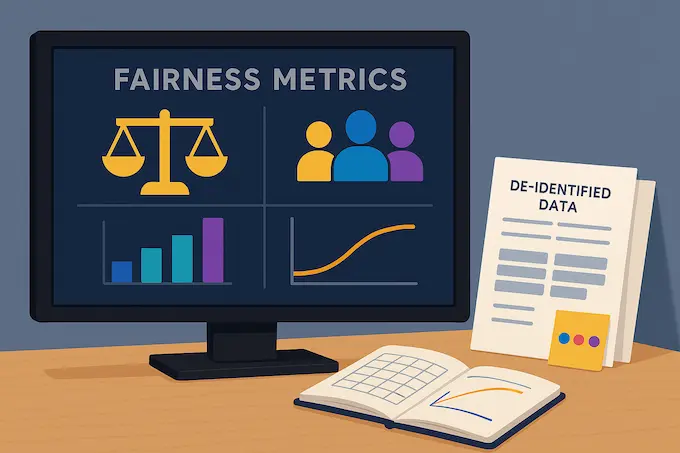
The UK Biobank is not a perfect mirror of the population. It overrepresents white British participants and skews toward healthier and more affluent groups. The model also learns artifacts from missing data patterns, which can inflate risks for people who interact with certain parts of the health system. If we want fair AI in medicine, we must test and report performance in demographic subgroups, disclose uncertainty, and fix pipelines that leak bias into predictions. That is table-stakes ethics for the future of AI in healthcare.
4. The Realistic Future: Accuracy, Bias, And The Road To The Clinic
4.1. A Sober Look At Performance
Accuracy is not a marketing adjective. It is a curve. In head-to-head comparisons on cardiovascular disease, Delphi-2M’s ROC AUC lands around 0.70, close to established tools like QRISK3 at 0.71. That is strong for a multi-disease model and a reminder that a good forecast still needs clinical judgment. Think of it as a map, not a steering wheel. That is exactly how the future of AI in healthcare should work.
4.2. External Validations And Limits
The model generalizes to Danish national registries with only a small performance drop, which is encouraging, yet it still inherits cohort biases and follow-up gaps. The authors caution against causal readings of temporal associations. Use it to rank concerns, not to claim mechanisms. The future of AI in healthcare will reward teams that treat these models as probabilistic tools that require expert interpretation.
4.3. Quick Reference Table
Below is a compact table of facts drawn from the study.
| Item | Detail |
|---|---|
| Training Cohort | 402,799 UK Biobank participants across more than 1,000 diseases. |
| External Validation | Danish National Patient Registry. |
| Forecast Horizon | Sampling future trajectories to estimate cumulative burden up to 20 years. |
| Performance Snapshot | Cardiovascular disease AUC: QRISK3 0.71 vs Delphi-2M 0.70 on internal test set. |
| Bias Notes | Selection bias in UK Biobank and non-random missingness that the model can learn. |
| Code Availability | Code on GitHub; checkpoint available via UK Biobank controlled access. |
5. How To Access The Model: What Is Public Today
Delphi-2M is a research artifact, not a consumer wellness app. The code and notebooks are openly available on GitHub. The full trained checkpoint sits behind UK Biobank’s controlled access process. That is by design since the training data include sensitive health records. This model is a tool for qualified researchers, not a website where you upload your lab results. That does not dampen the future of AI in healthcare, it protects it.
The practical takeaway is clear. If you want to experiment today, you can clone the repository, run a demo on synthetic data, and reproduce core analyses. If you want a model tuned to your population, you will need your own approved data and careful governance. The future of AI in healthcare runs on both science and stewardship.
6. The Augmented Clinician: Human And Machine As Teammates
The most useful picture is not doctor versus model. It is doctor plus model. Delphi-2M can scan long histories without fatigue, flag rising risks, and surface patterns of comorbidity that are easy to miss. The clinician weighs those signals against context that lives outside any dataset, such as family history dynamics, patient preferences, or barriers to care. That partnership is the practical future of AI in healthcare many clinics will adopt first.
It also resets expectations for AI in medicine. The machine ranks options. The human sets plans. Together they make predictive healthcare AI useful under real-world constraints. That partnership will decide whether the future of AI in healthcare becomes a steady upgrade to preventive care or just another dashboard that nobody trusts.
7. Hands-On: Install And Run Delphi-2M In A Weekend
You can learn a lot by running the code. Below is a concise guide that works on a workstation or a cloud VM. It uses the project’s synthetic demo so no private health data are required.
7.1. Prerequisites
- A recent Linux or macOS machine. Windows with WSL is fine.
- Python 3.11 and Conda.
- Optional GPU with CUDA for faster training. CPU works for the demo.
- Disk space for checkpoints and notebooks.
7.2. Get The Code
$ git clone https://github.com/gerstung-lab/Delphi.git
$ cd Delphi
7.3. Create An Environment And Install
$ conda create -n delphi python=3.11 -y
$ conda activate delphi
$ pip install -r requirements.txt
7.4. Run A Demo Train
This trains a small model on the provided synthetic dataset.
$ python train.py config/train_delphi_demo.py --out_dir=delphi_demo
# GPU users can add: --device=cuda
Training completes quickly on a modern GPU. CPU is slower but workable for the demo.
7.5. Explore Accuracy
Open the evaluation notebook to compute AUC and inspect calibration.
- Launch Jupyter in the project root.
- Open evaluate_delphi.ipynb.
- Point it to your delphi_demo checkpoint when prompted.
- Run the cells to generate ROC curves and summary plots.
Compare your curves to established baselines to get a feel for signal. Delphi-2M often lands in the same ballpark as single-disease tools for common endpoints, which supports its value as a broad forecasting engine in the future of AI in healthcare.
7.6. Inspect Explanations
Open shap_analysis.ipynb to compute SHAP scores. You will see which prior events most influenced a given prediction in the demo data. Treat these as pattern hints, not clinical truth. They are valuable for debugging your pipeline and for building clinician trust in predictive healthcare AI.
7.7. Sample Synthetic Futures
Open sampling_trajectories.ipynb to generate trajectories forward in time. This is useful for scenario exploration and for building intuition about cumulative burden. The sampling feature is part of what makes Delphi-2M interesting for the future of AI in healthcare, since it supports planning horizons measured in years.
7.8. Bring Your Own Data
To adapt the model:
- Read data/README.md and the UKB conversion example in data/ukb_simulated_data/.
- Build a secure ETL that converts your records into Delphi-compatible tokens and timelines.
- Add strict governance, de-identification, and access controls.
- Retrain with your cohort splits, and always keep a holdout set.
Do not ship anything into production without subgroup analysis and calibration checks. The authors highlight selection biases and source-missingness artifacts. Your pipeline should quantify those and report uncertainty in ways clinicians can use. That is the unglamorous work that earns trust in the future of AI in healthcare.
7.9. Prefer Containers When You Scale
The repository includes a Dockerfile. Containerize the environment to keep dependency drift from breaking your runs. For teams, add CI to rerun notebooks on new checkpoints and to publish metrics that track AUC, calibration, and subgroup performance.
7.10. Responsible Use Checklist
- Document data lineage and approvals for every table you touch.
- Report performance by age, sex, and relevant social indices.
- Add clear uncertainty bands to dashboards.
- Keep explanation plots available and interpretable.
- Write a patient-facing note that explains what the forecast is, and what it is not.
This level of craft is how Delphi-2M AI and tools like it become part of the future of AI in healthcare, not curiosities that live in papers.
8. What This Means Right Now
The headline is not that a model can predict everything. It cannot. The headline is that a multi-disease transformer can match single-disease tools on some endpoints, generalize across national systems with small performance drops, and generate useful synthetic futures for planning. That is enough to move the field. It is also the honest answer that the future of AI in healthcare needs.
Clinics should not wait for perfection. They can start with low-risk uses. Rank screening priorities. Automate chart searches for overlooked comorbidities. Support tumor boards with longitudinal context. Each of these improves care without pretending forecasts are facts. That is how AI in medicine earns a place beside the stethoscope.
Researchers should build on the foundation the team released. The code and notebooks are public, and the checkpoint is accessible under UK Biobank procedures. That creates a shared starting line. The fastest path from lab to clinic will come from collaborations that combine robust datasets, pragmatic endpoints, and transparent evaluation. The future of AI in healthcare advances when we ship less mystique, more reproducibility.
9. Conclusion: Cautious Optimism, Clear Next Steps
If you want a tidy moral, here it is. The future of AI in healthcare is not about replacing clinicians, it is about amplifying them. Delphi-2M shows what is possible when we model health as a timeline and compare predictions to strong baselines. The work is not finished. Biases must be measured and mitigated. Uncertainty must be communicated. But the arc is promising.
If this excites you, do something small and real. Clone the repo. Run the demo. Share a benchmark you trust. Draft a one-page policy for how your team will handle consent and subgroup reporting. Publish your calibration plots. That is how the future of AI in healthcare becomes ordinary, useful, and fair.
And if you are a clinician, bring this into your next team meeting. Ask one question. Where could a ranked list of future risks make our next decision simpler? Try it on one workflow, then iterate. Patients will feel the difference. That is how we make the future of AI in healthcare arrive on time.
Call To Action: If you have a dataset and the mandate to use it responsibly, prototype a Delphi-style forecast this quarter. If you do not, partner with someone who does. Build a thin slice, measure it, and publish what you learn. The future of AI in healthcare will be written by the teams who ship careful tools that help one clinic at a time.
Q1. What is Delphi-2M and why does it matter for the future of AI in healthcare?
Delphi-2M is a generative model that reads health histories as timelines and estimates the likelihood and timing of future conditions across more than a thousand diseases. It signals where the future of AI in healthcare is heading, toward proactive risk stratification, earlier screening, and research at population scale.
Q2. Is the future of AI in healthcare already improving outcomes, or is it hype?
It is moving from pilots to practice. Hospitals use AI to triage images, summarize notes, and flag high-risk patients for targeted follow-ups. The future of AI in healthcare is practical when models are calibrated, audited for bias, and paired with clinician judgment that converts scores into decisions.
Q3. What ethical issues could slow the future of AI in healthcare?
Three stand out. First, bias, since models inherit skewed data. Second, privacy and informed consent for sensitive records. Third, misuse risks, such as insurers or employers inferring health status. The ethics of AI in healthcare demand transparency, guardrails, and documented human oversight.
Q4. Can AI disease prediction replace doctors?
No. Forecasts are probabilistic, not diagnoses. The future of AI in healthcare is a co-pilot model where AI sorts signals, ranks risks, and surfaces patterns, and clinicians interpret those signals, tailor plans, and talk with patients. Human context, empathy, and accountability remain central.
Q5. How can a hospital start with predictive healthcare AI safely?
Begin small. Pick a narrow use case, for example risk-based screening reminders. Validate on local data, track calibration and subgroup fairness, and require clinician review before action. Document consent and data lineage, explain outputs in plain language, and measure patient outcomes, not model scores.