
Introduction
We are doing something unprecedented. In the name of artificial intelligence, the world’s richest companies are quietly betting trillions of dollars that turning more and more of the planet into data centers will always pay off.
For now, the story feels intoxicating. Smarter models, happier users, higher revenue, repeat. Yet under the surface, an uncomfortable phrase keeps showing up in investor letters and Reddit threads alike: data center bubble.
On one end of the spectrum, Demis Hassabis argues that we “must push that to the maximum,” talking about scaling today’s systems as far as possible. On the other end, IBM CEO Arvind Krishna runs the numbers on giant AI data campuses and concludes there is “no way” the current spending can pay off at today’s costs. Somewhere in between, Anthropic’s Dario Amodei talks about a massive “cone of uncertainty” around future demand and revenue.
The tech is real. The gains are real. The question is whether the economics and physics of AI data centers can keep up with the dreams, or whether we are inflating a data center bubble that later generations will have to clean up.
Table of Contents
1. What Are AI Data Centers And Why They Are Different
Traditional cloud facilities juggle a mix of web traffic, storage and databases. They are built for reliability and decent utilization, not for pushing every watt to its thermal limits.
AI data centers are different. They are dense barns of accelerators, with GPUs and custom chips wired together like supercomputers. Cooling often means elaborate liquid systems, not just big fans. Power feeds come from dedicated substations. Network design assumes huge training jobs and enormous numbers of inferences.
That hardware cocktail changes the economics. Refresh cycles get shorter because a “slower” chip quickly loses competitive value. Site selection tilts toward cheap and stable electricity. Misjudging demand can strand billions. Which is why talk of a data center bubble has escaped niche forums and now appears on earnings calls.
1.1. Where AI Data Centers Are Being Built
Ask “where are AI data centers located” and you get a map of electricity, climate and politics.
There are huge clusters in the United States, including a fast growing corridor of AI data centers in Texas. Northern Europe leans on cooler weather and strong grids. Gulf states and parts of Asia try to turn cheap energy into long term advantage.
The builders range from hyperscalers to specialist AI data centers companies. Their pitch to local officials is simple. More jobs, more tax base, more innovation. Their unstated assumption is even simpler. This data center boom will be matched by demand for decades.
2. From Data Center Boom To Data Center Bubble

Why is there a data center boom at all? Because scaling has worked astonishingly well.
For more than a decade, researchers have watched a simple pattern. Increase model size, data and compute, and with small tweaks the system gets better at almost every cognitive task. Coding, science, biomedicine, law and finance all ride the same curve. Amodei points to this trend when he explains why he is so bullish. Inside Anthropic, he now hears engineers say things like “I don’t write any code anymore. I just let Claude write the first draft and I edit it.”
Hassabis takes a similar view. He argues that existing systems must be pushed as far as possible and that “there’s a chance that just scaling will get you there,” meaning AGI. His timeline is not distant either. He estimates we are “five to 10 years away,” and says his bar includes creative and inventive abilities.
Krishna looks at the same buildout and sees something different. On the Decoder podcast he estimated that filling a one gigawatt facility costs roughly eighty billion dollars. If the world ends up with one hundred gigawatts of AI buildout, his math is simple. In his words, “$8 trillion of capex means you need roughly $800 billion of profit just to pay for the interest.” His verdict on that outcome is direct. In his view there is “no way” those investments pay off at today’s infrastructure cost.
Put those views together and you see the outline of a data center bubble. Scaling laws justify huge bets, while the balance sheets behind data center demand forecast decks start to look very fragile.
3. Scaling Laws Versus Infrastructure Reality
Underneath the hype, this is a collision between mathematical scaling curves and physical infrastructure. Amodei is frank that the same scaling laws which once looked speculative now feel routine. Increase compute, clean up training, add small innovations and every model release is smarter than the last. He has watched revenue follow that curve, with enterprise demand for coding, analysis and automation climbing at the same time.
Hassabis shares that optimism, but he is explicit that scaling is not optional. He has said AI leaders “must push that to the maximum” because at minimum, today’s systems will be a key component of any eventual AGI.
The problem is that grids, transformers and planning rules do not scale on the same curve. The data center costs breakdown for a major site is not just chips. It is land near transmission lines, steel, concrete, cooling, substations and an increasing amount of political capital.
Amodei describes trying to navigate that gap. His “cone of uncertainty” is a polite way of saying that he does not know whether revenue will be twenty billion or fifty billion when some of today’s build decisions finally show up in invoices. The lag can be years. That gap alone is enough to produce a data center bubble even if the long term demand turns out to be real.
4. How The Big Three See The Bubble Risk
One handy way to understand the data center bubble debate is to line up three of the most quoted voices.
Leader Perspectives On The Data Center Bubble
| Leader | View On Scaling | View On Infra Economics | AGI Or Long Term View |
|---|---|---|---|
| Demis Hassabis | Scaling is central, “we must push that to the maximum.” | Confident long term value can justify big builds. | AGI “five to 10 years away” with a high bar. |
| Dario Amodei | Scaling laws are real and still working. | Worried about a “cone of uncertainty” and overextension. | Extremely bullish on upside and productivity. |
| Arvind Krishna | Current tech may not reach AGI. | At $8T capex there is “no way” to get a return. | Puts AGI chance from current path at 0 to 1%. |
You can read this as three different ways to price the same future.
Hassabis treats the data center bubble as a manageable risk on the way to an extraordinary prize. Amodei sits in the middle, trying to be aggressive enough to compete without “yoloing” his way into insolvency. Krishna focuses on the total system and worries that the aggregate spending simply will not pencil out.
None of them think AI is fake. All of them think it will reshape the economy. They disagree on how much infrastructure is “enough” and on how fast revenue shows up.
5. Data Center Costs Breakdown: Chips, Power, Land And Cooling
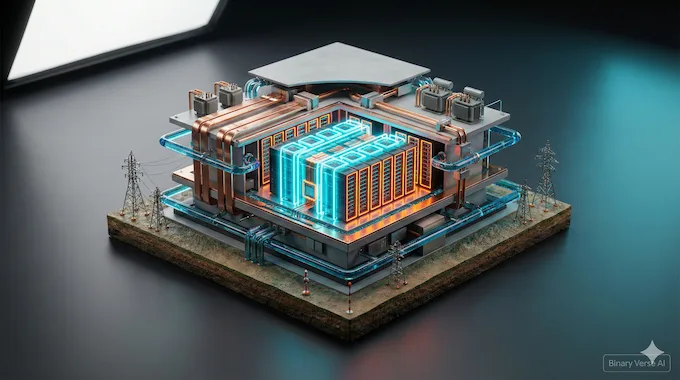
When people argue about the data center bubble, they are usually arguing about a balance sheet.
Here is a simplified data center costs breakdown for a large AI facility.
Cost Structure Inside The Data Center Bubble
| Cost Category | Capex Or Opex | Notes |
|---|---|---|
| Accelerators (GPUs, TPUs) | Capex | Biggest single line item, short useful life in hyper competitive AI. |
| Buildings And Racks | Capex | Shells, racks, fiber, physical security. |
| Power Infrastructure | Capex | Substations, transformers, high voltage lines. |
| Cooling Systems | Capex | Liquid loops, chillers, heat rejection hardware. |
| Data Center Energy | Opex | Long term electricity contracts or spot pricing. |
| AI Data Centers Water Usage | Opex | Cooling water, often politically sensitive. |
| Staff And Maintenance | Opex | Operations teams, security, repairs. |
Accelerators dominate the bill, but they also depreciate fastest. Krishna argues that “you’ve got to use it all in five years because at that point, you’ve got to throw it away and refill it.” That is not literally true in a physical sense. It captures the competitive reality. If your rival trains on hardware that is twice as fast and far more efficient, your fleet still works, but it no longer wins.
Vendor financed chip deals do not remove that risk. They spread it around. When a chip maker invests in an AI startup, and the startup commits to spend that capital back on chips, the circular flow can amplify both the upside and the eventual pop if a data center bubble bursts.
6. Energy, Power And Water: The Physical Limits Of AI Data Centers
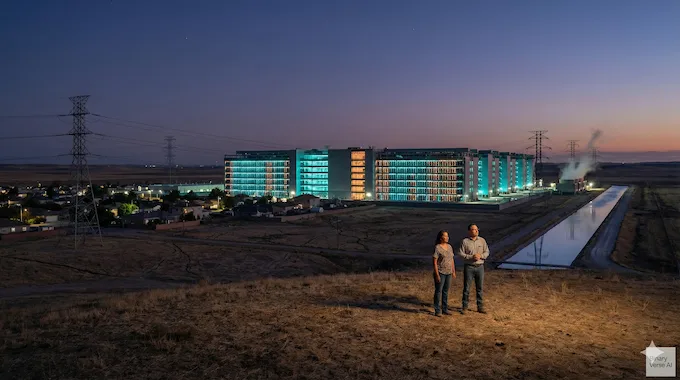
You cannot talk about AI data centers power consumption without talking about grids.
Each major training cluster behaves like a heavy industrial load. The data center energy footprint of hyperscale AI already rivals legacy industries in some regions. Globally, data center power consumption worldwide is still a modest slice of total electricity use, but it is growing faster than almost everything else.
Water adds another constraint. High density cooling often trades energy efficiency against liquid use. In dry regions, AI data centers water usage turns into a headline, not just a line item. Residents ask why their town should bear extra stress on aquifers so a distant platform can ship more tokens.
Add noise, truck traffic, emissions from backup generators and waste heat and you get a broader picture of AI data centers environmental impact. None of these issues are fatal on their own. Together, they slow permits, shift sites and inject more uncertainty into any emerging data center bubble.
7. Demand Models And The Risk Of Overbuild
On spreadsheets, demand looks beautiful. Enterprises discover new use cases every quarter. Consultants publish data center demand forecast charts that climb like staircases.
Amodei’s experience is what the bullish case feels like from the inside. He describes Anthropic’s revenue jumping by an order of magnitude year after year, while internal productivity soars. He also admits that he has to decide today how much compute to buy for 2027 without knowing where that curve will flatten.
That timing gap is exactly where a data center bubble can form. If everyone assumes straight line growth, build decisions get synchronized. If reality bends that line downward, you end up with more capacity than you can profitably use. The revenue cone that once looked generous suddenly narrows around the low end.
In a broader AI bubble, the unwind is rarely gentle. Capacity does not disappear. It changes hands at distressed prices. Stronger players consolidate, and weaker ones discover that their highly leveraged bets on AI data centers looked smart only in slides.
8. Why Communities Push Back Against AI Data Centers
From a distance, a new facility is just another dot on a global map. Up close, it is trucks, dust and construction noise.
Local residents near new sites worry about AI data centers pollution, traffic and diesel generator tests at night. They read about AI data centers environmental impact and wonder what exactly their town is gaining in return. They see headlines about “free” clean jobs and ask hard questions about power deals and who pays for grid upgrades.
They also see climate targets. A city that just promised deep emission cuts might not be thrilled about hosting yet another fossil heavy plant built mainly to serve one company’s training runs.
The result is simple. Permits take longer. Conditions get stricter. Some sites move, and some die. All of that friction feeds back into the timing and location of any data center bubble.
9. What Governments, Enterprises And Investors Should Do Now
If you are in government, the data center bubble is not just a tech story. It is industrial policy, climate strategy and local politics wrapped together.
Treat big AI data centers like other critical infrastructure. Demand clear data center costs breakdown numbers. Require credible plans for AI data centers power consumption that match realistic grid expansion, not wishful thinking. Put hard constraints around AI data centers water usage in stressed basins. Make sure communities share upside, not just inconvenience.
If you run an enterprise, your risk is different. You can benefit enormously from this buildout without owning much of it. The danger is lock in. When you bet everything on one vendor during a data center bubble, you inherit their risk curve. A multi provider strategy, with clear exit routes, gives you leverage if any single platform overbuilds or stumbles.
For investors, the job is to separate structural opportunity from narrative hype. Some companies will own indispensable capacity with healthy data center profit margin even if valuations deflate. Others will be left with stranded sites and debt. Look past glossy claims about data center energy and data center power consumption worldwide and inspect quiet details like long term power contracts and actual occupancy.
10. The Next Ten Years: Scaling Dreams, Physical Limits And Your Role
Over the next decade, AI will keep getting better. On that point, Hassabis, Amodei and Krishna actually agree. They only diverge on the timeline, the route and the infrastructure bill.
Hassabis expects AGI to be “five to 10 years away” and thinks scaling should be pushed as far as possible. Amodei has watched scaling laws stay accurate for a decade and talks about future models that look like a “country of geniuses in a data center” working on your behalf. Krishna thinks today’s path has only a “0 to 1%” chance of reaching AGI and that the current capex math is wildly optimistic.
The emerging data center bubble lives right in the overlap of those views. It is the zone where scaling dreams meet hard limits on land, power, water and capital. If you care about AI as a technology, as a business or as a citizen, you do not get to ignore that zone.
The good news is that bubbles are not only stories about excess. They are also stories about infrastructure that later generations can repurpose. A more disciplined approach to the current data center bubble can do something similar without blowing up as many balance sheets.
So treat this era as an invitation to be specific. If you build, know exactly why and on what timeline. If you regulate, set clear guardrails instead of vague aspirations. If you invest, decide whether you are buying sustainable capacity or pure narrative.
Either way, the data center bubble will shape how AI actually lands in the real world. You will feel its effects whether you plan around it or not. The only real choice is whether you help steer the outcome, or simply ride along and hope the math works out.
What are AI data centers?
AI data centers are large computing facilities designed specifically to run intensive artificial intelligence workloads on GPUs and other accelerators. They pack high-density servers, specialized networking, and advanced cooling into a single campus so they can train and serve large models at scale while trying to keep performance, cost, and reliability under control.
Where are the AI data centers being built?
Most AI data centers are being built where three things line up: cheap and stable electricity, access to fiber networks, and friendly local permitting. That often means clusters around U.S. hubs like Northern Virginia and Texas, European sites in Ireland and the Nordics, and emerging locations that offer land, power, and tax incentives for hyperscalers.
What company builds AI data centers?
AI data centers are usually financed and operated by hyperscale cloud providers, then designed and built with help from specialist engineering firms and equipment vendors. Companies like Amazon, Microsoft, Google, Meta, and Nvidia set the requirements, while construction, power, and cooling vendors turn those designs into physical campuses.
Why are data centers booming?
Data centers are booming because almost every digital service now runs in the cloud and AI models need far more compute than traditional apps. That demand, combined with national security concerns and competition to reach advanced AI capabilities first, is driving a rapid build-out of new capacity that many analysts now describe as a full-blown infrastructure investment cycle.
How much power will a data center consume in 2030?
By 2030, individual AI data centers are expected to draw tens to hundreds of megawatts each, similar to a mid-size town, depending on design and utilization. At national scale, scenarios suggest that data center energy could reach a meaningful share of total grid demand, which is why utilities, regulators, and AI companies are suddenly talking so much about new generation, grid upgrades, and long-term power contracts.