
A keyboard usually needs fingers. Brain2QWERTY, the brain-computer interface Meta AI just published in Nature Neuroscience, manages without them. It reads the intent to type a specific letter straight from a person’s brain activity and reconstructs full sentences from the pattern, with no electrodes and no incisions.
The peer-reviewed paper went live on June 29, and Meta followed almost immediately with Brain2QWERTY v2, a second model that pushes the same idea from spelling out single characters to decoding whole words and sentences in real time. Together, the two releases mark a concrete step toward a non-invasive BCI that’s actually useful, not just theoretically interesting.
Before the excitement runs ahead of the science, it helps to be precise about what’s happening. It isn’t reading thoughts. It’s decoding the motor signals your brain sends once you’ve already decided to type something specific, on a specific keyboard. That distinction is the key to understanding what this technology can do today, and what it still can’t.
Table of Contents
1. What Is Brain2QWERTY? Meta’s Non-Invasive BCI Explained
Brain2QWERTY is a deep learning system built by Meta AI alongside researchers in Paris, Lille, and the Basque Center on Cognition, Brain and Language (BCBL) in Spain. Its job: take brain recordings from someone typing a memorized sentence and reconstruct that sentence as text.
The original study, now referred to as v1, recorded 35 healthy volunteers using two non-invasive BCI devices, EEG and MEG, while they typed short Spanish sentences on a custom keyboard. The model decoded individual characters with an average error rate of 29 percent using MEG (roughly, the share of characters it gets wrong), falling to 18 percent for the strongest participants. Some sentences outside the training data were decoded perfectly, character for character.
A day after that paper published, Meta shared Brain2QWERTY v2, trained on nine volunteers who each logged roughly ten hours wearing an MEG scanner, about ten times longer per person than v1. Instead of spelling words out letter by letter, v2 decodes entire words and sentences in real time, reaching 61 percent average word accuracy and 78 percent for its best participant.
Here’s how the two versions stack up:
Brain2QWERTY Comparison: Brain2QWERTY v1 vs Brain2QWERTY v2
| Aspect | Brain2QWERTY v1 (Nature Neuroscience) | Brain2QWERTY v2 (Same-Week Update) |
|---|---|---|
| Status | Peer-reviewed, published June 29, 2026 | Research preview, announced days later |
| Decodes | Individual characters | Full words and sentences |
| Signal Source | MEG and EEG, compared head-to-head | MEG only |
| Real-Time Output | No, requires the full sentence first | Yes, end-to-end decoding |
| Volunteers | 35 (19 in the MEG analysis, 20 in EEG) | 9 |
| Training Data | About 5,100 MEG sentences, under 1 hour per person | About 22,000 sentences, roughly 10 hours per person |
| Average Accuracy | 29% character error rate (MEG) | 61% word accuracy |
| Best Participant | 18% character error rate | 78% word accuracy |
2. Decoding Motor Intent, Not Inner Thoughts: Why This Isn’t Mind Reading
Headlines about brain decoding reach for “mind reading” almost by reflex, and the online reaction to this announcement followed the same pattern. Some of the sharper commentary worried about an advertising company gaining a direct line into people’s heads. That worry deserves a real answer, not a dismissal, and the honest answer starts with what the model is trained to predict.
Brain2QWERTY never sees a thought. It sees brain activity from the half-second window around a keystroke (0.2 seconds before the key press to 0.3 seconds after), specifically the motor cortex signals tied to planning and executing a finger movement. Every example came from someone who had already decided what to type and was physically attempting it. Nothing in this pipeline listens for background mental chatter, daydreaming, or unspoken opinions, because none of that was ever part of the data.
That doesn’t make the privacy question disappear. A system built around deliberate motor commands is a narrower, more contained kind of decoder than one built around free-floating thought, but it still raises real questions about consent and data ownership once research like this leaves the lab. We’ll come back to that.
3. Inside the Architecture: How Brain Signals Become Typed Text
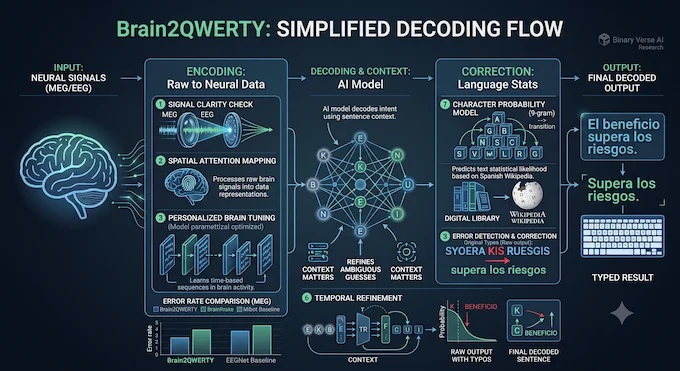
Getting from raw brain activity to a clean sentence takes three stages, stacked end to end.
3.1 The Convolutional Module Reads Raw Brain Signals
The first stage compresses that half-second window of brain activity into a compact numerical representation, using spatial attention to weigh which sensors matter most, a layer tuned to each individual’s brain, and eight convolutional blocks that pull out patterns over time. On its own, this module already beats EEGNet, a well-established BCI baseline, on both MEG and EEG.
3.2 The Transformer Adds Sentence-Level Context
A single keystroke’s signal is ambiguous in isolation. The transformer looks at an entire sentence’s worth of these representations together and uses that context to refine each character guess, which measurably improved accuracy on both recording types.
3.3 The Language Model Cleans Up the Output
The final stage is a 9-gram character-level language model trained on Spanish Wikipedia, nudging the output toward statistically likely Spanish. The effect can be dramatic: in one example, a participant’s fingers produced “EK BENEFUCUI SYOERA KIS RUESGIS,” full of typos, yet the pipeline still recovered the intended sentence, “El beneficio supera los riesgos” (the benefit outweighs the risks), perfectly. Stacked together, the three stages cut EEGNet’s error rate by 1.2 times on EEG and 2.5 times on MEG.
4. MEG vs EEG: Why Magnetism Beats Electricity for Brain Decoding
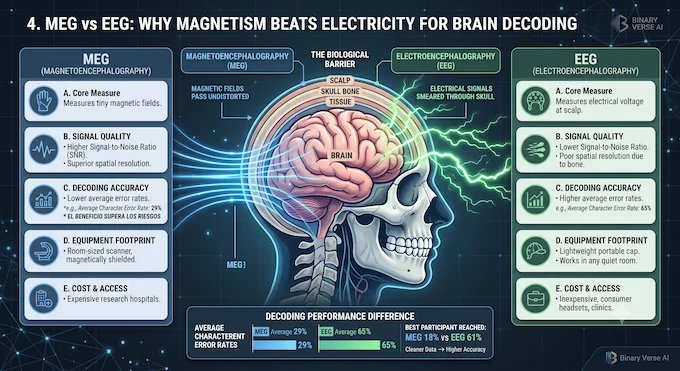
This question sits at the center of the whole project, and the paper treats it as a controlled experiment: the same model, the same training process, the same task, run separately on EEG and MEG recordings from comparable participants.
EEG measures electrical activity using electrodes on the scalp, but electrical signals from inside the skull get smeared and weakened as they pass through bone and tissue before reaching a sensor. MEG instead measures the tiny magnetic fields neurons produce, and magnetic fields pass through the skull largely undistorted. That gives MEG a cleaner signal, at the cost of needing far more sensitive, far more expensive hardware.
That cleaner signal translated directly into better decoding here. The average character error rate came out to 29 percent with MEG versus 65 percent with EEG, a difference far too large to attribute to chance (p < 0.0001). The best MEG participant reached 18 percent error. The best EEG participant, by comparison, still sat at 61 percent.
None of this makes EEG useless. It’s cheap, portable, and already built into clinics and consumer headsets worldwide. It just means EEG-based brain-to-text, at least with this approach, isn’t close to MEG’s reliability yet.
Brain2QWERTY MEG vs EEG Comparison: Signal Quality, Accuracy, and Hardware
| Factor | MEG | EEG |
|---|---|---|
| What It Measures | Magnetic fields generated by neural activity | Electrical voltage recorded at the scalp |
| Channels Used | 306 (102 magnetometers, 204 gradiometers) | 64 |
| Signal-to-Noise Ratio | Higher | Lower |
| Average Character Error Rate | 29% | 65% |
| Best Participant’s Error Rate | 18% | 61% |
| Hardware Footprint | Room-sized, magnetically shielded, cryogenically cooled | Lightweight cap that works in almost any quiet room |
| Cost & Accessibility | Expensive, primarily available in research hospitals | Affordable and widely used in clinics and consumer devices |
5. The Leap to Brain2QWERTY v2: Real-Time Brain-to-Text at the Word Level
The Nature Neuroscience paper covers v1, a careful, peer-reviewed, character-by-character decoder. It’s rigorous, but slow by design. The transformer and language model both need a full sentence before producing an answer, so v1 can’t run in real time.
Brain2QWERTY v2, announced the same week the paper went live, attacks that limit directly. Rather than decoding one letter at a time and patching the result afterward, v2 is trained end to end to predict characters, words, and sentence-level meaning together, leaning on a language model fine-tuned on neural data to fill gaps the raw signal can’t resolve cleanly. Meta also reports using AI agents to help search pipeline configurations during development, with engineers choosing the final setup.
The numbers back up the framing. Trained on roughly 22,000 sentences from nine volunteers, each contributing about ten hours of MEG data (versus under an hour per person in v1), it reaches 61 percent average word accuracy. Earlier non-invasive approaches, by Meta’s own account, topped out around 8 percent. The strongest participant hit 78 percent word accuracy, with more than half the decoded sentences containing one word error or fewer.
Meta has released the full training code for both versions, and BCBL has made the original v1 dataset public on Hugging Face, a decision that lets independent labs check the claims rather than take Meta’s word for it.
6. What the Errors Reveal: Keyboard Geometry and Cognitive Diversity
Some of the clearest evidence that the model decodes motor commands, not some more abstract layer of language, comes from looking at exactly where it gets things wrong.
The mistakes aren’t random. They cluster around keys physically close to the intended one on a QWERTY layout, a pattern strong enough to produce a clear statistical correlation between keyboard distance and confusion rate. Clustering the model’s internal representations, with no hint given about hand or finger assignment, split cleanly into left-hand and right-hand groups, and finer clustering kept tracking the keyboard’s real layout. The model had rediscovered the keyboard’s geometry from brain signals alone: that geometry is baked into the motor plan for typing.
That has a reassuring implication for a question that came up often in online discussion: does this only work for people who “hear” their thoughts as an inner monologue? Some pointed to anendophasia, the term for the 5 to 10 percent of people with little or no internal verbal narration, and asked whether a typing decoder would fail for them.
Probably not. Brain2QWERTY isn’t reading verbal thought of any kind, narrated or silent. It’s reading the motor sequence of intentionally pressing keys, which engages the same hand and finger circuitry whether or not someone narrates the action internally. The harder question is whether typing as a stand-in for intent generalizes to people who can’t move their hands at all, which is the population this research actually targets.
7. Non-Invasive BCI Devices vs Surgical Implants: A Safer, Slower Path
The comparison people reach for first is Neuralink and similar surgical implants, a fair one to make, just incomplete without the tradeoffs spelled out.
Implanted electrode arrays read activity from inside the skull, much closer to individual neurons than any external sensor can get. That’s exactly why invasive systems currently post the field’s strongest numbers: one widely cited implant-based system reached 90 characters per minute with under 6 percent character error. This system, even with v2’s gains, isn’t at that level yet.
What invasive systems can’t avoid is the surgery itself: real exposure to brain hemorrhage and infection, plus the challenge of keeping an implant working for years afterward. None of that reflects badly on that research. It’s simply why invasive BCIs have stayed limited to small numbers of patients willing to accept neurosurgery for a chance at communication.
Non-invasive BCI devices sidestep that by definition. Nobody’s skull gets opened. For someone with ALS or a brainstem stroke who retains some residual motor control, the population the paper’s authors flag as the most realistic near-term beneficiary, lower accuracy in exchange for zero surgical risk is a reasonable trade. The harder case is locked-in patients who’ve lost all voluntary movement, where even imagining a typing motion, rather than attempting one, hasn’t yet been proven to work with non-invasive signals. The paper is upfront about that gap.
8. What Brain2QWERTY Still Can’t Do (And Who Should Control the Data)
Even with v2’s real-time word decoding, real constraints separate this research from anything usable today.
Start with the hardware. The MEG scanners used here are 306-channel MEGIN systems, the kind of equipment that fills a magnetically shielded room and needs cryogenic cooling to keep its sensors working. Nobody is wearing one of these on the bus. There’s a real path toward something more portable: optically pumped magnetometers (OPM-MEG), which the paper’s authors point to as a way MEG’s sensitivity might eventually fit into a wearable headset. That technology exists in labs today, but it isn’t yet sensitive or affordable enough to replace the room-sized scanners used here.
Then there’s the population gap already mentioned. Everyone in both studies was a healthy volunteer physically typing on a real keyboard. Whether the same decoding holds up for paralyzed patients attempting or imagining the same movements, without ever actually moving a finger, is an open question the researchers themselves flag as unresolved.
And there’s the question nobody can fully answer yet: who should control data this personal? Here, structural brain scans and other identifying material were stripped out before public release, and what remains is de-identified and shared under a noncommercial license, with the underlying research cleared by an independent ethics committee. That’s a reasonable standard for an academic dataset. Whether that standard holds once this kind of decoding moves from a research dataset into an advertising company’s product is a separate question, and it’s driving most of the public reaction. This research doesn’t answer it. But it’s a question worth keeping in view as the accuracy keeps climbing.
9. Conclusion: A Realistic Step Toward Giving People Their Voice Back
Strip away the mind-reading framing, and what’s left is still significant. Brain2QWERTY shows that a non-invasive scan, run through the right deep learning pipeline, can decode typed language well enough to matter. Not perfectly, not in every setting, but well enough to narrow a gap that’s stood for years between BCIs that are safe and BCIs that actually work. The peer-reviewed v1 paper proves the science holds up under scrutiny. The v2 announcement, arriving the same week, shows the underlying approach still has real headroom to climb.
None of this means a wearable brain-to-text headset is showing up at a pharmacy next year. The hardware is still enormous, validation in paralyzed patients hasn’t happened yet, and the questions around data ownership are far from settled. But for the people this research actually targets, those with ALS, brainstem strokes, or other conditions that take away speech and movement while leaving the mind intact, even an imperfect, lab-bound, non-invasive option that skips neurosurgery is worth taking seriously.
We’ll keep tracking this story at Binary Verse AI as the hardware shrinks and the accuracy climbs. If you want the next update on non-invasive BCI and Meta’s brain-to-text research, that’s exactly what we cover.
What is Brain2QWERTY and how does it translate brainwaves to text?
Answer: Brain2QWERTY is a non-invasive brain-computer interface (BCI) developed by Meta AI. It uses a three-stage deep learning pipeline (a convolutional model, a transformer, and a pre-trained language model) to decode raw neural signals from magnetoencephalography (MEG) or electroencephalography (EEG) into text while a user imagines typing on a QWERTY keyboard.
Is thought-to-text possible without brain surgery?
Answer: Yes, thought-to-text is possible without surgery, but historically it has suffered from high error rates. Meta’s Brain2QWERTY has bridged this gap by utilizing high-fidelity MEG sensors, achieving a character error rate (CER) as low as 18% in top-performing participants, bringing non-invasive BCI closer to the accuracy of invasive implants like Neuralink.
How does Brain2QWERTY decode typing for people who do not have an “internal monologue”?
Answer: Brain2QWERTY does not decode a user’s internal verbal thoughts. Instead, it translates the motor intentions and spatial representations of typing on a keyboard. Because it decodes the brain’s motor-cortex signals associated with finger movements rather than inner speech, individuals without an internal monologue (anauralia) can use the system without difficulty.
What is the clinical difference between EEG and MEG in brain-to-text decoding?
Answer: Magnetoencephalography (MEG) measures cortical magnetic fields, which pass through the skull with minimal distortion, offering a far higher signal-to-noise ratio than scalp Electroencephalography (EEG). In Brain2QWERTY trials, MEG achieved an average character error rate of 29%, whereas EEG recorded a significantly higher error rate of 65%.
Can Brain2QWERTY be used at home or integrated into consumer smart glasses?
Answer: Currently, no. High-accuracy decoding requires a large, room-sized MEG scanner and a highly controlled environment. While the software has been open-sourced, consumer smart glasses (like Meta Ray-Bans) cannot currently house the complex sensors required. However, emerging research into wearable Optically Pumped Magnetometers (OPM-MEG) may eventually make portable versions viable.