Introduction
Some weeks in AI feel like a neat row of press releases. This week felt like someone kicked the table, then handed us a spreadsheet of consequences. We got open models that finally talk like engineers, not mascots. We got one-step ImageNet and diffusion language models that can edit themselves mid-thought. We got research agents pushing math and physics forward, and product teams quietly admitting the new meta is not write code, it’s design the harness that writes the code.
If you only skim one thing today, skim the pattern. The pattern behind AI News February 14 2026 is simple: capability is rising, latency is dropping, and the real competition is shifting from clever answers to finished work. These are the AI updates this week that matter, plus the takeaways you can actually use.
Table of Contents
1. Glm-5 Launch: Open Agentic Model Targets Long-Horizon Engineering Workflows
GLM-5 is open models growing up. Bigger, yes, 744B parameters, but more importantly, more serious. It’s tuned for long-horizon engineering tasks where you plan, execute, backtrack, and still have to ship something coherent at the end. Sparse attention shows up here as a cost and context play, which is a good sign that long context is becoming table stakes, not a luxury.
The post-training story is the tell. Their async RL setup is basically an admission that the bottleneck is no longer data, it’s iteration speed on training loops. In AI News February 14 2026, GLM-5 reads like a work engine, Agent mode, deliverables-first, permissive licensing, more stacks, more hardware.
GLM-5 benchmarks, pricing and agentic engineering workflows explained.
2. Minimax M2.5: 1-Per-Hour Agent Hits Frontier-Level Coding Performance
MiniMax M2.5 is what happens when someone treats cost as a feature, not a footnote. The benchmark scores are strong, but the headline is the economics. Pricing that maps to about a dollar an hour reframes agent usage from careful, tokens are expensive to leave it running while you think. That changes behavior, and behavior changes markets.
The interesting training detail is its habit of planning like a senior engineer. Specs first, then code, then tests, then iteration. Two variants, Standard and Lightning, same brains, different throughput. This is Agentic AI News in its purest form: performance that’s good enough, cost that’s low enough, and workflows that finally feel normal.
3. Llada2.1-mini: Diffusion Language Model Brings Editable Generation To Text
LLaDA2.1-mini is a quiet rebellion against left-to-right tyranny. Instead of predicting the next token forever, it refines a draft through diffusion-style steps, which makes editing while generating feel native rather than bolted on. The pitch is speed plus controllability, two things transformers keep promising and rarely deliver at the same time.
Benchmarks land in the credible zone across reasoning, math, and coding, and the product angle is the two-mode setup. Speed mode for low-latency tasks, quality mode when you want more steps and fewer mistakes. A 32K context window and permissive licensing make it practical, not just academic.
4. Gemini Deep Think Drives AI Breakthroughs Across Math And Science
Gemini Deep Think is trying to be less answer machine and more colleague who checks your proof and calls your bluff. The math agent runs loops of generation, verification, revision, and importantly, restarts when it’s wrong. That restart behavior sounds small, but it’s a structural fix for one of the biggest failure modes in automated reasoning.
The bigger story is workflow. It’s contributing across math, CS, and physics by doing the grindy parts humans hate: literature synthesis, counterexample hunting, and structured proof search. These AI world updates hint at a new default: researchers steering, models iterating, and proofs getting tested harder than before.
5. Sequential Attention: Making Large AI Models Leaner Without Accuracy Loss
Sequential Attention tackles subset selection, the unglamorous NP-hard chore hiding inside pruning, feature selection, and what can we delete without breaking everything. The trick is to make selection a step-by-step process inside training, using attention weights as a cheap importance signal. That’s appealing because it avoids the expensive loop of retraining after every greedy choice.
What makes it compelling is that it can capture interactions, not just isolated feature scores. The extension pushes toward structured pruning that hardware actually likes, whole blocks, channels, heads. This sits squarely in AI Advancements that will matter operationally, because efficiency wins compound when every model is gigantic.
6. Drifting Models Achieve State-Of-The-Art One-Step Imagenet Generation
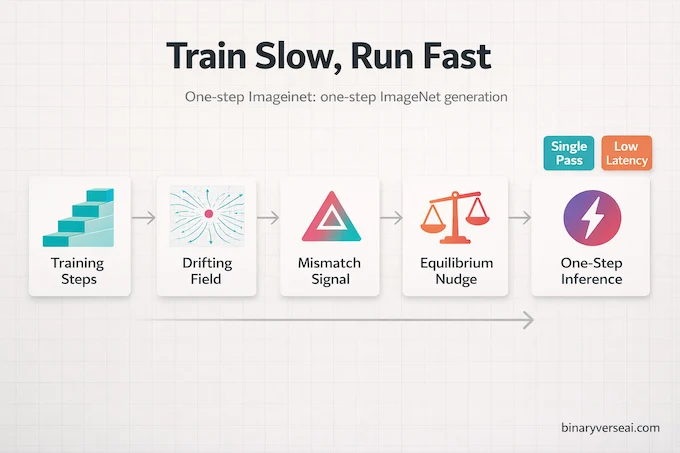
Drifting Models are a neat reframing: pay the complexity bill during training so inference becomes a single forward pass. Diffusion models are gorgeous but slow, and a lot of recent work is basically how do we cheat the steps. Here, a drifting field acts like a training signal that measures distribution mismatch and nudges the generator toward equilibrium.
The empirical result is the eyebrow-raiser. One-step generation hitting FID in the mid 1s is not a rounding error, it’s a statement. If this line holds up, it changes how we think about deployment for generative media, especially at scale where latency is money.
7. Gpt-5.3-Codex-Spark: Ultra-Fast Real-Time Coding Model
Codex-Spark is the industry admitting what developers already know: speed is a feature you feel in your bones. This model is built for tight loops, instant edits, quick refactors, and that subtle productivity drug, low friction. The headline number, over 1000 tokens per second on the right hardware, is less about bragging and more about changing the default experience of coding assistants.
The deeper story is infrastructure. Persistent connections, serving stack rewrites, streaming improvements, this is the boring engineering that turns a clever model into a tool you keep open all day. In AI News February 14 2026, this points to a split, slow-think agents for autonomy, spark-fast models for collaboration.
8. Harness Engineering: Building A Million-Line Product With Codex Agents
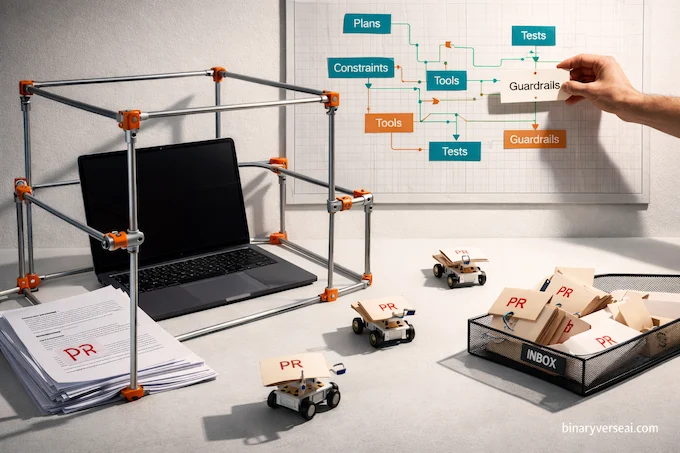
Harness engineering is the new learn Git, except the tool you’re learning is the environment itself. A small team shipped an internal beta with zero human-written code, and the repo ballooned to about a million lines over 1,500 pull requests. That sounds like hype until you read the key lesson: capability wasn’t the bottleneck, scaffolding was.
They won by making the system legible to agents. Not one mega prompt file, but a repo that encodes plans, maps, constraints, and mechanical guardrails. Agents ran tools, reproduced bugs, read logs, fixed UI flows, and reviewed each other. The human job shifted toward architecture, incentives, and constraints, not syntax.
9. Gemini 3 Deep Think Upgrade Targets Frontier Science And Engineering
Gemini 3 Deep Think is positioned like a lab partner that doesn’t get tired. It’s tuned for problems that don’t have clean datasets and don’t reward shallow pattern matching. Google is pushing it into the Gemini app for Ultra subscribers and into the API for select researchers and enterprises, which is the real move. Models don’t change workflows until they’re where the work happens.
The benchmark spread is loud: Humanity’s Last Exam, ARC-AGI-2, Codeforces performance, Olympiad medals, plus physics and chemistry. But the product story is stronger, sketch-to-3D outputs and engineering-grade analysis. This is AI news this week February 2026 that signals a platform bet.
10. Anthropic Series G Funding Pushes Valuation To 380 Billion
Anthropic’s fundraising is not subtle. A giant round at an enormous valuation is the market shouting that frontier AI is infrastructure, not an app. The company frames it as fuel for research, product expansion, and compute. It also reads like a defensive move, because in a compounding race, you don’t want to be the lab that slows down first.
Claude Code is the growth engine in the narrative, and enterprise traction is the tell. Lots of big customers, lots of recurring spend, and broad hardware partnerships across clouds. In AI News February 14 2026, this kind of capital scale signals that distribution plus reliability is becoming as important as raw model IQ.
11. Anthropic And Codepath Bring Claude To 20,000 Cs Students
The CodePath partnership is a quiet cultural shift. Instead of teaching CS the old way and sprinkling AI tools on top, they’re redesigning curriculum around AI-native workflows. That matters because tools change what entry level even means. If students learn with agents from day one, they’ll treat delegation as normal, not cheating.
The equity angle is real. The program reaches community colleges, state schools, and HBCUs, where access to cutting-edge tools has historically lagged. Early pilots had students contributing to real open source using Claude Code, which is exactly the kind of experience that builds confidence and career leverage.
12. Seedance 2.0 Redefines Text-To-Video With Director-Level Control

Seedance 2.0 is the kind of model that makes people stop joking about AI video. The pitch is not just prettier frames, it’s stability and synchronization, the stuff that separates a demo clip from something you’d actually publish. It also leans into multimodal control, using images, audio, or video references so creators can steer outputs instead of gambling on prompts.
The vibe is digital director, not slot machine. Better control over lighting, camera motion, and performance gets you closer to intentional filmmaking. In the world of new AI model releases, video is moving from novelty into infrastructure.
13. Gpt-5.2 Finds A New Gluon Interaction Once Thought Impossible
The gluon result is fascinating because it’s narrow and deep, not broad and fuzzy. A scattering configuration long assumed to be zero turns out not to vanish under a special momentum alignment. The work is framed as progress toward a general formula for gluon interactions across any particle count, which is exactly the kind of math that gets ugly fast.
The workflow is the headline. Humans computed small cases, the model simplified the expressions, spotted a pattern, and then a scaffolded reasoning run produced a general formula plus proof. Verification used standard checks, not vibes. This is what Artificial intelligence breakthroughs look like when they’re real.
14. Ai Job Disruption Warning: Industry Insider Says Change Is Immediate
This warning genre is getting crowded, but the underlying point is simple: agents are starting to complete multi-hour tasks, and that shifts the economic math fast. People inside labs describe a threshold moment where describe the goal is enough for substantial chunks of technical work to happen without constant supervision.
The compounding loop is the scary part. Models help build better models, which accelerates the next cycle, which expands what agents can do, which feeds back into more automation. The only advice that actually helps is boring: learn the tools, practice delegation, build taste, and stay adaptable using AI productivity tools.
15. Seedance 2.0 Sparks Hollywood Panic After Viral Ai Movie Clip
The viral Seedance clip with hyper-realistic celebrity lookalikes hit entertainment like a cold splash of water. The reaction is not just fear of deepfakes, it’s fear of unit economics. If a small team, or one creator with taste, can generate film-quality sequences cheaply, the old production pipeline starts to look like a luxury brand.
The policy fight is reigniting. Studios and rights holders want licensing, safeguards, and legal clarity, while model builders want broad training freedom. This is AI regulation news colliding with product reality in public, and the outcome will shape what video models can ship next.
16. Vla-Jepa Boosts Robot Learning By Predicting Actions In Latent Space
VLA-JEPA goes after a classic robotics problem: models trained on video often learn the wrong thing. Pixels are full of easy-to-predict junk, lighting changes, camera wobble, background motion. Robots don’t need that. They need representations that track state transitions and action-relevant dynamics. Predicting future latent states, instead of reconstructing pixels, forces the model to care about the right signals.
The architecture is clean: separate encoders for current observations and future latent targets, which reduces leakage and shortcuts. Results across simulation and real manipulation show better robustness and generalization. It’s a strong entry in new AI papers arXiv that could influence how robots learn from internet-scale video.
17. Skillrl Teaches Ai Agents To Learn And Reuse Skills
SkillRL treats agent memory like a product problem. Storing raw trajectories is like saving every screenshot of your life and calling it wisdom. SkillRL distills experiences into structured skills, including failure lessons, and organizes them into a SkillBank the agent can query when it needs strategy, not noise.
The loop matters. As reinforcement learning runs, the agent keeps extracting and refining skills based on what went wrong, then uses those skills to improve future decisions. Benchmarks show big gains, especially as tasks get harder. This is exactly where open source AI projects and agent frameworks are heading, less logging, more learning.
18. Elon Musk Predicts Coding Jobs Could Disappear By End Of 2026
Musk’s claim is classic provocation wrapped around a real trend. The specific idea, AI generating optimized binaries directly, skips over a lot of messy reality. But it lands because everyone can feel the slope. AI coding tools are moving from autocomplete to build the whole thing, and teams are reshaping how they work around that fact.
The useful framing is role shift, not role extinction. Software engineering is architecture, trade-offs, debugging in production, ownership, and accountability. Models can do more of the middle now, and that squeezes the old definition of junior work hardest. The right response isn’t panic, it’s fluency using best LLM for coding.
Closing
The pulse this week was loud, but the pattern is louder. Open models are chasing long-horizon work, not just chat polish. Closed models are chasing latency, because speed changes habits. Video is crossing into usable, which triggers both creativity and lawsuits. Research agents are entering math and physics in a way that produces checkable artifacts. And the agent stack is growing a memory layer that looks more like skills than logs.
If you want a simple filter for the next wave of AI world updates, ask this: does it produce finished work, faster, with fewer babysitting loops? If yes, it’s not a toy. It’s a job redesign.
If this roundup helped, share it with one builder who’s still treating agents like a novelty, subscribe for next week’s AI News February 14 2026, and tell me which thread you want a deeper technical teardown on, serving stack latency, diffusion text, pruning math, or video control.
1) What is GLM-5, and why are people calling it “agentic engineering”?
In AI News February 14 2026, GLM-5 stands out because it’s aimed at long-horizon work, planning, tool use, and multi-step delivery, not just chat. Think “ship the doc, the sheet, the plan,” instead of “answer the prompt.” It’s open-weights, agent-oriented, and clearly designed to run real workflows.
2) How does MiniMax M2.5 reach the “$1 per hour” agent claim?
AI News February 14 2026 highlights MiniMax M2.5 because pricing is the story, not just benchmarks. The claim comes from sustained token throughput and low per-token cost, so continuous agent operation becomes predictable and cheap. It’s a deliberate push toward always-on agents, not occasional queries.
3) What is GPT-5.3-Codex-Spark meant to change for developers?
Codex-Spark is the “real-time” model archetype: fast edits, quick iterations, tight feedback loops. The point isn’t only correctness, it’s time-to-result. If your workflow is lots of small changes, refactors, and tests, speed becomes a product feature.
4) Why is Seedance 2.0 such a big deal for text-to-video right now?
Seedance 2.0 because it signals a shift from fun clips to controlled production. The attention is on motion stability, audio-video sync, and reference-driven direction, which is what creators actually need. The debate it triggers is less about “can it generate,” and more about “who owns the training inputs.”
5) Is Elon Musk right that coding jobs could disappear by the end of 2026?
AI News February 14 2026 treats that claim as a pressure test, not a prophecy. AI can already generate large chunks of working software, but engineering is still full of messy requirements, accountability, security, and trade-offs. The more realistic shift is role-shape: less typing code, more specifying, verifying, and operating agent pipelines.