
Can two quantum systems be entangled yet supply no usable secret key? OpenAI’s September 27, 2026 paper answers yes within its specified local-instrument protocol model. It constructs a state on two ten-dimensional systems for which unlimited copies and permitted two-way public discussion cannot produce even one arbitrarily accurate secret bit. Bound entanglement alone never established that conclusion: some bound-entangled states do supply keys. The new proof separates these resources through a quantitative obstruction, then uses exact algebraic geometry to show that the supposedly useless state really is entangled.
Table of Contents
01. What OpenAI Proved: An Entangled State With Zero Secret Key
Theorem 1.1 of the original manuscript constructs a density operator on with distillable secret key . A density operator is a positive matrix with trace one. Here its range contains no nonzero product vector, a strong certificate of entanglement.
For every positive number of copies and every admitted completed bit-output protocol, the output stays at least from every ideal secret bit in the unhalved trace norm. Conventional trace distance includes a factor of one half, making the corresponding bound . These are mathematical guarantees, independent of available computing power.
| Result | Precise Scope |
|---|---|
| Entangled state | Two local dimensions of ten, with |
| Uniform separation | At least in trace norm, or in trace distance |
| PPT composition | Two maps on 10×10 matrices compose to a map that is not entanglement breaking |
| Channel square | One trace-preserving PPT channel on 21×21 matrices has a non-entanglement-breaking square |
| Lean scope | The map pair and channel consequence, excluding the zero-key theorem |
OpenAI included the manuscript in its mathematics release. The announcement supplies provenance for this AI-assisted mathematics, while the paper supplies the hypotheses and proof.
02. The Original Problem: Must Every Entangled State Contain Usable Secrecy?
An entangled state cannot be written as a mixture of independent local states. That failure of separability establishes a quantum correlation resource, but does it always establish a cryptographic resource? The distinction matters because a secret key must be both shared and hidden.
Separable states have no distillable key against an adversary holding a purification. Intuitively, an apparently shared random label can be available to Eve as well. Alice and Bob’s agreement then provides no secrecy.
The reverse implication was the difficult part. The manuscript traces the question of secret key from every entangled state to Problem 24 in Krüger and Werner’s collection, dated March 15, 2005. Entanglement can make correlations costly to prepare using secrecy without making secrecy recoverable from those correlations. Preparation cost and distillation rate answer different operational questions.
03. Why Bound Entanglement Was Not Enough to Settle the Question
Entanglement distillation aims to recover nearly perfect maximally entangled pairs, often called Bell pairs. Secret key distillation asks only for matching uniform classical bits hidden from Eve. Bell pairs provide a route to secrecy, but they are not the only route.
A state has positive partial transpose, or PPT, when transposing one subsystem leaves a positive matrix. PPT entanglement has zero distillable entanglement under local operations and classical communication, abbreviated LOCC. Nevertheless, earlier constructions showed that some PPT entangled states have positive distillable secret key. Additional quantum systems, called shields, can protect the private correlations.
| State Type | Bell-Pair Distillation | Secret-Key Distillation |
|---|---|---|
| Separable state | Impossible | Impossible against purifying Eve |
| PPT entangled state | Impossible | Possible for some states |
| This constructed state | Impossible | Zero rate in the specified model |
Earlier distance bounds near private bits depended on shield dimension, which may grow during a protocol. This paper instead bounds the final classical bit output together with Eve’s information, uniformly over input length and local memory.
04. The Security Model: Alice, Bob, Eve, and Unlimited Public Communication
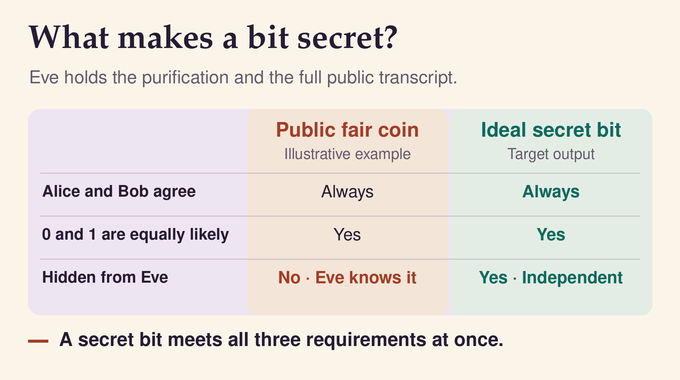
Alice and Bob receive copies of the state. Eve holds a purification: a larger pure state whose reduction gives their shared input. She also receives the complete public transcript, including speaker choices and stopping decisions. Authenticated communication prevents undetected message alteration, but does not hide messages.
Even perfect agreement is insufficient. If Alice and Bob both copy a publicly announced fair coin, their bits match and are uniform, but Eve knows them exactly. Conversely, independent private coins hide outcomes from Eve while failing to agree. A usable key must satisfy all three requirements simultaneously. An ideal secret bit has joint state
The two outcomes occur equally often, Alice and Bob agree, and Eve’s state does not depend on the bit. Correctness and secrecy must hold together.
Definition 4.1 permits joint processing of all local copies, private ancillas, private randomness, and independent public randomness recorded for Eve. Conditional on that public randomness, the two initial private auxiliary resources and the input-reference state must form a product. There is no preshared secret key or other shared resource besides the supplied input.
Completion means both parties produce their prescribed outputs almost surely, with normalized joint output. Definition 5.1 defines through asymptotic bits per input copy, optimized over such protocols whose error tends to zero.
05. The Proof’s First Ingredient: PPT Maps, Choi Matrices, and the Represented Class
A completely positive, or CP, map preserves positivity even when an untouched auxiliary system is present. A PPT map remains completely positive after output transposition. The word complete matters because positivity on isolated inputs does not guarantee positivity when an input is entangled with a reference. These conditions describe maps more general than physical channels because trace preservation is not assumed.
The proof studies a represented class : normalized states obtained by applying local PPT maps to a pure bipartite input. Rectangular maps and unnormalized input vectors are allowed. Crucially, tensor powers remain in this class, so processing many copies does not remove the obstruction.
The Choi matrix encodes a linear map as a bipartite matrix. For composable maps and , the bridge is
Here is unnormalized, and , with denoting coordinate transposition and the Hilbert–Schmidt adjoint. The vectors form the standard coordinate basis, and is the intermediate dimension shared by the two maps. Lemma 2.6 shows that a nonzero composite Choi matrix of two PPT maps, divided by its actual trace, belongs to .
06. The Four-Effect Coherence Inequality: Why Bit Agreement Constrains Secrecy
Consider four branches: 00 and 11 represent agreement, while 01 and 10 represent disagreement. Positive local effects and give and weights . For , Lemma 3.2 proves
The left side measures coherence connecting the equal-bit branches. Every term on the right contains disagreement weight. If both disagreement branches vanish, this coherence must vanish too.
The proof pulls the effects back through the local maps’ adjoints. A change of coordinates makes Alice’s two pullbacks commute without changing the represented state. This works even when their sum is singular, by normalizing on its support.
A positive block matrix bounds an off-diagonal block’s trace norm by the square root of the two diagonal traces. Complete positivity gives one estimate, and complete positivity after transposing both input factors gives a reversed estimate. Splitting the input along the commuting pullbacks and combining four terms yields the displayed inequality. The effects need not constitute normalized measurements at each transcript.
07. Why Interactive Protocols Cannot Escape the Inequality
Interaction appears to threaten the simple product form because later operations depend on earlier messages. The solution is to fix the complete transcript. Once every public choice is specified, Alice’s compatible private histories can be summed inside her laboratory and Bob’s inside his. The resulting branch effects factor using the same two local pairs for all four final bit outcomes.
For continuous records, a single transcript may have probability zero. The proof therefore works with matrix densities relative to one common transcript measure. It runs the protocol on auxiliary product probes, each attached to an untouched reference. Conditional independence of the local histories, followed by informationally complete reference tests, recovers common product factors. A reference filter then transfers them to the actual input.
Definition 4.1 also admits specified countably indexed processes. Their measurable histories, local terminal readouts, and instrument laws must remain compatible with untouched finite-dimensional references. The result includes ordinary finite protocols with no uniform round limit, plus these carefully defined extensions. It does not silently replace those conditions with every imaginable infinite procedure.
08. The Quantitative Proof: Why Even One Approximate Secret Bit Fails
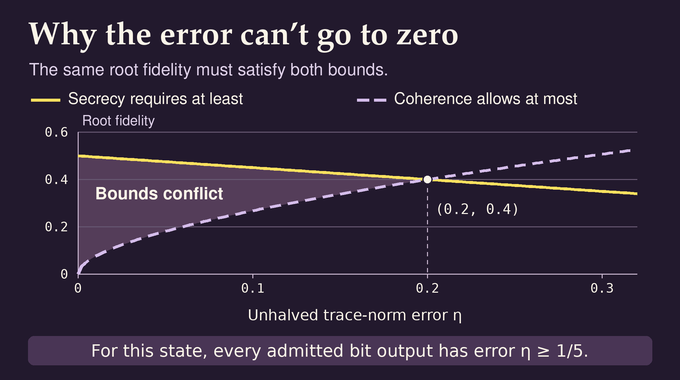
After integrating over transcripts, let be the four outcome probabilities and the disagreement probability. Let be the integrated root fidelity between Eve’s unnormalized 00 and 11 branches. For positive matrices, root fidelity is . It measures overlap, not a squared fidelity. The trace norm sums singular values, with denoting conjugate transpose.
The four-effect bound and Cauchy–Schwarz give the central inequality:
Small disagreement therefore forces limited overlap between Eve’s equal-bit branches. Yet secrecy demands that those branches look alike. If is the unhalved trace-norm error from an ideal bit, correctness and secrecy require
The factor of two in the correctness bound matters. Disagreement contributes error directly, and its missing probability must also be restored in the equal-bit blocks. For secrecy, the trace-norm difference between Eve’s equal-bit branches is at most , giving the stated lower bound on their overlap.
Suppose . Then . The upper bound is strictly below , while secrecy requires . Contradiction. As a worked example, a proposed error requires , but allows at most .
A longer secure key cannot evade this obstruction. Keeping only its first bit cannot increase trace-norm error. Thus no secure sequence with positive asymptotic rate exists, proving .
09. Constructing the Dimension-Ten PPT Maps From Four-Dimensional Geometry
The operational argument needs an entangled member of . Sections 6 and 7 build one from four integer 6×4 matrices forming a matrix pencil . The associated map acts on 4×4 matrices. Exact block identities prove it is PPT.
Why does ten appear? The symmetric square of has dimension . Its coordinates record four square monomials and six cross terms. The exterior square has dimension , recording antisymmetric pairs.
For example, the normalized symmetric coordinate for is when . Those factors ensure the embedding is isometric. Symmetric coordinates encode quadratic evaluations, while exterior coordinates detect rank loss.
Compressing between these spaces, then using a complementary-pair operation on the exterior square, produces the maps in Equation (6.5). A positive-definite test output ensures the composite Choi matrix is nonzero. Normalizing it by its trace gives the required state.
10. Twenty Singular Directions: Proving the State Is Truly Entangled
The pencil loses rank at exactly twenty complex projective directions. A projective direction identifies vectors differing by a nonzero scalar. The crucial additional property is that no nonzero homogeneous quadratic vanishes at ten of these directions.
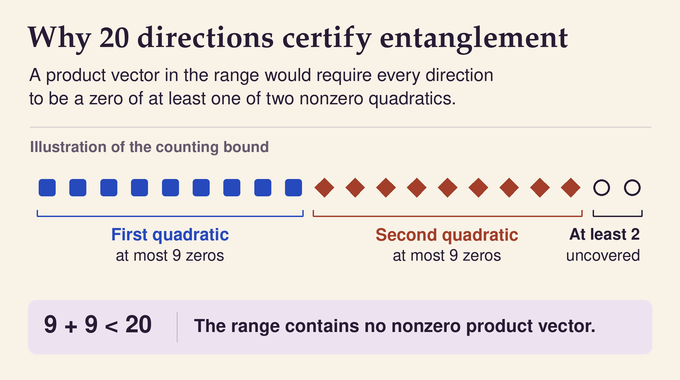
Lift each direction to its symmetric-square vector . Exterior-square geometry puts in the kernel of the positive composite Choi matrix . If a nonzero product lay in its range, orthogonality to that kernel would require
Here and are nonzero quadratics. Each can vanish at at most nine directions. The obstruction is a counting argument about zeros of polynomials, not a numerical test on a sample of product states. Together they cover at most eighteen, and . Hence no nonzero product vector lies in the range. A nonzero separable positive matrix necessarily has one, so is entangled.
The exact certificate uses reductions at primes 41, 131, and 139. Together with the paper’s algebraic arguments, these establish a degree-twenty field and a full symmetric Galois action, transferring one independent ten-point quadratic evaluation to every ten-point choice. The verification files check finite arithmetic, not the entire conceptual proof.
11. The Second Result: A PPT Channel Whose Square Preserves Entanglement
The same construction refutes the unrestricted two-map PPT-composition conjecture. Its two PPT maps on 10×10 matrices compose to a map that is not entanglement breaking. Entanglement breaking means destroying entanglement with an external reference for every bipartite input. The maps may differ and need not preserve trace or the identity.
Theorem 1.3 supplies a separate physical channel. First rescale the maps so they cannot increase trace. Alternate them between two ten-dimensional blocks, and send missing trace to a one-dimensional absorbing flag. The total dimension is .
After two applications, a local corner of the channel’s Choi matrix is a positive multiple of . Local compression preserves separability, so that entangled corner proves the square is not entanglement breaking. This is a structural statement. Channel capacity and practical communication performance require separate analysis. Failure at the second iterate is also compatible with eventual entanglement breaking after more iterations.
12. What the Proof Establishes and What Remains Open
The paper also develops an independent construction using real vectors, projective measurements, restricted intersections, and tensor products of Mermin–Peres parity measurements. Its dimensions are much larger, but it offers another mechanism for preserving entanglement through two PPT maps.
Neither ten nor twenty-one is proved minimal. The operational conclusion retains Definition 4.1’s resource and compatibility requirements. Public conditioning on a positive-probability event cannot defeat the gap, and Proposition 5.4 treats vanishing abort probability and limits retaining recoverable access to Eve’s complete information.
The Lean scope must stay separate. Family 272’s published formalization covers the dimension-ten PPT pair, its product-free Choi range, and the 21-dimensional channel consequence. Its scope document explicitly excludes the zero-distillable-secret-key statement. Reading a formal proof’s exact statement remains essential.
Ordinary quantum key distribution is not disproved. The result identifies a particular resource from which secrecy cannot be distilled under the stated conditions. Bound entanglement now has an explicit example where entanglement survives but usable secret key does not. Follow Binary Verse AI for research explainers that connect the theorem, its mechanism, and the precise limits of what has been established.
Can two quantum systems be entangled but have no distillable secret key?
Yes. OpenAI’s proof constructs an explicit entangled state on two ten-dimensional systems for which the distillable secret-key rate is zero under the specified local-instrument protocols.
What is the difference between bound entanglement and zero distillable secret key?
Bound entanglement cannot be distilled into maximally entangled pairs using local operations and classical communication. However, some bound-entangled states still yield secret keys. The new construction demonstrates that entanglement does not always guarantee either resource.
Why is local dimension ten important?
The construction uses two ten-dimensional local systems. The number emerges from the symmetric-square geometry of a four-dimensional space. The paper does not establish that ten is the minimum possible dimension.
Could unlimited copies and two-way communication extract a secret key?
Not from this state within the stated protocol model. The proof gives an error bound independent of the number of copies and the amount of permitted public communication.
How does the proof establish that the constructed state is entangled?
It constructs a nonzero positive Choi matrix whose range contains no nonzero product vector. Such a matrix cannot be separable. The twenty singular directions provide the crucial geometric obstruction.
What does the proof establish about PPT channels?
It constructs two PPT maps whose composition is not entanglement breaking. Separately, it produces a trace-preserving PPT channel on 21-dimensional matrices whose square remains non-entanglement-breaking.
Was OpenAI’s entire zero-secret-key theorem formally verified in Lean?
No. The released Lean formalization covers the dimension-ten PPT composition result and the 21-dimensional channel consequence. The zero-distillable-secret-key theorem is outside its stated formalization scope.