
A finite shape can fill three-dimensional space perfectly and still refuse every arrangement with three independent repeating directions. OpenAI’s September 23, 2026 manuscript presents exactly that counterexample to the periodic tiling conjecture: one finite lattice tile that tiles, yet admits no fully periodic tiling. Its unit-cube version has the same property in ordinary space, even when translations need not have integer coordinates.
The surprise is not a clever nonrepeating arrangement. Many shapes permit those alongside repeating ones. The claim is that this shape excludes every fully repeating alternative. The argument builds an arithmetic Sudoku rule, translates it into finite constraints, then packages those constraints into one tile. For AI readers, the interesting achievement is the chain of exact reductions, together with the published proof artifacts supporting it.
Table of Contents
1. What Is Periodic Tiling? The Original Conjecture Explained
A translational tile is a shape used repeatedly by sliding identical copies, without rotation or reflection. In the lattice setting, the shape is a finite set of integer points. The translation set records where copies begin. Exact coverage is written:
Here is the tile, is the translation set, and is the integer lattice. The direct-sum symbol means each lattice point has exactly one representation as a translation plus a tile point. Overlap and missing points are both forbidden.
1.1. Periodic Tiling: Key Facts
| Feature | Precise Meaning |
|---|---|
| Lattice result | One finite, nonempty tile in three dimensions admits tilings but no fully periodic translation set. |
| Euclidean result | The same tile thickened into unit cubes tiles space up to measure-zero boundaries, with no full-rank periodic translation set. |
| Allowed motions | Translations only, including arbitrary real vectors for the Euclidean assertion. |
| Periodicity excluded | Invariance under a finite-index lattice subgroup, or a full-rank Euclidean lattice. |
| Properties not asserted | Connectedness, absence of every single period, or a small practical construction. |
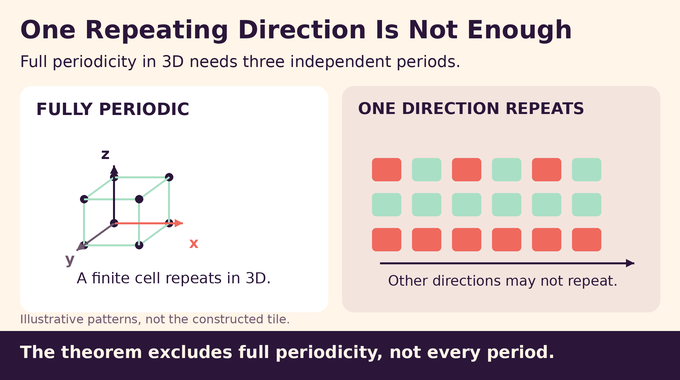
Full periodicity means repeating in enough independent directions to give a finite repeating cell. A striped arrangement might repeat along one direction while remaining irregular elsewhere. The conjecture asked whether every tile capable of covering space has at least one fully periodic arrangement. The paper’s answer in three dimensions is negative.
2. What OpenAI’s Periodic Tiling Proof Actually Establishes
Theorem 1.1 of the original periodic tiling manuscript has two linked assertions. First, its finite tile covers , but no valid translation set is invariant under a subgroup of finite index. Such a subgroup leaves only finitely many residue classes, providing the algebraic version of a repeating cell.
Second, replace each tile point with a closed unit cube:
This thickened shape tiles up to null sets, meaning boundaries of zero volume may overlap. No translation set for it is invariant under a full-rank lattice. Allowing fractional offsets cannot rescue full periodicity.
OpenAI included the paper in its October 6 mathematics release, describing the collection as outputs of an internal frontier model. Its formalization scope note reports Lean coverage of both counterexamples and the least lattice dimension. That is evidence beyond an unsupported announcement, but this article does not independently rebuild those artifacts or certify peer review. The distinction between a mathematical argument and a checked formal statement is also central to our Fermat proof formalization explainer.
3. Why Three Dimensions Were the Last Barrier to the Conjecture
Newman’s one-dimensional argument shows that translation sets tiling with a finite tile are periodic. In two dimensions, Bhattacharya’s periodicity theorem guarantees that every finite translational tile of admits a periodic tiling. It does not require every possible arrangement to repeat.
Greenfeld and Tao’s earlier counterexample to the periodic tiling conjecture established failure in sufficiently high dimensions. Their encoding used two infinite coordinates plus a finite abelian group. The obstacle was the finite group’s structure: several generators can require several extra lattice coordinates.
A cyclic group needs only one generator. Keeping the entire finite encoding cyclic therefore lets the two infinite coordinates and one modular coordinate come from three integer coordinates. That is the dimensional breakthrough. Like the lower-dimensional Borsuk counterexample, it brings an existing failure closer to familiar geometry, rather than first disproving the conjecture in every dimension.
The qualification “lattice” matters. Positive planar results cited here do not settle periodicity for every arbitrary bounded measurable Euclidean tile. The paper establishes the minimum lattice dimension and proves its Euclidean counterexample directly.
4. The p-Adic Sudoku Construction Behind the Proof
This Sudoku has no nine-by-nine boxes. Choose a prime , set , and use the nonzero residues as symbols. Columns lie in , while rows extend through all integers. The array must obey a finite word rule along every integer-slope line .
An allowed word has integer witnesses whose coefficients are not both divisible by . At each column index, evaluate . If it is not divisible by , use its residue. If divisible by but not , divide once before taking the residue. If divisible by , any nonzero symbol is allowed. The witnesses matter only modulo , so the rule is finite.
The model solution uses the last nonzero base-p digit:
The order in the denominator counts how many factors of divide a nonzero integer. For example, with prime 211, the function assigns 422 the value two and 44521 the value one. Removing trailing zero digits exposes the first nonzero residue. The separately defined value at zero avoids division there.
The array satisfies every line rule after common powers of the prime are removed from the line’s coefficients. Every column is nonconstant. A finite alphabet thus carries arithmetic structure at arbitrarily deep scales.
5. Why the Sudoku Array Cannot Have a Vertical Period
The central obstruction is a descent argument. The line rule forces a global affine approximation over the field of residues:
The coefficients are not all zero. The proof first finds a four-by-four square avoiding exceptional cells in three line directions. Agreement there propagates across the strip. The bound on the prime supplies enough room for this counting argument.
Every column is nonconstant exactly when the vertical coefficient is nonzero. In that case, comparing entries separated by a hypothetical positive period forces . Normalize the array by shifting each column so that its affine approximation has only the vertical term, then rescale:
The rescaled array retains the line rule. Crucially, the paper proves that its columns remain nonconstant, using the second digit rule along a suitable diagonal. Simply sampling every pth row would not guarantee that property for an arbitrary array.
The new array has period . Choose the smallest period occurring among all eligible arrays, and this produces a smaller one, a contradiction. No positive vertical period survives. This is stronger than observing irregularity in a finite picture, whose unseen continuation might eventually repeat.
6. How Sudoku Constraints Become Translational Tiling Equations
The encoding works in , where the finite group must stay cyclic. A graph equation makes the unknown translation set contain exactly one point above each combination of horizontal position and low input digits:
The finite subgroup on the left fills each output fibre. Exact coverage therefore means one graph point per input. Other tiling equations restrict the useful outputs so that ordinary channel number n depends on its own digit input and the line coordinate .
A symbol is active when changing its designated input digit can change that channel’s output. Inactive digits have no effect. Arbitrary solutions may activate several symbols, so the encoding must constrain every combination selected from their active sets. It cannot silently assume one symbol per position.
All component orders are chosen pairwise coprime, making their product cyclic by the Chinese remainder theorem. Horizontal residue pairs index the values of a single cyclic output coordinate. They are not added as a two-generator group factor. This bookkeeping controls the final dimension, much as preserving algebraic requirements matters in the Boone–Higman embedding construction.
7. Cycle Tests, Activation Rules, and the Two-Seed Breakthrough
Cycle tests rule out forbidden words. They connect output shifts around a cycle of channels. If one chosen digit is inactive, the equations can be inverted successively around the cycle. If every chosen digit is active, suitable shifts create two inputs with the same output. That collision violates exact tiling.
Exclusions alone would permit empty active sets, an unhelpful escape hatch. Activation equations close it using a shift list with nonuniform multiplicities but uniform coordinate marginals. Its multiplicities are two at two diagonal positions, zero at the other two corners, and one elsewhere. The total coordinate counts stay balanced.
An ordinary channel with constant output would reproduce those uneven multiplicities instead of covering its output fibre uniformly. Therefore each ordinary channel has an active symbol everywhere. The two seed channels are each forced active somewhere by a separate counting contradiction. Their small coordinate orders are two and three, neither dividing for the chosen prime.
When the first seed is active, every ordinary channel must select symbol one. The second seed forces symbol two. Consequently, every decoded column takes two distinct values. This use of finite compatibility constraints has an instructive parallel in geometric coloring obstructions, although the constraints and conclusions differ.
8. How the Proof Constructs a Solution but Rules Out Every Fully Periodic One
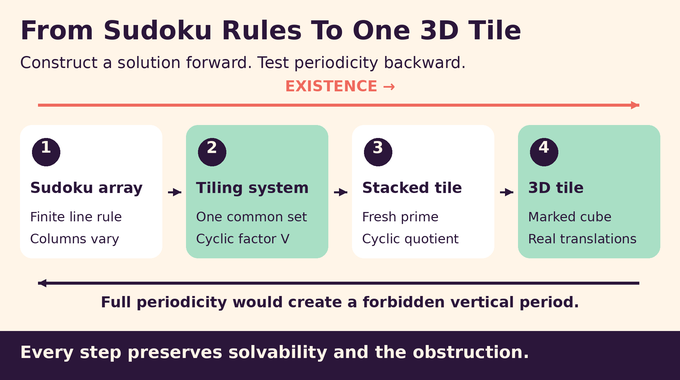
Forcing activity could accidentally make all equations impossible. Section 5 prevents that by constructing a single common solution. Input digits are partitioned into labelled blocks of two permitted sizes. Within each block, a permutation shifts labels while a useful output records the appropriate coordinate.
The labelled-block inverse recovers exactly one source from each target output. That gives existence and uniqueness together, rather than a loose count suggesting coverage. Ordinary channels activate precisely the last-nonzero-digit symbol evaluated at their line coordinate.
The seeds require additional coordination. Their active regions are disjoint sets of three and four horizontal residue pairs. The remaining region has size divisible by six, allowing compatible labels for both seeds. One shared auxiliary output satisfies both seed tests. Separate graphs solving separate equations would not establish a common solution.
8.1. What Each Reduction Must Preserve
| Stage | Existence Guarantee | Periodicity Obstruction |
|---|---|---|
| Sudoku array | Last-nonzero-digit model obeys the line rule. | Nonconstant columns forbid vertical periods. |
| Common tiling equations | Labelled-block inverses produce one shared graph. | A finite-index period decodes into a vertical array period. |
| Single stacked tile | A fresh cyclic coordinate combines the equations. | Exact fibre counts recover a common solution. |
| Three-dimensional tile | Grid assembly and marked-point relocation preserve coverage. | Periodic grid rigidity forces descent to the forbidden quotient tiling. |
Conversely, a finite-index period subgroup of a common solution contains some positive pure vertical translation. Selecting the least active symbol in a fixed alphabet ordering then gives a vertically periodic Sudoku array. The seeds make its columns nonconstant, contradicting the arithmetic obstruction. Both directions are essential.
9. How Stacking Turns Multiple Tiling Equations Into One Tile
The system still has many tiles sharing one unknown translation set. Stacking converts it into one shape by adding a fresh prime-order coordinate. Partition that cyclic coordinate into nonempty color classes, each having the whole group as its difference set.
That condition means two translates of the same color class must intersect. In any exact stacked tiling, a fibre can therefore receive at most one contribution of each color. Since the classes partition the fibre, total coverage forces exactly one contribution from every color. Projecting the translations recovers a common solution to all original equations.
Choose the fresh prime not to divide the order of . The enlarged finite factor is still cyclic, now of order . The result is one finite tile in that tiles but admits no fully periodic arrangement.
The suitable partition exists by a probabilistic argument, and terminating finite search can select it. This is an existence construction, not a benchmarked efficient generator. As with computation encoded into fluid motion, mathematical realizability and practical engineering performance are separate questions.
10. The Final 3D Counterexample: Marked Cubes, Grid Rigidity, and Real Translations
The quotient map retains the first two integer coordinates and reduces the third modulo . Its kernel is , with . Lift the quotient tile to finitely many lattice representatives. Merely lifting points, however, does not prove that arbitrary real translation vectors cannot restore periodicity.
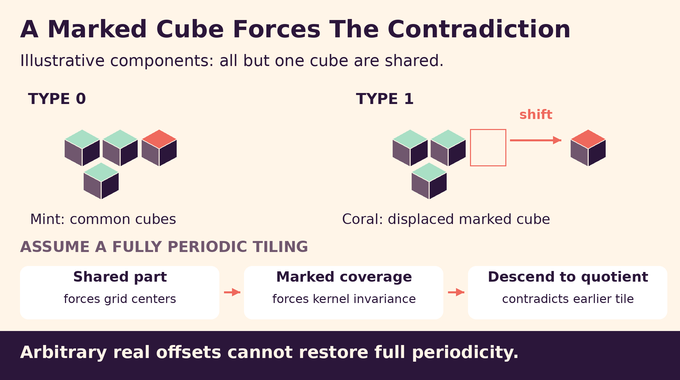
The construction supplies two component shapes. Both have one representative of every residue modulo a sufficiently large integer scale and share all but one marked point. The second shape displaces that point by the scaled kernel vector. Combining these components according to the lifted quotient tile produces the final finite shape.
A known quotient tiling lifts to a kernel-invariant translation set. On the scaled grid, replacing some first-type components with second-type components removes and reinserts exactly the same collection of marked points. Coverage remains unique, proving that the final tile really tiles.
For the reverse direction, assume a fully periodic Euclidean tiling exists. Differences in the components’ common part force nearby centers into compatible grid positions. Periodic volume counting with auxiliary cubes shows that all centers fill one translated grid. This rigidity step addresses real offsets, a geometric issue absent from the earlier symbolic encoding.
Marked-cube coverage then forces for the normalized translation set. Kernel invariance allows it to descend to a fully periodic quotient tiling, contradicting Section 9. The same argument excludes a periodic lattice tiling through unit-cube thickening.
The result neither asserts a connected tile nor eliminates every individual repeating direction. It supplies no small printable model or demonstrated application speedup. A three-dimensional Einstein monotile would involve different, stronger aperiodicity requirements. What periodic tiling gains here is a precise boundary: finite exact-cover rules can force the absence of every fully repeating arrangement in three lattice dimensions. Follow Binary Verse AI’s research-level AI mathematics coverage for explanations that track the theorem, its verification artifacts, and what remains unproved.
11. Frequently Asked Questions
What is a periodic tiling?
A periodic tiling covers a space without gaps or overlaps and repeats under translations. In three dimensions, full periodicity requires three linearly independent translation periods. Euclidean coverage is understood up to measure-zero boundaries.
What did OpenAI’s periodic tiling proof disprove?
The manuscript gives a counterexample to the conjecture that every translational tile admitting a tiling must also admit a fully periodic one. Its finite three-dimensional tile permits tilings but excludes every fully periodic translation set.
Why was dimension three the critical case?
Every finite translational tile that tiles the integer line or the two-dimensional integer lattice admits a periodic tiling, while higher-dimensional counterexamples already existed. The reported construction establishes three as the smallest lattice dimension where the conjecture fails.
How does a Sudoku rule prove that periodic tiling is impossible?
The proof uses a finite line rule that admits an array with every column nonconstant but forbids any positive vertical period for such an array. It encodes that rule and the column conditions into tiling equations. A hypothetical fully periodic solution would decode into a forbidden vertically periodic array.
Does the proof work in ordinary three-dimensional space without rotations?
Yes. Theorem 1.1 states that the unit-cube thickening tiles ordinary three-dimensional space by translations alone, up to null boundaries. It excludes every fully periodic translation set, even when arbitrary real translation vectors are allowed.
Is OpenAI’s counterexample the same as a three-dimensional Einstein tile?
No. The manuscript concerns translational tilings and the absence of full-rank periodicity. It does not establish connectedness or the absence of every individual nonzero period, and should not be equated with stronger geometric aperiodicity claims in Einstein-monotile research.
Does the constructed tile eliminate every possible repeating direction?
Not necessarily. The theorem excludes full periodicity, meaning three independent periods in three dimensions. It does not assert that every tiling lacks every individual nonzero translation period.