
Ten pieces should have been enough. OpenAI’s September 23, 2026 preprint gives a compact set in nine-dimensional Euclidean space that refuses to fit that rule: every cover by ten subsets leaves at least one subset with the original diameter. The Borsuk conjecture counterexample lowers the previously reported counterexample dimension from 63 to nine.
The original conjecture was already disproved in 1993. This paper changes how close its failure reaches to ordinary geometry. Its construction uses four-dimensional vectors, nine-dimensional matrix coordinates, and a covering obstruction that turns topology into a finite contradiction. Here is what the OpenAI Borsuk proof establishes, how its argument works, and which questions survive it.
Table of Contents
1. Borsuk Conjecture: What OpenAI Actually Proved in Nine Dimensions
Theorem 1.1 of OpenAI’s original research paper concerns all rank-one orthogonal projectors on real four-dimensional space. Their trace-one matrix space is Euclidean of dimension nine. The set is compact, has diameter , and cannot be covered by ten subsets whose diameters are strictly smaller.
1.1. Key Facts About the Nine-Dimensional Result
| Feature | Verified Scope |
|---|---|
| Witness | Full compact projector image of |
| Ambient dimension | Nine, with the Frobenius metric |
| Diameter | |
| Covering obstruction | Ten strictly smaller-diameter subsets are insufficient |
| Earlier reported bound | 63 dimensions, using a finite configuration |
| Unsettled quantity | The exact Borsuk number of this projector set |
OpenAI included the preprint in its October 6 mathematics release. As with other AI mathematical proofs, the useful question is the exact theorem, rather than the number of problems a headline says were solved.
2. What Was Borsuk’s Original Covering Problem?
Karol Borsuk’s 1933 question asks whether every bounded set of positive diameter in can be covered by at most subsets of strictly smaller diameter. Diameter means the supremum of distances between two points in the set. On a closed interval, two half-intervals provide the simplest example.
Write for the least number of smaller-diameter subsets needed to cover . Borsuk’s assertion predicts . Here the conclusion is . It does not say that eleven pieces suffice.
Covers may overlap. Partitions may not. They give the same minimum because assigning each point to one covering set only shrinks those sets, and shrinking cannot increase diameter.
“Strictly smaller” carries real mathematical weight. Merely avoiding pairs at maximum distance is insufficient: distances inside a subset might still approach that maximum. The Borsuk covering problem requires a genuine gap below the original diameter for every covering subset.
3. From 63 Dimensions to Nine: The Barrier OpenAI Overcame
Kahn and Kalai disproved Borsuk’s conjecture in 1993 using combinatorial restrictions on intersections. Subsequent constructions reduced the counterexample dimension through 946, an announced 903, 561, and 560. Spherical codes then produced bounds of 323, 321, and 298.
Strongly regular graphs supplied another route. Bondarenko reached dimension 65, Jenrich and Brouwer reached 64, and Max Grinsztajn’s 63-dimensional proof and exact verification repository supplied the finite benchmark cited by OpenAI.
The new nine-dimensional Borsuk counterexample does not prune another finite graph. It uses an entire compact space of lines, then proves that no suitable ten-set cover exists. The projector embedding is classical. The contribution is the new covering obstruction for the projector set associated with four-dimensional space.
This distinction also prevents a misleading reading of the record: nine replaces 63 as an upper bound on the dimension of failure, while the paper supplies an infinite compact witness.
4. The Nine-Dimensional Counterexample: Rank-One Projectors in Four Dimensions
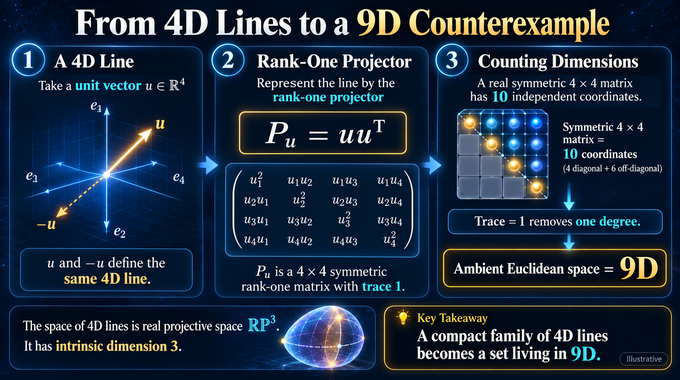
Take a unit column vector and form its outer product:
The matrix projects vectors onto the line through . Its rank is one, it is symmetric, and its trace equals one. Replacing by leaves the projector unchanged. Thus the construction records unoriented lines, not individually signed vectors.
A symmetric four-by-four matrix has four diagonal entries and six independent off-diagonal entries. That makes ten coordinates. Fixing the trace imposes one independent linear condition, leaving a nine-dimensional affine space.
The lines themselves form real projective three-space, : the unit three-sphere with opposite points identified. Its intrinsic dimension is three, even though this distance-preserving matrix model occupies nine ambient dimensions. Those are different quantities.
Compactness follows because the unit sphere is compact and the projector map is continuous. For Euclidean coordinates, off-diagonal entries need a factor of , since each appears twice in the matrix norm. Counting nine entries without matching the metric would miss part of the construction.
5. The Frobenius Metric: Why Orthogonal Lines Determine the Diameter
The Frobenius norm squares and sums every matrix entry. For symmetric matrices its square is . Since each projector squares to itself, expanding the difference gives:
The inner product measures the angle between unit representatives. Its square removes the sign ambiguity of the underlying lines. Identical lines give distance zero. Orthogonal lines have inner product zero and give the largest distance, .
For example, the first two coordinate axes produce diagonal projectors differing in two entries, one by plus one and the other by minus one. Their squared distance is two.
Every smaller-diameter covering set must therefore separate orthogonal lines. This resembles the forbidden-distance rule in the Hadwiger–Nelson problem, but the strict diameter gap supplies additional structure. That extra condition is what allows the next reduction.
6. From Ten Covering Sets to an Impossible Admissible Map
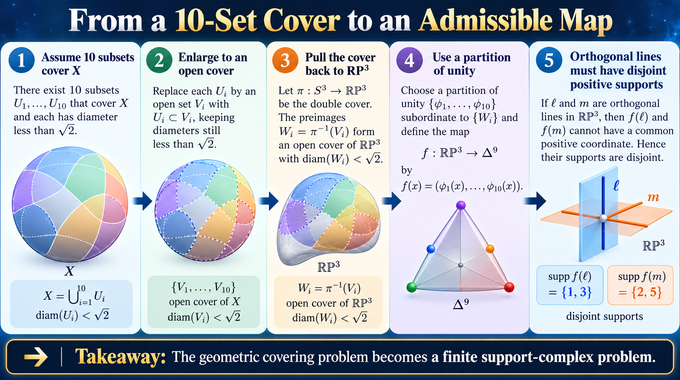
Assume ten smaller-diameter subsets cover . For a nonempty covering set of diameter , enlarge it inside by radius:
The enlarged open set has diameter at most the average of and , still strictly below . This handles arbitrary covering sets without assuming they were measurable, closed, or geometrically tidy.
Pull the open cover back to projective space and choose a smooth partition of unity. This supplies ten nonnegative coordinate functions adding to one, a map . The simplex consists of ten nonnegative weights totaling one.
Define the positive support as the labels whose weights at line are positive. Orthogonal lines have disjoint supports because no enlarged covering set contains both. The paper calls such a smooth map admissible.
Its support complex records a face whenever all its labels occur together at some line. This finite object packages the cover’s possible overlaps. The argument now asks whether an admissible ten-label map can exist at all.
7. The New Proof’s Central Construction: An Odd Map on Symmetric Matrices
The paper first extends to positive semidefinite matrices. Define for nonzero vectors and set . For a positive semidefinite matrix , average over the unit sphere:
Here is rotation-invariant probability measure and is the positive square root. The extension is continuous even at singular matrices. Its coordinates are nonnegative, sum to the trace of , and recover on projectors. Its positive labels are exactly those used by lines in the range of .
For an arbitrary symmetric matrix, split its spectrum into positive and negative parts and . Their ranges are orthogonal. Define:
Orthogonality makes the two positive supports disjoint, so subtraction causes no cancellation. Consequently:
The left side sums absolute coordinates. The right side sums absolute eigenvalues. Also , making the extension odd. Restricting to the respective unit norm spheres produces an odd map from a nine-sphere to a nine-sphere, ready for a topological obstruction.
8. The Topological Obstruction: Mod-Two Degree and Simplicial Cycles
In vector dimension , symmetric matrices have independent coordinates. An odd map between the resulting spheres requires at least labels. With exactly that many, the sphere map has odd degree, or degree one modulo two. In practical terms, suitable regular target values have an odd number of preimages.
For , ten labels sit exactly at this threshold. Surjectivity forces every pair of labels to occur as an edge. More work proves that every maximal support contains precisely four labels, giving tetrahedral facets.
Why can no maximal support be smaller? The paper selects a regular value inside such a support and studies its level set. A support with fewer than four labels creates a positive-dimensional level set inside one affine projective chart. The matrix extension on each line’s orthogonal complement supplies a map on a sphere bundle over that set.
The original odd degree forces an odd preimage count. Yet the chart trivializes the bundle, and the induced projective-bundle map has mod-two degree zero, forcing an even count. These conclusions conflict.
Once maximal supports have four labels, local parity counts make the sum of all tetrahedral facets a simplicial cycle modulo two. Every triangular face consequently lies in a positive even number of tetrahedra.
This is not an assumed triangulation of projective space. Familiar three-manifold language, explained in our Poincaré conjecture guide, cannot replace the paper’s task of deriving the face structure from the map.
9. Six-Label Triangle Systems: The Hidden Combinatorial Constraint
Fix one tetrahedral facet. Its four labels leave six complementary labels. At a line witnessing the facet, restrict the admissible map to the perpendicular three-dimensional vector space. Its lines form , and the restriction must use all six labels.
The equality argument now gives triangular facets, all fifteen edges, and positive even triangle multiplicities around edges. Complementary triples cannot both occur: witness lines for both would leave a line perpendicular to them with no available label.
There are twenty triples, arranged into ten complementary pairs. At most ten triangles are allowed. But fifteen edges, each requiring at least two incident triangles, demand at least ten triangles. Thus exactly ten occur, one from every complementary pair, and each edge occurs exactly twice.
Every vertex link is therefore a five-cycle. Additional compatibility rules prohibit a transposition of two labels from preserving the system, and triangles on any five labels determine the entire six-label system.
The paper also proves these are exactly the triangles of the original complex on the complement. Extra triangles would exhaust all labels at a common perpendicular line. Two tetrahedral facets cannot be disjoint, since a disjoint tetrahedron would contribute all four triples on four complementary labels, violating the triangle-system rules.
10. The Final Ten-Label Contradiction That Completes OpenAI’s Proof
First, every triangle belongs to exactly two tetrahedra. Three extensions would transport complementary triangle systems around a loop of label exchanges whose composite is a forbidden transposition. The earlier positive-even condition supplies the second extension.
Next, each component of an edge link must be a three-cycle or four-cycle. Five consecutive distinct vertices would transport the systems into identical restricted links at two different labels, contradicting their compatibility rule.
Now fix a tetrahedron . For each vertex in it, let be the unique outside label completing its opposite triangle to the neighboring tetrahedron. Group vertices sharing a partner into blocks:
The short edge cycles ensure that crossing a triangular face preserves these blocks. Omitting any one element from each block produces another tetrahedron. Every tetrahedron must contain two members of some block, since otherwise a choice of omissions would create a disjoint tetrahedron.
If there are four blocks, each has size two and the original tetrahedron violates that requirement. With fewer than three blocks, at least four labels remain outside the blocks. Those labels cannot contain a triangle, although the complementary six-label system requires a triangle on every four labels.
Only three blocks remain, with sizes three, two, two, and three outside labels. Choose two outside labels. Their pair belongs to two complementary-system triangles. At least one third vertex lies in a two-element block. That triangle has only one possible tetrahedral extension: the other member of its block. Two extensions are required. Contradiction.
Unlike the explicitly specified finite pattern in the Sidorenko counterexample, these labels describe a hypothetical cover. Their inconsistency rules that cover out.
11. Has OpenAI’s Borsuk Conjecture Proof Been Formally Verified?
As checked on October 12, 2026, OpenAI’s Lean formalization catalogue explicitly includes the Borsuk result. The declaration OAI.BorsukNine.main_theorem states compactness, containment in the trace-one symmetric space, diameter , and the absence of a ten-set smaller-diameter cover.
That scope reaches the main counterexample, rather than merely checking the final combinatorial calculation. The repository supplies a comparator configuration identifying the theorem and permitting the usual logical axioms. I have inspected the listed statement and configuration, rather than independently rebuilding the Lean development.
Formal checking establishes that an encoded theorem follows from its definitions, dependencies, and permitted axioms. Assessing whether those definitions match the intended mathematical statement remains essential. Independent mathematical assessment and journal peer review are separate processes.
Our explanations of Fermat’s Last Theorem formalization and Lean-checked percolation research explore that distinction. For Borsuk, the verified reporting claim is precise: OpenAI has released formalization material explicitly covering its main nine-dimensional result.
12. What the Nine-Dimensional Proof Settles and What Remains Open
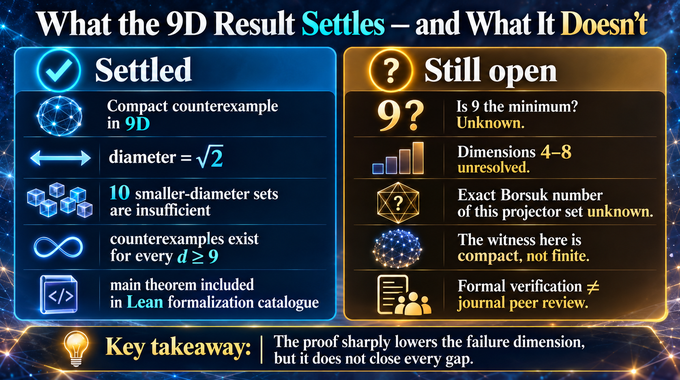
Corollary 7.1 extends compact counterexamples to every dimension . Simply embedding the same set in a larger space would not suffice, because the permitted number of pieces increases. Instead, the paper adds points at maximum distance from every old point and from each other. Each added point consumes a separate covering set, leaving at most ten for the original obstruction.
12.1. What the Result Does and Does Not Determine
| Question | Answer |
|---|---|
| Does failure reach dimension nine? | Yes, for this compact projector set |
| Does failure extend above nine? | Yes, through the added-point construction |
| Is nine the smallest dimension? | Unknown; dimensions four through eight remain unresolved |
| Is the witness finite? | No; the theorem uses the full compact set |
| Is the exact covering number known? | No; the theorem proves only that it exceeds ten |
For researchers, the reusable insight is the route from strict geometric gaps to smooth maps, spectral extensions, parity constraints, and finite combinatorics. For developers, this is a proof result, without demonstrated gains in compression, clustering, or numerical performance. Those applications require separate evidence.
The Borsuk conjecture now has a strikingly lower-dimensional obstruction. Follow Binary Verse AI’s mathematics coverage for explanations that connect the theorem, the proof mechanism, and the questions still worth asking.
What is the Borsuk conjecture, and has it been disproved?
Proposed in 1933, the Borsuk conjecture claimed that every bounded set of positive diameter in d-dimensional Euclidean space could be partitioned into at most d + 1 subsets, each of strictly smaller diameter. Kahn and Kalai disproved it in 1993. OpenAI’s September 2026 preprint presents a compact counterexample in nine dimensions, substantially lowering the previously reported dimension bound.
What exactly did OpenAI prove about the Borsuk conjecture?
OpenAI presented a compact set of rank-one orthogonal projectors in a nine-dimensional Euclidean affine space, with diameter , that cannot be covered by ten subsets of strictly smaller diameter. The paper also constructs compact counterexamples in every higher dimension. Its main result is explicitly included in OpenAI’s released Lean formalization catalogue.
Why does OpenAI’s counterexample use four-dimensional vectors but exist in nine dimensions?
Each line in four-dimensional real space is mapped to its symmetric four-by-four rank-one projection matrix. Such symmetric matrices have ten independent entries. Every projector has trace one, imposing one independent condition and placing the set in a nine-dimensional affine Euclidean space. The underlying projective space itself has intrinsic dimension three.
How does OpenAI’s Borsuk conjecture proof show that ten pieces are insufficient?
The proof assumes a ten-set smaller-diameter cover and converts it into a smooth admissible map on real projective three-space. An odd extension to symmetric matrices forces topological restrictions on its support complex. Six-label triangle systems then impose incompatible conditions on the tetrahedral facets, producing a contradiction and ruling out the assumed cover.
Is nine the smallest dimension in which Borsuk’s conjecture fails?
That remains unknown. OpenAI’s paper establishes failure in dimension nine, but does not establish minimality. Dimensions four through eight remain unresolved. The exact number of smaller-diameter subsets required to cover this particular projector set is also unknown, and the theorem does not supply a finite nine-dimensional witness.