
How tightly can you pack a line segment pointing in every possible direction? The question sounds like a puzzle involving a pencil and an unusually patient afternoon. Its answer reaches into the mathematics of waves, Fourier analysis, and the limits of geometric compression.
On October 6, 2026, OpenAI released a manuscript claiming to resolve the four-dimensional Hausdorff-dimension case of the Kakeya conjecture. The statement is striking: every set in four-dimensional space containing a unit segment in every direction must have dimension four, even when its volume is zero.
If you remember Hong Wang and Joshua Zahl solving Kakeya already, your memory is correct. They established the three-dimensional set conjecture in 2025. OpenAI claims to extend the dimension result to 4D and, in a separate paper, settle a stronger quantitative problem in 3D. Understanding those distinctions explains both the excitement and the work still needed to establish confidence in the claims.
Table of Contents
1. What OpenAI Actually Claims
The lead paper, Every Four-Dimensional Kakeya Set Has Full Hausdorff Dimension, is dated September 24, 2026. Its 175 pages propose a proof covering arbitrary sets, rather than a specially structured class.
Here are the distinctions to keep straight:
Kakeya Conjecture: Results, Scope and Proof Status
| Result | Precise Scope | Status |
|---|---|---|
| Planar set theorem | Every 2D Kakeya set has Hausdorff dimension two | Established |
| Wang–Zahl, 2025 | Every 3D Kakeya set has Hausdorff and Minkowski dimension three | Established result |
| OpenAI’s 4D manuscript | Every 4D Kakeya set has Hausdorff dimension four | Published proof claim |
| OpenAI’s 3D companion | Sharp Kakeya maximal estimates in three dimensions | Separate published proof claim |
| General higher-dimensional problem | Full dimension in every ambient dimension | Not settled by these two papers |
The 4D theorem requires no compactness, measurability, or special “stickiness” assumption on the set or its chosen segments. That unrestricted scope is the central advance being claimed.
This also answers the familiar search, “Kakeya conjecture solved?” The answer depends on which dimension and which formulation you mean. A headline without those qualifiers leaves out the most useful information.
2. What Is a Kakeya Set?
A Kakeya set in n-dimensional Euclidean space contains a straight segment of length one pointing in every direction. Each segment may occupy a different position. They do not have to share a center, and their arrangement does not need to provide a continuous route for a moving needle.
Imagine collecting every orientation of a tiny ruler, then sliding those rulers around to maximize overlap. The puzzle is how small their combined footprint can become.
The following vocabulary helps decode the paper:
Kakeya Conjecture: Key Mathematical Concepts Explained
| Concept | Accessible Meaning | Why It Matters |
|---|---|---|
| Volume or Lebesgue measure | The ordinary amount of space occupied | A Kakeya set can have volume zero |
| Hausdorff dimension | Size inferred from covers using pieces of varying diameters | The main 4D theorem concerns this dimension |
| Minkowski dimension | How the number of equal-sized covering pieces grows as they shrink | Connects the problem to common-scale counting |
| Thin tubes | Segments thickened by a small radius | Allow quantitative overlap estimates |
| Maximal operator | The largest tube average available in each direction | Measures more than the size of one set |
These distinctions become important whenever someone mistakes a dimension theorem for a positive-volume theorem.
3. The Needle Problem Behind the Conjecture
In 1917, Sōichi Kakeya asked how little planar area was needed to turn a unit needle around until its endpoints reversed. Rotating it around its midpoint sweeps out a disk. Allowing translations alongside rotations produces smaller regions.
Besicovitch’s work revealed that the required swept area can be made arbitrarily small. Related constructions produce sets that contain a segment in every direction yet have exactly zero area.
Those are different statements. Arbitrarily small regions permitting continuous motion and zero-measure sets containing all orientations should not be casually treated as identical constructions.
The modern Kakeya needle problem leads naturally to another question: if ordinary area can disappear, what mathematical notion of size survives?
The dimension conjecture proposes an answer. Overlap can destroy volume, but the need to accommodate every direction should prevent a set from becoming genuinely lower-dimensional. That tension, between directional variety and spatial compression, drives the research.
4. Zero Volume Does Not Mean Low Dimension
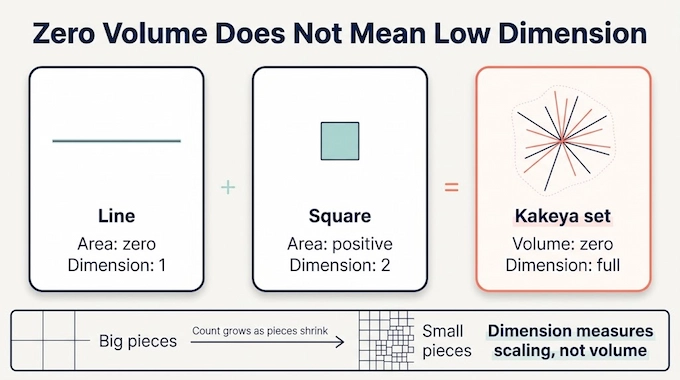
A line in a plane has zero area, but dimension one. A square has dimension two and positive area. Kakeya sets introduce a less familiar possibility: full dimension without positive area or volume.
Dimension is not simply another unit for measuring volume. It describes scaling behavior.
For Minkowski dimension, imagine covering a bounded set with cubes of side length δ. If the covering count scales approximately like δ to the power minus d, the exponent d describes its dimension. Slowly changing factors can affect the occupied volume without changing that exponent.
Hausdorff dimension allows covering pieces of different sizes. This flexibility can detect structure that a single-resolution count misses. It is also why proving a Hausdorff statement demands careful control across scales.
The paper’s conclusion is therefore compatible with existing zero-volume examples. It says their covering complexity must still reach dimension four. It does not say they contain an open region, fill a solid block, or suddenly gain ordinary volume.
5. What Wang and Zahl Already Accomplished
Hong Wang and Joshua Zahl released their 3D proof in February 2025. Their work showed that every three-dimensional Kakeya set has Hausdorff and Minkowski dimension three. arxiv.org
That achievement resolved the 3D Kakeya conjecture for sets. It did not establish the full maximal-function conjecture, which asks for stronger estimates involving arbitrary functions and tube averages.
Searches associating Hong Wang with the Kakeya conjecture should credit both researchers. Their joint result also supplies part of the foundation for the new work.
The OpenAI manuscript uses a three-dimensional weighted plank estimate from its companion paper. That estimate, in turn, builds on a streamlined union estimate by Larry Guth, Wang, and Zahl. Other ingredients come from established work in multilinear analysis, projection theory, and additive combinatorics.
The significance of an AI contribution lies in how it combines and extends those ingredients. Understanding that dependency chain gives a much more accurate picture than imagining a model producing advanced mathematics in isolation.
6. Why Four Dimensions Create New Difficulties
Adding a coordinate changes the ways lines can cluster. Concentration may occur near planes, thin boxes, or algebraic surfaces, with different patterns becoming visible at different resolutions.
A strategy that controls all dangerous arrangements in three dimensions can leave additional possibilities in four. The difficulty is identifying those possibilities and proving that none supports a counterexample.
Earlier 4D research obtained partial dimension bounds and results for restricted families. “Sticky” configurations, roughly speaking, have line families that retain organized clustering across scales. Their additional structure makes them more manageable.
OpenAI’s claimed theorem removes that restriction. It must handle a set whose selected segments behave irregularly, without assuming the organization that makes a special case easier.
Four dimensions here means four Euclidean coordinates. The paper sometimes labels one coordinate “time” to parameterize trajectories. That convenient language does not turn the theorem into a statement about physical spacetime.
7. Inside the Proposed Proof
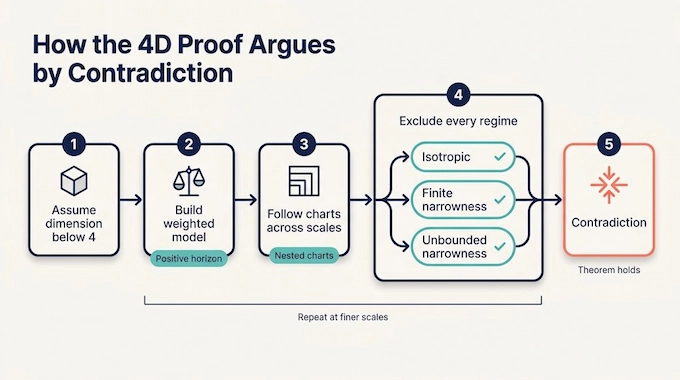
The manuscript argues by contradiction. Suppose a 4D Kakeya set has Hausdorff dimension below four. The proof then tries to show that the resulting line configuration must satisfy incompatible requirements.
7.1. Turn a Dimension Deficit Into a Weighted Model
A hypothetical counterexample admits unusually economical Hausdorff covers. The paper converts those covers into a weighted model that tracks where segments pass and how incidence mass changes as resolution increases.
Weights keep the analysis focused on substantial portions of the configuration. Finding elegant structure in a negligible collection of lines would not resolve the original problem.
The reduction produces a positive “horizon,” an optimized exponent recording the interval-length cost of constructing sufficiently accurate local descriptions. Think of it as a bookkeeping obstruction: the counterexample forces a cost that subsequent arguments must eliminate.
7.2. Follow Local Structure Across Scales
The paper organizes line pieces into “charts.” A chart combines a moving spatial box, a parameter interval, and a quadratic polynomial relation that remains small along enough of the selected trajectories.
Quadratic means degree two. Such relations can capture curved organization beyond a simple plane while remaining constrained enough to analyze.
Rescaling a chart produces another problem of the same type. Nested charts therefore let the argument follow concentration through progressively finer scales. A comparison principle helps match compatible local descriptions and extend the intervals over which they hold.
The proof then chooses an extremal configuration, meaning one optimized against the relevant improvements. Producing a genuinely better description contradicts that choice, provided enough mass survives and the improvement returns correctly to the original scale.
7.3. Exclude Every Narrowness Regime
The optimized configuration falls into three regimes according to how strongly its spatial shape narrows relative to its interval scale.
- In the isotropic regime, sufficiently varied directions support polynomial fitting and interpolation. Switching between trajectories constrains the fitted field and produces a potential. When higher-degree terms obstruct the desired quadratic form, the argument uses the remaining coordinate to recover admissible quadratic tests.
- With finite positive narrowness, scalar projections either provide improved intervals directly or lead to a structured horizontal model. Further estimates treat the different rates at which this model can concentrate.
- With unbounded narrowness, nested charts localize trajectories across the normalized interval. A final scalar projection produces descriptions whose time cost tends to zero, contradicting the positive obstruction inherited from the counterexample.
The difficult connecting step is converting local candidates into chart systems covering enough of the original family. The manuscript explicitly develops mass estimates and finite lists of labels for that purpose. These are essential logical bridges, not administrative details.
8. Why the Maximal Conjecture Is Stronger
The companion claim concerns the Kakeya maximal conjecture in three dimensions. Start with a function describing spatial intensity. For each direction, consider all unit-length tubes of radius δ and choose the placement with the largest average intensity.
The conjecture bounds how large those directional averages can collectively become relative to the original function. In 3D, the relevant norms are L³ norms. The allowed loss is δ raised to minus ε, for every positive ε, with a constant depending on ε.
That detail matters. The claim allows arbitrarily small power losses as tubes become thinner. It does not promise a single uniform constant independent of tube thickness.
A set theorem addresses the dimension forced by containing every direction. A maximal estimate controls a wider range of weighted configurations and functions. This explains why the 3D set result could be established while the stronger formulation remained unresolved.
The 4D manuscript does not itself claim the full 4D maximal estimate.
9. What This Could Change in Analysis
The connection to waves starts with wave packets: localized pieces of oscillatory functions whose energy can concentrate along elongated regions. Understanding how those regions overlap helps mathematicians estimate the combined function.
That is why Kakeya geometry appears in Fourier restriction, Bochner–Riesz analysis, and local smoothing for wave equations. The relationship is technically precise, but the intuition is accessible: many directions create many opportunities for concentration, and geometric estimates constrain their interaction.
Related conjectures still require their own arguments. OpenAI’s release contains separate restriction, Bochner–Riesz, and local-smoothing claims. Their presence in the same collection does not make them automatic consequences of the 4D set theorem.
The paper also develops direct geometric consequences. Full Hausdorff dimension forces full packing dimension, and bounded 4D Kakeya sets acquire full lower and upper Minkowski dimension. Established transfer results yield applications to Nikodym sets on constant-curvature manifolds and particular curved Kakeya families under stated hypotheses.
These are meaningful Kakeya conjecture applications within mathematics. An immediate improvement to a graphics engine, medical scanner, or signal-processing product would need further evidence. The research provides structural knowledge, rather than a ready-to-install engineering upgrade.
10. What Has Been Verified?
As of October 7, 2026, neither Kakeya paper appears in OpenAI’s catalogue of formalized main results. The company says its collection includes results at different verification stages and acknowledges that some unformalized manuscripts could contain issues. GitHub
A published Kakeya conjecture proof claim is therefore an invitation to examine an argument, not evidence that every lemma has already passed independent checking. Consultation with a release advisory group also differs from certification of each mathematical result.
Lean can check formal proofs against encoded statements and assumptions. Establishing confidence requires inspecting what was formalized, which axioms were used, and whether the formal statement matches the advertised theorem. Verification of another paper cannot be transferred to Kakeya by association.
The public materials examined here do not establish independent validation of this specific 4D argument. The useful next milestones are expert scrutiny, documented corrections or confirmation, and a formalization that clearly matches the unrestricted theorem.
11. What Remains Open?
The 4D claim would imply that every Kakeya set in any higher-dimensional space has Hausdorff dimension at least four. Projecting onto a four-dimensional subspace preserves the required segments, and projection cannot increase Hausdorff dimension.
In five dimensions, however, the full conjecture asks for dimension five. A lower bound of four does not finish that problem. Higher-dimensional set questions and stronger quantitative formulations remain separate targets.
There is also an access limitation. OpenAI attributes the release to an unreleased internal model. Its reported average of roughly three hours of ChatGPT Pro thinking compute per result describes the collection, not a guaranteed budget for reproducing this paper. Public model access, reproducibility, and complete verification remain distinct issues.
12. The Result to Watch Next
If the unrestricted 4D argument holds, it would close a major geometric gap soon after the human breakthrough in three dimensions. Its importance would extend beyond the theorem to the proposed methods for managing irregular concentration across scales.
For readers and builders, the next meaningful update is evidence that those methods work throughout the proof. Watch for expert explanations, revisions, and formal checks tied to the exact statement. Those developments will tell us more than another round of astonishing headlines.
The Kakeya conjecture offers a particularly clear test of AI-assisted discovery: a simple question, a difficult argument, and a conclusion precise enough to scrutinize. Follow Binary Verse AI at binaryverseai.com for research explainers that connect the claims, the mathematics, and the evidence needed to trust them.
1. What is the Kakeya conjecture?
The Kakeya conjecture says that a set containing a unit line segment in every direction in an n-dimensional space must have Hausdorff dimension n. Such a set can have zero volume while still having full dimension: volume measures how much space it occupies, while dimension describes how its covering complexity grows at finer scales.
2. Is the Kakeya conjecture solved?
The set conjecture is established in two and three dimensions. OpenAI has published a claimed proof of the four-dimensional Hausdorff-dimension case, alongside a separate claim resolving the three-dimensional maximal conjecture. These claims do not settle every version in every dimension, and publication should be distinguished from independent verification.
3. Did Hong Wang prove the Kakeya conjecture?
Hong Wang and Joshua Zahl jointly proved the three-dimensional Kakeya set conjecture in work first released in 2025. Their result establishes full Hausdorff and Minkowski dimension for 3D Kakeya sets. OpenAI’s new papers address the four-dimensional set problem and the stronger three-dimensional maximal problem.
4. What is the Kakeya needle problem?
The Kakeya needle problem asks how little area is needed to turn a unit-length needle around using rotations and translations. The required area can be made arbitrarily small. The modern Kakeya set conjecture asks a related question about dimension, but containing a segment in every direction does not itself require a continuous path between those positions.
5. Why is the Kakeya conjecture important?
Kakeya connects the geometry of overlapping line segments with Fourier analysis and the behavior of waves. Progress can inform research on restriction estimates, maximal operators, local smoothing and geometric measure theory. OpenAI’s 4D claim also tests AI’s ability to extend advanced mathematical research, although practical benefits would require further work.