
The Riemann hypothesis remains unsolved. Clay Mathematics Institute still lists it as an open Millennium Prize Problem. OpenAI’s new Quasi-Riemann Hypothesis manuscript addresses a weaker statement, but “weaker” hardly means small. If its argument holds, it establishes a fixed limit on where certain mathematical zeros can occur, tightening our understanding of prime numbers.
Released on October 6, 2026, the paper claims that the Riemann zeta function and broader families of L-functions have no zeros when the real part of their input exceeds 7/8. It also comes with formal proof materials.
That deserves careful attention. It doesn’t justify a “Riemann hypothesis solved” headline. The useful questions are what the boundary means, how the proof works, and precisely what has been checked.
Table of Contents
1. What OpenAI Claims About the Quasi-Riemann Hypothesis
OpenAI’s September 30 manuscript belongs to family 003 in its mathematics release. The collection contains 722 manuscripts across 372 families, so related papers shouldn’t be counted as separate solved problems. The announcement describes results produced by an internal frontier model and formalizations of many proofs, rather than universal verification of the collection.
Quasi-Riemann Hypothesis: Key Facts and Proof Status
| Key Fact | What It Means |
|---|---|
| Claimed boundary | No zeros with real part greater than 7/8 |
| Functions covered | Zeta, all Dirichlet L-functions, and specified Hecke L-functions |
| Manuscript date | September 30, 2026 |
| Public release | October 6, 2026 |
| Full RH status | Still open |
| Verification materials | Lean code and a Comparator challenge are available |
The central distinction is between releasing a proof, checking its formal statement, and establishing that its full mathematical interpretation survives scrutiny. Readers need all three layers to assess an announcement this consequential.
2. The Quasi-Riemann Hypothesis, Explained Simply
The Riemann zeta function, written ζ(s), connects an infinite sum with prime numbers. In its initial domain, it adds terms of the form 1/n raised to the power s. Its Euler product expresses the same function through primes.
The input s is a complex number with two coordinates: its real part, usually written σ, and its imaginary part, usually written t. Think of σ as horizontal position and t as vertical position. A zero is an input where the function’s output equals zero.
Quasi-Riemann Hypothesis Explained: Key Mathematical Terms
| Term | Plain-English Meaning | Why It Matters |
|---|---|---|
| Real part, σ | Horizontal coordinate of s | Determines which side of a boundary a zero occupies |
| Height, t | Imaginary coordinate of s | Can grow without limit |
| Critical strip | Region between real parts 0 and 1 | Contains zeta’s nontrivial zeros |
| Critical line | Vertical line at real part 1/2 | Where RH places every nontrivial zero |
| Zero-free half-plane | Everything right of a fixed vertical line | Rules out zeros throughout that entire region |
The Quasi-Riemann Hypothesis asks whether some fixed boundary below 1 excludes every zeta zero to its right. OpenAI claims the specific boundary 7/8, or 0.875:
[ \zeta(s)\neq 0\quad\text{when}\quad\operatorname{Re}(s)>7/8. ]
Zeta is understood through analytic continuation beyond the original series’ domain. Its pole at s = 1 is a singularity, not a zero, and is treated separately.
3. Why a Fixed 7/8 Boundary Matters
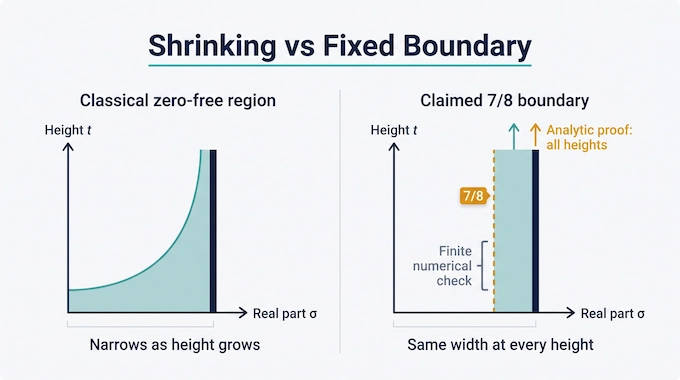
Classical results already establish substantial Riemann zeta function zero-free regions near real part 1. The difficulty is that their guaranteed width shrinks as height increases. For broader L-functions, the conductor, a measure of arithmetic complexity, also enters the bounds.
Imagine a protected corridor beside a wall. Existing guarantees can make that corridor narrower as you travel upward. The claimed result gives it a fixed width, continuing indefinitely.
This is the decisive feature: one boundary works at every height. Checking a trillion zeros, however rigorously, still checks a finite range. An analytic proof must exclude zeros beyond every possible numerical search.
Zero-density estimates answer another question: how many zeros can lie in a region? A very strong bound on their number need not prove that the number is zero. The manuscript explicitly distinguishes those advances from its proposed uniform exclusion.
Uniformity also changes what a reader must inspect in the proof. Establishing a separate bound for each character is insufficient if those boundaries approach 1 across the family. The claimed theorem needs one numerical boundary that survives all those choices.
The importance therefore comes from the statement’s scope, not the visual appeal of the fraction. Seven-eighths is a constant barrier in a problem where established barriers can retreat.
4. Quasi-Riemann Hypothesis vs Riemann Hypothesis
RH says every nontrivial zeta zero has real part exactly 1/2. The claimed theorem leaves considerable room for zeros away from that line.
Using zeta’s functional-equation symmetry, exclusion to the right of 7/8 also excludes nontrivial zeros to the left of 1/8. The remaining possible region is a closed central strip:
block-beta
  columns 3
  A["0 < Real Part < 1/8"] B["1/8 ≤ Real Part ≤ 7/8"] C["7/8 < Real Part < 1"]
  D["Excluded By Symmetry"] E["Still Allowed By The Claim"] F["Excluded By The Claim"]
This schematic shows horizontal regions, not measured distances. RH would restrict every nontrivial zero in the middle region to the single line at 1/2.
GRH, the generalized Riemann hypothesis, extends the critical-line requirement to broader L-function families, including Dirichlet L-functions. A fixed boundary at 7/8 doesn’t establish their critical-line conjectures either.
For example, a hypothetical nontrivial zero with real part 0.7 would violate RH but remain compatible with the proposed 7/8 theorem. Its reflected partner at 0.3 would also fit inside the remaining strip.
And 7/8 does not mean “87.5% solved.” There’s no progress bar here. Reducing a boundary requires mathematical arguments whose difficulty need not track the numerical distance remaining.
5. Exactly Which Functions the Result Covers
The paper’s theorem is broader than zeta alone. It claims the same zero-free half-plane for every Dirichlet L-function and every finite-order Hecke L-function over the number field ℚ(√−3).
Dirichlet L-functions help study primes in arithmetic progressions. Hecke L-functions extend related ideas to number fields, where the arithmetic objects are more general than ordinary integers. “Finite-order” specifies the characters included. It isn’t permission to generalize the result to every L-function in mathematics.
Two qualifications matter. Principal functions may have a pole at s = 1. Also, the inequality is strict: the line at 7/8 is not included in the zero-free region.
The boundary is claimed to be independent of the character, conductor, and height. That doesn’t mean every constant appearing elsewhere in the proof is equally uniform. The manuscript allows certain constants and thresholds to depend on the chosen character.
6. Inside the Proof: From 11/12 to 7/8
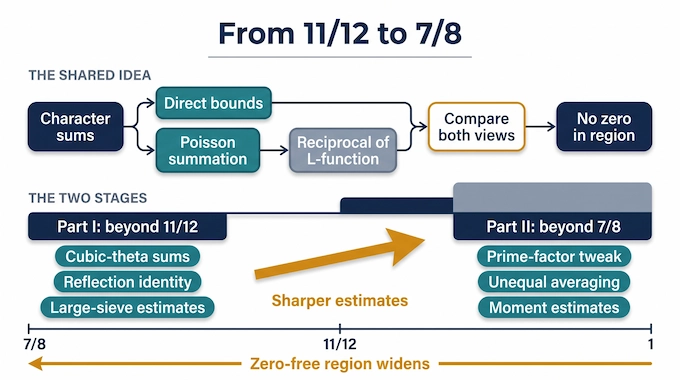
The Quasi-Riemann Hypothesis proof has two stages. Part I establishes the proposed zero-free half-plane beyond 11/12. Part II strengthens it to 7/8.
The shared idea is to study carefully constructed character sums in two ways. One representation gives direct bounds. Another, obtained through Poisson summation, connects the same arithmetic construction with the reciprocal of a target L-function.
Why study a reciprocal? If a function vanishes, its reciprocal develops a singularity. Proving that the reciprocal extends holomorphically into a region, with the necessary nonvanishing auxiliary factors controlled, rules out the original zero there.
6.1. The First Stage Establishes a Fixed Barrier
The first stage uses completed cubic-theta sums, a reflection identity, and large-sieve estimates. Those estimates control aggregate sizes across families of arithmetic terms. The reflected and Poisson representations must agree while satisfying bounds strong enough to exclude a hypothetical zero beyond 11/12.
“Completed” matters because the proof retains whole arithmetic indices and their character restrictions. Removing inconvenient factors would alter the identities the argument needs.
6.2. The Second Stage Sharpens the Estimates
The second stage modifies the sum using selected prime factors to cancel an unwanted local contribution. It also uses unequal averaging scales and additional moment estimates. Moments measure average powers of size, helping bound how many problematic terms can survive.
The final comparison requires positive savings in the exponents, chosen independently of the target character. These savings drive the contradiction needed for the 7/8 boundary.
This describes the architecture, not an independent validation of its estimates. The supplied manuscript runs to 199 pages, and the difficult work lies in proving that every transformation, error bound, and recursive step has the stated strength.
7. What This Would Change About Prime Numbers
Zeta zeros influence the error in estimates of how many primes lie below a given number. In explicit formulas, a zero with real part β contributes behavior on roughly the scale of x raised to β, with additional factors and cancellation to consider.
A fixed bound β ≤ 7/8 would therefore support power-saving prime-counting error estimates. Informally, one can work with exponents slightly larger than 7/8, rather than assuming an exact endpoint bound without tracking logarithmic factors.
RH promises much tighter control associated with real part 1/2. The claimed advance would be substantial while leaving that stronger conclusion unresolved.
7.1. Arithmetic Progressions and Exceptional Zeros
Dirichlet L-functions describe prime distribution among residue classes, such as numbers congruent to 1 modulo 4. Their inclusion gives the result a broader arithmetic reach.
The theorem would also exclude exceptional real zeros in the interval (7/8, 1). These possible Landau–Siegel zeros complicate uniform estimates. Excluding them doesn’t locate every remaining zero on the critical line.
7.2. A Concrete Algorithmic Consequence
The manuscript states a polylogarithmic bound for the least quadratic nonresidue modulo an odd prime. From that bound, it derives a deterministic algorithm running in polynomial time in log p for finding square roots modulo p, or reporting that none exist.
That is a specific consequence worth discussing. It inherits the central theorem’s correctness and should be distinguished from speculative applications.
8. What Lean Verification Establishes
The Quasi-Riemann Hypothesis Lean proof materials are more specific than a general promise of future formalization. The published catalogue identifies a zeta nonvanishing theorem, and the accompanying solution file also contains a Dirichlet L-function nonvanishing theorem with the principal pole excluded.
The Comparator configuration targets the zeta statement and permits three standard logical axioms: propositional extensionality, quotient soundness, and classical choice. It also records that the optional Nanoda check is disabled. Those are configuration details, not evidence that an independent verification run has succeeded.
Lean checks that a formal conclusion follows from its definitions and assumptions. Comparator supplies an additional framework for checking the solution against a specified challenge. The repository provides instructions for running that check.
A meaningful audit asks:
- Does the formal theorem match the advertised mathematical statement?
- Do its definitions represent the intended zeta or L-functions?
- Are dependencies proved, with no unapproved assumptions or proof placeholders?
- Can another party reproduce the check using the specified versions?
The challenge’s zeta target should not automatically be described as verification of every Hecke-function claim or every paragraph of the manuscript. Formal coverage needs to be traced explicitly.
Expert reading serves a complementary purpose. It explains the mechanism, checks correspondence between prose and code, and identifies what future arguments can reuse. Social-media confidence cannot substitute for either task.
9. Which Model Produced It, and How Much Compute Did It Use?
OpenAI attributes the release to an unreleased internal frontier model. The announcement does not identify the producer as a particular publicly available ChatGPT model. Assigning it a familiar model name would add information the sources don’t provide.
The repository reports an average of roughly three hours of ChatGPT Pro thinking-equivalent compute per result across the collection. That is not a runtime measurement for this manuscript.
Its production notes explicitly list work on a zeta zero-free region as an exception to the standard procedure. They also say the 11/12 writeup was human edited for readability.
The ten published reasoning summaries cover other listed families. Family 003 is absent, so readers shouldn’t mistake those summaries for a disclosed discovery trace of this argument.
These distinctions prevent an attractive but unsupported story: that a named consumer model solved the problem autonomously in three hours. The available disclosure supports a more limited account of model contribution, compute, and human involvement.
10. Does This Break Encryption or Replace Mathematicians?
The theorem alone provides no integer-factoring algorithm and no demonstrated attack on deployed encryption. Better control of prime distribution does not automatically make recovering a secret key easy.
The modular square-root consequence is also a different problem from factoring a composite integer whose prime factors are unknown. Sharing the word “prime” doesn’t make two computational tasks equivalent.
For mathematicians, the immediate implication is a change in research workflow. AI-generated arguments can create material to verify, explain, simplify, and extend. Formal tools can make some checks reproducible.
That still leaves mathematical judgment: choosing worthwhile problems, understanding why an argument works, connecting it to earlier literature, and deciding which consequences are useful. This release shows a potential contribution to that work. It supplies no measured conclusion about employment or the disappearance of human research.
11. Where to Read the Evidence and What Comes Next
Start with the main manuscript, especially Theorem 1.1, the introduction, and the proof overview. Those sections state the scope, boundary exclusions, and two-stage structure before the technical machinery begins.
Family 003 also lists an alternative 11/12 proof and a Landau–Siegel zero exclusion companion. Consult the formalization catalogue to connect papers with their proof artifacts. GitHub
The next useful developments are reproducible verification reports, expert explanations, and documented corrections if needed. OpenAI says revisions will preserve previously released versions, making the record inspectable.
Read an assessment for what it actually checks. A build log, a theorem audit, and a specialist’s exposition provide different evidence. None should be silently promoted into a prediction that full RH will fall next.
12. A Major Claim Deserves a Precise Reading
The Quasi-Riemann Hypothesis announcement matters because it claims a permanent zero-free barrier across infinitely many heights and broad arithmetic families. Its accompanying formal materials make the claim more inspectable, while the remaining questions require explicit answers about coverage and reproducibility.
Keep three facts together: the proposed boundary is 7/8, the critical-line goal remains 1/2, and publication begins scrutiny rather than ending it.
Follow Binary Verse AI for clear explanations of AI-assisted mathematics, with the theorem, verification evidence, and practical consequences given the attention each deserves.
1. What is the quasi-Riemann hypothesis?
The quasi-Riemann hypothesis says there is a fixed number α below 1 such that the Riemann zeta function has no zeros with real part greater than α. Unlike classical zero-free regions that narrow at increasing heights, this boundary must work at every height.
2. Has OpenAI solved the Riemann hypothesis?
OpenAI’s paper claims a proof of the weaker quasi-Riemann hypothesis, with a zero-free region Re(s) > 7/8. It does not prove that every nontrivial zero lies on Re(s) = 1/2, which is what the full Riemann hypothesis requires.
3. Why is the 7/8 result important?
Its significance is the claimed fixed boundary, valid at every height. If established, it would rule out zeros throughout a region that classical narrowing bounds cannot uniformly exclude and strengthen conclusions about prime-number distribution.
4. Is OpenAI’s quasi-Riemann hypothesis proof verified?
OpenAI lists a Lean formalization of the main result. Formal proof checking provides evidence about the encoded theorem, but reviewing its definitions, assumptions and correspondence with the manuscript remains essential. Published files and independent validation should be described separately.
5. Does proving the quasi-Riemann hypothesis break encryption?
The claimed result does not itself provide an efficient algorithm for factoring large integers or breaking RSA. Its immediate significance concerns analytic number theory and prime-distribution estimates; practical cryptographic consequences would require additional results.