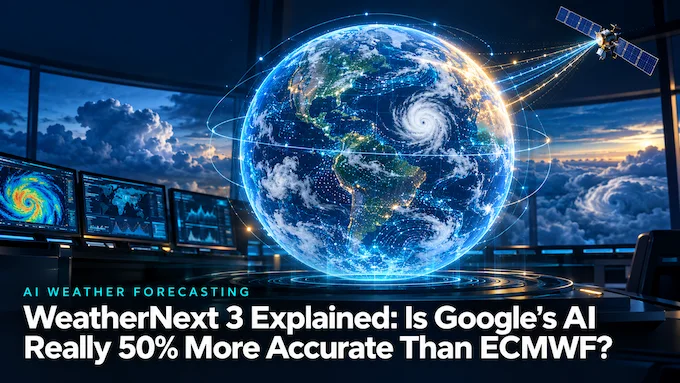
Google has a new weather model, and the headline numbers are hard to ignore: forecasts refreshed every hour, local output down to roughly 5 km, and precipitation predictions that Google says can be up to 50% more accurate for people planning a day or more ahead.
The interesting part is that WeatherNext 3 isn’t simply a bigger neural network trained on more old weather maps. Google DeepMind and Google Research have changed what goes into the forecasting system. The model now consumes recent geostationary satellite imagery directly, learns from weather-station observations, predicts specialized precipitation products, and produces a 64-member probabilistic ensemble. The research paper describes it as a new state of the art for probabilistic medium-range forecasting.
But three claims need separating: “50% more accurate,” “5 km resolution,” and “better than ECMWF.” All are defensible in the right context. None means WeatherNext 3 is simply 50% better at predicting all weather everywhere.
That distinction matters more than the launch headline.
Table of Contents
1. What Is WeatherNext 3? Key Facts At A Glance
WeatherNext 3 is an operational Google AI weather model built by Google DeepMind and Google Research. It extends the Functional Generative Network approach used by WeatherNext 2, but adds multiple data modalities, higher-resolution outputs, direct observations, and much more frequent initialization.
The system produces a probabilistic forecast rather than pretending there is one certain future. Its core configuration generates 64 ensemble members, effectively sampling multiple plausible weather trajectories.
WeatherNext 3 Specifications and Key Features
| Feature | WeatherNext 3 |
|---|---|
| Developer | Google DeepMind + Google Research |
| Model Type | Global probabilistic AI weather model |
| Architecture | Functional Generative Network mesh transformer |
| Ensemble | 64 members |
| Initialization | New forecast every hour |
| Key Inputs | ECMWF analysis + recent geostationary satellite mosaics |
| Highest Spatial Detail | ~5 km for station-trained temperature/dewpoint output |
| Gridded Surface Output | ~10 km for many surface variables and precipitation |
| Upper-Atmosphere Output | ~25 km for pressure-level variables |
| Maximum Horizon | 15 days on main 6-hourly cycles |
| Interim Hourly Runs | Up to 48 hours |
| Status | Operational |
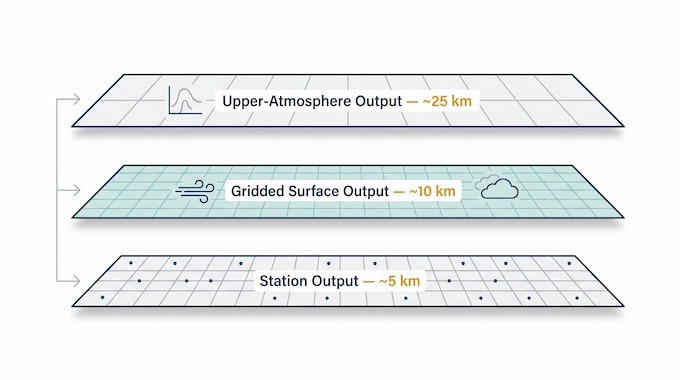
The mixed resolution is important. Google WeatherNext 3 isn’t one uniform 5 km global model. Different prediction heads operate at different spatial and temporal scales. The published specifications list roughly 5 km station output, 10 km gridded surface output, and 25 km pressure-level fields.
1.1 WeatherNext 3 Vs WeatherNext 2
The upgrade is much more substantial than a simple resolution bump.
WeatherNext 3 vs WeatherNext 2: What Changed?
| Capability | WeatherNext 2 | WeatherNext 3 |
|---|---|---|
| Main Input | Analysis data | Analysis + recent satellite observations |
| Forecast Initialization | Primarily 6-hour cycles | Every hour |
| Core Grid | ~25 km | Multiple resolutions, ~5 to 25 km |
| Hourly Output | Separate upsampling approach | Native hourly prediction for key variables |
| Precipitation | Analysis-based precipitation | Dedicated IMERG and PARDIG precipitation heads |
| Weather Stations | No dedicated sparse observation head | Temperature/dewpoint predictions using station training |
| Solar And Cloud Variables | More limited | Expanded cloud and solar radiation output |
| Cyclones | Strong dedicated forecasting | Further improvements in track, intensity and extent |
WeatherNext 2 was already a strong probabilistic forecasting system. WeatherNext 3 changes the pipeline by allowing observations and different resolutions to interact inside one model rather than forcing everything through the same traditional analysis representation.
2. Why WeatherNext 3 Watches The Atmosphere Every Hour
Traditional global AI weather systems have usually depended heavily on atmospheric “analysis” data. An analysis combines observations with a physics-based numerical model to estimate the atmosphere’s current state.
That’s useful, but it adds latency. The WeatherNext paper notes that operational global analyses can leave the latest usable atmospheric state roughly 6 to 12 hours behind real time. Geostationary satellite imagery arrives much faster.
WeatherNext 3 combines both.
Its satellite mosaic has roughly one-hour latency and contains information about clouds, water vapor and temperature. The model can therefore start a fresh forecast every hour instead of waiting for the next main analysis cycle.
2.1 Why Hourly Initialization Matters
“Hourly forecast” can be misleading because many weather apps already show temperatures hour by hour.
This is different.
WeatherNext 3 can start a new forecast every hour using newer atmospheric observations. If a rain system has developed since the previous major model run, that newer information can enter the next forecast.
Google’s latency-adjusted experiment found that hourly initialization effectively gained about two to three hours of useful precipitation lead time over the same model restricted to six-hour initialization cycles. That’s particularly relevant when storms are changing quickly.
3. Is WeatherNext 3 Really A 5 Km Weather Model?
Yes, but only for part of the system.
The roughly 0.05° or 5 km output refers to the station-trained head used for near-surface variables such as 2-meter temperature and dewpoint. Many gridded surface forecasts, including winds, cloud fields, solar radiation and precipitation, are produced at approximately 0.1° or 10 km. Upper-atmospheric pressure-level fields remain around 0.25° or 25 km.
So calling the entire system “5 km WeatherNext 3” hides an important architectural detail.
There’s another caveat. Grid spacing isn’t the same thing as the minimum physical weather feature a forecast can accurately resolve. A 5 km output grid doesn’t mean every 5 km thunderstorm, sea-breeze boundary or mountain-valley effect suddenly becomes predictable.
What Google has demonstrated is more specific and more useful: its station head can incorporate exact geographical information such as elevation and land or sea context, then produce local temperature and humidity estimates at much finer spacing than WeatherNext 2.
On held-out stations that the model did not see during training, short-range 2-meter temperature CRPS improved by up to 30% versus WeatherNext 2 and 40% versus ECMWF ENS.
4. Is WeatherNext 3 Really 50% More Accurate?
This is where the marketing headline needs its largest footnote.
WeatherNext 3 is not 50% more accurate at “weather” in general.
Google says people planning a day or more ahead can see up to 50% more accurate precipitation forecasts in products powered by the new system. That claim refers to rain forecasting in specific product contexts, not temperature, wind, hurricanes and every other variable bundled into one universal accuracy score.
The research paper gives a better view of how much the result depends on what counts as ground truth.
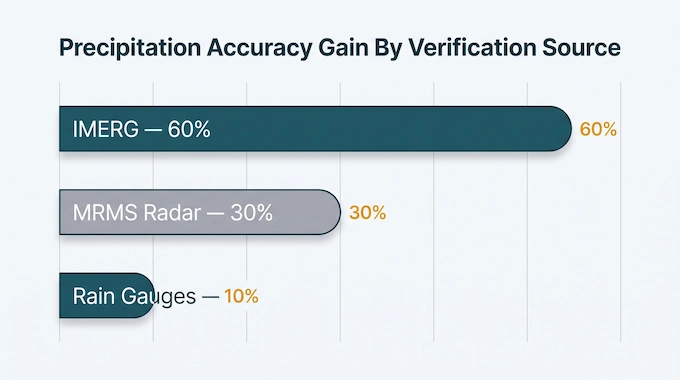
For early lead times, its PARDIG precipitation head reduced CRPS by up to:
- 60% when evaluated against IMERG
- 30% against MRMS radar-based estimates
- 10% against rain gauges
Those aren’t contradictory numbers. They show why WeatherNext 3 accuracy can’t be compressed into one percentage. Different observational datasets have different coverage, measurement characteristics and relationships to the model’s training targets.
IMERG also isn’t a fully independent test for every WeatherNext 3 output because IMERG itself is used as a training target. The researchers therefore evaluate against MRMS and rain gauges as additional checks.
The impressive result isn’t “50% better weather.” It’s that precipitation, historically one of the hardest global forecasting problems, improves substantially across several different verification sources.
5. WeatherNext Vs ECMWF: Did Google Actually Win?
This question needs one clarification first: ECMWF isn’t a single forecast model.
The research compares WeatherNext 3 with both ECMWF’s traditional ENS forecasting system and AIFS ENS v2, ECMWF’s own AI ensemble model. So framing this purely as “Google AI versus old-fashioned physics” misses part of the competition.
In a quasi-real-time evaluation from July 1 through August 11, 2026, WeatherNext 3 beat AIFS ENS across all evaluated upper-level variables, averaging roughly a 10% improvement during the first forecast week. It also outperformed AIFS ENS across the majority of evaluated variables and lead times.
That’s a meaningful result for the WeatherNext vs ECMWF comparison.
5.1 Why “Beat ECMWF” Still Needs Qualification
The same paper tells readers not to overread the result.
The operational comparison covers only six weeks. Some single-level comparisons are affected by different grid interpolation and verification choices. The researchers explicitly say the sample is relatively small and smaller signals shouldn’t be over-interpreted.
Google also points to Brightband’s independent live leaderboard as evidence for the model’s operational strength. That’s useful confirmation beyond Google’s internal benchmark suite, but leaderboard leadership still doesn’t establish superiority for every variable, geography, forecast horizon and type of weather event.
The defensible verdict is narrower: WeatherNext 3 now appears to outperform leading systems across many important probabilistic medium-range metrics. It has not proven that Google is better than ECMWF at everything.
6. How Far Ahead Can WeatherNext 3 Predict?
The maximum forecast horizon is 15 days, but not every hourly run stretches that far.
The main 00, 06, 12 and 18 UTC initialization cycles can extend to 360 hours. The additional hourly runs between those cycles are shorter, reaching up to 48 hours.
That design makes practical sense. The freshest hourly updates matter most in the short range, where rapidly changing observations can change near-term decisions.
The 15-day forecast is probabilistic, too. The point of the 64-member ensemble isn’t to claim certainty on day 12. It’s to estimate a distribution of plausible future states and how that distribution evolves as lead time increases.
7. Can It Predict Rain, Hurricanes And Local Weather Better?
7.1 Rain And Precipitation
This is arguably the strongest part of the Google DeepMind weather model upgrade.
WeatherNext 3 predicts both NASA IMERG precipitation and Google’s experimental PARDIG precipitation reconstruction. Its hourly initialization also gives rain forecasts fresher information, where a few hours can matter far more than they do for a slow-moving large-scale pressure pattern.
7.2 Tropical Cyclones
The system directly predicts cyclone existence, position, intensity and wind-field extent.
Against WeatherNext 2, the paper reports small but consistent improvements in cyclone track and intensity error, with larger gains in storm extent at roughly one to three days. It also identifies a weakness: some cyclone forecasts are more under-dispersed, meaning the ensemble may express less uncertainty than it ideally should.
7.3 Local Temperature And Geography
WeatherNext 3’s station head is particularly interesting because it breaks away from rigid grid-only forecasting.
It uses location information including elevation and land or sea context. Google held back 5% of METAR and Mesonet stations during training to test whether the model could generalize to unseen locations.
That’s a better test of local usefulness than simply measuring how well a model reproduces the analysis data it learned from.
7.4 Extreme Rain Is Still An Open Test
There is a critical limitation hiding behind the strong precipitation results.
The paper caps one precipitation evaluation at 4 mm per six hours because more extreme cases become too sparse for reliable statistics. The researchers explicitly leave evaluation of extreme precipitation for future work.
So excellent average rain skill should not yet be translated into “Google solved extreme rainfall forecasting.”
8. Can You Use WeatherNext 3 Now?
Yes. This isn’t a research demo waiting for deployment.
Google says the Google AI weather forecast is being integrated into Search, Gemini, Google Maps, Google Maps Platform Weather API and Earth Engine. Developers and researchers can also query forecast data through BigQuery and Earth Engine or work with bulk data in Google Cloud Storage.
For visual exploration, Google Weather Lab lets users inspect WeatherNext forecasts in a weather-map interface.
WeatherNext 3 itself is not a standalone weather app. It’s the forecasting system underneath products and datasets.
One product you shouldn’t automatically add to that list is Pixel Weather. The supplied Google material explicitly names Search, Gemini, Maps, Maps Platform and Earth Engine, but doesn’t establish Pixel Weather as a confirmed WeatherNext 3 integration.
9. Can You Trust WeatherNext 3 Forecasts?
Trust the probabilities, not the mythology.
The model produces a 64-member ensemble precisely because the atmosphere isn’t deterministic in any practically usable long-range sense. A good probabilistic forecast tells you something like “there is a high chance of this threshold being exceeded,” not “this exact rain cell will be here in nine days.”
The paper also exposes flaws instead of hiding them. Individual samples can show hexagonal spatial artifacts related to the model’s underlying mesh, especially in precipitation and station output. Some heads also show jumps at six-hour boundaries. Ensemble medians and quantiles are much cleaner, although Antarctica remains poorly constrained for the station head because observations are sparse.
That’s a useful reminder for any benchmark leader: better scores don’t make every individual local forecast correct.
And for severe weather warnings or public-safety decisions, Google’s own material directs users to their national or local meteorological authority.
10. Has AI Finally Beaten Physics-Based Weather Forecasting?
On a growing number of forecasting metrics, AI weather models have crossed that line.
But saying “AI replaced physics” would be wrong.
WeatherNext 3 still consumes ECMWF HRES analysis alongside its newer direct satellite observations. Those analyses are generated using the traditional numerical weather prediction machinery that AI weather models are supposedly replacing.
The WeatherNext researchers make this dependence explicit. They describe physics-based analyses such as ERA5 as a major reason AI weather forecasting advanced so rapidly in the first place. Their real innovation is combining that dense analysis foundation with low-latency observations that traditional analysis-only AI models couldn’t exploit as directly.
So the more interesting future isn’t likely to be “neural network versus physics model.”
It’s a forecasting stack where observations, physics-based assimilation, learned forecasting, specialized observation heads and probabilistic post-processing increasingly blur together.
WeatherNext 3 is compelling precisely because it moves in that direction.
11. WeatherNext 3 Verdict: A Real Breakthrough With Important Asterisks
WeatherNext 3 looks like a genuine technical advance, not just a prettier weather map.
Direct satellite ingestion lets Google refresh forecasts every hour. Native higher-resolution output gives the model much more local detail than WeatherNext 2. Direct training against precipitation and station observations attacks known weaknesses in analysis-only AI forecasting. And on several medium-range benchmarks, including a six-week operational comparison with ECMWF’s AIFS ENS v2, the results are strong enough to take seriously.
But the qualifiers are part of the story.
“50% more accurate” applies to specific precipitation forecasts, not all weather. “5 km resolution” applies to the highest-resolution station-trained output, not the whole atmospheric model. And “WeatherNext beats ECMWF” describes benchmark results, not universal superiority across every location, variable and weather event.
That doesn’t make the achievement less impressive. It makes it easier to understand what was actually achieved.
For Binary Verse AI, that’s the part worth following: not which lab wins the launch-day headline, but how systems like WeatherNext 3 are quietly changing the architecture of real-world scientific forecasting.
Follow Binary Verse AI for evidence-first breakdowns of new AI models, research papers and benchmark claims, without turning every impressive result into a revolution.
1. Is Google Weather using AI?
Yes. Google increasingly uses AI weather models to generate and improve forecasts across its products. WeatherNext 3 is Google’s latest global AI forecasting model and is being integrated into services including Search, Gemini and Maps. It combines traditional atmospheric analysis with recent satellite and weather-station observations rather than relying only on historical weather-model data.
2. Is WeatherNext 3 more accurate than ECMWF?
WeatherNext 3 outperforms ECMWF systems on many of the benchmarks reported in Google’s research, including numerous medium-range atmospheric, surface and precipitation measures. However, this does not mean WeatherNext 3 is more accurate for every weather variable, location or forecast horizon. Some comparisons also use different resolutions and verification datasets, so the result depends on what is being measured.
3. Is WeatherNext 3 really 50% more accurate?
The claim needs context. Google says users can see precipitation forecasts up to 50% more accurate in some circumstances, but that does not mean every WeatherNext 3 forecast is 50% better. The research reports different precipitation improvements depending on the reference data, including up to 60% against IMERG, 30% against MRMS and about 10% against rain gauges at early lead times.
4. How far ahead can WeatherNext 3 forecast?
WeatherNext 3 can produce forecasts up to 15 days ahead from its main 00, 06, 12 and 18 UTC initialization cycles. Additional forecasts launched between those cycles refresh every hour but have a shorter 48-hour horizon. As with every weather model, uncertainty generally increases as the forecast extends farther into the future.
5. Can I use WeatherNext 3 now?
Yes, although WeatherNext 3 is not a standalone weather app. Google is using it across products including Search, Gemini and Maps, while researchers and developers can access WeatherNext data through services such as Weather Lab, Earth Engine, BigQuery and Google Cloud. Google’s live SERPs already show strong related interest in Google Weather Lab, at about 1,000 searches per month in your dataset.